Follow Us:
Follow Us:


Defense Feeds – China Reveals HQ-29 Missile Defense system for the first time during rehearsals in Beijing, showcasing its long-rumored next-generation interceptor platform ahead of a military parade.
The surprise appearance confirmed months of speculation as the transporter vehicles and missile canisters were finally seen in full view, marking a major step in Chinese defense modernization.
The HQ-29 remained shrouded in mystery for years, with only scattered images surfacing and frequent debates taking place across Chinese defense forums.
Just last week, photos circulated online showing a six-axle transporter carrying two unusually large missile canisters during a rail transfer.
At the time, analysts debated whether the platform could be a new high-altitude interceptor or even part of a satellite strike program.
Those theories gained weight when the same transporter-mounted system rolled into full view during practice runs for Beijing’s upcoming parade.
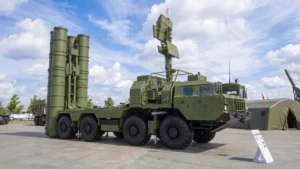
Each vehicle carries two imposing launch canisters measuring roughly 1.5 meters—or nearly five feet—in diameter.
This design immediately set the HQ-29 apart from the existing family of Chinese air and missile defense systems, which typically employ smaller-diameter launch tubes.
The sheer size of these canisters points to an interceptor with significantly more thrust and range than China’s current medium- and high-altitude defenses.
Military observers argue that the HQ-29 likely fills a critical gap between the so-called “terminal” defense layers, such as the HQ-9, and more strategic missile interceptors that engage threats in space.
Chinese media outlets have described the HQ-29 as a “double-barreled satellite hunter.”
The nickname is telling. It suggests that the new system is designed not just to intercept ballistic missiles in near-space conditions but also to potentially engage satellites in low Earth orbit.
If accurate, this capability would place the HQ-29 in the same category as America’s Standard Missile-3 (SM-3) and Russia’s S-500 and PL-19 Nudol platforms—systems specifically built to hit exoatmospheric targets.
Reports indicate the range of the HQ-29 may exceed 500 kilometers, a leap forward compared to the HQ-19 interceptor, which is believed to be based on technology similar to the U.S. THAAD (Terminal High Altitude Area Defense) system.
Unlike the lower-tier HQ-9, which focuses on tactical ballistic missile threats at reduced altitudes, the HQ-29 appears poised to counter weapons at much higher trajectories, giving China a wider security umbrella against long-range strategic strikes.
Strategically, the introduction of the HQ-29 signals Beijing’s determination to expand its missile defense capabilities beyond its immediate regional concerns.
By incorporating a system with possible anti-satellite functions, China is not only strengthening homeland defense but also projecting a new ability to contest space-based assets—an area increasingly tied to military advantage in modern warfare.
The debut of the HQ-29 is sparking debate among defense circles worldwide.
The transporter’s design, with its oversized canisters and dual-missile loadout, indicates China’s intent to ensure a higher intercept probability against complex, fast-moving threats such as decoys or multiple warheads.
Observers have noted the close resemblance to the transporter-erector-launchers used with Russia’s S-500 system, raising questions about whether similar design philosophies—or even technology transfers—have influenced China’s program.
For the United States and its allies, the HQ-29 represents another sign that China is moving toward layered missile defenses capable of handling threats both regionally and globally.
If the system proves effective in targeting satellites, it could disrupt the space-based infrastructure relied upon for communication, navigation, and battlefield awareness.
That possibility complicates the already tense strategic balance in the Indo-Pacific, particularly as Washington, Moscow, and Beijing continue to prioritize counter-space strategies.
At the same time, the HQ-29 reflects a broader trend: major powers are accelerating the militarization of space and the development of missile defenses that push beyond national borders.
While traditional missile defense focuses on protecting cities and critical infrastructure, advanced systems like the HQ-29 blur the line between defensive and offensive capability by denying adversaries access to space-based assets.
This dual-purpose capacity raises an important strategic question—whether such technology stabilizes deterrence by making surprise strikes harder, or whether it provokes a new arms race in both missile and space systems.
Given Beijing’s consistent emphasis on “active defense” in its strategy documents, the HQ-29 may be pitched domestically as a purely protective tool.
Nonetheless, its influence on neighboring states and rival militaries is more likely to encourage counter-moves than reassurance.