Follow Us:
Follow Us:


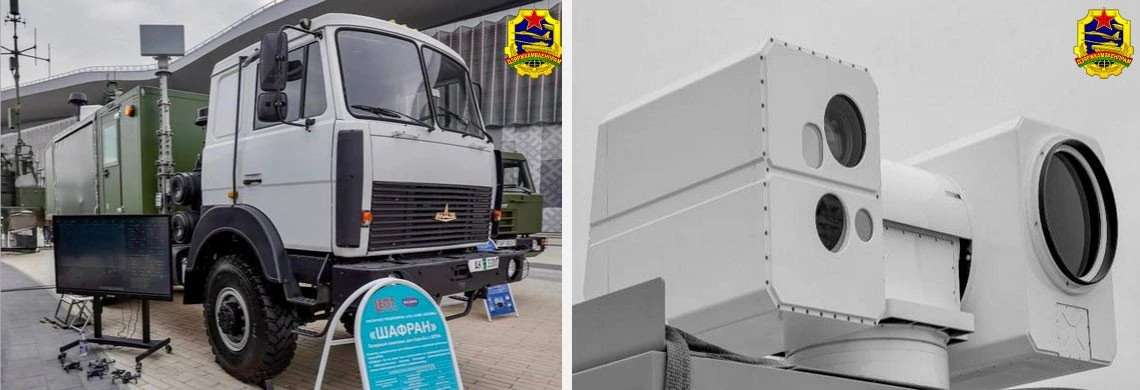
Defense Feeds – Belarus Unveils Shafran Laser during the joint Russian-Belarusian exercise Zapad-2025, showcasing what Minsk describes as an indigenous counter-drone weapon.
The new system, demonstrated on September 16 at the Borisov training range, was presented as a homegrown capability able to disable small unmanned aerial vehicles (UAVs) at ranges of up to one kilometer.
Belarusian and Russian forces staged the live-fire scenario for foreign observers, diplomats, and media to highlight the country’s defense industry progress.
Local state outlets claimed the Shafran successfully engaged a commercial drone in seconds, promoting it as a modern directed-energy solution against growing drone threats on the battlefield.
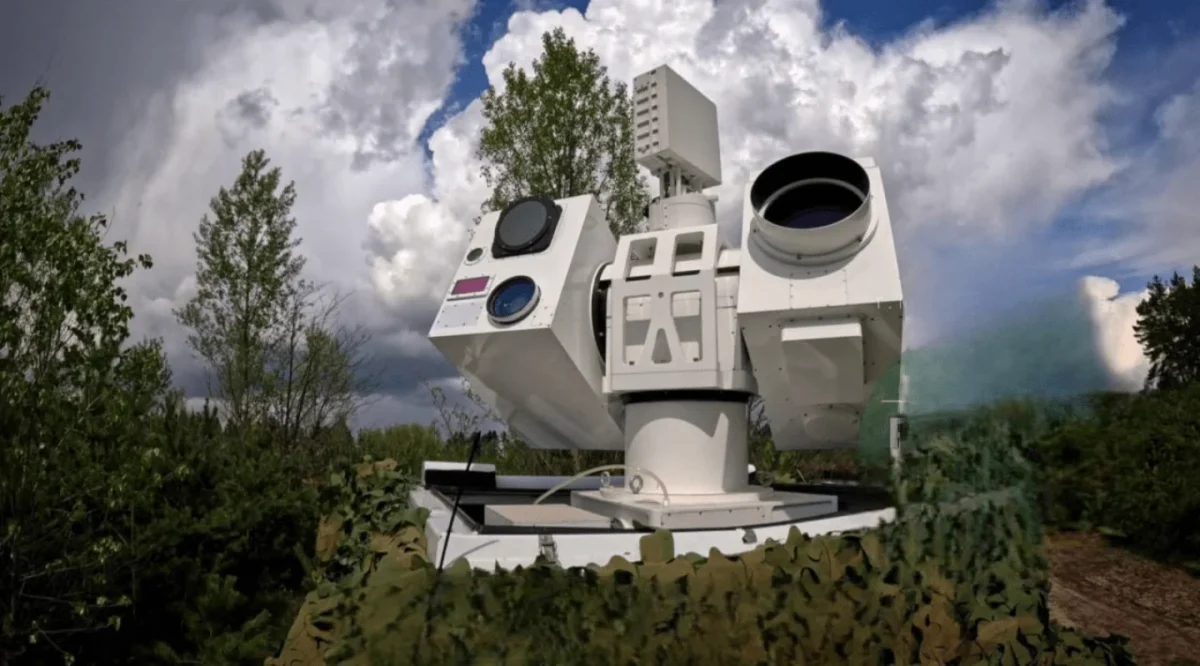
Military analysts, however, expressed skepticism about its origin. According to the Ukrainian defense outlet Defense Express, the Shafran is likely a repackaged version of the Chinese-designed Silent Hunter laser system, previously exported to Iran, Saudi Arabia, and even displayed under a new name by Russia.
The unveiling has sparked controversy due to the unusually short timeline of Shafran’s supposed development.
The system was formally announced only in spring 2025 by the Belarusian company LEMT, yet within a few months it was demonstrated as a functioning prototype.
For comparison, similar high-energy laser projects typically undergo years of prototyping, field testing, and refinement before reaching an operational level.
Defense Express highlighted that as recently as early September there was only one prototype undergoing internal testing.
This raises the possibility that the system was imported in near-final condition and presented under a Belarusian name. The suspicion is strengthened by several technical observations.
For instance, the operator’s control interface bears an almost identical layout to that of the Chinese Silent Hunter, including a distinctive 45-degree angled camera used for target tracking.
Such parallels make it difficult to accept that Shafran is an independent development. Analysts believe that Belarus’ defense industry may have acquired a Silent Hunter unit directly and only repackaged it cosmetically to showcase as a national product at Zapad-2025.
This would not be unprecedented. In 2024, Russia showcased a similar system called Kochevnik, which also turned out to be a Silent Hunter disguised under a new name.
The wider context is that both Minsk and Moscow are under pressure to display indigenous innovation as Western sanctions and ongoing conflicts increase reliance on non-Western suppliers.
Presenting imported systems as local breakthroughs allows them to project technological capability while masking actual dependence on Chinese defense exports.
The Chinese Silent Hunter, on which the Shafran appears to be based, has had a mixed record in real-world application.
Saudi Arabia procured the system to counter Yemeni drone threats, but reports from the kingdom suggested that performance fell far short of expectations.
Disabling a single UAV could reportedly require between 15 and 30 minutes of continuous target engagement, limiting its practicality against swarms or fast-moving drone attacks.
Belarusian officials did not mention such limitations during the Zapad-2025 showcase. Instead, the demonstration aimed to convey strong deterrent messaging that Minsk and Moscow are investing in cutting-edge tools to address one of the most persistent challenges in modern warfare—cheap, widely available drones used in reconnaissance and strike roles.
At the same time, evidence continues to mount on Chinese components being widely embedded within Russian and Belarusian systems.
Earlier this year, Ukrainian forces recovered wreckage of a Russian-made “Gerbera” reconnaissance drone that contained a Chinese-produced Viewpro A40 camera. The device still carried factory test footage shot in Shenzhen.
Analysts from the open-source intelligence community Cyberboroshno later geolocated the material, confirming its Chinese origin and highlighting the porous links between Chinese civilian technology and Russian military hardware.
This pattern reflects how Moscow and its close allies, under pressure from Western export restrictions, are sourcing electronics, optics, and in some cases entire weapon systems from non-Western suppliers like China.
The Shafran serves as yet another example of this trend, revealing underlying dependence despite official narratives of defense self-sufficiency.
For Belarus, the showcasing of Shafran during Zapad-2025 serves multiple goals. Domestically, it signals that the country’s defense sector is adopting futuristic technologies like directed-energy weapons.
Internationally, it offers a spectacle to impress foreign observers, signaling alignment with Russia’s narrative of technological parity with NATO powers. Still, the credibility of Shafran as a battlefield-ready solution remains shaky.
If its performance truly mirrors China’s Silent Hunter, then it may function more as propaganda than as an effective counter-drone defense.
Military planners are well aware that in active conflict, drone swarms pose a far greater challenge than isolated UAVs, meaning systems with such long engagement times would quickly be overwhelmed.
Nonetheless, the direction is clear. Both Russia and Belarus are eager to display laser-based solutions as part of their integrated air defense concepts.
Even if current performance is underwhelming, the visibility of projects like Shafran will ensure that directed-energy research remains part of Belarus’ military-industrial messaging.
Whether this adopted Chinese technology evolves into a genuinely improved domestic product remains to be seen.
What is clear for now is that the Shafran demonstration underlines the deepening military-technical ties among Minsk, Moscow, and Beijing.
As sanctions squeeze traditional supply chains, such interdependence on Chinese systems is likely only to intensify, reshaping the landscape of Eastern European defense development.