Follow Us:
Follow Us:


Defense Feeds – The Armed MUTT XM Robot from General Dynamics Land Systems (GDLS) took center stage at the AUSA 2025 defense exhibition in Washington, D.C., unveiling a groundbreaking leap in autonomous ground warfare.
This next-generation unmanned platform pushes the boundaries of battlefield automation by combining higher power output, payload capacity, and mobility in a compact system designed for future combat missions.
The MUTT XM represents the evolution of the Small Multipurpose Equipment Transport (S-MET) already operational within U.S. Army units, aligning closely with modernization programs like the Next Generation Combat Vehicle (NGCV) and Robotic Combat Vehicle (RCV) initiatives.
Its advanced hybrid build allows it to handle multiple missions, from delivering supplies and gathering intelligence to providing firepower in hostile zones, showcasing how armed robotic ground systems can strengthen frontline units.
A highlight of AUSA 2025 was the debut of the MUTT XM fitted with the XM915 three-barrel 20mm Gatling gun, mounted on a Kongsberg RS6 Remote Weapon Station.
This configuration transforms the vehicle into a mobile counter-drone weapon system, capable of targeting and engaging unmanned aerial threats autonomously.
Developed by General Dynamics Ordnance and Tactical Systems, the XM915 is the lightest 20mm Gatling gun in its class, weighing about 52 kilograms (114 pounds).
It features selectable firing rates of 750 to 1,500 rounds per minute and supports multiple ammunition options, including the M940 multipurpose self-destruct round that reduces collateral risks in close quarters or urban areas.
The RS6 station’s electro-optical sight and automated target-tracking further boost its precision and responsiveness against drones, loitering munitions, and light vehicles.
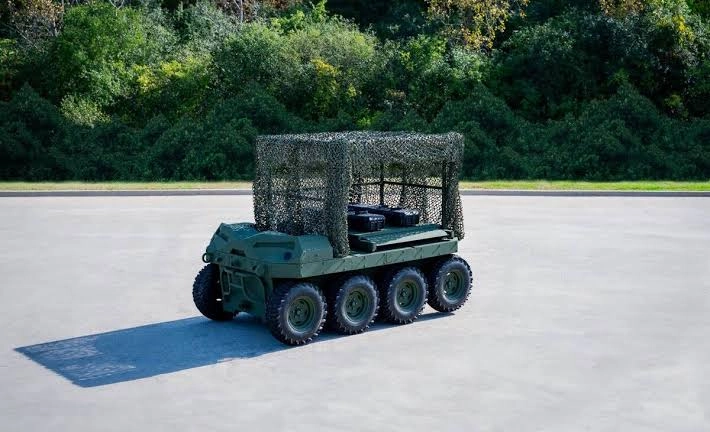
According to GDLS engineers, the MUTT XM’s hybrid powertrain produces more than 10 kilowatts of exportable power, allowing operators to support heavier mission systems such as radar sensors, directed-energy weapons, or electronic warfare payloads.
Its modular chassis, designed to accommodate over 3,000 pounds (1,360 kilograms) of cargo, supports a wide range of configurations, from reconnaissance units to swarm launch vehicles.
The MUTT XM is designed for manned-unmanned teaming, capable of operating autonomously or under remote control.
Through this approach, the U.S. Army aims to expand human-machine collaboration across tactical units, enhancing survivability and situational awareness while reducing the physical and cognitive burden on troops.
Defense experts note that by arming a compact robotic vehicle with a 20mm weapon system, the Army is signaling its intent to integrate UGVs into core combat tasks, not just logistical support.
Systems like the MUTT XM are expected to operate alongside the Optionally Manned Fighting Vehicle and AbramsX, improving combined-arms coordination across complex terrains.
Introducing the MUTT XM goes beyond showcasing a single vehicle; it underscores the Army’s evolving strategy to meet the growing international use of robotic combat systems.
Nations like Russia and China have already fielded battlefield-ready robotic platforms capable of providing reconnaissance, firepower support, and even swarm tactics.
These developments have intensified the need for the U.S. military to push forward with its own autonomous ground warfare initiatives, accelerating research under programs such as Project Convergence and the EDGE series of experiments.
In these live-force exercises, Army units test how robotic systems integrate with manned formations, proving concepts like human-machine teaming in complex, contested environments.
The lessons learned directly shape future doctrinal and procurement decisions, particularly for cutting-edge systems like the Armed MUTT XM Robot, which is designed to act as both a counter-drone defense asset and a modular combat enabler.
Although the Army has yet to announce a specific timeline for acquiring the armed version, its AUSA 2025 reveal makes clear that fielding plans are moving forward.
Defense analysts view this as a pivotal step toward fully integrated multi-domain operations, where autonomous vehicles operate side-by-side with human soldiers, extending surveillance coverage, delivering rapid fire support, and reducing exposure in dangerous zones.
The trajectory of modern warfare is evolving at unprecedented speed. Adversaries are investing heavily in robotics, AI-driven targeting, and resilient electronic warfare systems.
In this landscape, the MUTT XM stands as a clear demonstration of how the U.S. Army blends mobility, digital connectivity, and modular firepower into a deployable solution capable of countering aerial threats, supporting ground offensives, and sustaining high-tempo operations.
By merging automation, counter-UAS capabilities, and precision strike potential into a single platform, the armed MUTT XM delivers the kind of battlefield adaptability required for victory in the conflicts of tomorrow.