Follow Us:
Follow Us:


Defense Feeds – Saab unveils Nimbrix missile, entering the rapidly growing counter-drone market with a dedicated interceptor designed to combat the increasing threat posed by small unmanned aerial systems (UAS).
The compact, affordable missile was officially revealed on August 28 and will make its first public appearance at the DSEI defense exhibition in London this September, where Saab will showcase it at stand N9-105.
This announcement comes at a crucial moment as militaries around the world are facing challenges defending against reconnaissance drones and swarming loitering munitions that have altered modern battlefields and exposed vulnerabilities in traditional air defense systems.
According to Saab officials, the Nimbrix is a short-range counter-UAS missile system optimized for flexibility and affordability.
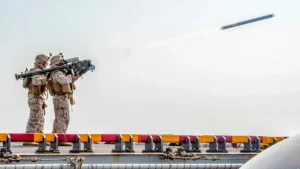
Compact in design and weighing under three kilograms, the weapon is less than a meter long, making it light enough for man-portable operations and suitable for integration on vehicles or stationary positions.
The missile features an operational range of up to 5 kilometers, guided by an active infrared seeker that enables fire-and-forget targeting.
Its warhead delivers an air-burst fragmentation effect, engineered specifically to neutralize small drones flying alone or in coordinated swarms.
By filling the capability gap between gun-based solutions and larger surface-to-air missiles like Saab’s RBS 70NG, the Nimbrix represents a critical layer in multi-tiered defense.
Production scalability is at the core of Saab’s pitch. “Volume matters in drone defense,” According to Saab, the missile can be produced economically and in large quantities, ensuring broad availability on the battlefield.
This affordability factor is key, as traditional interceptors costing over $100,000 per shot have proved unsustainable against drones that can be assembled for a fraction of that sum.
First deliveries of Nimbrix are planned for 2026, with the possibility of licensed production in customer nations later.
The missile underwent evaluation during the Baltic Trust 2025 exercise in July, where the Swedish Armed Forces tested its effectiveness in live operational scenarios.
The unveiling of the Nimbrix reflects a global shift in military thinking influenced heavily by lessons from the Ukraine war, which began in 2022.
Both Russia and Ukraine have deployed massive drone fleets, ranging from armed first-person-view (FPV) quadcopters to long-range attack drones like the Iranian-made Shahed-136.
Conventional air defense systems, built primarily to counter fast jets or ballistic threats, have struggled against the sheer scale of drone incursions.
This mismatch has forced militaries to seek cheaper and more flexible counter-drone technologies, including jammers, directed-energy weapons, and especially interceptor drones. Ukraine has emerged as a key testing ground for counter-drone technologies.
Local companies and volunteer groups have introduced a wide range of innovative solutions, including Besomar’s fixed-wing interceptor drones, the Wild Hornets system with FPV drones that successfully target Shahed UAVs, and VARTA’s DroneHunter, which employs a shotgun module for close-range drone neutralization.
Kyiv’s Ministry of Defense has even authorized the Chief-1 quadcopter in 2025, designed with autonomous target recognition and aerial shot capability.
Russia has also accelerated counter-drone development with platforms like the Tarantul-Ptitselov net-launching interceptor and the Yolka kamikaze-style shoulder-fired drone. Meanwhile, NATO states and allies are scaling up their own projects.
The United States deploys the Raytheon Coyote Block 2, Israel’s defense industry continues testing guided close-in interceptors, and Europe has multiple parallel developments underway.
Latvia’s Origin Robotics is advancing the EU-funded BLAZE project, while France’s CERBAIR and Germany’s Argus Interception GmbH have introduced AI-enabled interceptors integrated with jammers.
Recognizing that uncrewed systems are now integral to contemporary warfare, militaries must develop defensive measures that are capable of adapting to this reality.
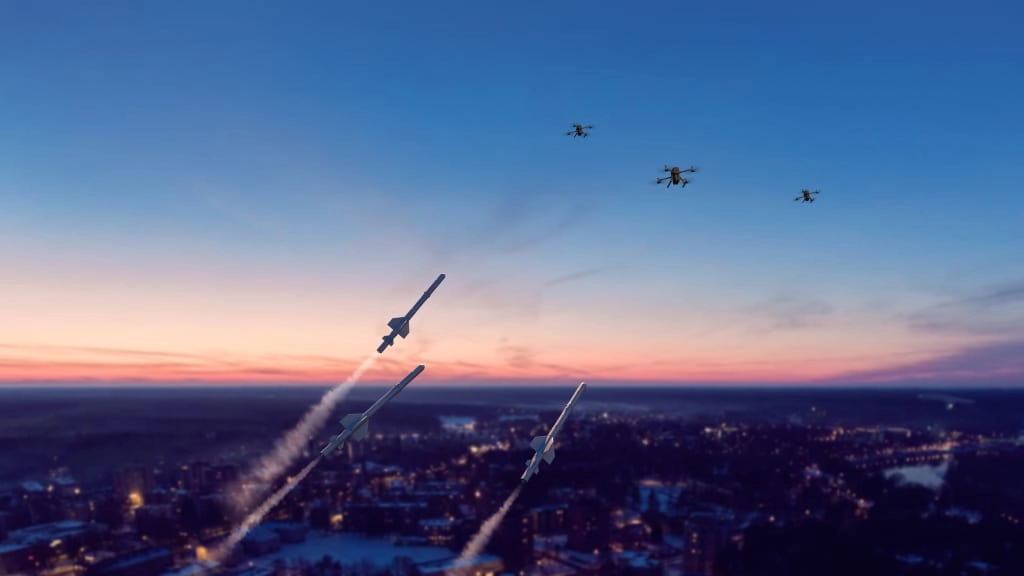
Experts note that the adoption of systems like Nimbrix marks a doctrinal shift toward layered air defense networks where drone interceptors complement rather than replace traditional weapons.
In Ukraine, operators now deploy separate interceptor drone units connected to radar networks, enabling agile and low-cost responses to incoming Shaheds and Lancets without wasting expensive long-range missiles.
Tactically, the field divides into two categories: kamikaze interceptors that collide with enemy drones and reusable drones equipped with nets or shotguns for capture or takedown.
Kamikaze types dominate due to their low cost and availability, while reusable designs offer the advantage of preserving captured adversary drones for exploitation.
Saab’s Nimbrix stands apart by retaining the traditional missile-based hard-kill approach, bridging the gap between expendable drones and larger surface-to-air defenses.
Analysts say its key advantage lies in scalability – the potential to deploy thousands across forward bases, civilian infrastructure sites, or alongside larger integrated defense systems.
The company’s openness to licensed production abroad also mirrors current industry trends, ensuring allied countries can maintain domestic production and scale up swiftly in times of crisis.
The increasing priority NATO places on counter-swarm defense highlights the timely arrival of Saab’s solution in a market where demand far surpasses availability.
As drone warfare evolves, the message from Saab’s latest offering is clear: the battlespace of tomorrow will demand cost-effective, high-volume defenses, and solutions like the Nimbrix are poised to play a central role.