Follow Us:
Follow Us:

Defense Feeds – Rafale fighters deployed to Poland by France mark a swift response to recent Russian drone incursions, underscoring NATO’s readiness to reinforce its eastern flank.
The decision, announced by the French presidency on 12 September, is part of a broader allied effort to deter provocations and reassure frontline states facing persistent aerial intrusions.
This latest deployment highlights the shifting security climate along NATO’s borders and the critical role modern fighter aircraft play in rapid crisis response.
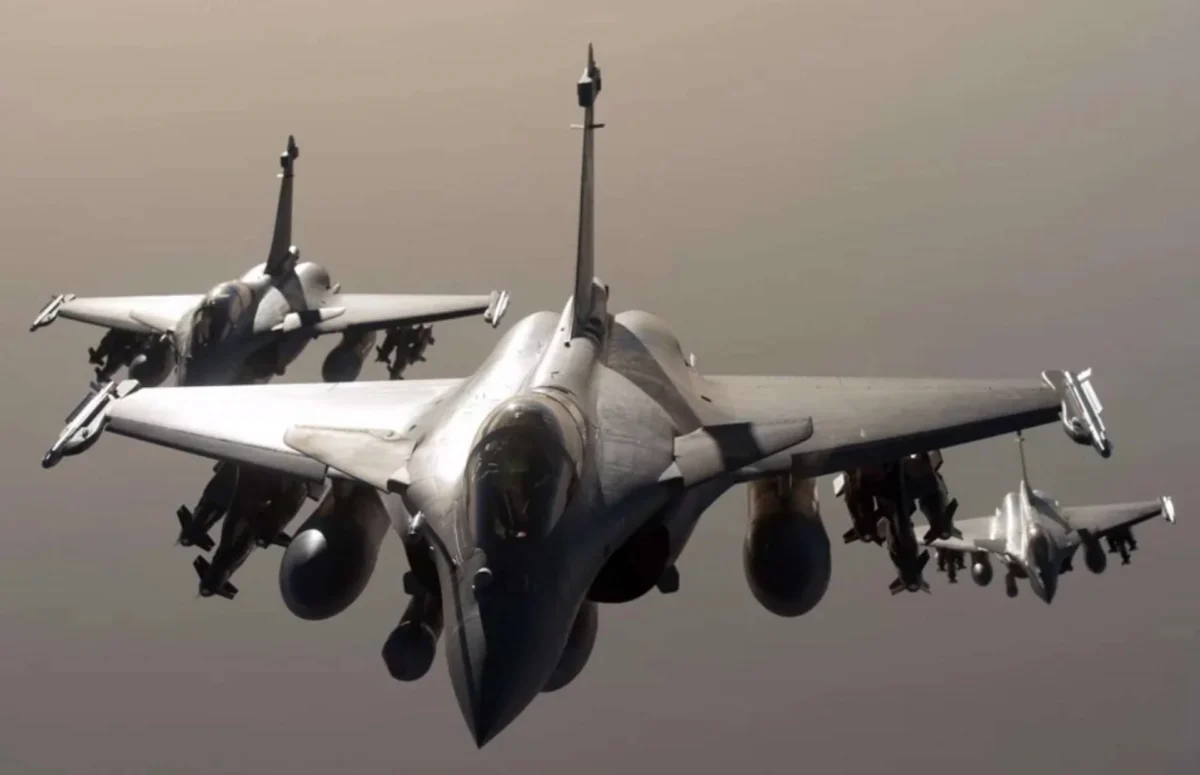
The deployment follows multiple incidents where drones reportedly crossed into Polish airspace, forcing temporary airport shutdowns and elevated alert levels.
Polish air defenses have been on guard throughout 2025, with authorities reacting swiftly to any airborne threat near the frontier with Belarus and Ukraine.
France’s decision to send Rafales to Poland is far from a symbolic gesture. Quick-reaction alert forces are an essential part of NATO’s defensive framework.
By placing advanced fighters in Polish territory under NATO command, the alliance raises the threshold of deterrence while giving local commanders the flexibility to intercept suspicious aerial contacts in real time.
This kind of rapid reinforcement has become routine since the escalation of the war in Ukraine. Rather than deploying large numbers of aircraft, NATO allies often contribute small but highly capable detachments.
The presence of even a handful of modern jets complicates the calculations of anyone contemplating airspace violations.
The centerpiece of this mission is Dassault Aviation’s Rafale, which has evolved into the French Air and Space Force’s workhorse.
Despite its compact design, the Rafale carries a formidable mix of sensors, electronic warfare tools, and long-range weapons ideally suited to air policing missions over NATO’s eastern frontier.
At the heart of the aircraft lies the RBE2 active electronically scanned array (AESA) radar, capable of seamlessly shifting between search, track, and specialized modes without the delays seen in older mechanical radars.
Complementing this is the front-sector optronics system, which provides passive identification—allowing Rafale pilots to observe a contact discreetly without broadcasting emissions.
For survivability, the fighter relies on the SPECTRA defensive suite, which continuously scans the electromagnetic environment, catalogues threats, and activates countermeasures.
Whether by deploying decoys, jamming hostile radars, or confusing missile seekers, SPECTRA ensures pilots can safely approach unidentified aircraft, even in high-risk encounters.
In combat loadout, Rafale typically carries a combination of Meteor beyond-visual-range missiles for high-value or distant targets, alongside MICA missiles for close-range defense.
This mix allows crews to seamlessly switch between intercepting fast aircraft or neutralizing small low-level drones—precisely the unpredictable spectrum Poland now faces.
With NATO tankers providing endurance and a robust command-and-control network guiding intercepts, Rafale pilots can focus on quick execution rather than extended searching.
France is now fielding the Rafale F4 upgrade standard, which prioritizes improved connectivity with allied forces.
Enhanced communications, updated radar modes, and streamlined cockpit systems reduce pilot workload and offer stronger integration with NATO’s air defense networks.
In contrast to earlier configurations, this connectivity ensures that French jets share and receive real-time targeting information with minimal lag, making joint operations smoother.
The mission profile over Poland is expected to cycle between combat air patrols (CAPs) and alert scrambles.
A standard NATO playbook applies: fighters launch at short notice, intercept unidentified tracks, and use radar and passive sensors to classify and shadow the intruder.
In most cases, these interceptions end with visual warnings and redirections rather than engagements, but the presence of armed jets ensures that any escalation can be countered immediately.
Hybrid pressure from Russia and Belarus has tested NATO’s air defenses consistently since 2022.
Drone incursions, electronic warfare exercises, and unidentified aircraft probing allied borders force commanders to calibrate responses carefully.
While a handful of Rafales cannot alter the balance of airpower in Europe, they carry disproportionate strategic weight by reducing the likelihood of miscalculation and stressing that any violation of NATO airspace carries costs.
Poland, sitting on the frontline of this contest, has repeatedly pressed the alliance for visible reinforcement of its skies.
France’s rapid deployment addresses those concerns directly while also demonstrating Paris’s willingness to share the air policing burden alongside other NATO members such as Germany, Britain, and Spain.
The Rafale’s mix of advanced radar, passive surveillance, and defensive jamming is particularly suited to handling drones or slow-moving intruders that often evade early detection.
Its ability to fly quietly at low speeds while maintaining stability makes close escorting of slow aircraft safer, an advantage during the often tense visual identification phase. The timing of this move reflects heightened vigilance across Europe.
While Russia continues large-scale military exercises with Belarus and conducts air activity near NATO borders, alliance members are determined to prevent even limited drone incursions from normalizing.
By rotating fighter detachments into Poland and other eastern allies, NATO demonstrates that airspace probes will be met not with hesitation but with rapid, coordinated reaction.
For Warsaw and Paris, the deployment key message is clear: presence matters. NATO’s credibility depends not only on large-scale exercises and forward basing, but also on flexible, small-unit responses to emerging threats.
A trio of fighters may not shift the strategic landscape, but on radar screens and in political calculations across Moscow and Minsk, that presence carries weight.
France’s Rafales now stationed in Poland embody that principle—modern, networked, and ready to react at a moment’s notice.
In an era defined by drones and persistent hybrid challenges, their role is less about firepower and more about stability.
NATO’s deterrence rests not merely on numbers, but on responsiveness, coordination, and the ability to show up quickly when a frontline state raises the alarm.