Follow Us:
Follow Us:


Defense Feeds – New Sparta Drone Mothership by Quantum Systems, recognized for its advanced unmanned aerial vehicles, is on the brink of rolling out its latest innovation.
The Sparta drone mothership, now in the final stages of development inside Ukraine, is a pioneering drone designed as a versatile “mothership” and is slated for mass production by the end of the year, according to company officials.
As global demand surges for advanced military technologies, the new Sparta drone mothership’s unique functions and flexible platform could mark a major leap for both Ukrainian defense and Quantum Systems’ growing influence in the drone warfare sector.
According to project insiders, Sparta is engineered as an unmanned aerial system (UAS) capable of carrying and releasing multiple drones while in flight, thereby expanding mission range and operational impact for military users.
Instead of flying single missions, Sparta acts as an airborne carrier, positioned at critical locations and ready to deploy its payload swiftly.
This approach not only boosts the operational range of smaller drones but also allows troops to react faster to threats or changing battlefield conditions by staging these drone motherships closer to areas of concern.
The German-developed platform leverages a catapult launch system — a departure from Quantum Systems’ prior vertical takeoff and landing (VTOL) designs.
By using a catapult, Sparta achieves greater lift and payload capability, launching directly into its designated flight path.
The eight-kilogram system, with a maximum takeoff weight of 23kg, is made for durability and endurance, boasting a flight radius up to 200km and an operating time between six and eight hours on a single mission.
This extended endurance makes it especially suitable for surveillance, intelligence-gathering, and supply roles across broad, contested landscapes.
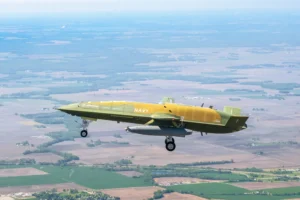
Flexibility is central to Sparta’s battlefield value. The drone features a long, narrow central fuselage flanked by extended wings, with each wing equipped with modular mounting points.
This means operators can quickly swap payloads between different operational needs, such as sensors, communications equipment, or additional drone launchers, without needing a dedicated fleet for each purpose.
Sparta’s aerodynamic design is enhanced by a rear-mounted electric pusher propeller and a V-shaped tail, which together improve both speed and efficiency.
Another distinguishing feature is Sparta’s landing system. Quantum Systems confirmed that instead of complex landing gear, Sparta performs a controlled belly landing, gradually decelerating before touching down.
Although the design may see refinements during production — potentially including upgrades or adjustments to the landing configuration — this pragmatic approach supports rapid turnaround and redeployment, reducing downtime between sorties.
Sparta can also be pre-deployed ahead of time to reduce response delays.
By pre-deploying these mothership drones at strategic locations, defense units gain the ability to launch coordinated, multi-drone strikes or surveillance missions with minimal lead time.
Quantum Systems’ decision to develop and launch Sparta in Ukraine is significant.
As Ukraine continues to modernize its defense technology and adapt to evolving battlefield challenges, the presence of state-of-the-art drone innovations like Sparta represents both tactical and symbolic support.
Not only will this boost Ukraine’s own capabilities, but it also demonstrates how local and international partnerships can drive rapid advances in military tech.
While Quantum Systems has not released detailed specifications regarding the exact number of drones Sparta can carry, nor specifics on the types deployable from the mothership platform, defense analysts anticipate that its modularity will draw broad interest from multiple sectors — both for defense agencies and allied partners seeking new solutions in UAV operations.
With serial production planned to start before year’s end, company representatives have stated there may still be design tweaks.
The landing system, payload interfaces, or control software could see last-minute changes as feedback from field tests and frontline operators is incorporated.
This agile approach suggests Quantum Systems is committed not only to delivering a capable product but also to ensuring it evolves rapidly alongside the needs of Ukraine’s defense forces.