Follow Us:
Follow Us:


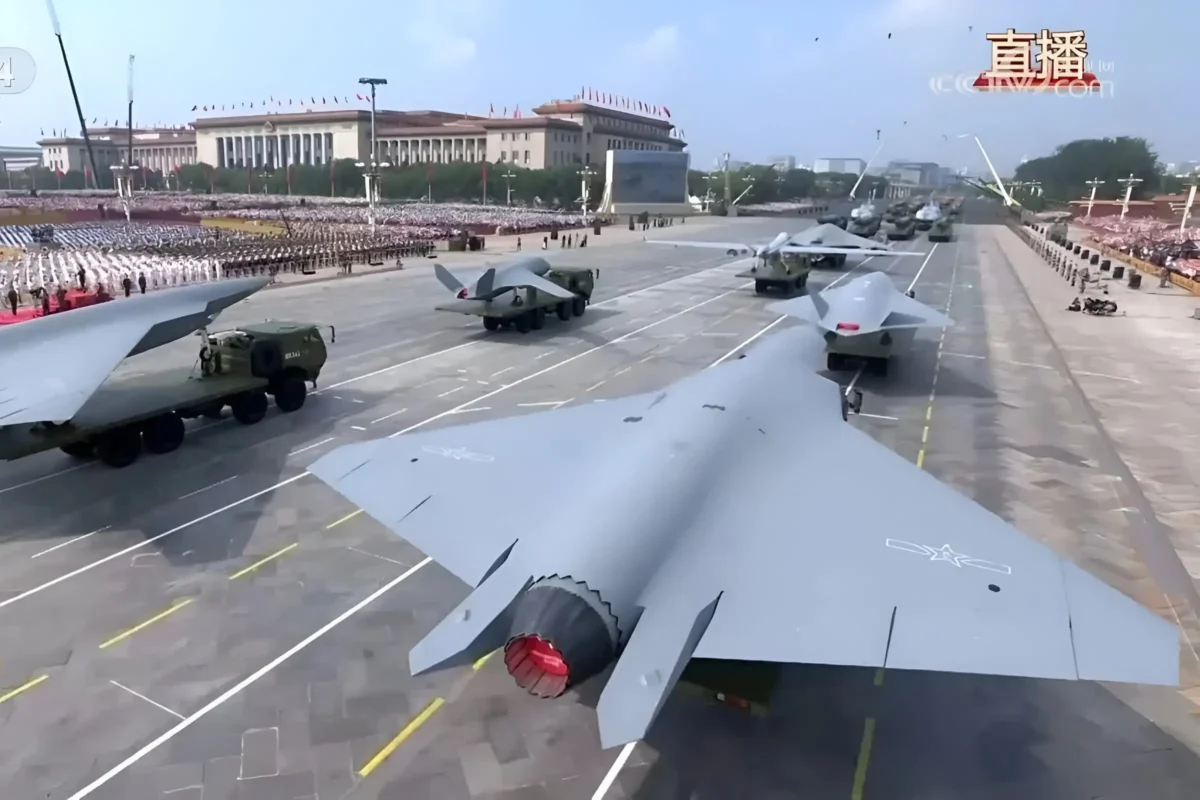
Defense Feeds – The new Chinese Type B Stealth Drone was officially unveiled during the September 3, 2025 military parade in Beijing, held to mark the 80th anniversary of Japan’s defeat in World War II.
Presented by the People’s Liberation Army Air Force (PLAAF), the drone is one of several next-generation unmanned aerial systems and has drawn global attention for its size, design, and advanced capabilities.
Comparable in dimensions to the J-10 fighter jet, this stealth platform has been informally labeled “Type B” and is already being described by analysts as an “unmanned air superiority fighter.”
The strength of the New Chinese Type B Stealth Drone lies in its stealth capabilities, refined aerodynamic design, and possibility of entering air combat roles that have historically been carried out by manned aircraft.
Its debut underscores Beijing’s increasing emphasis on sophisticated UAVs that go beyond reconnaissance and precision strikes, signaling a readiness to deploy drones capable of supersonic air combat and direct engagement with enemy aircraft.
What makes Type B stand out is its sophisticated design. Equipped with a diamond-shaped wing and lacking a tail, the platform uses adjustable wingtips in place of typical control surfaces to improve its stealth profile and aerodynamic efficiency.
Positioned beneath the nose is an electro-optical sensor similar to systems used on Western combat jets, complemented by stealth-friendly communication antennas and twin diverterless supersonic intakes supplying a WS-10C-class powerplant.
At the rear, the single-engine drone showcases a serrated, variable-geometry exhaust nozzle resembling that of the U.S. F-35 Joint Strike Fighter.
This design not only indicates an effort to reduce radar cross-section but also suggests the possibility of high maneuverability at supersonic speeds.
The streamlined fuselage, which eliminates pilot-related support systems, further allows extended range and endurance—providing operational advantages in long-range patrols or offensive sorties.
The Type B also integrates a substantial ventral weapons bay, a crucial feature for maintaining low visibility while carrying missiles or precision strike munitions internally.
This configuration strongly hints that the drone is designed with both air-to-air and multi-role offensive operations in mind.
While China’s earlier GJ-11 Sharp Sword stealth drone prioritized precision strikes and intelligence-gathering, the new Type B appears ready to cross into missions traditionally dominated by frontline manned fighters.
Industry sources indicate that the 611 Institute of Chengdu Aircraft Corporation (CAC) is behind the creation of the Type B unmanned stealth drone.
Satellite images from as early as 2021 indicate that prototypes were already in testing at Chengdu’s facilities.
At the Beijing parade, drones were seen bearing serial numbers tied to a PLAAF brigade in southwest China, fueling speculation that the system may already be linked to an operational unit, though its deployment status remains unclear.
In addition to the Type B, a second stealth drone was revealed at the military parade. Another platform, provisionally referred to as “Type A,” was also displayed.
With a smaller frame than the Type B, it incorporates a lambda-shaped wing and distinctive caret-style air intakes.
Unlike its larger counterpart, it lacks an under-nose sensor and appears to be designed for different missions, possibly surveillance or strike operations rather than air superiority engagements.
Despite their differences, both Type A and Type B reflected a refined level of finish, indicating more than prototype-level maturity.
The unveiling of the Type B signals more than just the arrival of a new drone—it underscores China’s doctrinal shift in aerial warfare.
Unlike the United States, which is heavily investing in less expensive collaborative combat aircraft to supplement manned fighters under its CCA program, Beijing seems intent on leapfrogging toward advanced unmanned combat air vehicles that can potentially replace manned fighters in high-intensity air-to-air roles.
This mirrors parallels with Russia’s Su-70 Okhotnik drone, which has undergone a similar demonstration and gradual integration process.
The development of the Type B showcases how China envisions the future of unmanned aerial warfare.
By pursuing a combination of stealth, high autonomy, supersonic capability, and internal weapons carriage, Beijing is signaling a willingness to deploy drones capable of direct combat engagement in contested skies.
The Type B could evolve into a dual-role platform adept at both air dominance and strike missions, bridging a gap between current UCAV designs and fully autonomous fighters.
Chinese defense parades have historically presented experimental systems that eventually matured into operational ones.
The GJ-11 Sharp Sword serves as a key precedent, having been unveiled in rudimentary form before becoming a more refined part of the arsenal.
Analysts suggest the Type B is on a similar path, potentially advancing toward thrust-vectoring nozzles or bidimensional exhaust systems to boost maneuverability and survivability in future iterations further.
With such developments, Beijing is demonstrating that its drone strategy is diverging sharply from Washington’s.
While the U.S. is aiming at affordability and manned-unmanned teaming, China is investing in stand-alone, advanced stealth UCAVs with capabilities approaching front-line fighters.
This evolution could tilt the balance of aerial power in Asia and beyond, raising questions about the next decade of great-power competition in air combat technology.
For now, whether the Type B becomes a widely fielded operational drone, a technology demonstrator, or a limited-use platform remains unknown.
The public unveiling of the Type B sends a clear message: China is rapidly moving toward a future where drones not only support manned aircraft but could replace them altogether in supersonic air-to-air combat roles.