Follow Us:
Follow Us:


Defense Feeds – Marines Unveil New MQ-9 Reaper in a significant step forward for advanced electronic warfare and long-range surveillance.
The U.S. Marine Corps, working with Naval Air Systems Command (NAVAIR), recently completed the first flight of an upgraded MQ-9A Reaper drone fitted with next-generation communication and electronic support pods.
This breakthrough enhances the Corps’ ability to operate effectively in contested environments across the Indo-Pacific.
Announced on August 12, 2025, the test flight confirmed the Reaper was operating with both the SkyTower II communication pod and the RDESS/SOAR electronic warfare system.
As part of the Marine Corps’ ongoing modernization efforts, the upgrades highlight a major achievement by adapting multi-role, long-endurance drones for use in both expeditionary and maritime operations.
Assigned to Air Test and Evaluation Squadron (UX) 24, which specializes in validating advanced aircraft systems, the upgraded MQ-9A Reaper took part in the recent trial flight.
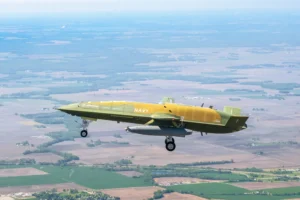
Images released by NAVAIR reveal the Reaper flying with the SkyTower II pod under its left wing, an external fuel tank alongside, and the RDESS/SOAR pod fitted beneath the right wing.
A third yet-to-be-identified pod was mounted on the aircraft’s centerline, signaling further enhancements in progress.
While NAVAIR did not reveal the exact date of the flight, the command noted that initial power-on testing of the SkyTower II pod had already been completed in February.
The modified MQ-9A Reaper used in the evaluation was operated by Air Test and Evaluation Squadron (UX) 24, a unit tasked with integrating and testing advanced aviation systems.
This suggests that the integration campaign for new systems on the MQ-9A is moving at pace and keeping in line with the Marine Corps’ operational timeline for 2026 deployments. The Marines view the SkyTower II as a crucial step forward in capability upgrades.
Developed by GALT and integrated via NAVAIR’s streamlined middle-tier acquisition process, the pod boosts airborne networking and real-time data exchange across units.
Commanders describe it as a vital tool in transforming the MQ-9 into a “digital quarterback” that allows dispersed forces to coordinate missions more effectively, even in heavily contested areas.
With the Marines planning their first operational deployment in 2026 with the Hawaii-based VMU-3 squadron, this capability is set to enhance forces tasked with reconnaissance, intelligence gathering, and target tracking across the Pacific.
Complementing the SkyTower II, the MQ-9A mounts the RDESS/SOAR pod, which was co-designed by General Atomics together with L3Harris.
Already in use on some U.S. Air Force Reapers since 2021, the pod strengthens the Marines’ electronic warfare portfolio by detecting, analyzing, and geolocating hostile signals over long distances.
What makes RDESS/SOAR particularly valuable is its ability not only to identify signals of interest but also to replicate and retransmit them when required.
While U.S. officials remain cautious about revealing operational details, Marine Corps Commandant General Eric M. Smith stated that the system provides an additional protective layer for forces by confusing adversary sensors and networks.
In a region where electronic jamming and countermeasures are expected to play a major role in conflict, this ability is a game-changer.
Together, these pods make the Reaper far more than a reconnaissance drone.
Once deployed, the aircraft will perform overlapping missions including ISR-T (Intelligence, Surveillance, Reconnaissance, and Targeting), Maritime Domain Awareness, Airborne Network Extension, and electronic support in coordination with Marine Littoral Regiments stationed in the Pacific.
The MQ-9A Reaper, originally derived from the Predator B design, has long been a workhorse drone for the U.S. military and its allies.
Equipped with the Honeywell TPE331-10 engine and supported by a redundant avionics setup, the platform achieves endurance of over 27 hours and can operate as high as 50,000 feet.
The Extended Range (ER) version improves this endurance to 34 hours, nearly a day and a half of sustained flight, giving the Marines unmatched persistence over vast maritime spaces.
Endurance is essential for the Indo-Pacific, often described by defense planners as the most geographically challenging theater in the world.
With bases spread far apart and adversaries fielding increasingly capable detection systems, the Marines are relying on long-range unmanned aircraft to maintain situational awareness while reducing risks to crewed platforms.
The flexibility of the MQ-9 is also critical. Alongside surveillance radars, electro-optical sensors, and communications relays, it can be configured to carry precision-guided weapons for strike missions, allowing rapid response against high-value maritime or coastal targets.
With the addition of electronic support pods, the Reaper now fills multiple roles once handled by different specialized aircraft.
This versatility means the Marine Corps can maximize coverage with fewer assets—a crucial advantage in distributed operations like Expeditionary Advanced Base Operations (EABO), which depend on agile, multi-function platforms capable of surviving in contested zones.