Follow Us:
Follow Us:

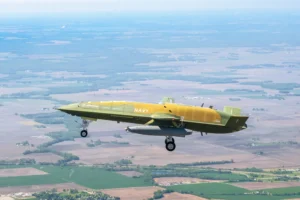
Defense Feeds – Lockheed Martin Rolls Out Vectis Drone, unveiling its latest unmanned combat aircraft designed to reshape the future of air warfare for the United States and allied forces.
Developed by the company’s Skunk Works division, the advanced system is positioned as a highly survivable, agile, and cost-effective Collaborative Combat Aircraft (CCA) built for contested environments and manned-unmanned teaming with frontline fighters.
According to Lockheed Martin, Vectis falls within the Group 5 family of unmanned aircraft, the largest and most capable drone category used in combat operations.
These platforms are built for long endurance, substantial payloads, and versatile mission roles.
The company stressed that Vectis is not simply another drone concept but a next-generation combat platform engineered for flexibility, affordability, and seamless integration across U.S. and allied air operations.

Skunk Works has designed Vectis with a focus on working hand-in-hand with fifth-generation fighters like the F-35 Lightning II and future sixth-generation aircraft under the U.S. Air Force’s Next Generation Air Dominance (NGAD) program.
The company described the drone as capable of conducting a variety of missions ranging from intelligence, surveillance and reconnaissance (ISR) to electronic warfare, strike missions, and air-to-air support.
This concept, often called manned-unmanned teaming, would allow commanders to deploy Vectis as a loyal wingman for advanced fighters, giving crewed aircraft enhanced protection and offensive reach in hostile environments.
Lockheed claims the platform can fly independently when required, while also adapting to collaborative operations to multiply the effectiveness of air campaigns.
One of the standout features highlighted by Lockheed Martin is its extended flight endurance, allowing Vectis to cover large theaters, including the Pacific, European, and Middle Eastern regions, where long-distance operations are essential.
This endurance factor also reinforces its suitability for countering near-peer challenges from nations such as China and Russia, where air dominance will rely on both survivability and persistent operations.
Lockheed Martin stressed that survivability remains a central requirement in the design of Vectis.
Building on the company’s vast experience with stealth platforms like the F-117 Nighthawk, SR-71 Blackbird, and F-22 Raptor, the new drone reflects advanced stealth shaping, radar-absorbing materials, and survivability enhancements to operate inside air defense zones controlled by near-peer adversaries.
The company believes Vectis reflects a balance between survivability and affordability—two factors that often conflict in next-generation drone development.
By applying digital engineering techniques and advanced manufacturing practices, Lockheed aims to produce the drone faster and at a lower cost while still offering the high-end capabilities demanded by the U.S. Department of Defense.
Importantly, its open mission architecture follows government reference standards, ensuring interoperability with allied systems and preventing dependence on a single vendor.
OJ Sanchez, vice president and general manager of Lockheed Martin Skunk Works, said Vectis embodies the company’s decades of innovation in fighter jet design and systems integration.
He described the aircraft as not just a new platform but a “paradigm shift” that leverages cutting-edge autonomy, modularity, and affordability.
Lockheed has already committed internal funding and manpower toward the project, with hardware orders placed and assembly teams organized.
The company set an ambitious timeline of “design, build, and fly within two years,” reinforcing its pledge to keep pace with rapidly evolving defense priorities.
The unveiling of Vectis comes at a critical juncture as the Pentagon finalizes its requirements for the formal Collaborative Combat Aircraft program.
The initiative, tied to the wider NGAD ecosystem, is expected to introduce a family of unmanned aircraft that will work closely with existing and future fighters.
Competitors including General Atomics and Boeing are also developing their own CCA concepts, making Lockheed’s entry an important milestone in shaping the coming decade of air combat.
Defense analysts note that Lockheed Martin’s Skunk Works has a proven track record in delivering transformative aircraft.
From the U-2 spy plane in the Cold War to the stealth revolution of the F-117, the division has consistently produced aircraft that shifted the balance of power.
The firm emphasized that Vectis builds on past innovations, providing exceptional survivability alongside an adaptable, multi-role framework.
By aligning its development with the Pentagon’s evolving multi-domain command and control architectures, Lockheed Martin ensures that Vectis will plug into larger networks that include space, cyber, and naval assets.
Such connectivity is vital to countering peer threats and shaping the future of joint warfare.
Industry observers view the Vectis program as part of a larger trend across Western militaries to prioritize autonomous systems and manned-unmanned teaming.
With near-peer rivals accelerating development of their own stealth drones and long-range strike aircraft, programs like Vectis will likely play a significant role in ensuring the U.S. and its allies maintain technological superiority.
For now, Lockheed Martin has not disclosed the full technical specifications of the drone, including its payload capacity or sensor suite.
However, the company has confirmed ongoing testing and development milestones are in progress, with operational testing expected in the near future.
The introduction of Vectis signals a growing recognition that the era of relying solely on crewed fighters is coming to an end.
Instead, the future will be shaped by flexible, networked combat drones capable of carrying out missions too risky or resource-intensive for manned aircraft.
As the Pentagon moves closer to defining its CCA requirements, Lockheed Martin’s Vectis stands as a major contender to shape the next generation of U.S. and allied air power.