Follow Us:
Follow Us:


Defense Feeds – Gray Eagle STOL Drone Production is moving forward as General Atomics Aeronautical Systems Inc.
(GA-ASI) and South Korea’s Hanwha Aerospace have officially joined forces to co-develop and manufacture the advanced Gray Eagle Short Takeoff and Landing (GE STOL) unmanned aerial system.
The strategic agreement, recently signed by both defense companies, marks a significant milestone in strengthening bilateral cooperation in next-generation unmanned aircraft technologies.
Under the deal, Hanwha Aerospace will take a major role in the Gray Eagle STOL Drone Production process, providing essential components such as advanced engines, landing gear, and avionics systems that enable the aircraft to operate effectively in short or confined areas where conventional drones are limited.
Hanwha also plans to invest in a new local production and assembly facility in South Korea to support large-scale manufacturing once the program enters the production stage.
Meanwhile, GA-ASI will continue producing other variants of the Gray Eagle series in the United States while leading system integration and joint testing.
Both firms stated that the Gray Eagle STOL Drone Production partnership will accelerate development, lower manufacturing risks, and contribute to South Korea’s long-term goal of expanding its domestic aerospace and defense industry.
Hanwha Aerospace’s CEO Jae-il Son emphasized that the partnership not only ensures technology transfer but also helps South Korea gain valuable experience in end-to-end UAS design and production.
“Jointly producing the GE STOL drone in South Korea and the US will create jobs, secure new technical talent, and strengthen the Korean drone ecosystem,” Son said in a statement.
He noted that Hanwha is transforming into a comprehensive unmanned systems manufacturer, managing everything from design and engine production to integration and upkeep.
The collaboration is expected to pave the way for future projects linked to South Korea’s next-generation reconnaissance and surveillance programs.
As part of the joint project timeline, the two companies expect a prototype to reach production readiness by 2027, with initial deliveries projected for 2028.

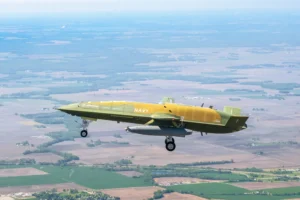
The Gray Eagle STOL is built for missions that extend beyond the reach of traditional unmanned aircraft.
Designed for rapid deployment and flexible operations, the drone supports surveillance, intelligence gathering, and precision-strike missions in challenging conditions.
The GE STOL measures about 9 meters in length with a 16-meter wingspan, compact enough for transportation by a UH-60 Black Hawk helicopter.
The system carries up to 3,400 pounds (1,542 kilograms) of payload and can be armed with as many as 16 AGM-114 Hellfire missiles.
It features satellite-based command and control for operations extending up to 2,500 nautical miles (4,630 kilometers) and relies on a robust architecture designed to withstand harsh weather and rugged terrain.
Fitted with a Rolls-Royce M250 engine generating 450 horsepower, the aircraft achieves speeds of up to 140 knots (259 kilometers per hour) with an endurance of around 25 hours and a service ceiling reaching 25,000 feet.
The new model shares core hardware and software features with the Gray Eagle 25M, ensuring operational continuity across military fleets.
A prototype of the STOL platform, known as the Mojave, has already demonstrated impressive performance in multiple international tests.
The drone successfully performed launch and landing trials from the South Korean Navy’s ROKS Dokdo amphibious assault ship near Pohang and later from the British aircraft carrier HMS Prince of Wales.
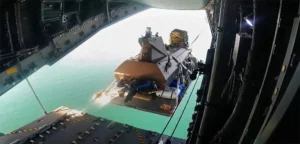
In addition, GA-ASI conducted live-fire trials with Mojave at the Yuma Proving Ground in Arizona, validating its ability to operate in expeditionary environments.
These trials highlighted the drone’s adaptability, especially its ability to conduct naval and field missions from short or improvised runways.
The GE STOL program reflects a growing demand for drones capable of operating in contested or limited environments, aligning with current trends in modern warfare.
For South Korea, the project represents a milestone in its push to localize key defense technologies and evolve into a global UAS manufacturing hub in partnership with leading defense firms like General Atomics.