Follow Us:
Follow Us:


Defense Feeds – The First MQ-25 Drone Tanker will join the US Navy’s carrier air wings by 2026, signaling a major leap forward in extending the strike range and operational flexibility of aircraft carriers.
Vice Admiral Daniel Cheever announced this timeline at a Washington, D.C. event hosted by the Center for Strategic and International Studies (CSIS) and the U.S. Naval Institute, confirming the Navy’s first operational carrier-based unmanned aircraft is on track for deployment.
With deployment approaching, the First MQ-25 Drone Tanker is set to revolutionize carrier aviation by replacing “buddy tanking” missions performed by F/A-18E/F Super Hornets.
This shift will free valuable strike fighters for combat missions and clear the path for integrating more unmanned platforms into naval air wing
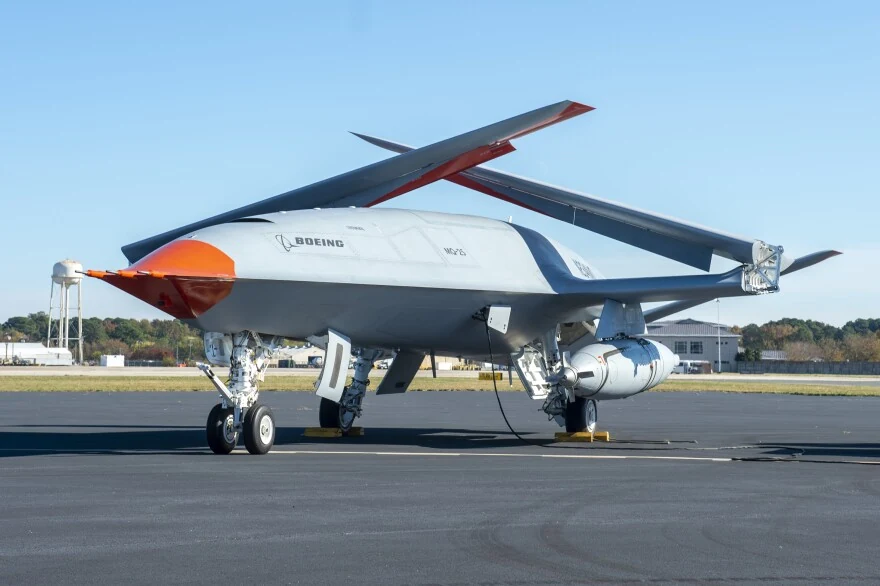
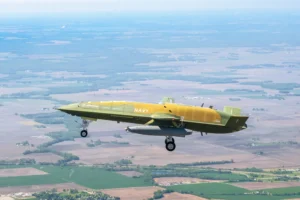
Since its first flight in 2019, the Boeing-built T1 prototype of the MQ-25 has progressed steadily through various phases of testing.
Over the last several years, the autonomous drone has successfully conducted aerial refueling trials with F/A-18E/F Super Hornet strike fighters, the F-35C Lightning II, and E-2D Hawkeye airborne command platforms.
The 2021 deck handling demonstrations on the USS George H.W. Bush validated the MQ-25’s capability to move and operate safely in the restricted and complex environment of a carrier deck.
As part of those early tests, the USS Bush became the first ship to receive the Lockheed Martin MD-5E ground control station, which will serve as the operational hub for managing unmanned systems on carriers.
This station will be central to what the Navy has termed the Unmanned Air Warfare Center, designed to coordinate not only the MQ-25 but future generations of carrier-based drones as well.
However, the program has not been without delays. Ongoing production challenges at Boeing’s Mascoutah, Illinois facility have raised concerns following a machinists’ strike in the St. Louis region.
The work stoppage, which has also slowed progress on the F-15EX, T-7A trainer, and F/A-18E/F lines, has lasted more than a month with no clear resolution.
While static testing of early engineering development models (EDMs) continues, the next major milestone remains the first flight of EDM-3, which will follow after ground validation testing.
At the heart of the MQ-25’s mission is solving a critical efficiency problem within the Navy’s carrier wings.
Currently, a significant portion of Super Hornet sorties—up to 30 percent in recent years—are dedicated to aerial refueling missions. Known as “buddy tanking,” this practice involves fighters carrying external fuel tanks to extend the reach of other aircraft.
While effective, it reduces combat aircraft availability and accelerates fatigue on valuable airframes expected to serve for decades.
The Stingray is designed to take over that burden. According to program requirements, the MQ-25 will be able to deliver 7,250 kilograms (15,000 pounds) of fuel at ranges exceeding 900 kilometers, enough to extend the reach of four to six combat aircraft on a single mission.
This capability significantly increases the striking distance of a carrier air wing, allowing F-35C stealth fighters and Super Hornets to penetrate deeper into contested regions without needing to rely on land-based tankers.
Vice Adm. Cheever emphasized that shifting the tanker role to an unmanned system is a “force multiplier,” unlocking more combat potential from the carrier air wing without increasing the number of manned fighters.
This approach not only enhances operational endurance but also conserves service life on aircraft already heavily tasked across global deployments.
Beyond its primary role as a tanker, experts highlight that the MQ-25 Stingray’s modular architecture allows it to support a wider range of payloads in the future.
Boeing has unveiled concept images showing the Stingray equipped with intelligence, surveillance, and reconnaissance (ISR) systems, as well as long-range anti-ship missile capabilities.
This adaptability highlights the MQ-25 Stingray’s potential to transform from a dedicated refueling drone into a versatile multi-mission platform, significantly boosting the effectiveness of carrier strike groups.
Navy leaders indicate such expansions will follow a spiral development model, adding new combat capabilities once the tanker mission is proven reliable.
The MQ-25 Stingray represents the latest chapter in a two-decade effort by the Navy to bring unmanned aviation to carriers.
The initiative began in the early 2000s under the Unmanned Carrier-Launched Airborne Surveillance and Strike (UCLASS) program, which aimed to field a stealthy strike and surveillance platform capable of penetrating modern air defenses.
Budget pressures and technological challenges caused the vision to be scaled back, shifting focus primarily to reconnaissance.
By 2016, with carrier air wing range limitations becoming more urgent, the program was reshaped into the Carrier-Based Aerial Refueling System (CBARS), with aerial refueling prioritized over strike.
In 2018, Boeing secured the contract with its wing-body-tail configuration, earning an $805 million deal to develop four MQ-25 aircraft.
The drone draws upon lessons from earlier unmanned projects such as the Phantom Ray while adapting them for demanding carrier conditions.
The physical size of the MQ-25 parallels that of current aircraft operating from carriers. It measures 15.5 meters in length, with a wingspan of 22.9 meters extended and 9.5 meters when folded, allowing it to fit through hangar elevators without modifications.
The Rolls-Royce AE 3007N engine, which powers the MQ-25, is a derivative of the MQ-4C Triton’s turbofan and generates over 44 kN of thrust.
Going forward, the Navy plans to procure at least 76 production aircraft with a projected program cost of about $13 billion.
Initial operational capability is targeted for 2027, following integration trials aboard carriers including USS Theodore Roosevelt, which is slated to host the Stingray’s first operational deployment in 2026.