Follow Us:
Follow Us:


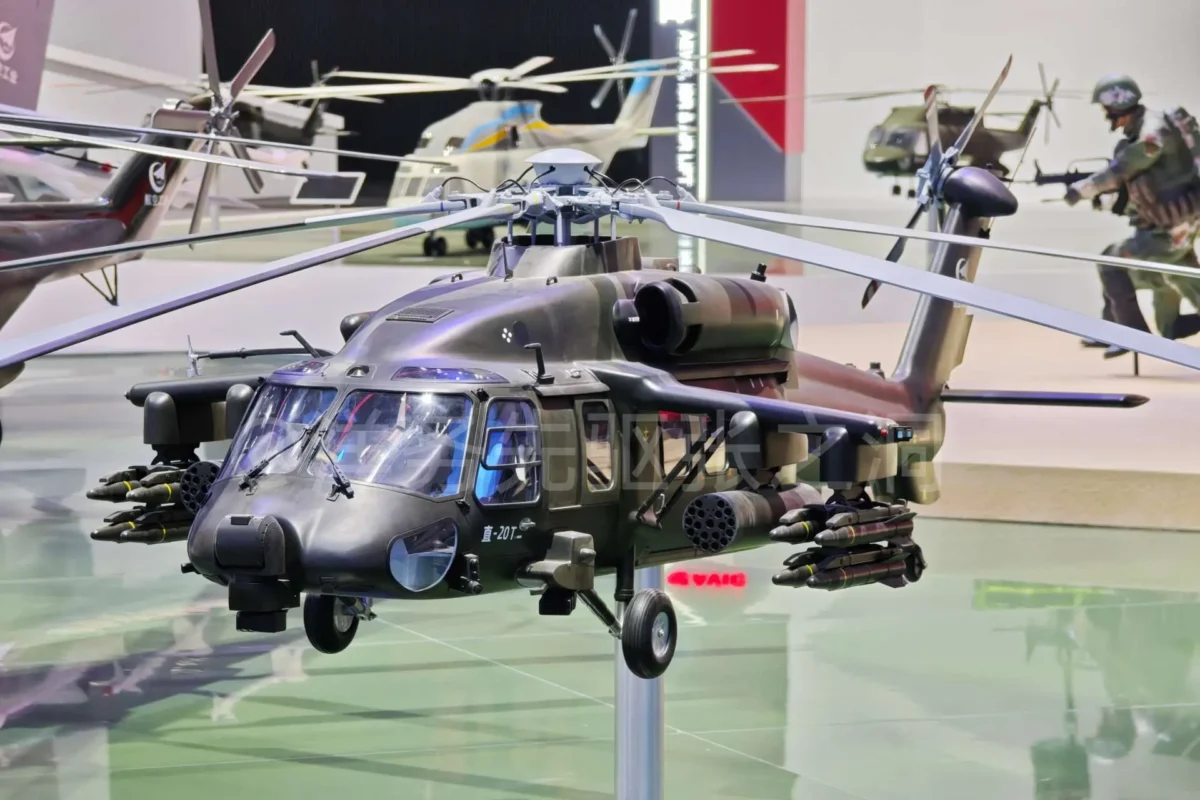
Defense Feeds – The Chinese Z-20T Assault Helicopter is set to make its first public flight display, adding a major highlight to China’s upcoming 7th Helicopter Exposition in Tianjin this October.
The aircraft, which initially captured attention during its September 3 grand parade unveiling, will be one of the key attractions at this prominent aerospace event.
The 7th China Helicopter Exposition, set to run from October 16 to 19 in Tianjin, will bring together military and civilian rotorcraft designs for display and demonstration.
According to organizers, the event will feature more than 50 helicopters, drones and electric vertical takeoff-and-landing (eVTOL) aircraft, making it one of the largest showcases of China’s rotary-wing aviation sector.
Among the scheduled highlights is the Z-20T, an assault-configured development based on the baseline Z-20 utility helicopter.
Its upcoming flight performance marks the first time the variant will be demonstrated in public air displays.
Chinese military sources confirmed that the People’s Liberation Army (PLA) will host live demonstrations, static aircraft presentations, and an indoor equipment exhibition.
The Z-20T previously attracted attention during the grand V-Day parade in Beijing on September 3, where seven Z-20T rotorcraft and three Z-8L heavy transport helicopters flew in tight formation over Tiananmen Square, symbolizing China’s growing push to expand its modern aviation assault capability.
Deriving from the medium-lift Z-20 helicopter platform, the Z-20T represents a specialized variant tailored for offensive operations.
Unlike the original transport-focused model, the Z-20T introduces additional aerodynamic surfaces and dedicated weapons-carrying pylons.
A Chinese military pilot familiar with the aircraft explained that the new version incorporates short stub wings designed to carry a mix of air-to-surface missiles and guided rockets developed domestically.
Another key upgrade lies in its integrated nose-mounted observation and targeting system, giving crews improved situational awareness and precision strike capability.
This sensor suite enables real-time data transmission to weapons systems, allowing the helicopter to engage ground targets with increased accuracy compared to the original transport variant.
Defense analysts note that this dual-role capability—combining troop transport with fire support—positions the Z-20T as an important step in China’s broader effort to create more flexible assault aviation brigades.
The platform’s internal capacity still allows for personnel or equipment transport, which greatly enhances its operational adaptability.
Military experts emphasize that this versatility makes the Z-20T well-suited for today’s shift toward mobile, integrated battlefield operations.
The Z-20 series has evolved rapidly since its introduction, with multiple adaptations serving in diverse roles. The debut of the Z-20T reflects the PLA’s expansion into assault-oriented helicopter missions, while other models focus on maritime support.
At Airshow China 2024 in Zhuhai, the shipborne Z-20J variant was revealed publicly for the first time.
This version has already been described as a critical aviation asset for China’s expanding amphibious forces.
According to Chinese naval experts, the Z-20J can mount anti-ship and land-attack weapons ranging from 70mm rockets to guided anti-armor missiles, as well as side-mounted cannons.
Aside from its combat function, the maritime model also contributes to logistics, transport and search-and-rescue missions aboard amphibious assault ships and aircraft carriers.
Military commentators suggest that the Z-20 family now mirrors the multipurpose framework seen in Western aircraft such as the UH-60 Black Hawk, which inspired the original Z-20’s development.
However, Chinese aerospace engineers have refined the platform specifically for regional requirements, including high-altitude performance needed for operations along China’s mountainous western frontier.
Zhang Junshe, a Beijing-based analyst, remarked that the Z-20J’s versatility demonstrates the PLA’s drive to enhance joint operations.
“The assault variant, shipborne variant and troop transport version together form a scalable helicopter ecosystem for the PLA,” he said. “This improves both amphibious strike capacity and inland mobility.”