Follow Us:
Follow Us:

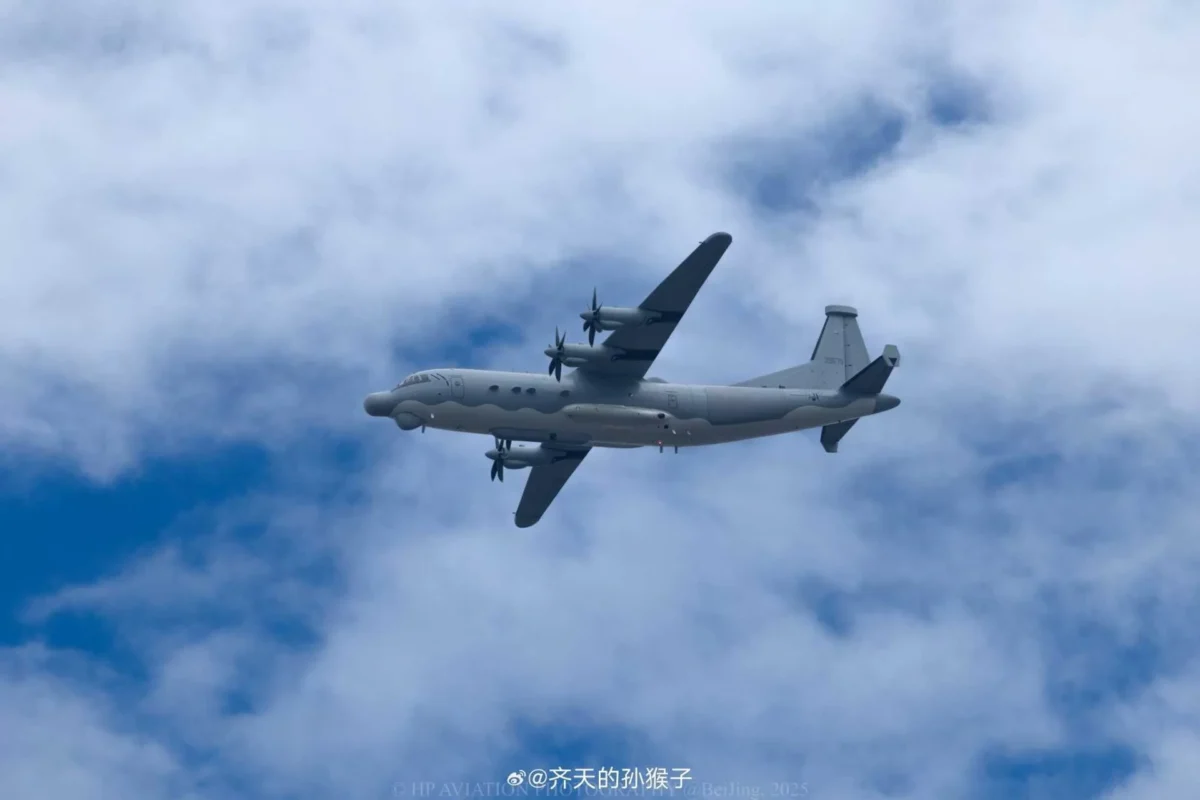
Defense Feeds – China’s September 3, 2025, military parade in Beijing revealed a significant advancement as three Y-9 special ops planes flew together for the first time in a coordinated formation.
The joint flight comprised three Y-9 special operations aircraft, including the Y-9Q maritime patrol and ASW aircraft, the electronic reconnaissance model, and the radar jamming variant.
Alongside these three Y-9 special ops planes, six J-16 multirole fighters carried various weapons tailored to tactical objectives, highlighting a shift toward more practical military training and operational transparency.
Identified as the KQ-200 by the PLAN, the Y-9Q conducts long-range maritime reconnaissance and anti-submarine operations.
Its features include a surface search radar under the nose, an electro-optical turret below the fuselage, and a tail-mounted magnetic anomaly detector for locating submarines.
The plane disperses rotary sonobuoys through launchers in the rear fuselage, allowing it to cover vast ocean areas with acoustic sensors. Additionally, it carries an internal bay to deploy lightweight torpedoes or depth charges.
This platform entered service around 2015 and has since been deployed widely across China’s major naval fleets, supporting near-daily patrols in strategic zones such as the Taiwan Strait and South China Sea.
The Y-9Q regularly conducts low-altitude flights and forward deployments, highlighting its key role in enhancing China’s maritime surveillance and anti-submarine operations.
This outreach reflects Beijing’s growing confidence in asserting dominance over contested sea lanes and monitoring submarine activity.
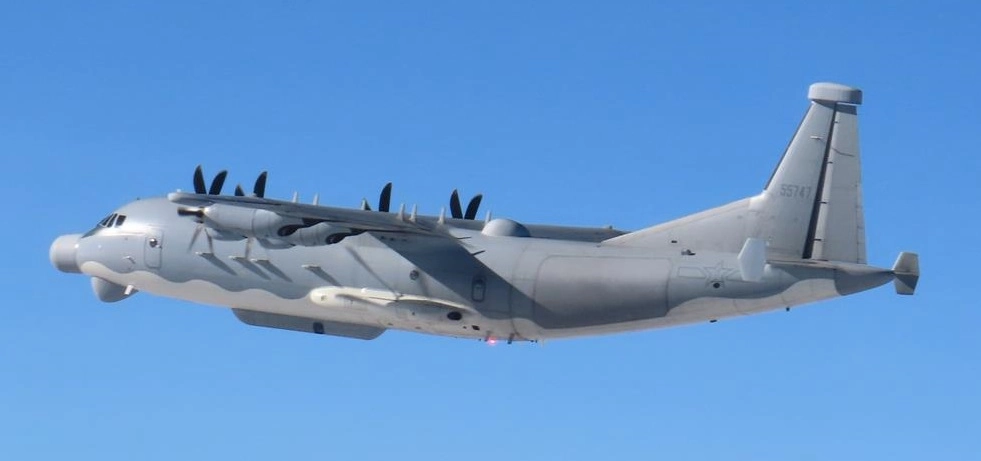
China’s Y-9 electronic reconnaissance aircraft represents a second-generation signals intelligence (SIGINT) and electronic intelligence (ELINT) platform.
Known in open-source circles as the Y-9JB or Y-9JZ, and referred to internally by the “High New 8” program, this variant is outfitted with a bulbous radome in the nose, four rectangular antenna pods along the sides, a satellite communications dome on the top, and an electro-optical turret beneath.
These features enable long-duration missions to gather radar and communication emissions.
Notably, the reconnaissance model in the recent parade is believed to be the GX-12 variant (also called Y-9DZ), a newer generation aircraft integrating synthetic aperture radar beneath its nose, conformal antenna arrays mounted along the rear fuselage, with several additional antennas installed on the tail and fuselage.
This advanced configuration allows the plane to intercept and geolocate enemy radar and communications signals, perform ground surveillance using radar imaging, and conduct electronic warfare operations including jamming and psychological broadcasts.
The aircraft first appeared operationally with low-visibility camouflage around 2022, and by late 2023, Japanese authorities confirmed sightings of this new Y-9 intelligence platform in nearby airspace, highlighting China’s growing presence in the Western Pacific.
The GX-12’s multi-role functionality provides a sophisticated tool for layered intelligence collection and electronic attack, combining reconnaissance and jamming capabilities on one versatile airframe.
The Y-9 radar jamming variant, linked to the “High New 11” program and labeled Y-9G or later Y-9LG, plays a vital role in electronic warfare by disrupting enemy radar and communication systems.
Distinguishing features include large antenna fairings on the fuselage, pronounced radomes under the nose, tail-mounted jamming pods, and various antennas on the vertical stabilizer and fuselage, delivering near-complete electromagnetic coverage.
Intended for long-range standoff roles, the aircraft flies beyond the reach of typical surface-to-air missile systems while emitting signals to interfere with enemy sensors and communications.
It also functions in electronic support measures and emitter geolocation, integrating attack and reconnaissance roles within one platform.
The Y-9G variant has seen regular appearances at national parades since 2019 and has been observed operating persistently near Taiwan and South China Sea strategic areas, highlighting its incorporation into China’s routine military posture.