Follow Us:
Follow Us:


Defense Feeds – China revives J-6 fighter as a supersonic unmanned combat drone, showcasing how legacy aircraft can still play a decisive role in future conflicts.
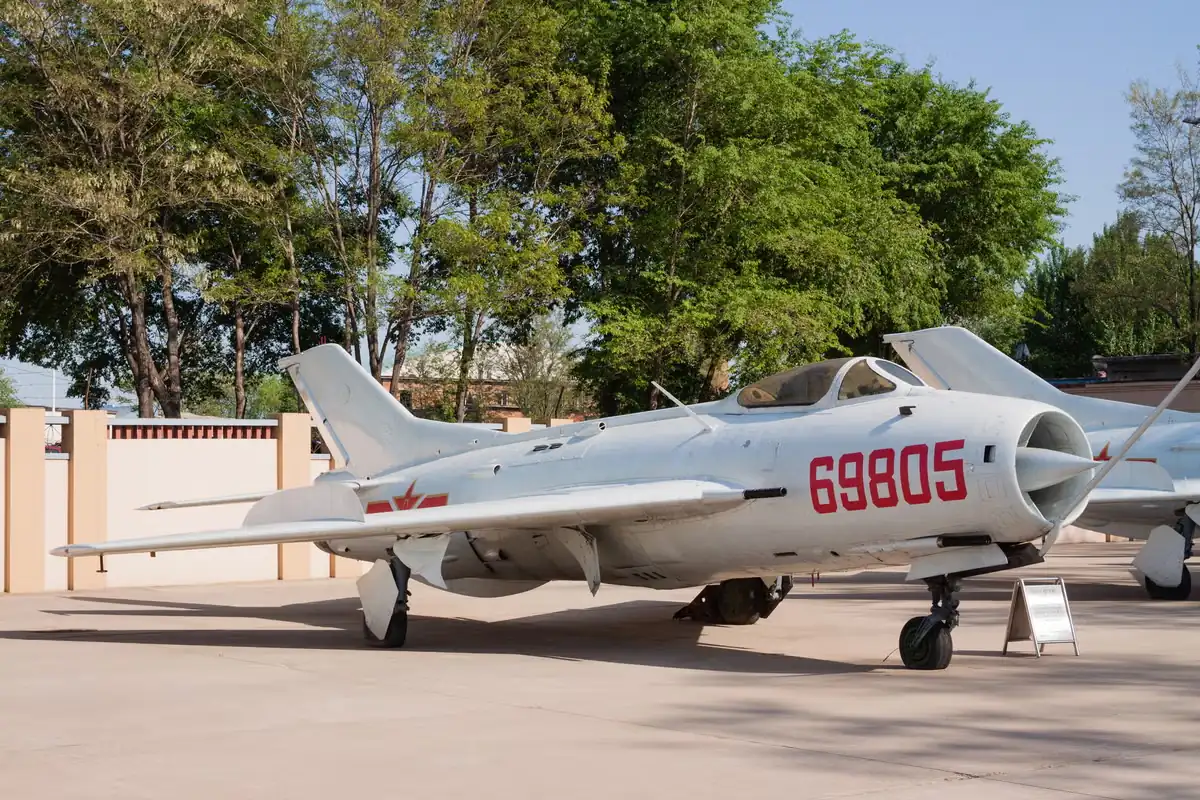
The modified aircraft, now referred to as the J-6W unmanned combat aerial vehicle (UCAV), was publicly displayed for the first time on 16 September 2025 ahead of the Changchun Air Show, which runs from 19 to 23 September.
The J-6 began life in the late 1950s as China’s license-built version of the Soviet MiG-19. Once the backbone of the People’s Liberation Army Air Force (PLAAF), it was gradually pulled from frontline service as more advanced fighters entered the fleet.
Rather than being scrapped, hundreds of J-6 airframes were preserved in storage. Now, China has given this Cold War jet a new life by converting it into an unmanned aircraft optimized for expendable roles in modern warfare.
The newly revealed J-6W prototype highlights extensive modifications from the original manned version.
Engineers have stripped out the ejection seat, cockpit controls and internal cannons to make room for advanced autopilot systems, automatic flight control features, terrain-following navigation, and reinforced pylons for bombs or other stores.
The jet’s overall structure remains largely intact, retaining its supersonic speed profile and aerodynamic design, but its purpose has been redefined.
Reports suggest the PLAAF had already been testing unmanned J-6 conversions as early as the mid-1990s, when some were flown as remotely piloted target drones to simulate enemy jets during training missions.
By 2022, defense analysts estimated that around 600 retired fighters had already been converted, and China may still hold over 1,000 more in mothballed condition. Many of these jets are believed to be stored in hardened shelters at airbases positioned close to Taiwan, allowing quick activation if required.
The J-6W’s relevance lies in its functional versatility rather than sophistication. PLAAF sources describe its value in three primary roles.
First, its use as a full-scale target aircraft provides more realistic training for fighter pilots and surface-to-air missile operators compared to smaller target drones.
The J-6W’s supersonic performance, radar signature and flight endurance more closely replicate those of an actual adversary jet.
Second, the aircraft can be operated as a decoy platform to lure enemy air defenses into revealing their radar locations and missile launch positions.
By deploying waves of expendable J-6Ws, Chinese tacticians could overwhelm or mislead defensive systems while protecting their more advanced strike aircraft and stealth drones like the GJ-11 Sharp Sword.
Finally, its role as an expendable strike vehicle is perhaps the most strategically significant.
With a range of roughly 350 miles and the ability to carry up to 1,000 pounds of bombs or guided munitions, the J-6W can hit high-risk targets without endangering a pilot.
While unlikely to penetrate modern layered air defenses alone, its value when deployed in massed formations lies in exhausting defensive munitions and creating confusion.
This doctrine reflects lessons observed during recent conflicts, where attritable drones saturated defenses before precision strikes landed from more survivable platforms. The concept aligns with strategies seen elsewhere.
The United States long employed QF-4 Phantom and QF-16 Fighting Falcon drones for testing and training.
During the Nagorno-Karabakh conflict, Azerbaijan effectively repurposed old Antonov An-2 biplanes as unmanned decoys to suppress Armenian air defenses.
China’s approach, however, appears on a larger and more deliberate scale, making drones like the J-6W a significant new component in its doctrine for large-scale air warfare.
The timing and public rollout of the J-6W’s exhibition carry significant strategic signals. Analysts believe the aircraft’s basing close to Taiwan underscores its role in future military planning.
In a conflict scenario, waves of J-6W drones could be launched rapidly to saturate Taiwanese or even U.S. and allied air defenses supporting the island.
Their use would not require the intense logistics and industrial output necessary for building large fleets of brand-new drones.
By drawing from a ready stockpile of legacy airframes, the PLAAF can field hundreds of attritable jets at relatively low cost.
This allows Beijing to conduct saturation strikes, drain enemy interceptor missiles, and complicate defensive planning.
Once enemy air defenses are pressured into action, more advanced platforms—such as stealth drones, next-generation fighters or long-range missile systems—could be employed with greater effectiveness.
The unveiling at Changchun also functions as a psychological and political message. It demonstrates that China intends to maximize every asset at its disposal, from cutting-edge stealth aircraft to airframes designed nearly seven decades ago.
In doing so, Beijing presents a vision of air warfare defined not just by advanced technology, but also by the clever reuse of older assets for attritable and expendable missions.
While the J-6W lacks the sophistication of stealth drones or precision strike aircraft, its true military value is tied to numbers and expendability.
In modern high-intensity conflict, where attrition is unavoidable, such systems provide commanders with additional tools to stretch an adversary’s defensive resources thin.
The Changchun preview suggests that future battles in the skies over East Asia may not be decided solely by elite stealth fighters, but by how effectively older jets like the J-6 can be repurposed to wage massed, attritable air campaigns.