Follow Us:
Follow Us:


Defense Feeds – China Debuts JL-1 nuclear-capable air-launched ballistic missile (ALBM) during a major military parade in Beijing, marking its first official confirmation.
The missile appeared alongside submarine-launched ballistic missiles (SLBM) and intercontinental ballistic missiles (ICBM), showcasing for the first time all three legs of China’s nuclear triad together in public.
For military analysts, the introduction of the JL-1 represents a significant milestone in Beijing’s evolving strategic deterrence strategy.
The JL-1, called Jinglei-1 or “sudden thunder” in Mandarin, is distinct from the decommissioned Julang-1 submarine-launched ballistic missile.
Defense observers believe this new missile is the same system previously identified by Western intelligence as the CH-AS-X-13, under development since at least the mid-2010s.
In past years, blurry images of a missile resembling the JL-1 were seen mounted under H-6N strategic bombers, but Chinese officials had not acknowledged the program until now.
The Xian H-6N, Beijing’s modified long-range bomber, is designed to carry heavy payloads externally and boasts in-flight refueling capability.
This gives the aircraft extended reach and makes it suitable to launch long-range strike weapons like the JL-1.
The Pentagon has pointed out that China’s return to an aerial nuclear deterrence posture is closely tied to the H-6N bomber.
Unconfirmed reports indicate the JL-1 may be derived from the DF-21 ballistic missile family, particularly the DF-21D variant optimized for conventional anti-ship strikes.
Similar to the ground-based version, the JL-1 air-launched missile uses a two-stage design equipped with a maneuverable re-entry vehicle (MARV) and a distinct three-fin tail suited for aerial release.
Earlier Pentagon assessments noted that a conventionally armed version could threaten U.S. carrier task groups in the Pacific, raising significant concerns for naval commanders in the region.
Chinese state media claimed during the parade broadcast that the JL-1 can reach targets up to 8,000 kilometers (4,970 miles) away, a range that notably surpasses both the DF-21’s maximum and even the longer-range DF-26.
If accurate, this extension vastly expands the potential strike envelope of China’s bomber fleet, giving it the ability to target U.S. bases in the Pacific and beyond.
Air-launched operations naturally enhance a missile’s reach when compared to ground-launched systems due to the speed and altitude advantage of the launch platform.
Russia’s Kinzhal missile, a modified air-launched version of the Iskander, demonstrates this same principle.
There has also been speculation over an alternative hypersonic boost-glide vehicle (HBGV) variant intended for the H-6N.
Unlike MARVs that stick to a semi-ballistic path, HBGVs travel through the atmosphere at over Mach 5 while executing unpredictable maneuvers.
Such capability would drastically complicate interception and tracking by missile defense systems.
Although officials did not confirm such a variant at the parade, past imagery of wedge-shaped payloads suggests China is exploring this technology.
Importantly, the Pentagon and independent analysts warn that the JL-1, like the DF-21 series, is likely dual-capable—meaning it can be fitted with either nuclear or conventional warheads.
This dual role provides Beijing with flexible nuclear escalation options while also making it an extremely versatile strike asset for regional operations.
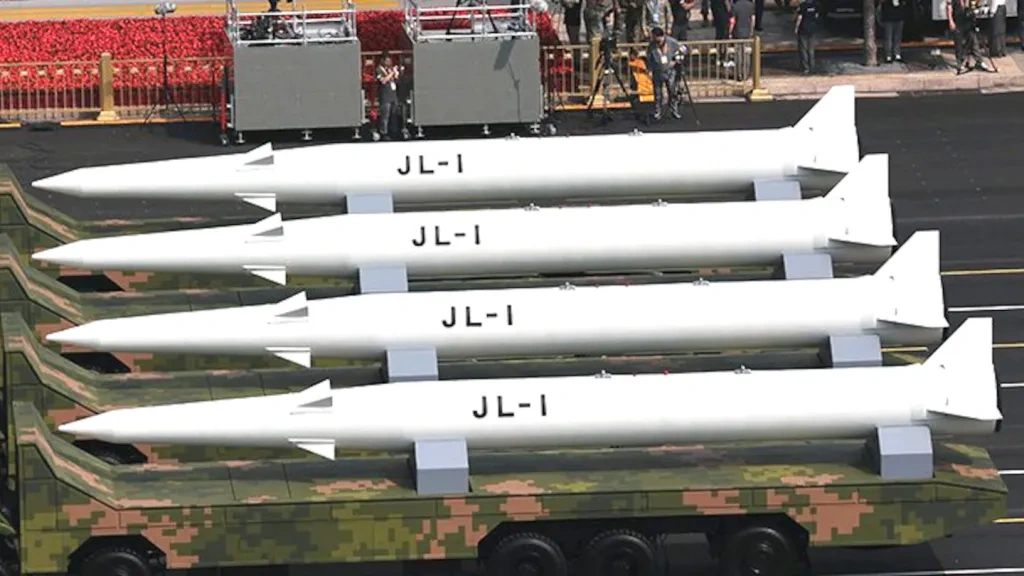
The unveiling of the JL-1 officially marks the emergence of China’s aerial leg of the nuclear triad, joining intercontinental missiles in silos and submarine-launched assets.
Only four countries—the United States, Russia, China, and India—currently field nuclear triads, highlighting the strategic importance of this development.
Washington has long assessed that the People’s Liberation Army (PLA) is pursuing a rapid nuclear build-up.
The U.S. Department of Defense reported in 2024 that China’s stockpile had already exceeded 600 operational nuclear warheads by mid-year, with projections of more than 1,000 in service by 2030.
Beijing is also constructing extensive ICBM silo fields, many of which may serve as part of a deception strategy to complicate enemy targeting.
Official U.S. assessments also point to China evolving toward a launch-on-warning (LOW) posture.
This strategy aims to ensure that retaliatory nuclear strikes can be launched immediately upon detection of incoming missiles, thereby increasing survivability of its arsenal.
Some analysts also argue Beijing is considering countervalue targeting, which includes enemy cities alongside military facilities, further raising the stakes of escalation.
The introduction of the JL-1 marks China’s entry into a new stage of its nuclear deterrence approach.
The aerial delivery option complicates adversary calculations, enhances survivability of its nuclear forces, and gives the PLA the means for precision nuclear or conventional strikes deep into the Indo-Pacific.
For the United States and other regional powers, the JL-1 not only represents technological advancement but also reflects the pace and scale of Beijing’s broader push to diversify and modernize its strategic forces.
This unveiling is not just about a missile—it is a demonstration of China’s intent to establish credible, survivable, and flexible deterrence options in the face of growing great power competition.