Follow Us:
Follow Us:


Defense Feeds – Anduril Unveils Omen VTOL Drone as part of a strategic collaboration with the United Arab Emirates’ EDGE Group.
The US defense technology company announced that the new hybrid-electric aircraft represents the next step in its push toward advanced autonomous air capabilities.
Developed under a joint venture aimed at strengthening autonomous air and defense systems in the Middle East, the Omen drone reflects Anduril’s growing presence in global defense innovation.
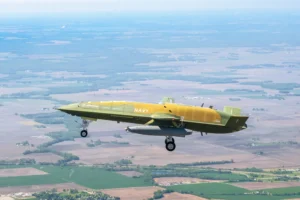
The Omen VTOL marks another milestone following Anduril’s recent achievement with its YFQ-42A “Fury” Collaborative Combat Aircraft test flight under the US Air Force’s CCA program.
With this new platform, Anduril aims to widen its autonomous portfolio across both military and civilian missions designed for greater flexibility, scalability, and operational adaptability.
The Anduril Omen is classified as a Group 3 Unmanned Aerial System (UAS). Standing around three meters tall, it uses a hybrid-electric propulsion system that supports runway-independent operations.
Omen’s tail-sitter configuration allows it to take off and land vertically, transitioning seamlessly to forward flight for long-range missions.
The aircraft’s modular design enables quick assembly and deployment by a two-person crew in the field.
Although Anduril has not disclosed detailed specifications, the company describes Omen as built for long endurance and heavy payloads, suitable for expeditionary operations across varied environments.
Designed as a true hover-to-cruise Autonomous Air Vehicle (AAV), the system blends endurance and intelligence found in larger drones with the portability of smaller units.
Its potential mission sets include maritime surveillance, logistics resupply, border security, and communications relay in both defense and emergency response roles.
The air vehicle can also function as a temporary communication node or mobile cell tower after natural disasters.
Observers note similarities to Shield AI’s combat-proven V-Bat VTOL drone, which has been actively deployed in conflict zones such as Ukraine.
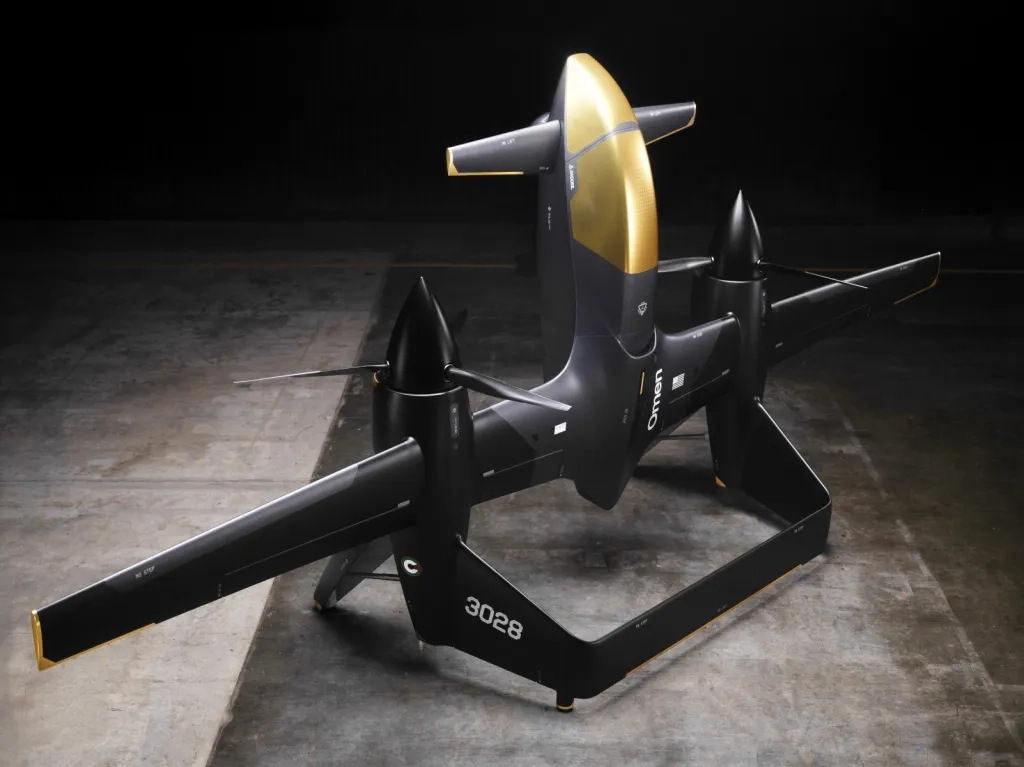
Under the newly signed UAE–US partnership, EDGE Group confirmed an initial purchase of 50 Omen drones, emphasizing the country’s intent to lead in regional autonomous air capabilities.
The UAE will serve as the “center of gravity” for co-production and future manufacturing of Anduril’s advanced systems across the Middle East.
The joint venture seeks to accelerate design and manufacturing cycles for scalable, affordable, and operationally ready autonomous systems.
According to Anduril, the Omen platform is only the first of several systems planned for regional co-development and production.
The company’s Lattice for Mission Autonomy software will serve as the digital core for Omen’s operations, enabling fully autonomous navigation and coordinated mission execution.
To support future programs, Anduril is setting up a 50,000-square-foot permanent facility in the UAE that can expand to handle upcoming development and training operations.
In parallel with its Middle East venture, Anduril is preparing for large-scale drone manufacturing in the United States.
The firm is constructing a massive “Arsenal-1” hyperscale factory in Ohio, described as a game-changer for defense production.
The facility will begin manufacturing operations by mid-2026, producing various uncrewed aircraft and underwater systems at unprecedented scale.
Anduril’s approach aims to reshape defense production into a faster, software-integrated model designed for rapid fielding and mass scalability.
The company has also announced plans to establish similar production lines in Europe, with customized variants of its autonomous drones being proposed for German and NATO forces by 2029.
With the Omen drone’s unveiling and the expansion of international partnerships, Anduril is reinforcing its role as a key driver in the global race toward deployable autonomous warfare systems.
The collaboration with the UAE not only deepens bilateral technological ties but also signals a shifting paradigm where AI-driven aircraft become central to both defense strategy and industrial growth.