Follow Us:
Follow Us:

When people talk about the M240 machine gun, there’s usually this quiet understanding that it’s one of those weapons that just works. It’s not flashy. Instead, it leans into reliability and raw practicality.
For decades, the M240 (and its lighter variant, M240L) has served as a workhorse. And yet, after all this time, the story around it is shifting in subtle but important ways.
Just recently, the U.S. Army awarded a fresh contract for more M240L guns and spare barrels. At the same time, the military has launched a formal program, called Future Medium Machine Gun (FMMG), aimed at finding a successor to the M240 series in the coming years.
That contrast, the continuing production and support on one hand, and plans to replace the system on the other, makes the M240’s story feel kind of transitional. It’s like you’re looking at a trusted veteran nearing the end of a long career. It doesn’t mean the gun is obsolete overnight, but it does mean its role might evolve, or gradually fade, as newer weapon concepts begin to take over.
In this analysis, we’ll walk through not just what made the M240 a go-to medium machine gun, but also what recent developments signal about its future and whether the qualities that made it legendary might survive in what comes next.
If you step back and look at the M240 machine gun as a whole, it’s basically the kind of machine gun that earned its place through years of doing the job without much drama. It’s part of that long line of weapons built around the idea that reliability, even if it isn’t glamorous, usually wins the day.

The short version is that the M240 comes from FN Herstal, the Belgian company that’s been making military firearms for well over a century. Over time, the U.S. shifted a lot of its M240 production to FN’s American arm, FN America, which is headquartered in South Carolina.
The Army has been buying different M240 variants since the late ’70s, and procurement has kind of happened in waves, sometimes slow, sometimes all at once.
Lately, it seems there’s been another small bump in orders, especially for the lighter M240L and new replacement barrels. And while that doesn’t necessarily hint at a huge expansion, it does suggest that the U.S. military still sees value in keeping the gun fully supported.
In short, yes, though the situation is a little more nuanced. The M240 is still widely used across the U.S. Army, Marine Corps, and various allied forces. You’ll still see it mounted on vehicles, carried by infantry machine-gunners, or attached to tripods for defensive positions.
At the same time, there’s been more talk lately about eventually replacing it. The Army’s “Future Medium Machine Gun” effort is meant to explore what comes next, but that’s more of a slow, exploratory process than an overnight swap. So while the M240’s long-term future might be shifting, it’s not like units are rushing to turn them in tomorrow.
Read also: M2 Browning: Inside the Ultimate Heavy Machine Gun
If anything, the M240 feels like one of those systems that’s still doing its job well enough that the military can take its time figuring out what a true successor should look like.
The M240 fires the 7.62×51mm NATO round. This is a cartridge that’s been around for decades and is still the standard “full-power” rifle round for a lot of Western militaries. It sits in that sweet spot where it’s heavy enough to hit hard but still manageable for machine-gun use.
In terms of range, it usually performs really well out to a few hundred meters. Depending on the setup, shooters often say it stays pretty effective somewhere in the 800-meter ballpark for point targets and even farther for area suppression.
Of course, that depends on things like barrel condition, ammo choice, and who’s behind the gun, but those numbers give you a rough feel for what it can do.

The M240 handles a variety of 7.62 NATO ammunition, and each type brings its own flavor to how the gun performs. The most common round is the M80 ball, which you might think of as the everyday, do-everything option. It delivers consistent performance for most situations.
Mixed in with it, you’ll usually find M62 tracer rounds. These are the ones that burn bright in flight, giving the gunner a visual cue about where rounds are landing, which is especially helpful during sustained or nighttime fire.
There are also moments where a bit more precision is needed, and that’s where something like an M118LR comes in. It’s a match-grade round, a little more refined, and often used in situations where accuracy matters more than raw volume.
No matter which combination is being used, the M240 almost always feeds from linked belts, usually arranged in patterns like “four ball and one tracer.” That mix keeps the gun predictable and flexible, letting the gunner adjust quickly while still maintaining a steady flow of fire.
The standard M240B is the one most people picture. It’s the heavier, more traditional setup, and it usually comes in around the low-20-pound range.

Once you start adding things like optics, rails, or a spare barrel, that number can creep up a little, which is part of why machine-gunners often joke that the weapon eventually feels heavier than it looks on paper. It also uses the longer 21.7-inch barrel, which gives it solid range and stability but adds to the bulk.
Then there’s the M240L, the lightweight variant. This one trims several pounds thanks to a titanium receiver and a few other design tweaks. It comes in closer to 20 pounds, sometimes a bit under, which might not sound like a dramatic difference, but in the field, those few pounds can feel like a small gift.
The L model can also use a slightly shorter barrel, which helps shave off weight and makes maneuvering it in tight spaces just a bit easier.
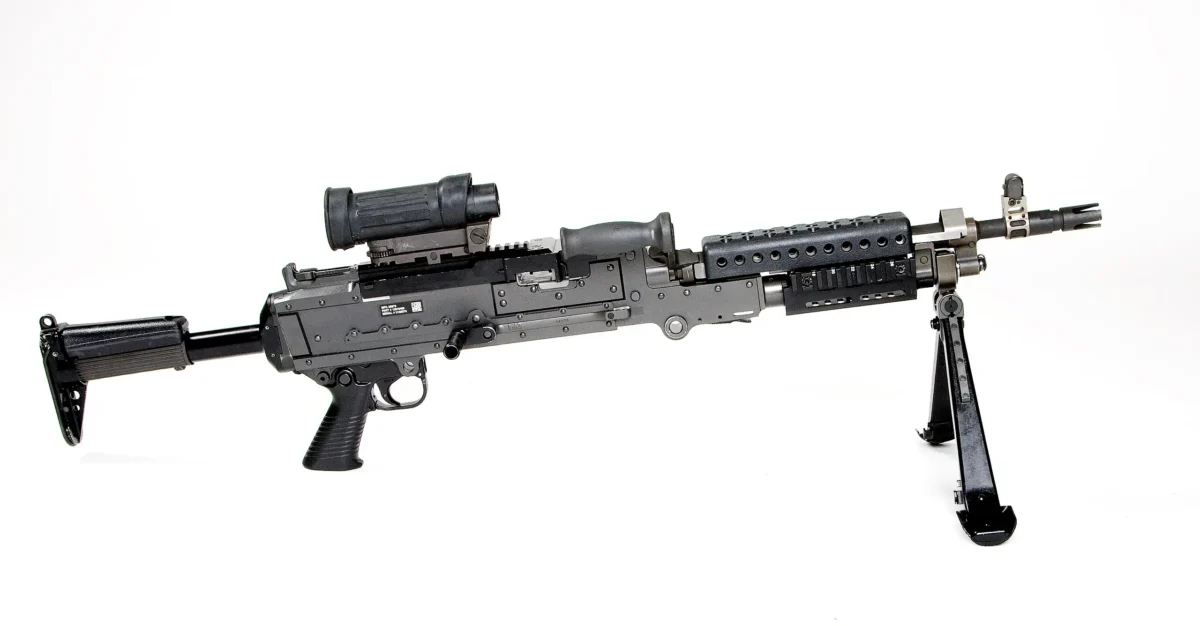
And of course, accessories always change the equation. Throw on a thermal sight, a laser, or even a basic optic, and the gun’s total weight starts creeping back toward the heavier end of the spectrum. So while the lightweight version definitely helps, real-world loadouts tend to level the playing field a bit.
Putting it into perspective, the M240 will probably never be described as “light,” but the effort to reduce its weight shows how seriously the military takes mobility and fatigue. Even a few pounds can matter when you’re carrying the thing for hours or days at a time.
On paper, its cyclic rate of fire falls somewhere around 650 to 950 rounds per minute, depending on the variant and specific configuration. That figure represents a kind of “maximum theoretical speed” or the rate at which the gun could run if the trigger stayed held down without pause.
In real-world use, the pace is usually more measured. Crews operate around what’s called the sustained rate of fire, a slower and more practical rhythm meant to keep the weapon manageable and avoid overheating.
This tends to sit in the lower hundreds of rounds per minute, and it often comes in short, controlled bursts. That approach helps maintain accuracy, manage recoil, and prevent the barrel from turning cherry-red.
Heat management is a big part of the M240’s design philosophy. Barrel-change intervals are built into normal operation, especially during heavier firing.
In high-tempo situations, a barrel might be swapped out every minute or two, while lower-intensity moments allow for longer gaps. The idea is to keep the gun reliable rather than push it to its breaking point.
Trying to put a price tag on the M240 is a bit like trying to guess the value of a used car. It really depends on the version, condition, configuration, and what else comes with it. That said, a commonly referenced figure for a freshly produced M240 (or variants thereof) lands in the ballpark of about US$6,000 to US$12,000 per unit, depending on configuration, quantity bought, and contract terms.
In practice, the military buys in bulk, so per-unit costs might shift depending on how many are ordered, how many spares or spare receivers are included, and whether extras (accessories, spare barrels, mounting kits) come along. For instance, large procurement packages for the M240 series, including multiple variants and spare receivers, have run into tens of millions of dollars.
Another example is the recent orders through FN America for the lighter variant M240L: those aren’t small-scale buys but rather part of broader supply efforts, which means the per-gun cost becomes more of a negotiated, institutional figure rather than a simple “sticker price.
| M240 Variant | Approximate Price per Unit* |
| M240 (original / older ground version, e.g. “M240G”) | ~ US$6,600 |
| Typical M240 / M240B (basic general-purpose MG) | ~ US$6,000 – US$12,000 (common reference range) |
| M240 with accessories/spare barrel / complete kit (some market-list pricing) | ~ US$9,800 – US$11,800 |
| Lightweight variant, M240L | Not officially listed per-unit in public, but contracts for batches exist (see note) |
Any time the M240 gets brought up, the M60 machine gun usually isn’t far behind. The two have this long, intertwined history, almost like one naturally replaced the other as expectations shifted.
And while both guns definitely have their fans, most comparisons tend to lean in a similar direction once reliability and day-to-day use are factored in.
| Feature | M240 | M60 |
| Reliability | Generally very high; known for running cleanly even in rough environments | More finicky; tends to wear faster and is more prone to stoppages |
| Weight | Heavier overall (varies by model, roughly 22–27 lb / 10–12.2 kg) | Slightly lighter (around 23 lb / 10.4 kg for the standard M60) |
| Caliber | 7.62×51mm NATO | 7.62×51mm NATO |
| Rate of Fire | ~650–950 rpm depending on variant | ~500–650 rpm |
| Barrel Changes | Quick, consistent swap system; barrels built for high-heat use | Barrel changes slower and more awkward under stress |
| Modern Support | Still in front-line use with multiple improved variants | Mostly phased out; limited to ceremonial, training, or niche contractor use |
From a reliability standpoint, the M240 generally comes out ahead. It’s built on a sturdier, more forgiving design that doesn’t need as much pampering to keep running.
The M60, on the other hand, has a bit of a reputation, depending on who’s telling the story, for needing extra attention, especially around things like the feed system and the receiver’s long-term durability. Some older-school gunners still love the M60’s feel, but most admit the M240 is the more dependable option when conditions get messy.
On the weight side of things, the conversation gets a little more mixed. The older M60s were usually lighter than a standard M240B, and that mattered when a machine gun team had miles to cover. But with the introduction of the M240L, the lighter, titanium-based variant, the gap narrowed quite a bit.
These days, the weight difference isn’t always big enough to change the overall judgment, although some might still prefer the M60 if sheer carry weight is the priority.

In terms of firepower, both guns fire the same 7.62×51mm NATO round, so the raw punch is basically the same. Where the M240 tends to pull ahead is in consistency. Its higher reliability under sustained fire makes it easier to maintain a steady rhythm, especially in longer engagements.
The M60 can deliver similar performance, but it’s sometimes described as being a little more temperamental, especially as the weapon ages.
If the goal is a clear, practical answer, the M240 is generally considered the better machine gun overall. It’s sturdier, more reliable, and better suited for long-term, high-volume use. That’s a big part of why the U.S. military phased out the M60 in favor of the M240 in the first place.
That said, there’s room for nuance. The M60 still has a smoother recoil impulse that some gunners genuinely like, and its lighter weight (at least in its classic form) made it easier to carry on long patrols. In certain niche roles or in private-sector use, those traits still matter.
But if the question is focused on modern combat expectations, like durability, reliability, and consistency under stress, the M240 is usually the one that checks more boxes. It might not be flashy, but it gets the job done with fewer surprises, and that tends to win the argument more often than not.
The talk about replacing the M240 usually sounds more dramatic than what’s actually happening. Nothing is swooping in to retire it outright; it’s more of a slow, experimental transition.
The big contender is the NGSW-AR program, especially the SIG MG 338. It’s built around the newer 6.8mm round and aims to deliver more range and stopping power while staying surprisingly light. On paper, it offers a noticeable performance jump, but it still has to prove it can hold up under real-world abuse the way the M240 has for decades.
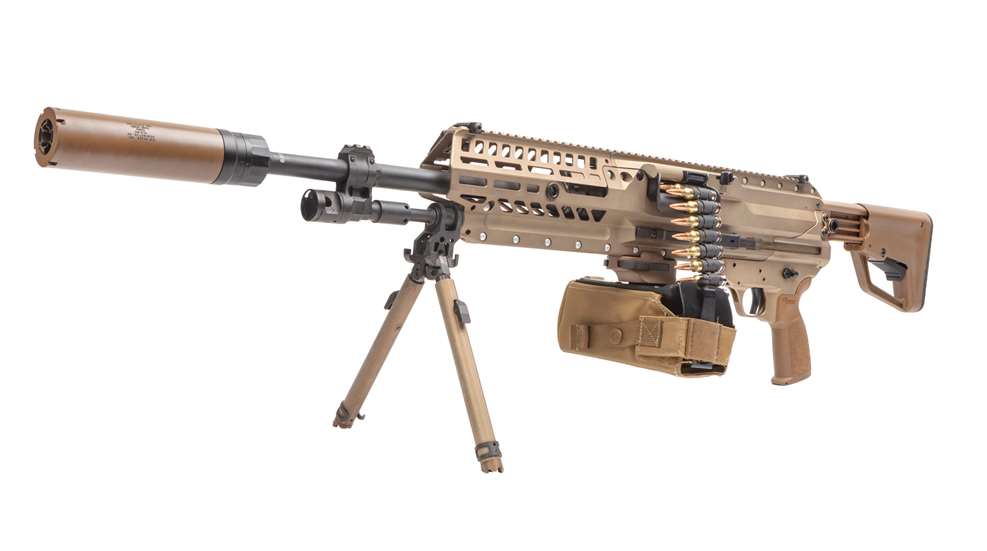
At the same time, the M240 line isn’t standing still. Lightweight titanium variants are already trimming weight without changing how the gun handles, which makes them an easy upgrade for units that want something familiar but less punishing to carry.
So, if a “replacement” happens, it’ll probably be gradual, elite units try the new guns first, data rolls in, and then leadership decides whether to expand. For now, the M240 isn’t being pushed out; it’s just being nudged toward a future where it might share the role rather than surrender it outright.