Follow Us:
Follow Us:

The M2 Browning is one of those weapons that seems to exist in every era, every theater, and on just about every vehicle the U.S. military has fielded for the past century.
The funny part is that the M2 wasn’t designed with today’s threats in mind. It’s a heavy machine gun from the 1930s, yet it keeps showing up in modern conflicts because it fills a niche that newer weapons haven’t quite replaced. It hits hard, reaches far, and seems to keep running even when conditions get ugly.
At the same time, there’s an ongoing debate about how long a century-old design can or should stay in service. Some people see it as a proven workhorse; others wonder if it’s time for something lighter, smarter, or more efficient.
So if you’re curious why a machine gun (maybe) older than your grandparents is still bolted onto American vehicles and aircraft and whether there’s anything on the horizon that could truly take its place, let’s dig into it!
At its core, the M2 Browning is a big, rugged, .50-caliber machine gun that’s been serving the U.S. military since the 1930s.
If you’ve ever seen a massive gun mounted on a Humvee, a helicopter door, or the top of a tank turret, there’s a good chance it was an M2. It fires the .50 BMG (12.7×99mm) round, a cartridge that’s almost comically large when you see it in person and it’s built for jobs where smaller rifles or machine guns just don’t cut it.
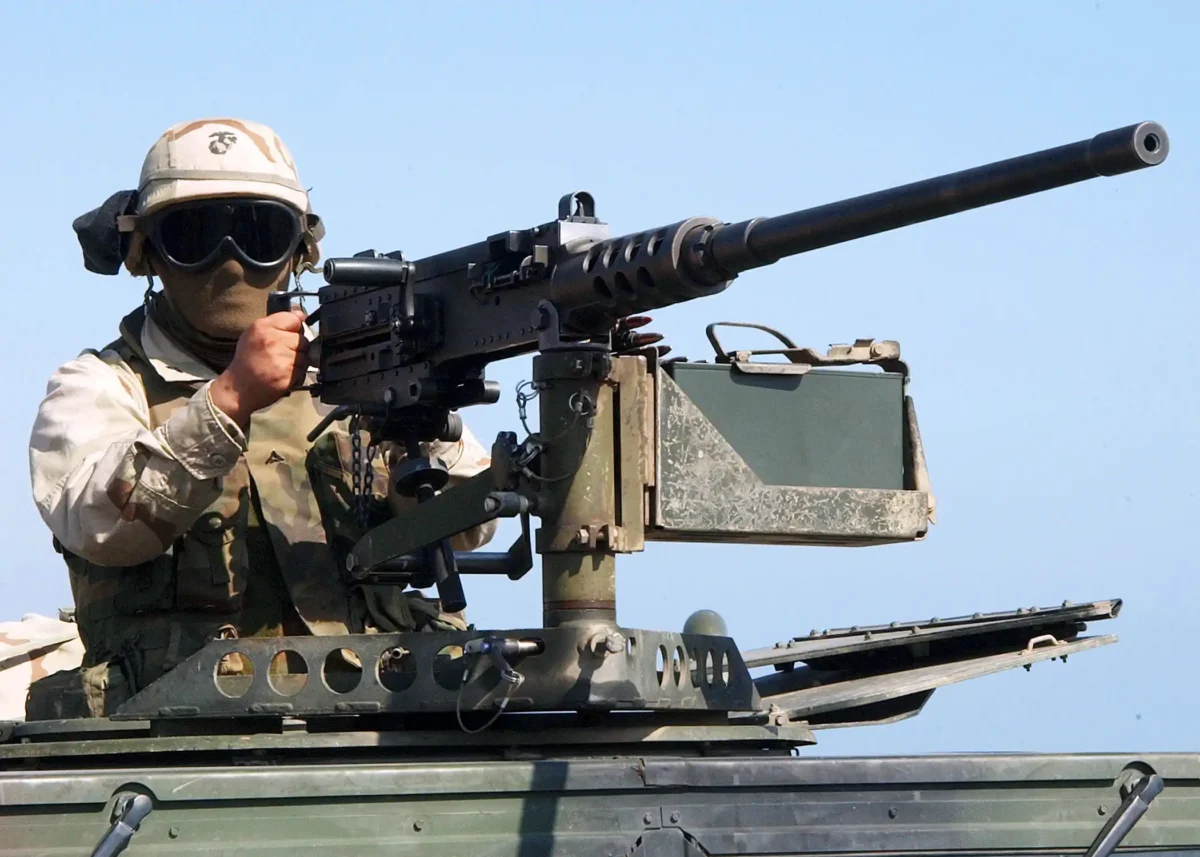
I’d say the simplest way to describe the M2 is that it’s a “problem solver” for tough situations: punching through vehicles, suppressing long-distance targets, or giving a convoy something with real authority when trouble pops up.
The “heavy machine gun” label isn’t just about how much the gun itself weighs, though the M2 is not lightweight. It’s really about the caliber and the role.
The .50 BMG round delivers serious energy, way beyond what medium machine guns like the 7.62mm M240 can provide. That extra power lets the M2 engage vehicles, structures, and distant targets that smaller weapons might struggle with.
Read also: M240 Machine Gun: Key Features That Make It So Powerful
There’s also the physical side of things: the M2 typically needs a solid mount; tripod, turret, vehicle, whatever, because the recoil is intense and the gun itself can weigh 80–90 lbs (36–41 kg) depending on the configuration.
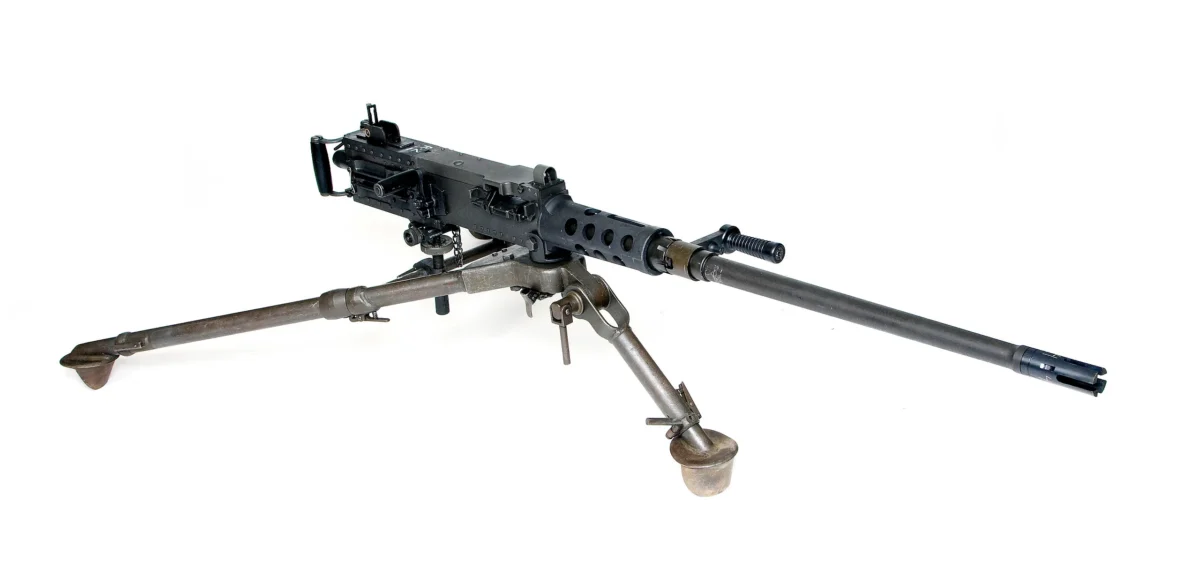
If anything, the “heavy machine gun” title is a reminder that the M2 sits in its own category. It bridges the gap between regular machine guns and dedicated anti-materiel weapons.
The story of the M2 goes all the way back to John Browning, who was basically the rockstar of early 20th-century firearms design.
Toward the end of World War I, the U.S. realized its existing machine guns didn’t have enough punch to deal with armored vehicles and aircraft. Browning was asked to scale up his proven designs into something bigger.
That eventually led to the .50 calibre concept. The early versions were a bit rough, and the ammo itself needed rethinking before it reached the performance the Army wanted.
But once the .50 BMG cartridge came together, the M2 took shape as a weapon designed for range, reliability, and raw stopping power. Even back then, it seemed like Browning had built something with more staying power than anyone expected.
By the time World War II kicked off, the M2 had already become a workhorse.
You could find it on bombers, tanks, ships, jeeps, or pretty much anywhere a big gun could be mounted. It filled a ton of roles: anti-aircraft, ground support, vehicle defense, even anti-materiel work. And because it was simple, rugged, and powerful, soldiers trusted it.
Read also: M60 Machine Gun: Why It Was Iconic And Controversial
What’s interesting is how little the core design has actually changed. Over the decades, there have been tweaks; better barrels, improved mounts, the M2HB “heavy barrel” version, and more recently the M2A1 quick-change barrel upgrade. But the heart of the gun? That’s basically the same machine Browning sketched out a century ago.

The M2 has shown up in Korea, Vietnam, Desert Storm, Iraq, Afghanistan, pretty much every conflict involving U.S. forces. It’s also been adopted around the world by dozens of countries. When a weapon sticks around that long and across that many regions, it probably says something about how well it does its job.
The M2’s history reads like a long-running reminder that sometimes you don’t need a futuristic system to stay relevant, you just need a design that works, decade after decade.
The M2 fires the heavy-hitting .50 BMG, and honestly, this cartridge is a whole character by itself. It was originally designed to punch through WWI-era armor, and it still holds up today.
You could say it’s a kind of “do-everything” round, big enough to knock out engine blocks, concrete barriers, lightly armored vehicles, and, in some cases, even disable aircraft.
I’d probably say the .50 BMG sits in an interesting middle ground: it’s not quite artillery, but it’s way past what most rifles can deliver.
Depending on the ammo type, it may penetrate over an inch of steel at closer ranges, and it carries that energy surprisingly far downrange. That’s one reason militaries keep coming back to it; it just solves a lot of problems.

The gun itself weighs around 84 lb (38 kg), and once you add the tripod or vehicle mount, you’re easily pushing 128 lb (58 kg) or more.
So it’s definitely not something you casually sling over your shoulder. At about 65 inches (165 cm) long, plus a 45-inch (114 cm) barrel, it has that “industrial” look that immediately tells you it’s built for serious, sustained firepower. If someone had never seen one before, they’d probably assume it belonged on a ship or an armored truck.
On paper, the M2 runs at about 450–600 rounds per minute. But in the real world, crews don’t just hold down the trigger and let it rip.
The gun gets hot fast; it’s a .50-calibre machine gun, after all, so gunners tend to fire in controlled bursts to manage heat and keep the barrel from warping.
Over the years, improvements like the M2A1 quick-change barrel have helped with heat concerns. Still, the core idea hasn’t changed: pace your shots, keep the barrel happy, and the gun will take care of you.
The numbers here are pretty eye-opening:
In practice, crews tend to work within the range where they can ID and track a target effectively, but knowing the M2 can reach out far adds a layer of psychological “presence.” You don’t ignore a .50 cal in the area.
| Feature | Specification (Approx.) |
| Calibre | .50 BMG (12.7×99mm NATO) |
| Weight | ~84 lb (38 kg) gun only; ~128 lb (58 kg) with tripod |
| Overall Length | ~65 in (165 cm) |
| Barrel Length | ~45 in (114 cm) |
| Rate of Fire | ~450–600 rounds per minute (cyclic) |
| Effective Range | ~1,800 yd (1,646 m) against area targets |
| Max Range | ~4.2 miles (6.8 km) |
Honestly, it’s kind of impressive how often the answer seems to be “yes, pretty much.”
The M2 has a bit of a reputation, in a good way, for being almost stubbornly tough. It was designed in a time when things had to survive mud, sand, freezing temperatures, and whatever else the battlefield threw at them. And the gun still basically shrugs all that off.
Part of that durability comes from how simple the core mechanism is. There’s no delicate system hiding inside it. If a soldier understands the basics, keep it lubed, keep the feed path clean, watch the barrel heat, the gun tends to stay happy.
Field maintenance is something crews get used to quickly: Wipe out carbon, check the feed tray and bolt for debris, make sure everything moves smoothly, swap barrels before they start glowing.
Nothing on the M2 feels fragile or over-engineered. It’s more like machinery from an era when things were built with thick steel and expected to last decades… which, in this case, is exactly what happened.
Even today, many militaries trust the M2 because it’s reliable in the boring, predictable way that makes logisticians sigh with relief. As long as you treat it with a bit of respect and maybe don’t drop it off an armored truck, it has a way of powering through almost anything.
Short answer? Yes, very much so.
Even though the M2 has been around for roughly a century, it’s still everywhere. And I’m not exaggerating when I say “everywhere.” It might sound almost unbelievable, but the more you look into modern militaries, the more you see the M2 quietly sitting on trucks, turrets, and ships like it’s the most natural thing in the world.
The U.S. military, for example, still fields the M2A1, which is the updated version with a quick-change barrel and slightly modernized internals. It’s on Humvees, JLTVs, Strykers, MRAPs, Black Hawks, CH-47 Chinooks, and even sitting up top on Navy vessels. If something has wheels, tracks, rotors, or a deck, there’s a decent chance an M2 is bolted to it.
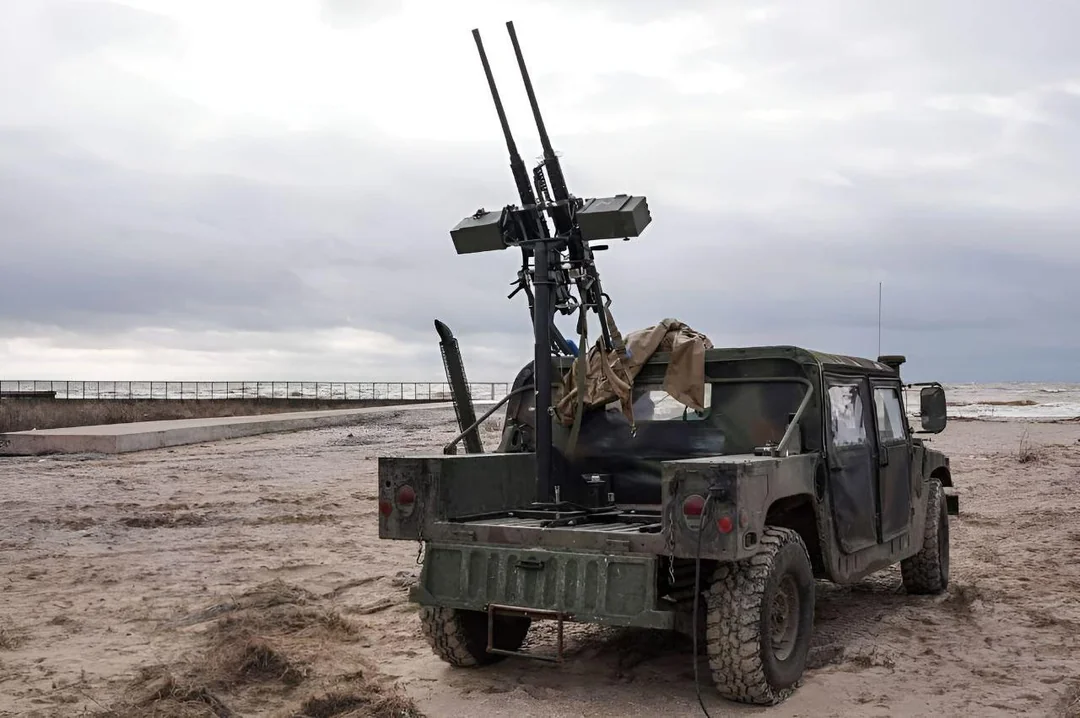
And it’s not just the U.S. A lot of NATO and allied nations still use their own versions or license-built variants, countries like: The UK (mounted on armored vehicles and patrol boats), Canada (C15 HMG), South Korea, Israel, Poland, Australia, and Indonesia (often mounted on Pindad vehicles and naval platforms).
There’s a kind of quiet irony here: militaries have poured billions into developing new weapons, but the old .50 BMG “Ma Deuce” keeps sticking around. And I’d guess part of the reason is that nothing has quite replaced the unique mix of range, punch, and reliability it brings.
Modern systems might outperform it in specific ways, but the M2 hits this sweet spot of “good enough at everything” that’s hard to beat.
Over the years, a few programs have tried to push the M2 aside, but none have really managed to take its spot. The most notable attempt was the XM806, a lighter .50-cal meant to cut recoil and ease maintenance.
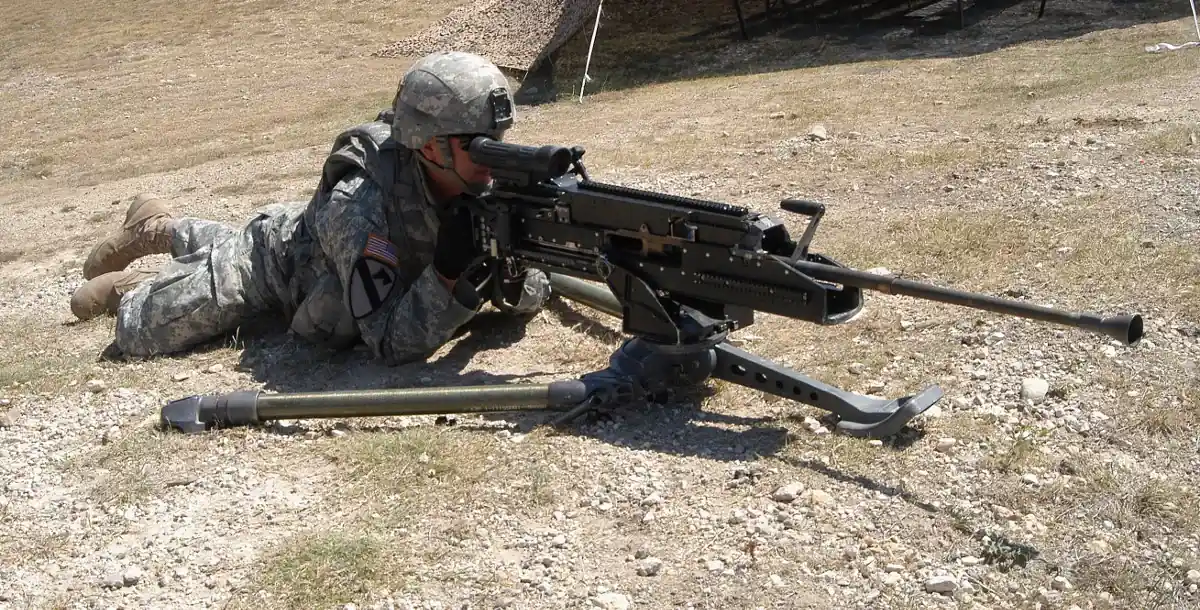
On paper it sounded promising, but in practice it didn’t offer enough improvement to justify replacing a weapon that already worked reliably everywhere. The program was eventually cancelled.
There were also experiments with automatic grenade launchers like the Mk 19 or more modern systems that could, in theory, replace heavy machine guns in some roles. But they’re more specialized, more complex, and they don’t give you the same long-range, high-precision suppression that a .50 BMG gun can.
The core issue seems pretty simple: the M2 hits a unique balance of lethality, durability, and flexibility that newer designs haven’t clearly outperformed. There’s also another practical reason the M2 keeps surviving every replacement attempt: it works, and everyone knows it works.
The cost of keeping it in service is low, because the infrastructure is already there, parts are standardized, training is deeply familiar, and maintenance is second nature to generations of gunners.
So even though militaries keep exploring options, the M2 stays bolted to the turret because it still does its job and does it well.