Follow Us:
Follow Us:

In an era defined by hypersonic missiles, anti-satellite weapons, and long-range ballistic threats, nations are racing to control the skies above and the space just beyond.
Among the fiercest competitors is China, whose answer to these challenges comes in the form of the HQ-19 air defense system, a highly classified, technologically advanced platform engineered to intercept threats thousands of kilometers away and at the edge of space.
More than just a missile, the HQ-19 air defense system represents a key component of Beijing’s long-term defense architecture, pushing the boundaries of what’s possible in missile interception and space warfare.
The HQ-19 SAM, often compared to the U.S. THAAD and SM-3 interceptors, is designed to detect and destroy medium- to intermediate-range ballistic missiles, as well as low Earth orbit (LEO) satellites.
Referred to by its NATO code CH-AB-2, the HQ-19 missile system forms part of China’s layered defense strategy alongside systems like the HQ-9 and HQ-26. While many of its specifications remain cloaked in secrecy, recent military parades, defense expos, and strategic leaks have provided enough data points for defense analysts to assess its capabilities and its implications.
As global tensions rise and nations like Pakistan reportedly consider HQ-19 exports, understanding this platform is no longer optional.
Whether you’re interested in the HQ-19 missile range, HQ-19 speed, or its integration into China’s broader anti-access strategy, this blog offers a deep, clear, and accessible dive into one of the world’s most powerful and secretive surface-to-air missile systems.
Let’s explore how this technology is reshaping the modern battlefield and why it matters more now than ever before.
The HQ-19 air defense system didn’t emerge overnight. Its roots trace back to China’s ambitious “863 Program,” a state-sponsored high-tech development initiative launched in 1986 to reduce reliance on foreign technology and propel China into the ranks of the world’s most advanced military powers.
Initially focused on strategic technologies like space, energy, and information systems, the program later expanded to include missile defense as China recognized the growing importance of shielding its airspace from modern ballistic threats.
Development of the HQ-19 missile reportedly began in the late 1990s or early 2000s, following lessons learned from observing Western conflicts, particularly the performance of the U.S. Patriot and THAAD systems in the Gulf War and beyond.
Early testing phases were shrouded in secrecy, but signs of progress appeared around 2010 when Chinese media hinted at successful high-altitude missile interception tests.
By 2018, it was clear that the Chinese air defense system had matured significantly, with the HQ-19 SAM believed to be entering limited operational service with the People’s Liberation Army Rocket Force (PLARF).
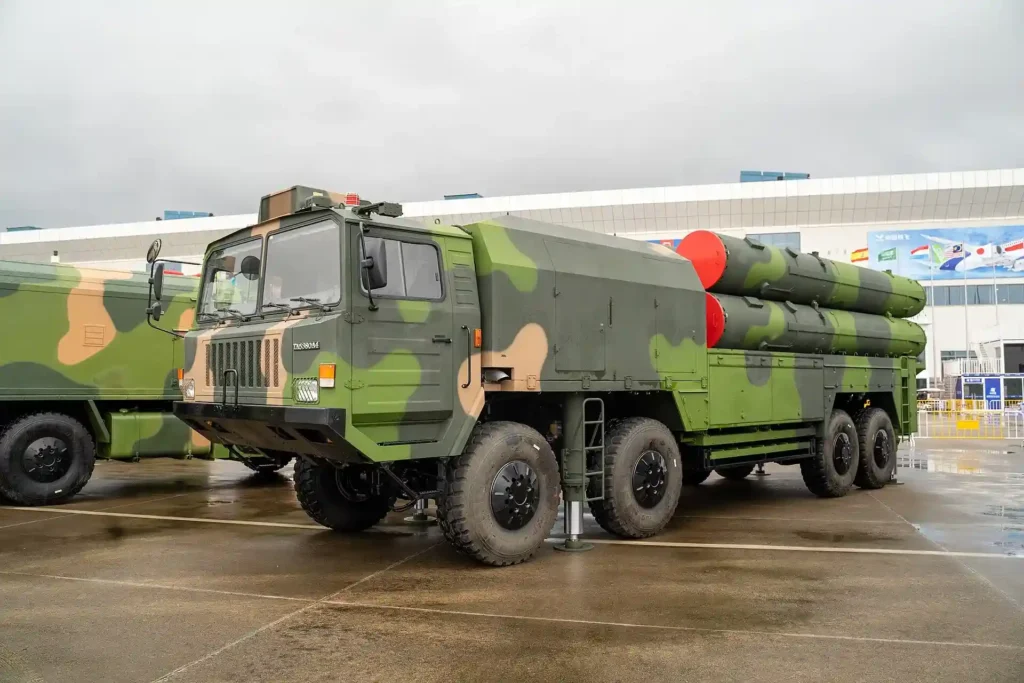
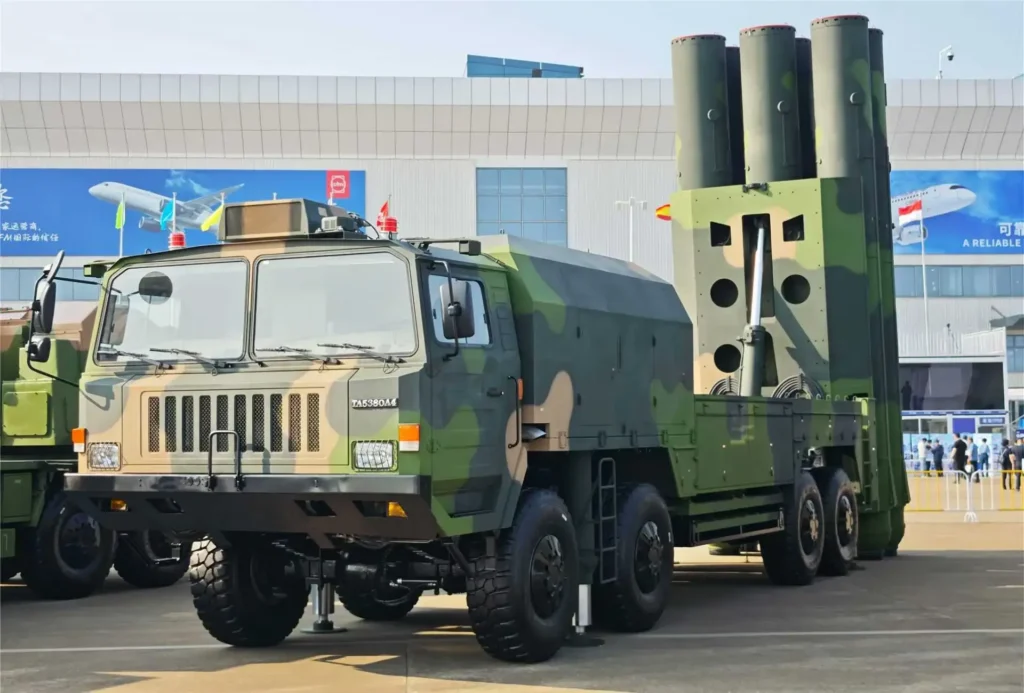
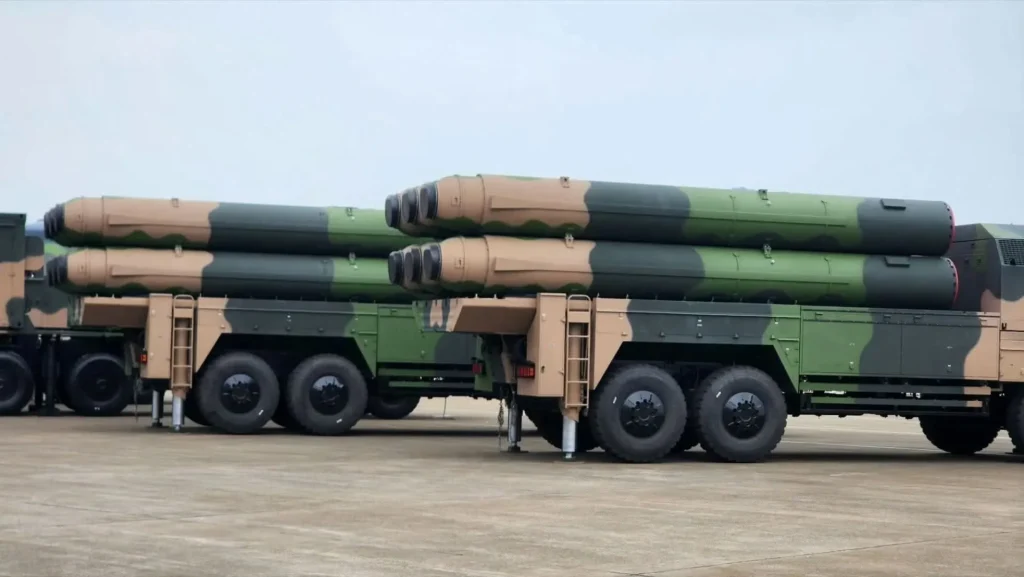
In 2024, the system made a rare public debut at the Zhuhai Airshow, offering defense observers a glimpse of its formidable design. Mounted on an 8×8 wheeled transporter-erector-launcher (TEL) and equipped with vertical cold-launch tubes, the HQ-19 surface-to-air missile signaled not only its technical readiness but also China’s intention to showcase and possibly market the system internationally.
At the core of the HQ-19 air defense system is a complex integration of cutting-edge missile design, high-resolution tracking radar, and real-time command-and-control capabilities, all engineered to intercept high-speed targets at altitudes and distances that rival the Earth’s atmosphere.
This system isn’t just another surface-to-air missile; it’s built specifically for exo-atmospheric intercepts, targeting medium- to intermediate-range ballistic missiles and even low-orbit satellites. In essence, the HQ-19 SAM operates at the strategic intersection of air and space warfare.
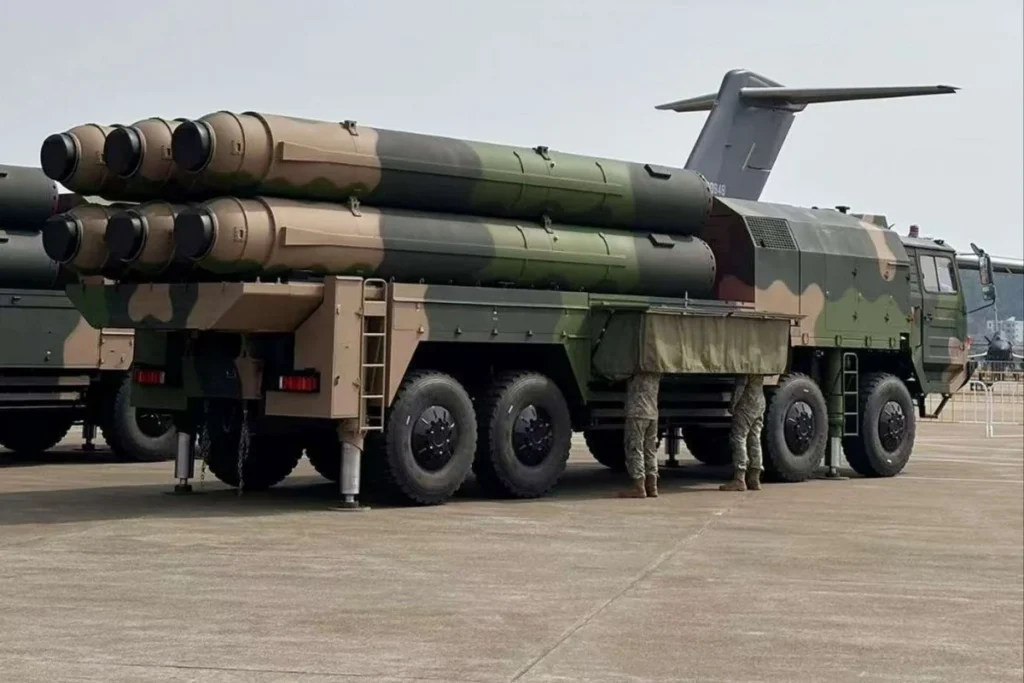
The missile itself is a two-stage, solid-fueled interceptor that features an advanced dual-pulse motor, designed to maneuver at hypersonic speeds in the vacuum of space. Constructed with a carbon fiber body to reduce weight and increase heat tolerance, the HQ-19 air defense system is capable of enduring forces exceeding 60 G during final-stage maneuvers.
Equipped with a kinetic kill vehicle, the system uses a “hit-to-kill” mechanism that obliterates its target through sheer impact rather than an explosive warhead, much like the U.S. THAAD and SM-3. For guidance, it combines active radar homing with a side-mounted infrared (IR) seeker, allowing it to track and engage high-speed targets with extreme precision.
Its performance envelope is no less impressive. With an estimated engagement range of up to 3,000 km and an intercept altitude reaching around 200 km, the HQ-19 surface-to-air missile pushes far beyond traditional air defense parameters.
The HQ-19 speed has been reported to exceed Mach 14, enabling it to close in on and destroy targets moving at velocities up to 10,000 meters per second. Supporting this is the Type 610A active electronically scanned array (AESA) radar, which can reportedly detect targets at distances of up to 4,000 km.
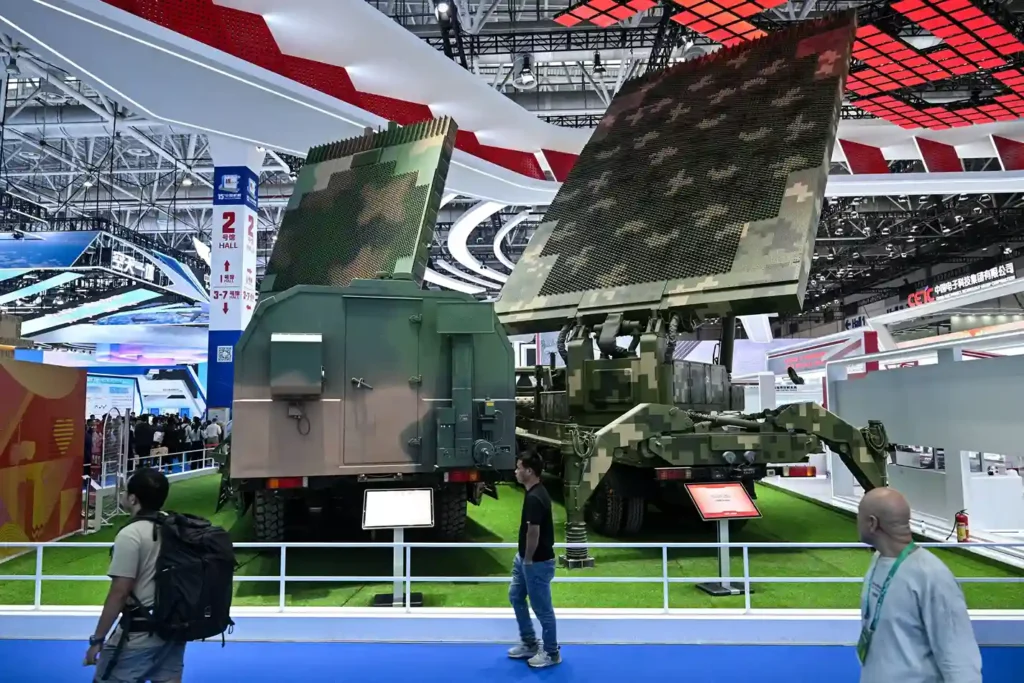
This radar system is linked to a broader command-and-control infrastructure that ensures real-time data sharing across multiple systems—critical in countering fast-moving ballistic missiles or potential hypersonic glide vehicles.
Mounted on a high-mobility TAS5380 8×8 TEL platform, the launcher is capable of rapid deployment and repositioning, making it difficult to target in a preemptive strike.
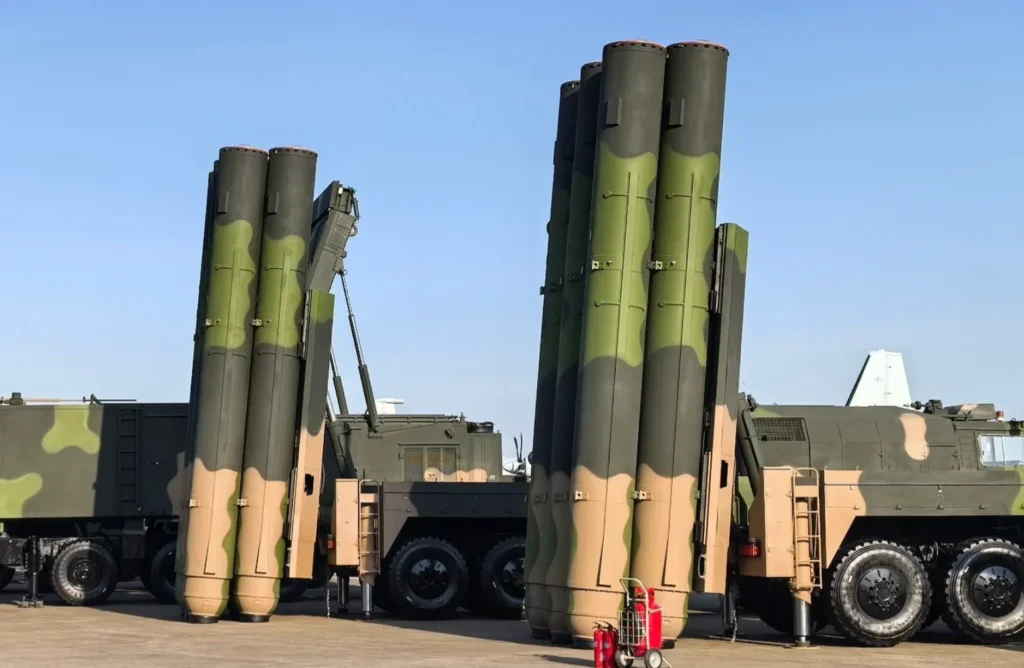
The TEL hosts six cold-launch vertical tubes, allowing the missile to be ejected upward using compressed gas before ignition, a safety feature that reduces wear on the launcher and minimizes launch signature.
The entire system is road-mobile, giving it the strategic flexibility to operate across varied terrain or relocate in response to satellite surveillance. These capabilities position the China HQ-19 not only as a national shield but also as a technological statement—China’s definitive entry into the elite club of nations with viable midcourse missile interception capability.
The HQ-19 air defense system plays a pivotal role in China’s broader strategy for layered missile defense and space denial.
Designed to complement existing systems like the HQ-9 (which handles lower-altitude and shorter-range aerial threats) and the still-developing HQ-26 (targeting intercontinental ballistic missiles and potentially hypersonic threats), the HQ-19 missile fills a crucial mid-course interception role. Its operational focus is on neutralizing medium- and intermediate-range ballistic missiles during their exo-atmospheric phase, when they are most vulnerable to interception.
Beyond missile defense, the HQ-19 SAM is also designed to perform anti-satellite (ASAT) functions, a capability that elevates its strategic value far beyond traditional surface-to-air missiles. With the increasing militarization of space and the growing reliance on low-Earth orbit (LEO) satellites for communication, navigation, and intelligence, the ability to disable space assets could serve as a potent deterrent.
The dual-use nature of the HQ-19 surface-to-air missile, capable of intercepting both terrestrial and space-based threats, aligns perfectly with China’s focus on asymmetric warfare—leveraging technology to offset conventional military disadvantages.
This system is not just a defensive tool; it’s a strategic signal. Its deployment demonstrates Beijing’s resolve to protect key installations, command centers, and population hubs from aerial and space-borne threats.
Moreover, as the U.S. and its allies continue to deploy systems like THAAD in Asia, the HQ-19 is positioned as China’s technological and geopolitical counterbalance. It’s a form of deterrence rooted not just in capability but in visibility, an overt reminder that China possesses the means to detect, track, and neutralize some of the most advanced missile threats in existence.
The HQ-19 air defense system is often compared to the U.S. THAAD and SM-3 systems, both of which are designed to intercept ballistic missiles in their midcourse phase. Like THAAD, the HQ-19 air defense system uses kinetic hit-to-kill technology, but China’s system appears to focus more heavily on longer-range, exo-atmospheric interceptions.
With a reported HQ-19 range of up to 3,000 km, it arguably exceeds THAAD’s coverage, which typically maxes out around 200 km. While these figures are difficult to independently confirm, they suggest the Chinese air defense system is optimized not just for missile interception, but potentially for anti-satellite roles as well.
When compared with the U.S. Navy’s SM-3, the HQ-19 SAM aligns more closely in both design and purpose. The SM-3 has demonstrated proven ASAT capability, having destroyed a satellite in orbit in 2008. Although sea-based, the SM-3 and HQ-19 share a strategic goal: neutralizing high-speed threats above the atmosphere.
However, the HQ-19 surface-to-air missile is deployed from mobile land-based launchers, integrating into China’s broader, terrestrial missile defense network rather than relying on naval assets. This difference reflects a fundamental divergence in deployment strategy between the U.S. and China.
As for affordability, the HQ-19 cost remains undisclosed, but defense experts speculate it is cheaper to produce than its U.S. counterparts. Lower production costs, along with China’s growing defense export infrastructure, may open the door for HQ-19 exports to countries seeking high-end missile defense capabilities without Western price tags.
This possibility positions the HQ19 missile not just as a strategic asset for China, but also as a potential player in global arms diplomacy, particularly in regions looking to counterbalance Western or regional missile threats.
Although the HQ-19 air defense system was originally developed for domestic deployment, there are increasing indications that China is positioning it for the global arms market.
Reports from defense expos and intelligence briefings suggest Beijing is actively considering HQ-19 export options, particularly to nations aligned with its Belt and Road Initiative or seeking alternatives to Western missile defense systems.
Countries like Pakistan, a long-standing strategic partner, have shown interest in acquiring high-altitude interceptors, and the HQ-19 air defense system could fill that demand at a lower cost and with fewer political strings attached than Western equivalents.
The geopolitical implications of exporting the Chinese air defense system are significant. For one, it would allow China to extend its military influence into volatile regions such as South Asia and the Middle East, where missile threats from neighboring adversaries are a constant concern.
Equipping nations like Pakistan or Iran with the HQ-19 air defense system would not only shift regional balances but also challenge the dominance of U.S.-made systems like Patriot, THAAD, and Iron Dome. Moreover, it would deepen military dependencies on Beijing, further entrenching its role as a counterweight to Western defense alliances such as NATO.
Exporting the HQ-19 surface-to-air missile also reinforces China’s broader geopolitical messaging: that it can match or exceed Western technology in the most advanced areas of warfare. This becomes especially potent when framed alongside China’s growing space capabilities and its push for a global network of surveillance, satellite communication, and military cooperation.
The proliferation of the HQ-19 air defense system abroad could accelerate arms races in sensitive regions and provoke new rounds of defensive countermeasures, particularly from the United States, India, and Israel. In short, the global spread of the HQ-19 air defense system could redefine more than just air defense—it could reshape the diplomatic and strategic landscape of entire continents.
The HQ-19 air defense system stands as a pivotal element in China’s expanding military doctrine—one that aims not only to defend but to deter, to project strength both at home and abroad.
As the global landscape grows increasingly uncertain, with rising missile threats and a new race for dominance in near-Earth space, the development and deployment of the HQ-19 missile system reflect a deep strategic shift. China is no longer just responding to threats; it’s proactively shaping the battlefield, from terrestrial borders to the fringes of the stratosphere.
What sets the Chinese air defense system apart is its combination of ambition, versatility, and calculated diplomacy. The HQ-19 air defense system doesn’t exist in isolation, it’s part of a broader matrix of systems designed to ensure layered defense, technological independence, and geopolitical leverage.
Whether it’s through potential HQ-19 exports or regional deployments, this missile system is already influencing security dialogues and military planning across Asia, the Middle East, and beyond.
In the coming years, we can expect the HQ-19 SAM to evolve in both capability and reach. As China continues to refine its missile interception technology, strengthen its ASAT credentials, and integrate space-based surveillance, the HQ-19 air defense system will likely remain a cornerstone of its strategy.
For observers, analysts, and policy-makers, understanding this system isn’t just about military hardware, it’s about comprehending the new rules of global power projection in an era where airspace and outer space are increasingly inseparable.