Follow Us:
Follow Us:

When you think of air power, it’s easy to get caught up in the high-altitude glamour of stealth jets or the massive presence of heavy-lift transport, but there is something uniquely fascinating about the MH-6 Little Bird.
At first glance, it honestly looks a bit small, almost like a toy compared to an Apache or a Black Hawk, but that compact size is precisely what makes it so indispensable.
If you’ve ever wondered, “What is the MH-6 Little Bird?” beyond just being a background character in a Hollywood action movie, it’s essentially the ultimate “surgical tool” for special operations.
It’s a specialized MH-6 helicopter that seems to thrive in the kind of cramped, chaotic environments where other aircraft would likely struggle. It appears to occupy a very specific niche, acting as a nimble MH-6 Little Bird light-attack helicopter while also serving as a high-speed taxi for some of the world’s most elite soldiers.
There’s a certain level of intrigue surrounding why the Army still uses Little Birds decades after their initial design, but it likely comes down to the fact that you just can’t easily replicate its agility.
At its core, the MH-6 Little Bird is a platform built for the messier parts of a mission. While most military aircraft are designed to stay far away from the ground, this MH-6 helicopter was essentially built to live right in the middle of it.

It’s officially categorized as a light utility and MH-6 Little Bird light-attack helicopter, but that’s a clinical way of saying it’s the aircraft the Army calls when they need to put people on a specific rooftop or a narrow street corner that a Black Hawk couldn’t even dream of touching.
It’s probably one of the most recognizable sights in special operations, specifically within the 160th SOAR.
If you’ve seen footage of operators sitting on benches on the outside of a moving helicopter, that’s almost certainly a Little Bird. It has this weirdly iconic status because it’s so specialized. It’s a “streetfighter” meant for tight, urban environments where agility is more important than armor.
As for the name, everyone just calls it the “Little Bird” because, well, look at it. Compared to the massive Chinooks or the jagged profile of an Apache, it’s tiny and rounded.
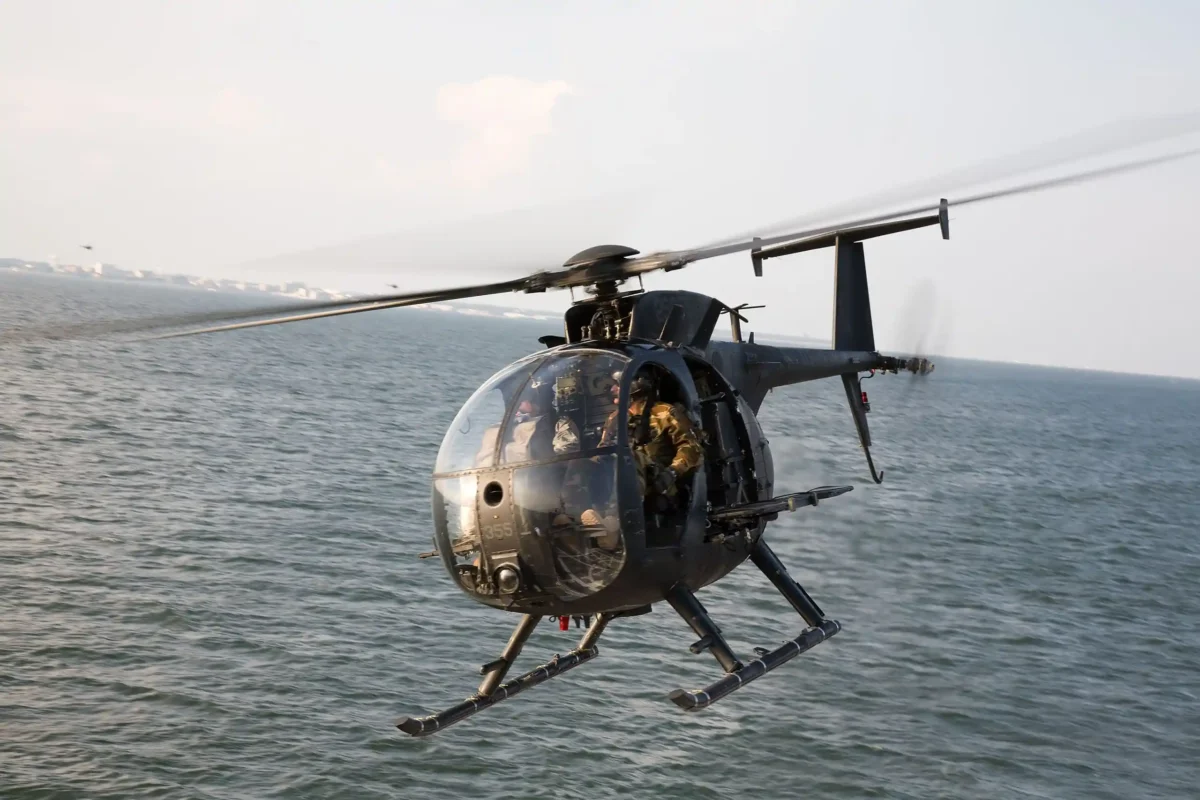
The nickname reportedly started back when the Army was looking at different transport and scout options; next to the bigger “birds” in the fleet, this one was just the little guy. The name stuck, and today it’s basically the universal shorthand for the airframe.
When you look at what this helicopter actually does on a day-to-day basis, it’s clear that it isn’t meant for standard patrol work.
If you’re wondering what the MH-6 Little Bird is used for, the simplest answer is that it’s the primary “delivery vehicle” for the Army’s most elite units, like Delta Force or the Rangers. Its entire mission profile is centered around the idea of getting in, doing the job, and getting out before the neighborhood even realizes what happened.
The primary roles usually break down into a few high-stakes categories:
A big part of why it works so well is its integration with the 160th Special Operations Aviation Regiment (SOAR), also known as the Night Stalkers.
These crews specialize in night operations and fast deployment, using the Little Bird’s small signature to maintain the element of surprise. It’s not uncommon to see these things operating in total darkness, zipping between buildings in an urban environment to drop a team exactly where they need to be.
| Feature | Specification |
| Max Takeoff Weight | ~3,100 lbs (1,406 kg) |
| Powerplant | 1x Allison T63-A-5A or Rolls-Royce 250-C30R/3M |
| Top Speed | ~175 mph (152 knots) |
| Cruise Speed | ~155 mph (135 knots) |
| Operational Range | ~270 miles (232 nm) |
| Service Ceiling | ~18,700 – 20,000 ft |
| Main Rotor | 6-bladed (on the modern M-variant) |
Looking at the raw data for the Little Bird, it’s honestly impressive how much performance they’ve managed to squeeze out of such a small airframe. It’s essentially a specialized racing machine built for combat.
When you dive into the MH-6 Little Bird helicopter specs, you realize it’s not just a legacy airframe from the 60s. The modern “M” models have been completely overhauled.
The transition to a six-bladed main rotor and a four-bladed tail rotor significantly improved its stability and lift capacity. It’s surprisingly powerful for its weight, which is exactly why it can handle those aggressive, low-altitude maneuvers without falling out of the sky.
The avionics are another area where it’s basically a mini-fighter jet.
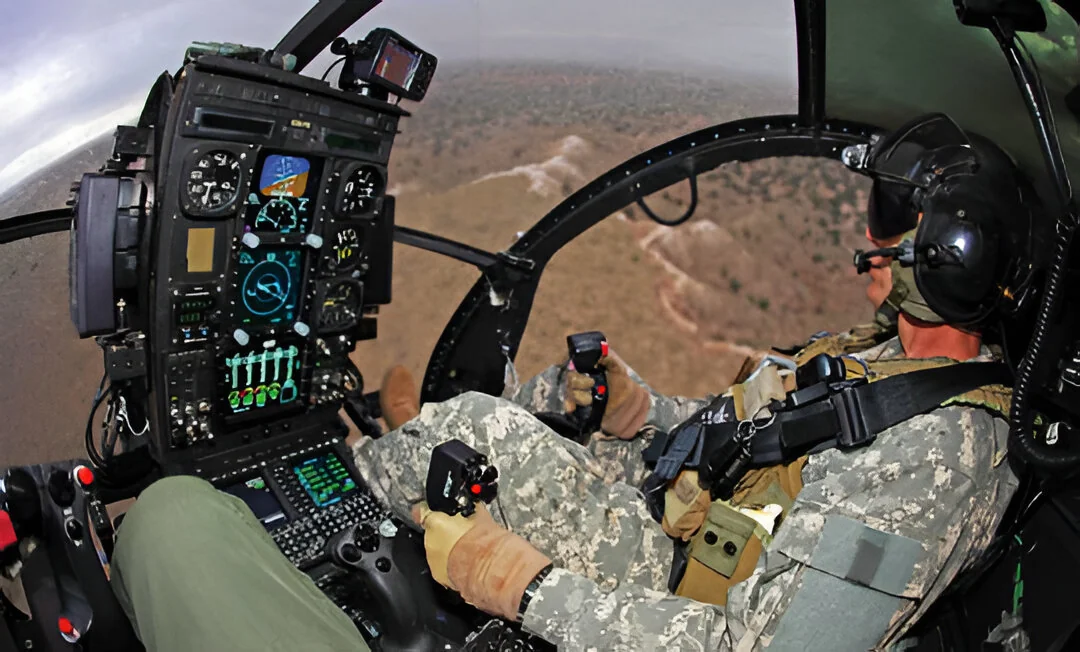
The cockpits in the newer blocks are fully digital and NVG-compatible, featuring glass displays that give pilots a lot more situational awareness than the old analog dials ever could. It’s got embedded GPS and inertial navigation, which is pretty much a requirement when you’re flying between buildings in total darkness.
As for the MH-6 Little Bird helicopter’s top speed, hitting 175 mph is no small feat for something this size.
That speed, combined with its 270-mile range, means it can be staged from a carrier or a remote base and get to the target area fast. It’s designed to be light enough to be broken down and shoved into the back of a C-130, then reassembled and flying in under 15 minutes.
When it comes to firepower, the MH-6 Little Bird is a bit of a chameleon.
Depending on the mission, it can look like a simple taxi for operators or a miniature gunship bristling with weapons. It’s important to note that while we usually call them all “Little Birds,” there’s a slight technical distinction between the two roles.
The MH-6 version is typically the “clean” transport variant, while the AH-6 is the designated attack version.
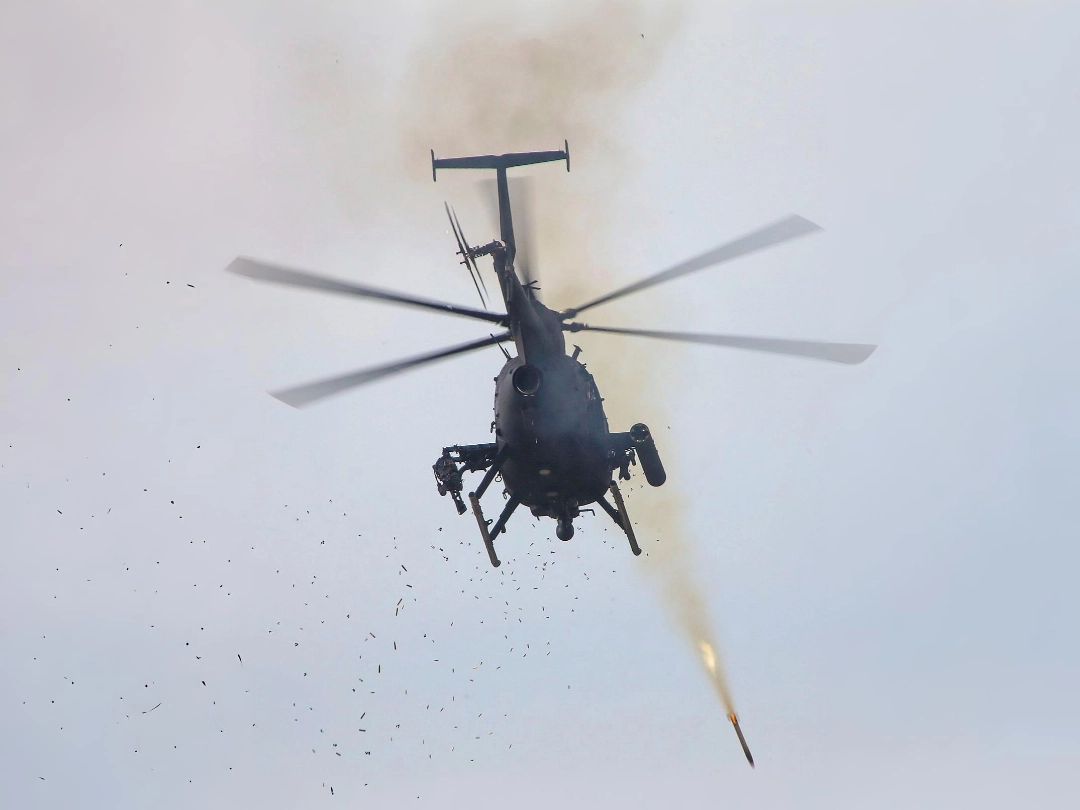
However, the reality is that the 160th SOAR can actually swap these configurations out pretty quickly. The same airframe that dropped a team on a roof in the morning could, in theory, be fitted with weapon pylons and sent back out as a gunship by the afternoon.
It’s basically down to a “plug-and-play” weapon system known as the Ordnance Mounting System (OMS), or more commonly, “the plank.”
Instead of having permanent wings like an Apache, the Little Bird uses a universal mount that can be bolted onto the airframe.
This allows crews to hang a surprising amount of hardware, ranging from heavy machine guns to laser-guided missiles, on a frame that’s barely bigger than a compact car. It turns what looks like a scout helicopter into a hyper-accurate, low-altitude gunship that can hover in a city alley and provide surgical fire support.
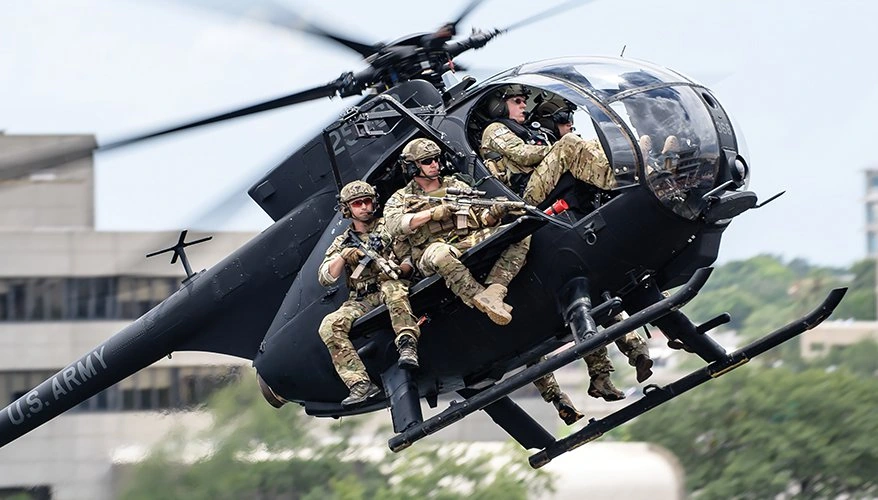
The MH-6 (Transport): This version is stripped of heavy weapon pylons to save weight. Instead, it’s fitted with those famous external benches. This is the “bus” configuration, where you’ll see operators strapped to the outside, ready to jump off the second the skids touch a rooftop.
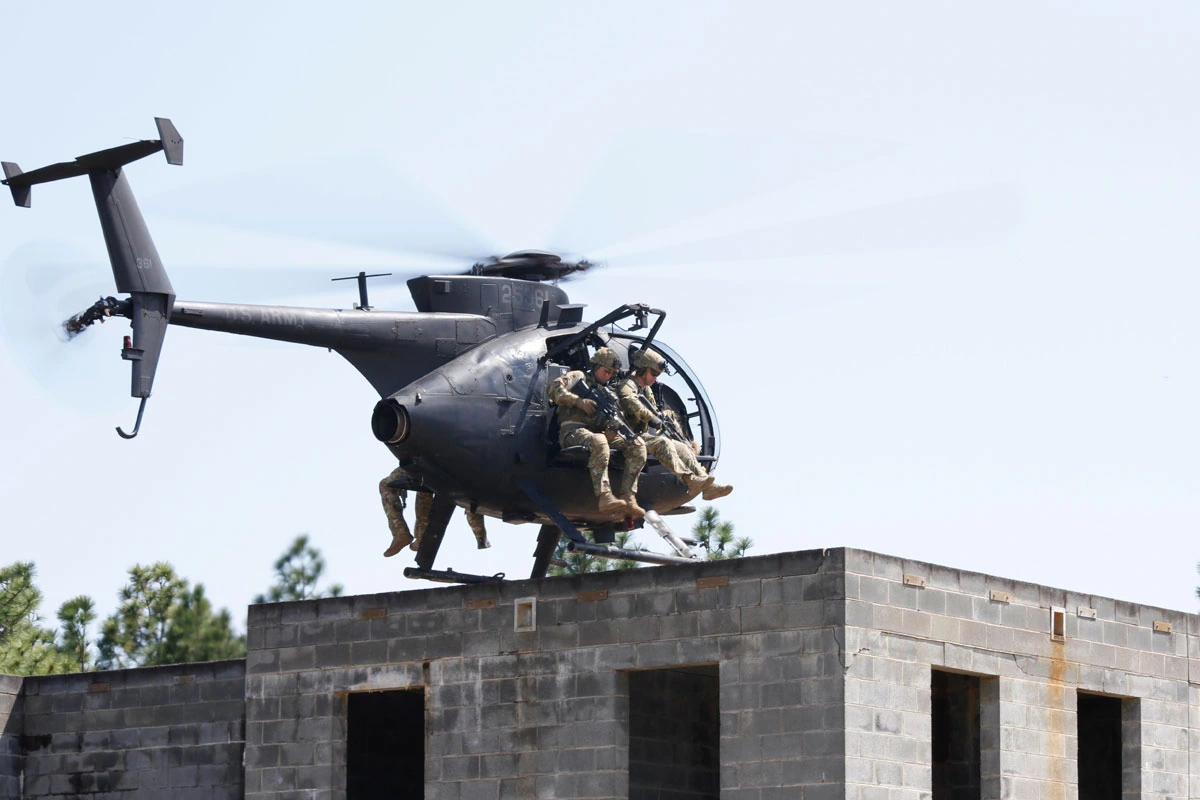
The AH-6 (Attack): This is the “Killer Egg” in its truest form. The benches are swapped for weapon stations. It usually loses the ability to carry a team of operators in exchange for becoming a dedicated escort and strike platform.
So, the main difference between the configurations is basically a choice between “people or pylons.” In the transport role, the focus is on those external benches that allow for how many people a Little Bird helicopter can carry.
In the attack role, those benches are removed to make room for the ammunition cans and weapon mounts. The interesting part is that a unit can technically reconfigure an airframe from a transport “MH” to an armed “AH” in a remarkably short amount of time.
Even though it’s small, the MH-6 Little Bird armament is surprisingly heavy-duty. You’ll typically see them carrying:
The standard crew usually consists of two pilots, a pilot and a co-pilot, sitting side-by-side in a glass cockpit.
Beyond the crew, you might wonder how many people a Little Bird helicopter can carry, and the answer is surprisingly high for its size: it can transport up to six fully-equipped operators.
However, they aren’t sitting inside. Here’s how that breaks down:
The short answer is a definitive yes. Even as we head into 2026, the MH-6 helicopter remains an active and critical part of the U.S. Army’s specialized inventory. While other Vietnam-era airframes have been phased out or replaced by massive “next-gen” projects, the Little Bird has managed to dodge retirement time and again.
As of late 2025, the Little Bird is still the go-to platform for the 160th Special Operations Aviation Regiment (SOAR). Recent reports show these aircraft are still being deployed globally for high-stakes missions where stealth and size are more important than heavy armor.
The Army recently went through a major shake-up with the cancellation of the Future Attack Reconnaissance Aircraft (FARA) program. Because FARA was supposed to be the “new” scout/attack solution, its cancellation basically left the Little Bird without a successor.
Special ops units still need that specific “surgical” capability, landing on a dime and zipping through urban canyons and nothing else in the fleet can quite replicate that yet.
There is a major push for the MH-6R (the “Romeo” or “Resurrection” variant). This upgrade involves moving to a “Block III” configuration, which includes a new, zero-timed airframe that can handle a much higher takeoff weight (up to 5,000 lbs). They are also looking at integrating the GE T901 engine and the Silent Knight radar.
Boeing was recently awarded a contract to support the fleet through at least 2030, meaning we’re likely to see the “Killer Egg” in service for at least another decade. It seems like as long as there are tight spaces that a Black Hawk can’t fit into, there’s going to be a role for the Little Bird
Essentially, the Little Bird is iconic because it’s the only aircraft that can do the “dirty work” of urban special ops with surgical precision. Why it’s a legend:
Even as we look at 2026 and beyond, it remains iconic because, despite numerous attempts to replace it, the Army keeps coming back to the realization that nothing else can weave through a city quite like a Little Bird.