Follow Us:
Follow Us:

In just over a decade, China has gone from having no aircraft carriers to operating some of the most closely watched warships in the world. At the center of this transformation is the Shandong aircraft carrier, the first domestically built flattop in the People’s Liberation Army Navy (PLAN).
As tensions rise across the Indo-Pacific, many are asking the same question: how powerful is this new symbol of China’s naval ambition?
Launched in 2017 and commissioned in 2019, the Type 002 aircraft carrier, officially named Shandong, is China’s second aircraft carrier but the first to be built entirely within the country.
Unlike its Soviet-built predecessor, the Liaoning, the Shandong is larger, more refined and clearly designed for long-term power projection. It marks a major milestone in the PLAN’s journey from a coastal defense force to a blue-water navy.
The China aircraft carrier program reflects more than military strength, it signals Beijing’s determination to challenge the U.S. and its allies in key maritime regions. With a growing carrier fleet, China is building the capability to protect its interests far from home.

In this post, we’ll break down the Shandong’s origins, design, combat potential and what it means for future naval balance in the region.
The Shandong aircraft carrier reflects China’s growing expertise in naval engineering. As the first Type 002 aircraft carrier, it was designed based on lessons learned from the Soviet-built Liaoning but features numerous enhancements tailored to Chinese requirements.
Although it retains the ski-jump launch system, the layout and internal configuration are uniquely Chinese, signaling a maturing shipbuilding industry capable of producing complex warships at scale.
The carrier measures approximately 305 meters in length and 75 meters in width, with a full-load displacement of about 66,000 to 70,000 tonnes. That places it roughly in the same class as older U.S. carriers like the USS Kitty Hawk, though it’s still smaller than the American Nimitz or Ford-class behemoths.
Shandong’s size enables it to house a sizable air wing, expanded maintenance facilities, and improved crew accommodations for long missions at sea.
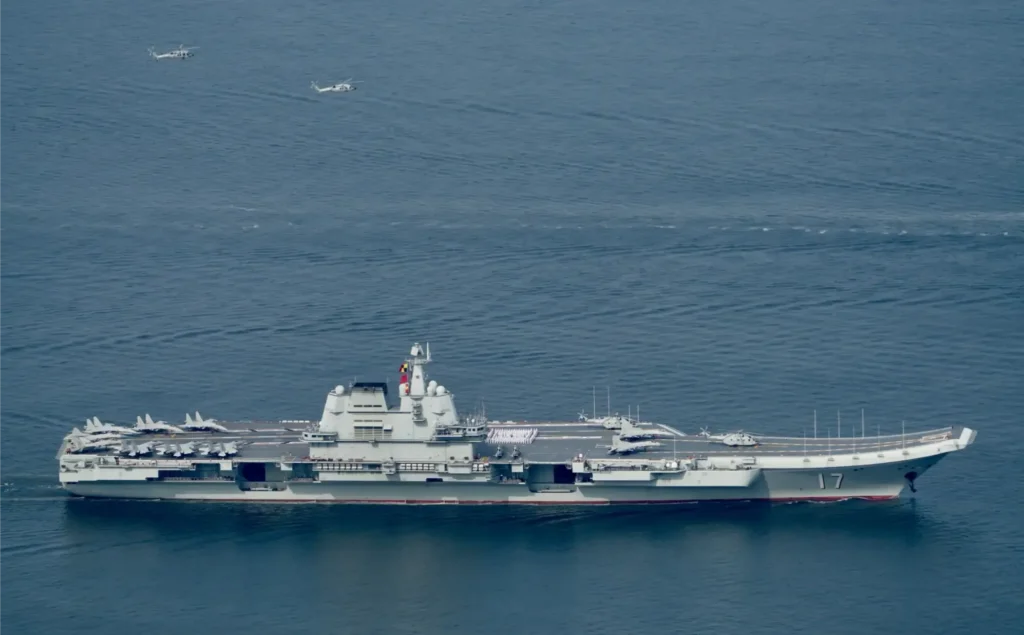
The ship uses a conventional propulsion system, likely powered by steam turbines fed by diesel or heavy fuel oil. Its maximum speed is estimated to be around 30 to 31 knots, with a cruising range sufficient to operate across the South and East China Seas.
Notably, Shandong’s ski-jump ramp is angled at 12 degrees, slightly steeper than Liaoning’s 14-degree ramp, which enhances short takeoff capabilities for heavier aircraft like the J-15.
While Shandong doesn’t employ electromagnetic catapults like the upcoming Type 003 Fujian, its Short Take-Off But Arrested Recovery (STOBAR) system is supported by an angled flight deck and three aircraft elevators, allowing quicker turnaround times between sorties.
Improvements to internal hangar space and deck arrangements also allow for higher sortie rates, a major boost to the PLAN’s ability to maintain persistent air coverage in contested areas.
On the defensive side, the carrier is outfitted with a Type 346A AESA radar system, Type 1130 Close-In Weapon Systems (CIWS), and HQ-10 surface-to-air missiles, all intended to intercept incoming threats like cruise missiles or low-flying aircraft. These systems offer a layered defensive umbrella for both the carrier and its escort ships.
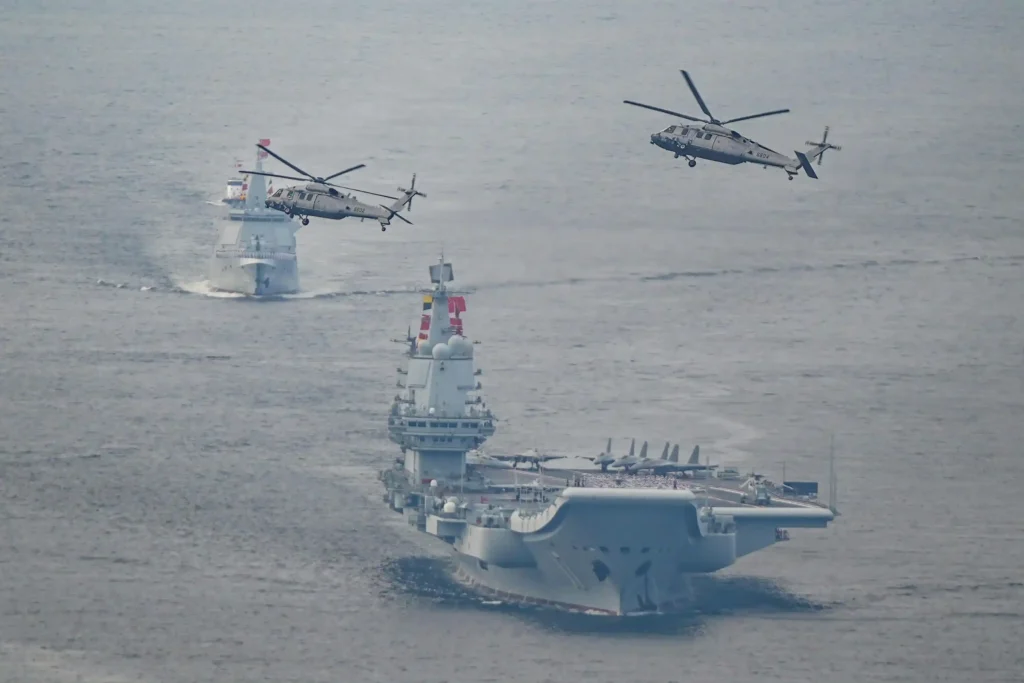
In short, the Type 002 aircraft carrier was purpose-built to meet the demands of modern naval warfare. It blends Soviet-era concepts with modern Chinese innovations, forming a credible backbone for Beijing’s expanding blue-water navy.
At the heart of any modern aircraft carrier lies its air wing, and the Shandong aircraft carrier was designed to carry and launch more aircraft than its predecessor. Its primary strike component is the Shenyang J-15 “Flying Shark”, a heavy carrier-based multirole fighter derived from the Russian Su-33.
While not as advanced as U.S. carrier-based jets like the F/A-18 or F-35C, the J-15 is a formidable aircraft that can carry a wide range of precision-guided munitions, anti-ship missiles, and air-to-air weaponry.
Read also: Top 5 Largest Aircraft Carriers in the World
The Type 002 aircraft carrier can typically support 24 to 28 J-15 fighters, though estimates vary depending on the mission profile.
In addition to fighter jets, the Shandong routinely carries a mix of helicopters, including the Z-18 AEW (Airborne Early Warning) variant, Z-18F for anti-submarine warfare (ASW), and Z-9 helicopters for search and rescue operations. These aircraft enhance the carrier’s ability to detect enemy submarines, control airspace, and conduct maritime patrols over long distances.
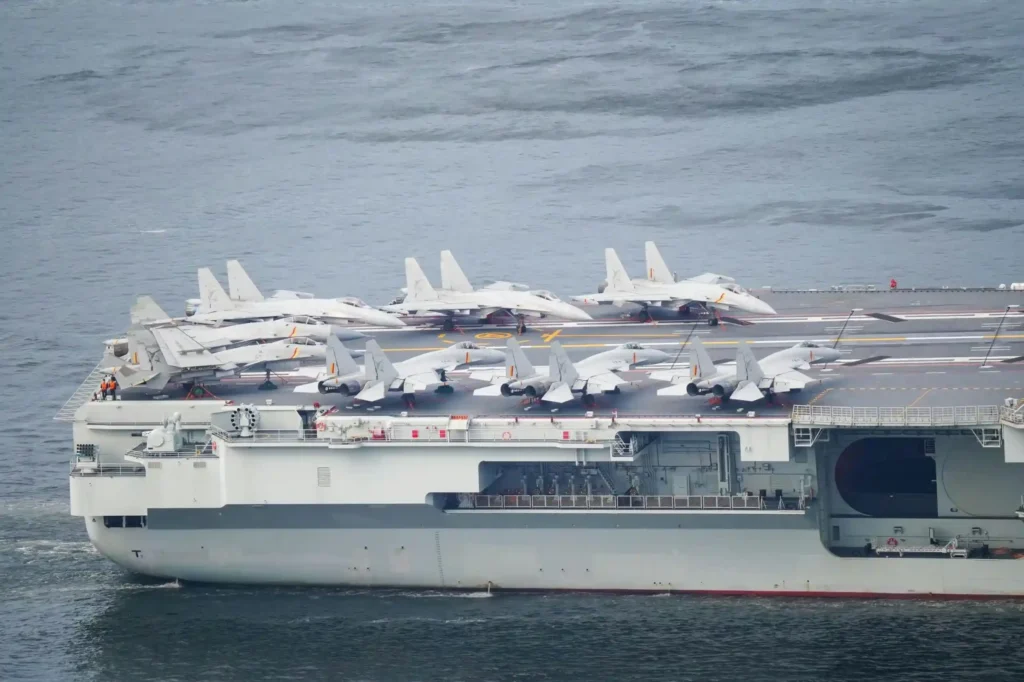
China has made several modifications to the J-15 for carrier operations, including strengthened landing gear, tail hooks for arrested recovery, folding wings for storage, and upgraded avionics.
While the STOBAR system limits the takeoff weight, forcing aircraft to sacrifice fuel or ordnance, the Shandong’s improved deck operations and larger hangar space allow for quicker launches and recoveries compared to the Liaoning. This translates to higher sortie rates, a key metric in modern naval warfare.
Additionally, China is reportedly working on a new carrier-based stealth fighter, often referred to as the J-35, which could eventually operate from both the Shandong and future catapult-equipped carriers like the Fujian. Until then, the J-15 remains the PLAN’s primary naval fighter.
In terms of mission versatility, the Shandong’s air wing is optimized for air superiority, strike missions, maritime interdiction, and fleet defense.
Together with AEW helicopters and ASW assets, this gives the carrier a balanced mix of offensive and defensive capabilities, allowing it to project power in contested regions like the South China Sea and near Taiwan.
While the current air wing has limitations, particularly in range and payload compared to U.S. equivalents, the China aircraft carrier program is clearly evolving.
The Shandong is a transitional platform, serving as both an operational asset and a training ground for a new generation of carrier pilots and deck crew.
Since its commissioning in December 2019, the Shandong aircraft carrier has quickly become a central asset in China’s naval strategy. Its operational history shows a clear pattern: frequent training exercises, strategic signaling, and increased presence in contested waters, particularly the South China Sea and Taiwan Strait.
In April 2023, the Shandong set a significant milestone by conducting over 620 takeoffs and landings during a single exercise near Taiwan, surpassing the records set by the Liaoning. These drills weren’t just routine, they were a calculated show of force.
The carrier sailed through the Bashi Channel, into the Western Pacific, and carried out flight operations in areas previously dominated by U.S. and allied navies. Chinese state media hailed it as a breakthrough in carrier-based combat readiness.
Read also: Is China Preparing to Invade Taiwan?
In September 2023, the Shandong led a strike group that sailed within 60 nautical miles of southern Taiwan, prompting alerts in Taipei and heightened monitoring from the U.S. Navy. Beijing called the maneuver a “routine patrol,” but few analysts saw it that way.
The deployment coincided with rising cross-strait tensions and was interpreted as a direct message of deterrence to both Taiwan and foreign powers operating in the region.
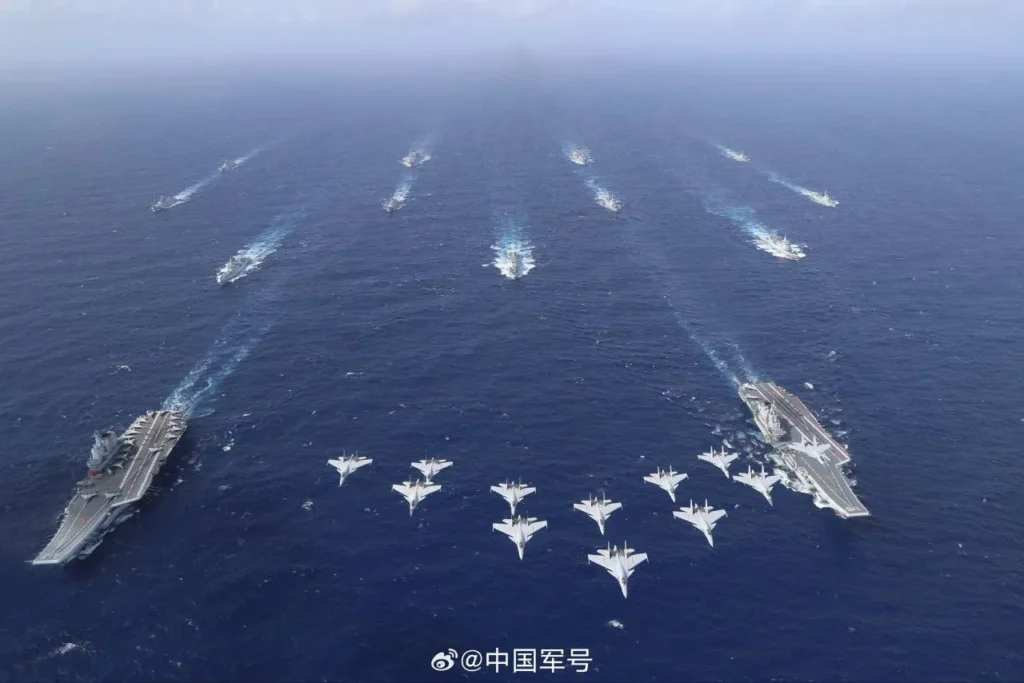
Perhaps the most provocative move came in June 2025, when the Shandong participated in “Strait Thunder 2025A,” a massive military drill that brought the carrier within 24 nautical miles of Taiwan’s coastline, the closest recorded distance for a Chinese carrier.
Backed by destroyers, submarines, and aerial assets, this operation simulated blockade scenarios and joint strike coordination, causing concern among Western defense planners.
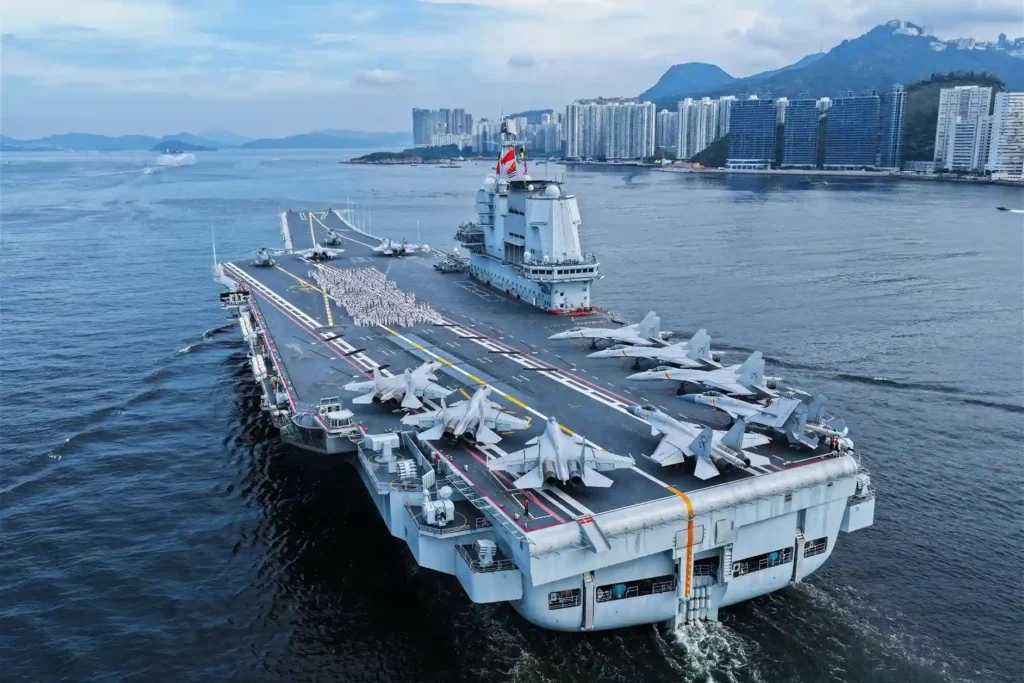
Beyond combat drills, the Type 002 aircraft carrier has also been deployed for diplomatic and public relations missions. In July 2025, it visited Hong Kong for the first time, docking at the city’s naval base as part of a highly publicized port call. The visit was framed as a patriotic celebration, drawing tens of thousands of spectators and reinforcing China’s sovereignty narrative over the city.
Shandong’s operational tempo demonstrates a shift in China’s carrier doctrine, from limited training to persistent regional power projection. Unlike Liaoning, which served primarily as a test platform, the Shandong is an active-duty Chinese aircraft carrier, built for presence, pressure, and influence across the Indo-Pacific.
The Shandong aircraft carrier represents a pivotal moment in China’s rise as a maritime superpower. As the country’s first domestically built carrier, it embodies Beijing’s ambition to transition from a regional naval player to a blue-water force capable of projecting power far from its shores.
Strategically, Shandong serves several critical roles. First, it boosts the People’s Liberation Army Navy’s (PLAN) operational readiness by providing a platform to train carrier pilots, test naval aviation tactics, and refine carrier strike group coordination.
This experience is essential as China seeks to match the carrier capabilities long held by the United States and its allies.
Read also: How Strong Is China’s Military
Second, Shandong enhances China’s ability to assert control over contested maritime regions such as the South China Sea and the Taiwan Strait. By sailing within close proximity to Taiwan’s coast and conducting high-tempo sorties, the carrier serves as both a deterrent and a tool of intimidation, signaling Beijing’s resolve to defend what it calls its sovereign territory.
Third, the carrier supports China’s broader geopolitical goals of expanding influence across the Indo-Pacific. Carrier strike groups, led by vessels like Shandong, can escort critical sea lanes, safeguard China’s growing overseas interests, and participate in joint exercises with partner nations. These operations underscore China’s intent to be seen as a responsible if assertive, global naval power.
At a regional level, Shandong’s presence has prompted strategic recalculations. Neighboring countries such as Japan, Taiwan, and India, along with the United States, have increased surveillance and bolstered their own naval capabilities in response.
The carrier’s deployments have contributed to rising tensions and a renewed focus on freedom of navigation operations in contested waters.
Finally, Shandong lays the groundwork for more advanced platforms like the Fujian (Type 003), China’s first carrier equipped with electromagnetic catapults. Together, these carriers form the backbone of a modernized PLAN carrier fleet that will shape maritime security dynamics for decades.
In summary, the Type 002 aircraft carrier is not just a warship, it’s a strategic asset that enhances China’s naval power projection, strengthens regional deterrence, and signals the nation’s growing ambition on the world stage.
The Shandong aircraft carrier is often compared to its predecessor, the Liaoning (Type 001), which was China’s first aircraft carrier but originally a Soviet-era hull refurbished for Chinese use.
While both ships share the same STOBAR (Short Take-Off But Arrested Recovery) ski-jump launch system, the Shandong introduces several important advancements that reflect China’s growing expertise and ambitions.
In terms of size, Shandong is slightly larger, stretching about 305 meters compared to Liaoning’s 304 meters, with a fuller flight deck and improved hangar space. This extra room allows it to carry a larger air wing, typically around 24 to 28 J-15 fighters versus Liaoning’s roughly 20, while supporting higher sortie rates.
The ramp angle on Shandong’s ski-jump is optimized at 12 degrees, a subtle adjustment that improves takeoff performance for heavier aircraft compared to Liaoning’s 14-degree ramp.
Internally, Shandong benefits from enhanced crew accommodations, modernized command and control systems, and more advanced radar and defensive weapons, including the Type 346A AESA radar and upgraded CIWS (Close-In Weapon Systems). These improvements enable better situational awareness and stronger defense against missile threats or aerial attacks.
More importantly, Shandong acts as a bridge toward China’s next-generation carriers, especially the Fujian (Type 003).
Fujian departs from STOBAR to a CATOBAR (Catapult Assisted Take-Off But Arrested Recovery) system with electromagnetic catapults, allowing the launch of heavier, more capable aircraft like the J-35 stealth fighter. This leap will enable longer-range missions and heavier payloads, dramatically expanding China’s naval aviation capabilities.
Looking forward, the Type 002 Shandong remains a critical platform for pilot training and operational experience while also serving frontline roles. It marks a clear progression in China’s carrier program, from buying and refurbishing foreign ships, to building effective indigenous warships, and ultimately to designing highly sophisticated supercarriers.
Together, these carriers illustrate China’s rapid evolution from naval newcomer to a peer competitor capable of challenging Western dominance in key maritime regions. The Shandong is a vital milestone in that journey, both a symbol of progress and an operational tool shaping the future of regional security.