Follow Us:
Follow Us:

The 2S35 Koalitsiya SV is Russia’s cutting-edge self-propelled artillery system, designed to offer superior firepower and precision on the modern battlefield.
Developed as a successor to the 2S19 Msta, the Koalitsiya-SV has been built to meet the demands of contemporary warfare, where speed, accuracy, and range are critical factors.
In this post, we will explore the key features, capabilities, and importance of the 2S35 Koalitsiya-SV within Russia’s military arsenal.
The 2S35 Koalitsiya SV is a self-propelled howitzer developed by Russia, featuring a 152mm caliber gun as its main armament. Self-propelled artillery is a type of mobile artillery that can move on its own without the need for towing by another vehicle.
The 2S35 is specifically designed for long-range, high-precision strikes, making it a formidable piece of equipment on the battlefield.
The primary role of the 2S35 Koalitsiya-SV is to provide long-range fire support to ground troops, destroying enemy fortifications, vehicles, and equipment from a safe distance. With its extended firing range and sophisticated targeting systems, it plays a crucial role in both offensive and defensive military operations.
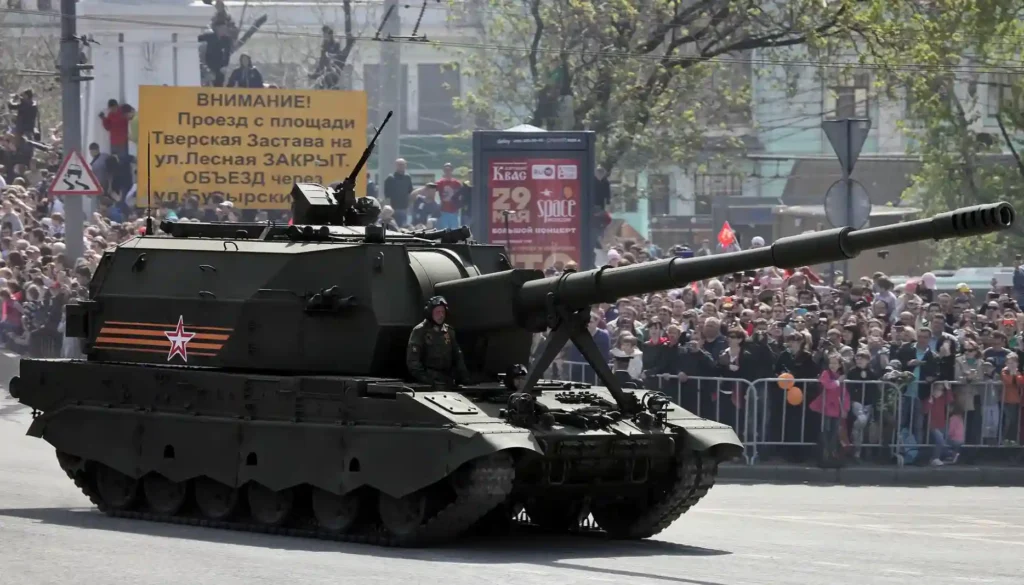
The 2S35 Koalitsiya SV was first revealed to the public during the 2015 Moscow Victory Day Parade, where it demonstrated its capabilities as a next-generation replacement for Russia’s older artillery systems, such as the 2S19 Msta.
By leveraging its mobility and firepower, the 2S35 Koalitsiya-SV has proven to be a critical asset in modern warfare scenarios where rapid deployment and precision strikes are necessary.
Self-propelled artillery combines the power of traditional artillery with the mobility of a tank. This allows systems like the 2S35 Koalitsiya SV to quickly move to a new firing position, avoiding counter-battery fire from the enemy.
Unlike traditional towed artillery, which must be attached to a separate vehicle for transportation, self-propelled units carry their own engine and mobility systems.
The 2S35 Koalitsiya SV stands out due to its advanced engineering and design, making it one of the most formidable self-propelled howitzers in the world.
Below, we’ll explore its key features and technical specifications, focusing on the weapon’s firepower, range, and innovations.
At the core of the 2S35 Koalitsiya-SV is its 152mm caliber gun. This large-diameter barrel allows the artillery system to fire a variety of munitions, from high-explosive shells to precision-guided projectiles. The 152mm caliber has long been a standard in Russian and Soviet artillery, known for its destructive power and flexibility in combat scenarios.
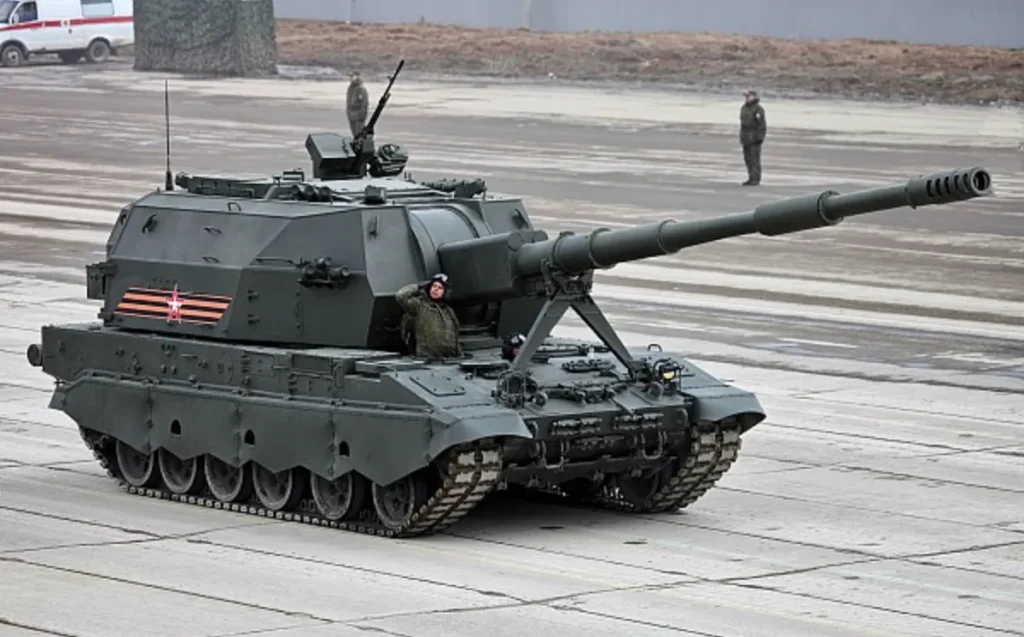
The howitzer 152 mm offers the ability to engage a wide range of targets, including infantry, armored vehicles, and even hardened fortifications. This level of versatility is key in modern warfare, where a single artillery system must handle multiple combat roles.
One of the most impressive features of the 2S35 Koalitsiya SV is its extended firing range. This self-propelled howitzer can fire projectiles at distances significantly greater than most comparable systems, giving Russian forces a strategic advantage in terms of stand-off distance.
This extended range is achieved through advanced propellant technology and precision-guided munitions. By being able to engage targets from up to 70 kilometers away, the Koalitsiya-SV can provide fire support without entering the effective range of most enemy counter-battery fire.
Read also: South Korea’s K9 Thunder Howitzer: Why Armies Rely on It?
There has been speculation and rumors surrounding the 2S35 Koalitsiya-SV’s double-barrel design, but these have largely been debunked. Early prototypes showed a potential twin-barrel design, which led to confusion in defense circles.
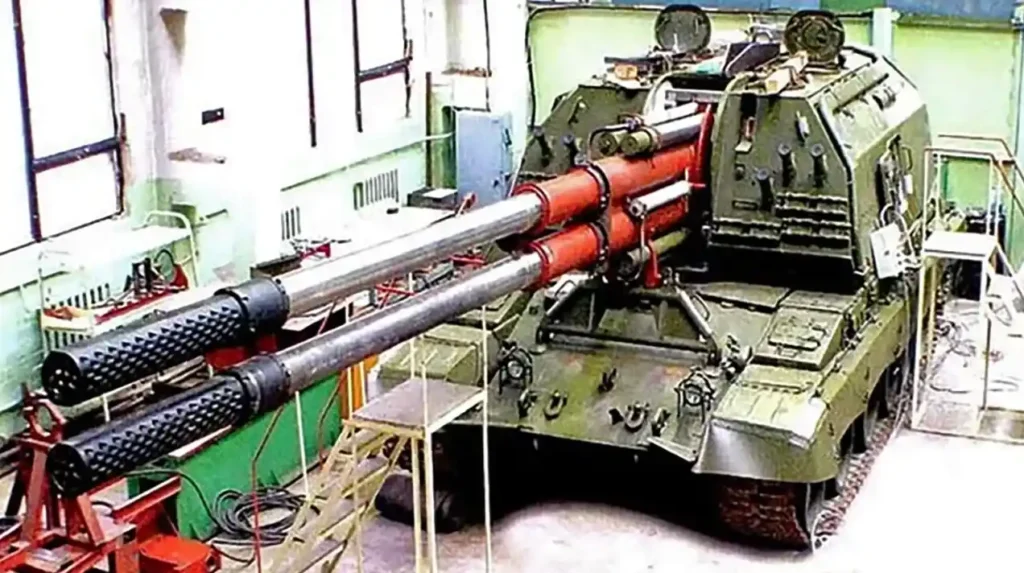
However, the final production model features a single-barrel design, optimized for efficiency and performance.
This confusion has been cleared up over time, and the single-barrel design was chosen for practical reasons, including ease of maintenance, reduction in weight, and improved firing stability. The decision to keep a single barrel underscores the focus on precision and durability in the system’s design.
| System | Caliber | Maximum Range | Rate of Fire | Country of Origin |
| 2S35 Koalitsiya-SV | 152mm | 70 km | 10 rounds/min | Russia |
| M109 Paladin | 155mm | 30 km | 4 rounds/min | USA |
| PzH 2000 | 155mm | 67 km | 10 rounds/min | Germany |
| K9 Thunder | 155mm | 40 km | 6 rounds/min | South Korea |
This table highlights how the 2S35 Koalitsiya-SV compares favorably to other leading self-propelled howitzers in terms of range and rate of fire, reinforcing its status as one of the most advanced systems on the battlefield today.
Read also: M109 Paladin: America’s Powerful Self-Propelled Howitzer
The 2S35 Koalitsiya SV represents a significant leap forward in Russian artillery technology. Its development was a response to the evolving requirements of modern warfare, where precision, range, and mobility are key factors.
In this section, we will explore how the Koalitsiya-SV evolved, from concept to the formidable system we see today.
The development of the 2S35 Koalitsiya-SV began in the early 2000s as a part of Russia’s broader military modernization efforts.
Russia had relied on the 2S19 Msta, a self-propelled howitzer that had been in service since the late 1980s. While the 2S19 was a reliable platform, advances in artillery technology and battlefield requirements prompted the need for a more advanced system.
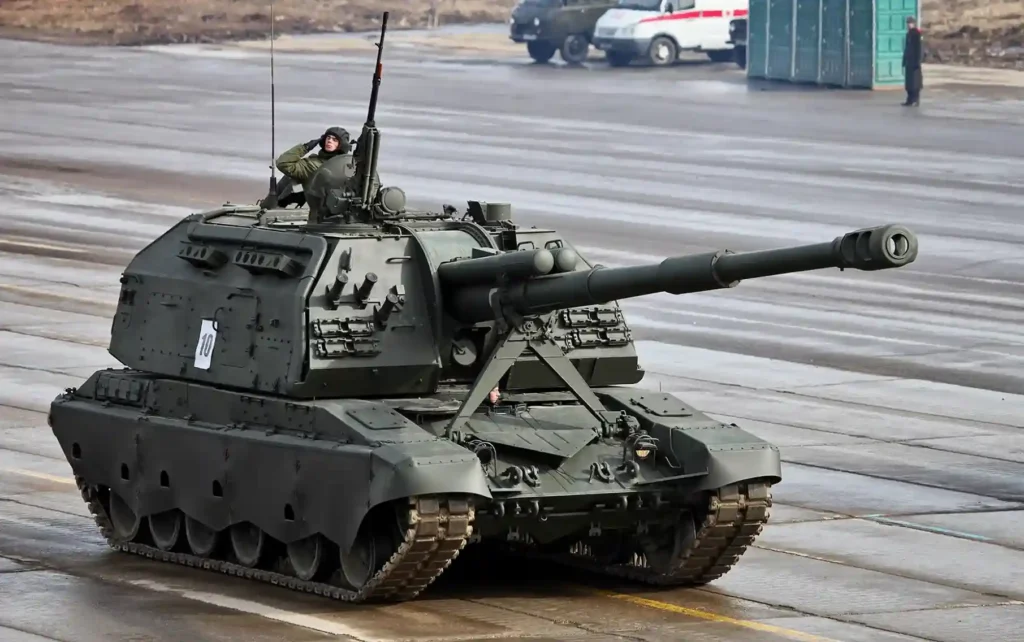
The program saw multiple iterations of design, with early prototypes featuring a double-barrel system. However, the final design focused on a single-barrel 152mm howitzer, optimizing for performance, range, and fire rate.
| Year | Development Milestone |
| 2000s | Initial research and development phase begins. |
| 2010 | First prototypes of the Koalitsiya-SV are unveiled. |
| 2013 | Testing and evaluation of various design options. |
| 2015 | The 2S35 Koalitsiya-SV is publicly revealed during the Moscow Victory Day Parade. |
| 2016 | Entered production for the Russian Army. |
| 2020 | Further refinement and deployment to Russian military units. |
The 2S35 Koalitsiya SV is part of a long lineage of Russian self propelled artillery systems, starting with the 2S1 Gvozdika and 2S3 Akatsiya, and later the 2S19 Msta.
Each system introduced incremental improvements in firepower, mobility, and protection, but the Koalitsiya-SV represents a significant leap due to its integration of modern technologies.
The Koalitsiya-SV has improved upon these earlier systems by introducing:
One of the most common questions about the 2S35 Koalitsiya-SV revolves around its cost, both in terms of individual units and overall deployment expenses.
Understanding the financial aspects of such advanced military equipment is crucial, especially for nations looking to modernize their artillery forces or assess the impact of Russia’s defense spending.
While official figures for the exact cost of the 2S35 Koalitsiya-SV are not always made public, defense analysts estimate the unit price to be in the range of $4 million to $6 million per howitzer.
This price reflects the high level of advanced technology integrated into the system, including its automated fire control systems, advanced targeting, and long-range capabilities.
| Item | Estimated Cost |
| 2S35 Koalitsiya-SV Unit | $4-6 million USD |
| Ammunition (per shell) | $1,000 – $5,000 USD |
| Precision-guided ammunition | $50,000+ USD per shell |
Several factors contribute to the unit cost of the 2S35 Koalitsiya-SV, including:
To better understand the value of the 2S35 Koalitsiya-SV, it is helpful to compare its estimated cost with other leading self-propelled artillery systems from around the world.
| System | Estimated Unit Cost | Country |
| 2S35 Koalitsiya-SV | $4-6 million USD | Russia |
| M109A7 Paladin | $9 million USD | United States |
| PzH 2000 | $7-8 million USD | Germany |
| K9 Thunder | $8-9 million USD | South Korea |
Read more: Why the PzH 2000 Howitzer Is the Most Feared Artillery System
As the table shows, the 2S35 Koalitsiya-SV offers competitive pricing compared to other leading artillery systems, especially given its extended range and firepower.
The cost advantage may allow Russia to field larger numbers of these systems without incurring as high an expense as some Western alternatives.
One of the standout aspects of the 2S35 Koalitsiya-SV is its integration of cutting-edge technology, making it one of the most advanced self-propelled howitzers in the world.
This section will dive into the technologies that make the Koalitsiya-SV so effective on the modern battlefield, focusing on its automated systems, firing accuracy, and defensive features.
A significant advancement in the 2S35 Koalitsiya-SV is its automated firing and loading system, which allows it to achieve an impressive rate of fire with minimal crew input.
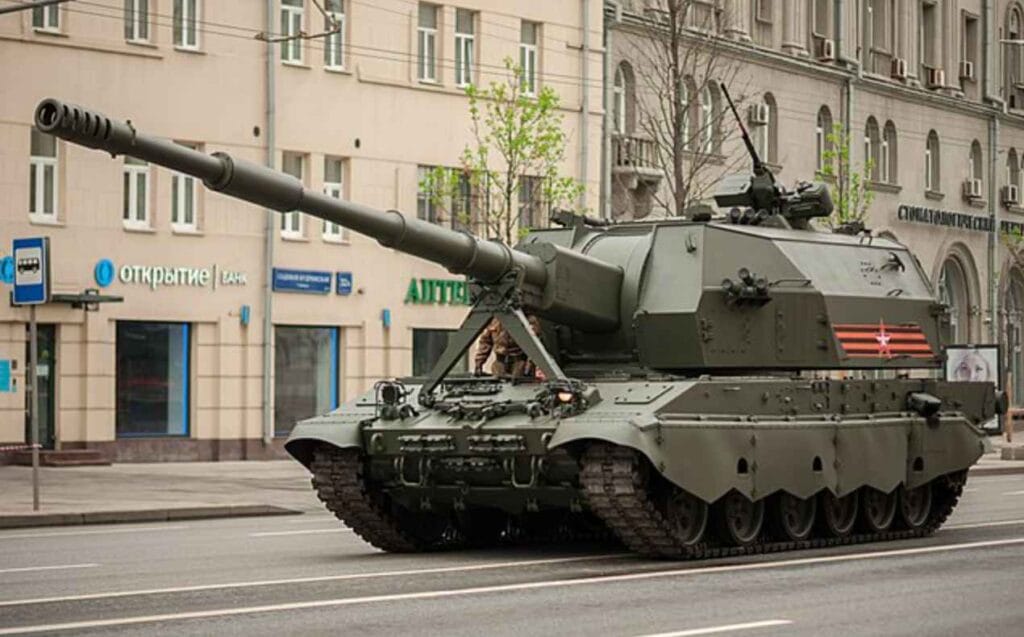
Traditional artillery systems require manual loading and aiming, which slows down the rate of fire and increases crew fatigue.
In contrast, the Koalitsiya-SV can automatically load and fire shells, significantly increasing efficiency.
This high degree of automation not only reduces crew size but also allows the system to engage multiple targets in rapid succession, making it a powerful tool in both offensive and defensive operations.
Despite its primary role as a long-range fire support system, the 2S35 Koalitsiya SV is designed with protection in mind. While artillery units often stay behind front lines, they are not immune to counter-attacks from enemy artillery or aerial strikes.
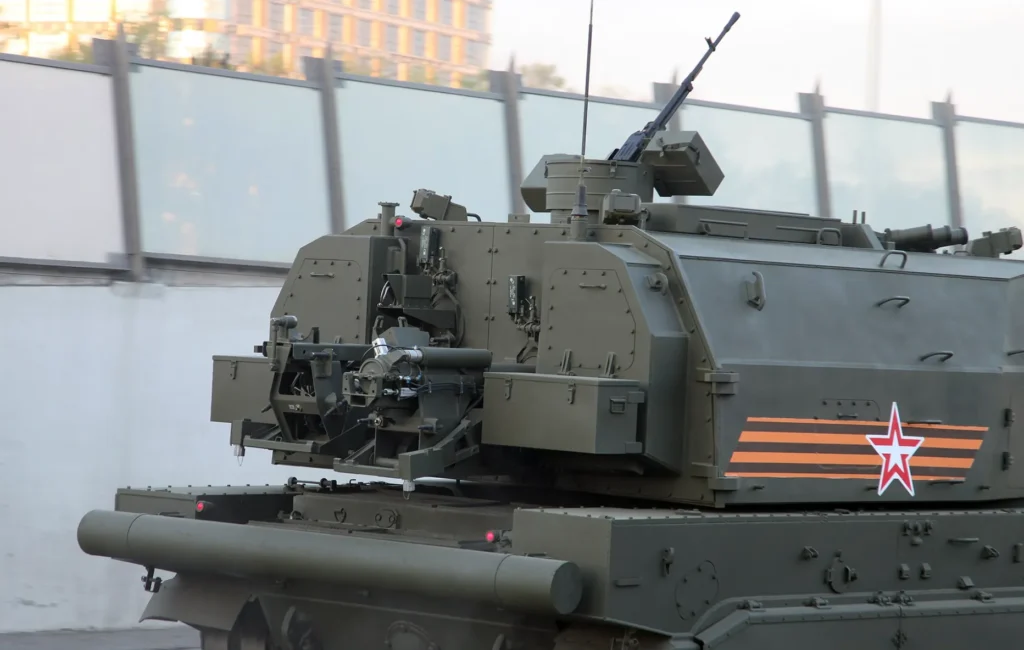
To ensure survivability in such conditions, the Koalitsiya-SV is equipped with several defensive features:
These protective features, combined with its long-range capabilities, make the Koalitsiya-SV not only a deadly offensive weapon but also a system that can withstand enemy attempts to neutralize it.
One of the critical strengths of the 2S35 Koalitsiya-SV is its ability to integrate with Russia’s broader network-centric warfare approach. This means that the Koalitsiya-SV doesn’t operate in isolation; it can communicate and coordinate with other units in real-time, thanks to its connection to battlefield networks.