Follow Us:
Follow Us:

Ever wondered what makes the U.S. military’s artillery so powerful on the battlefield? The answer often rolls in on steel tracks and fires with devastating force from miles away, meet the M109 Paladin.
This self-propelled howitzer isn’t just another armored vehicle, it’s the backbone of American artillery, trusted in every major conflict since Vietnam. Often called the M109 Paladin howitzer, this beast packs a 155mm cannon, rugged mobility, and advanced fire control systems, making it one of the most effective mobile artillery systems in modern warfare.
What sets the Paladin howitzer apart from older systems is its ability to fire and move quickly. No more being stuck in one place like traditional towed guns. The M109’s tracked platform means it can shoot, shift, and keep up with fast-moving armored units, giving it a huge tactical advantage.
With a range of up to 30 km using rocket-assisted projectiles and the ability to fire precision-guided rounds like the Excalibur, the M109 artillery system delivers serious punch. The latest M109A7 Paladin brings even more power, using a new chassis, engine, and electronics to meet modern battlefield needs.
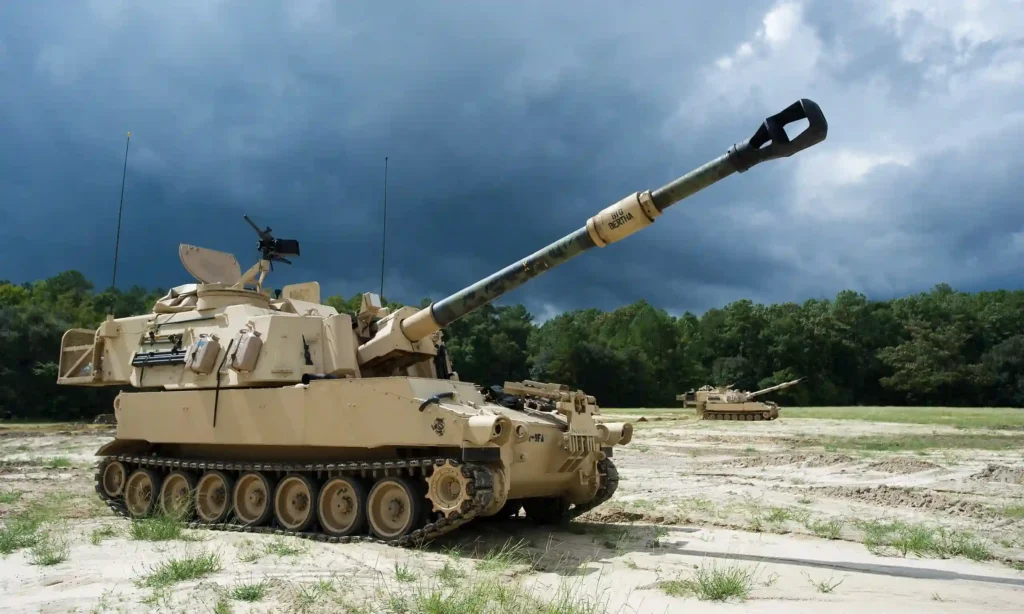
Whether you’re into military tech, defense strategy, or just curious about how artillery works, the M109 is worth exploring. This post will walk you through its history, how it’s evolved, what makes it tick, and why it remains the go-to self-propelled howitzer for the U.S. and its allies.
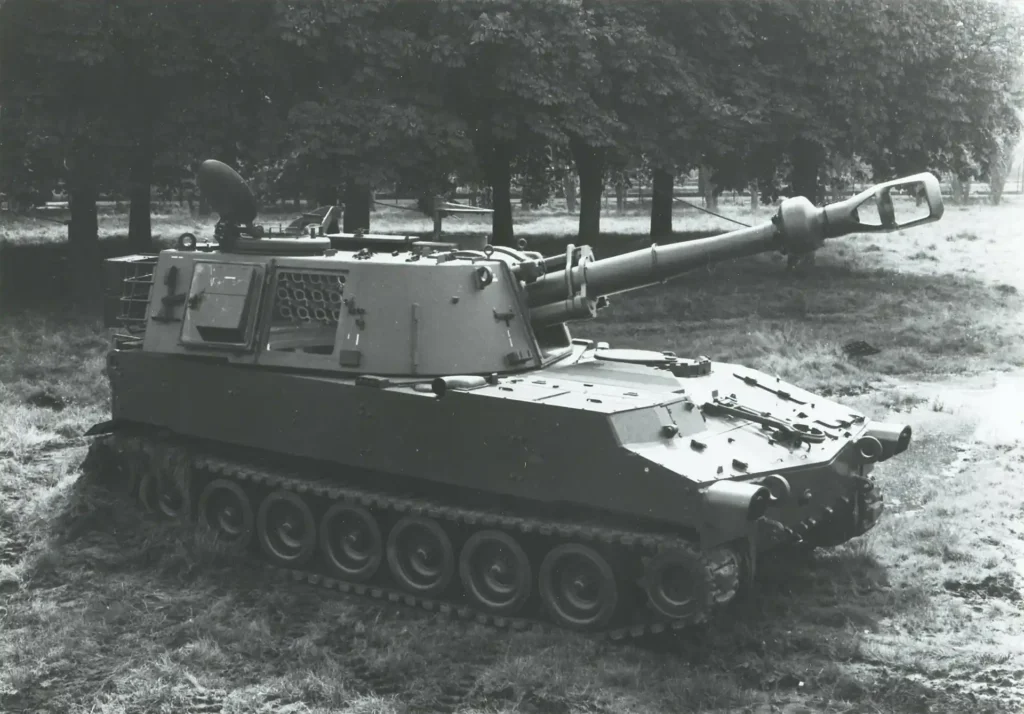
The story of the M109 Paladin begins back in the early 1960s, during the Cold War. At the time, the U.S. Army needed a new artillery system that could keep up with fast-moving armored units and deliver long-range, indirect firepower. What they came up with was the original M109 self-propelled howitzer, which quickly replaced older systems like the M44 and M52.
The first M109 rolled out in 1963. It was basic by today’s standards—shorter range, manual systems, and limited crew protection. But it laid the foundation for what would become one of the most successful artillery platforms in military history. Early versions saw action in Vietnam, providing critical fire support in jungle warfare where mobility and fast repositioning were essential.
Over the decades, the M109 underwent multiple upgrades, each designed to boost performance, survivability, and lethality. Variants like the M109A1 through A4 extended range, improved targeting, and enhanced reliability. These upgrades kept the M109 relevant through conflicts like the Yom Kippur War, the Gulf War, and the wars in Iraq and Afghanistan.
But the real game-changer came with the M109A6 Paladin in the 1990s. It introduced advanced fire control, GPS, Kevlar armor, and an improved M109 Paladin engine. This variant could fire faster, more accurately, and with less setup time—crucial for surviving modern counter-battery threats.
Read also: 2S35 Koalitsiya SV: Russia’s Advanced Self-Propelled Howitzer
The evolution didn’t stop there. The current M109A7 Paladin builds on this legacy with a redesigned chassis, upgraded transmission, and digital systems. It shares many components with the Bradley Fighting Vehicle, improving logistics and performance across the board. It’s the most lethal, survivable version yet—ready for 21st-century threats.
Through it all, the Paladin artillery system has stayed one step ahead. It’s a rare example of a Cold War-era weapon that’s still effective today, thanks to continuous innovation and battlefield feedback. No wonder it remains the core of American M109 artillery units and a favorite among U.S. allies worldwide.
The M109 Paladin isn’t just a single vehicle—it’s a family of constantly evolving machines. Over the years, the M109 series has seen several major upgrades, each version improving range, accuracy, survivability, and battlefield performance. Let’s take a closer look at the key M109 artillery variants and how they’ve shaped modern mobile fire support.
The original M109 howitzer debuted in the early 1960s with a 23-caliber M126 gun. It had a firing range of about 14.6 kilometers and relied on analog controls. While revolutionary at the time, it would soon be outpaced by the changing demands of mobile warfare.
To improve range and reliability, the U.S. Army developed the M109A1, which introduced the longer 39-caliber M185 gun. This allowed it to fire standard HE rounds up to 18 kilometers. The A2 and A3 brought tweaks to the gun mount, engine, and suspension, while the M109A4 focused on safety—adding an upgraded fire suppression system to deal with propellant fires inside the turret.
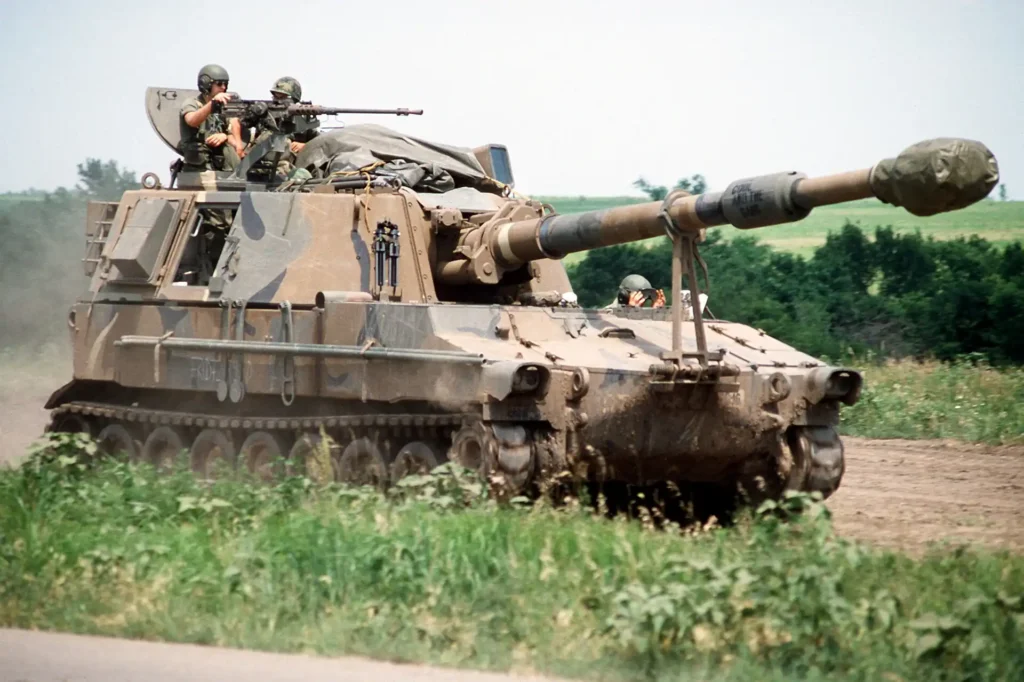
One of the most widely used versions in NATO, the M109A5 came with the M284 cannon and improved fire control systems. It remained in service for decades and was the bridge between old-school mechanical artillery and the digital age.
Here’s where things took a major leap. The M109A6 Paladin was introduced in the 1990s with an emphasis on speed and survivability. It added GPS-based navigation, inertial positioning, Kevlar-lined armor, and digital fire control. The Paladin howitzer could fire its first round within 60 seconds of stopping and relocate in under three minutes, making it much harder for enemies to strike back.
The latest and most advanced version is the M109A7 Paladin Integrated Management (PIM). It retains the firepower of the A6 but overhauls the chassis, replacing decades-old components with modern systems. It uses the Bradley Fighting Vehicle’s engine and transmission, improving mobility and commonality across the fleet. This variant also replaces hydraulic systems with electric ones, enhancing reliability and reducing maintenance needs. The M109 Paladin’s weight in this version is about 38 tons, but its upgraded powertrain handles it with ease.
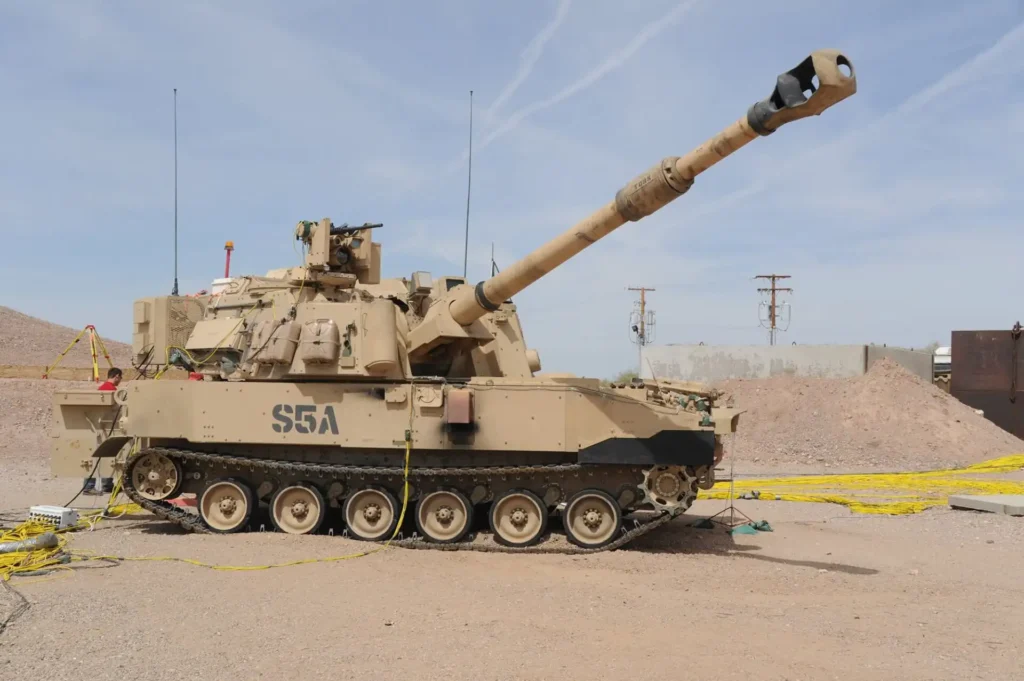
In 2025, BAE Systems unveiled plans for the M109-52, a 155mm howitzer with a 52-caliber barrel. This model aims to push the M109 Paladin range to over 60 kilometers using precision munitions—a potential game-changer if fielded.
Each new variant of the M109 builds on lessons learned from the battlefield. From the jungles of Vietnam to the deserts of the Middle East, the Paladin’s upgrades have kept it ahead of the curve. And with the M109-52 on the horizon, this self-propelled howitzer isn’t slowing down anytime soon.
Let’s break down what makes the M109 Paladin howitzer such a battlefield powerhouse. From firepower to protection systems, this self-propelled artillery platform is built to hit hard, survive harsh combat conditions, and keep moving when others can’t. Whether you’re a military enthusiast or just exploring what makes M109 artillery tick, here’s a look under the hood.
The main gun on the M109 Paladin is a 155mm cannon—either the M284 or M185 depending on the variant. It can fire a range of shells, including:
Rate of fire varies by version. In short bursts, the Paladin howitzer can fire 4 rounds per minute. For sustained operations, it usually fires 1–2 rounds per minute to prevent overheating and conserve ammo.
Read also: How Does Artillery Know Where to Shoot
Mobility is critical for modern artillery, and the M109 Paladin engine makes sure this system can keep up with frontline units. Earlier variants used a Detroit Diesel 8V71T engine producing around 405 horsepower. But the M109A7 uses the Bradley Fighting Vehicle’s 600-horsepower Cummins engine, giving it more muscle and compatibility with other U.S. armored vehicles.
Top speed is about 61 km/h on roads, and operational range exceeds 300 km—enough to support advancing forces across extended operations. Its tracked suspension handles rough terrain, urban rubble, and muddy fields with ease.

The M109 Paladin weight tips the scale at over 35 tons. Armor protection includes reinforced aluminum hulls and, in newer variants, Kevlar spall liners. While it’s not designed to survive tank shells, it can take hits from shrapnel, small arms fire, and artillery fragments. The interior also includes:
A full Paladin artillery crew includes 4–6 personnel: commander, driver, gunner, and loaders. In modern variants, much of the aiming, targeting, and firing is done through digital control panels with GPS, inertial navigation, and advanced fire control systems. Crews can receive fire missions electronically, calculate firing solutions in seconds, and fire without needing to dismount.
All of this combines to make the M109 Paladin howitzer a lethal, flexible, and survivable platform. It’s not just about hitting targets—it’s about doing so faster, safer, and more accurately than ever before.
While many Cold War-era systems have been retired, the M109 Paladin keeps rolling—thanks to continuous upgrades that make it one of the most relevant self-propelled howitzers in service today. From cutting-edge electronics to longer barrels and smarter shells, the Paladin has evolved with the times. Here’s how it stays mission-ready in the modern battlefield—and where it’s headed next.
The most significant recent upgrade is the M109A7, also known as the Paladin Integrated Management (PIM) variant. This isn’t just a minor tweak—it’s a ground-up overhaul. While it keeps the familiar turret and cannon, nearly everything else underneath has changed:
This upgrade also supports new-generation smart munitions, enabling pinpoint strikes against fortified positions, vehicles, or fast-moving enemy units from up to 40 kilometers away.
In 2025, BAE Systems announced the M109-52, a prototype designed to give the Paladin even more punch. This variant features a longer 52-caliber barrel (compared to the current 39-caliber), which could extend its maximum range to over 60 kilometers when firing advanced precision-guided rounds.
That’s a massive leap in firepower, potentially putting it on par with Europe’s PzH 2000 or South Korea’s K9 Thunder. If adopted, the M109-52 could serve as a bridge to the Army’s future long-range artillery strategy, especially as the U.S. shifts focus to large-scale, peer-to-peer conflict scenarios.
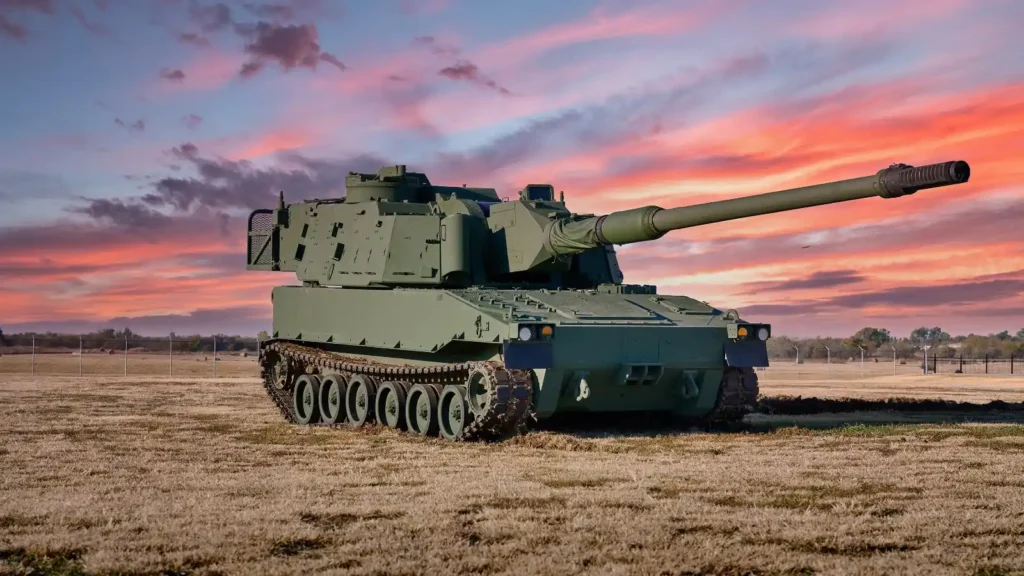
The U.S. Army has explored M109 Paladin replacement options, such as the Extended Range Cannon Artillery (ERCA) under the M1299 program. However, as of now, M109 upgrades continue to be the most cost-effective path. With every upgrade, the platform adds more years to its operational life while keeping pace with 21st-century warfare demands.
Bottom line? The M109 isn’t going anywhere soon. With smarter tech, longer reach, and better survivability, the Paladin artillery system continues to evolve—and remains a cornerstone of U.S. and allied firepower.
In a world filled with advanced artillery systems, how does the M109 Paladin hold its ground? Quite well, actually. The M109A7, the latest evolution of the Paladin series, competes with some of the most sophisticated self-propelled howitzers on the market. But each system brings its own strengths—and trade-offs. Let’s compare the Paladin with its closest rivals.
The PzH 2000 is often regarded as the gold standard in Western artillery. It features an automatic loader, a 52-caliber gun, and a max range of over 40 km with standard rounds and beyond 60 km with advanced munitions.
The K9 Thunder is South Korea’s flagship artillery system and has been widely exported to countries like Australia, Poland, and Finland.
The M109A7 may not outperform the K9 in every metric, but it’s a better fit for forces already invested in the M109 ecosystem.
As a result, the M109 Paladin remains the U.S. Army’s primary solution for long-range artillery—proving that modernization can sometimes be more effective than starting from scratch.
The M109 Paladin is more than just a Cold War relic, it’s a modern, battle-hardened artillery system that continues to evolve with the times. With its proven reliability, adaptability, and lethal firepower, the M109 self-propelled howitzer remains a cornerstone of U.S. and allied artillery forces worldwide.
Its continued upgrades, especially in the M109A7 variant, show how smart modernization can keep a platform relevant. From digital fire controls and GPS navigation to electric gun systems and improved survivability, the Paladin artillery system is fully equipped for 21st-century combat. It balances performance, cost, and maintainability better than most of its competitors, making it a preferred option for many armed forces.
As new threats emerge and warfare becomes more technology-driven, the M109 Paladin howitzer proves that with the right upgrades, older platforms can remain deadly, efficient, and tactically vital. Whether delivering precision strikes from over 30 kilometers away or maneuvering alongside armored brigades, the M109 Paladin is still a force to be reckoned with.
For military analysts, defense enthusiasts, or anyone tracking artillery trends, the Paladin isn’t just a topic of history, it’s a living example of battlefield innovation in action.