Follow Us:
Follow Us:

When standard bombs can’t reach the target, the military turns to a different kind of weapon, one that’s designed to smash through reinforced concrete, buried bunkers, and deep underground facilities.
Enter the GBU-28 bunker buster, a massive precision-guided munition that was born out of necessity during the Gulf War and has remained a cornerstone of deep-penetration bombing ever since.
Originally developed in just a few weeks to tackle Iraq’s underground command bunkers in 1991, the GBU-28 bomb wasn’t just innovative; it was a game-changer. With a hardened steel casing, advanced laser guidance, and the power to dig through up to 20 feet of concrete or 100 feet of earth, the GBU 28 bunker buster proved its worth the moment it hit the battlefield.
In this post, we’ll explore the full story behind this iconic bunker buster bomb, how it was created, its technical specifications, and why it remains relevant in today’s evolving conflict zones.
The GBU-28 bunker buster is a laser-guided bomb engineered specifically to destroy deeply buried and hardened enemy targets.
Unlike conventional bombs, which often detonate on or near the surface, the GBU 28 is designed to penetrate the ground or reinforced structures before exploding, maximizing destruction where it counts most: beneath the surface. Developed by the U.S. Air Force during the closing days of the Gulf War, this weapon quickly earned a reputation as the first true modern bunker buster bomb.
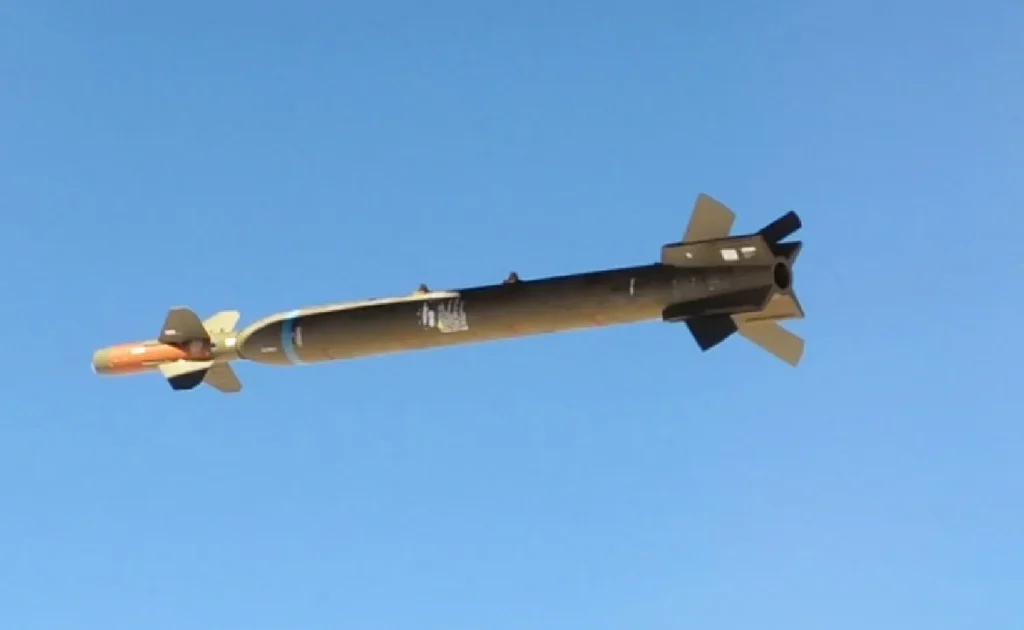
What sets the GBU-28 bomb apart isn’t just its size, though at over 4,000 pounds and roughly 19 feet long, it’s a behemoth, but its combination of precision and power.
The bomb was initially constructed using surplus Army M201 howitzer barrels, which were both heavy-duty and immediately available, allowing rapid prototyping. Fitted with a laser guidance system and packed with high explosives, such as Tritonal or AFX-757, the GBU 28 bunker buster can accurately hit deeply buried bunkers or command posts with pinpoint precision, guided by a laser designator from an aircraft or ground team.
Read also: How Do Bunker Buster Bombs Work? Mechanics Explained
Its effectiveness lies in its ability to penetrate extreme depths, up to 100 feet of earth or 20 feet of reinforced concrete, before detonation, destroying even the most secure underground facilities.
Since its first use in 1991, the bunker buster bomb has become synonymous with high-value target strikes and has influenced the development of even more powerful penetrators in later years. While newer models exist today, the GBU-28 remains a key part of the U.S. and allied arsenals due to its proven track record and specialized capabilities.
The story of the GBU-28 bunker buster is one of necessity-driven innovation. In early 1991, during the Gulf War, U.S. intelligence identified heavily fortified Iraqi bunkers, some buried deep beneath layers of earth and reinforced concrete, that conventional bombs simply couldn’t touch. With coalition forces preparing for a ground offensive and Saddam Hussein’s command bunkers still intact, the Pentagon issued an urgent call: build a bomb that could reach and destroy those targets. Timeframe? Less than a month.
In an extraordinary feat of engineering, the U.S. Air Force and defense contractors like Texas Instruments and Watervliet Arsenal collaborated to create what would become the GBU-28 bomb.
The team used 8-inch (203 mm) Army artillery barrels, specifically the M201 howitzer barrels, for the bomb’s casing. These heavy, durable barrels had already proven in battle and could be adapted quickly.
Engineers machined the barrels into bomb bodies, filled them with explosive material, and fitted them with laser guidance kits from the existing Paveway III system. Within just three weeks, a working prototype of the bunker buster bomb was ready for testing.
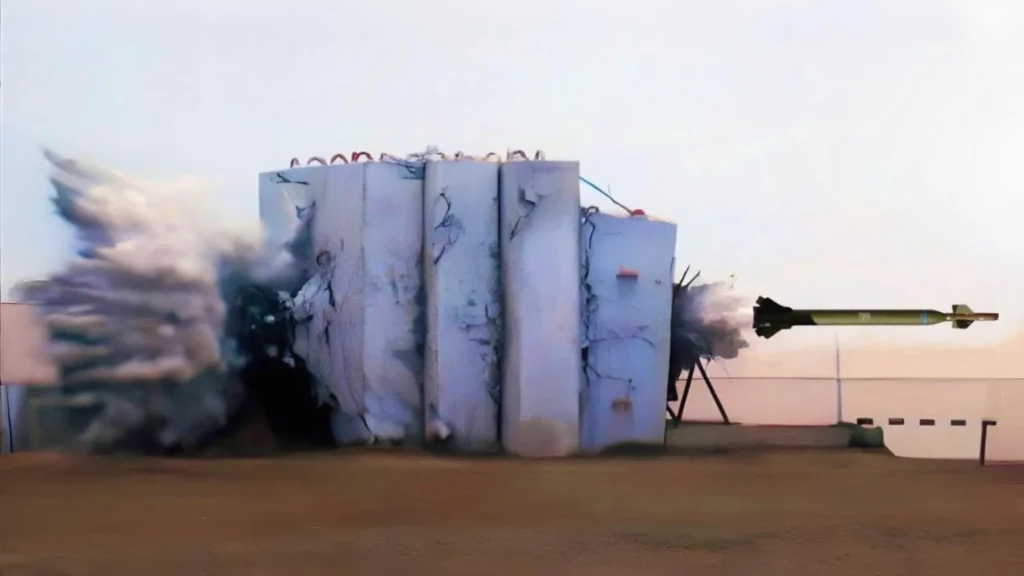
Testing began at the Tonopah Test Range in Nevada, where the bomb successfully demonstrated its ability to burrow through thick earth and concrete before exploding.
Read also: GBU-72 Bunker Buster: Inside the Advanced 5K Penetrator Bomb
On February 27, 1991, only days after testing began, two GBU-28s were dropped in combat by F-111F Aardvark aircraft over Iraq. Both struck their targets with precision, an underground bunker complex suspected of housing Iraqi command elements.
The results confirmed what the Pentagon had hoped: a deep-penetration bomb could be built fast, work reliably, and change the way modern wars are fought. The success of the GBU-28 bunker buster paved the way for a new era of precision-guided, hard-target munitions.
The raw power of the GBU-28 bunker buster bomb is reflected in its sheer physical and technical specifications. Weighing in at approximately 5,000 pounds (2,268 kg), this massive munition is 25 feet (7.6 meters) long and about 14.5 inches (37 cm) in diameter. It carries a high-explosive payload, typically around 630 pounds of Tritonal or the more advanced AFX-757, designed to create devastating underground shockwaves that collapse bunker walls and tunnels from within.
But weight alone doesn’t make the GBU 28 bomb a world-class penetrator. Its casing is what allows it to survive the brutal impact of high-speed ground penetration. Early versions used repurposed 8-inch artillery barrels made from tough alloy steel, which were strong enough to maintain structural integrity while burrowing through concrete and soil.
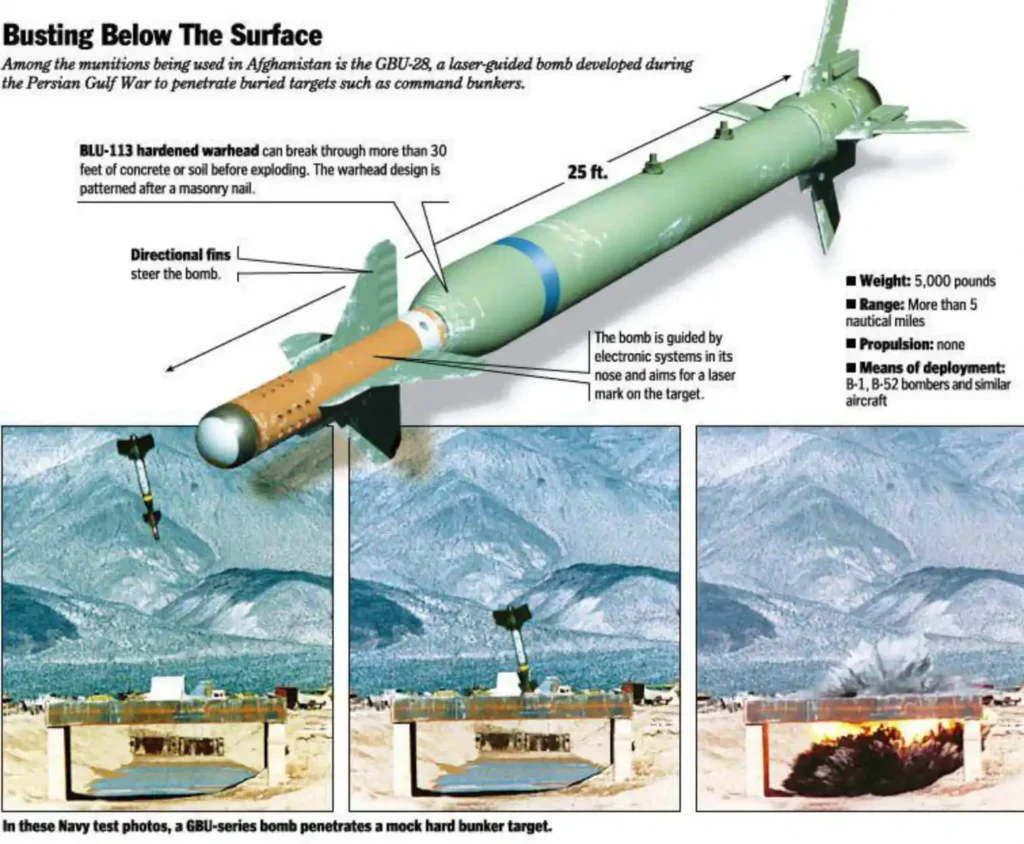
Later versions improved on this design with materials like Eglin steel and specially heat-treated alloys to boost penetration even further. When dropped from altitude, the bomb can hit the ground at speeds exceeding 700 miles per hour, more than enough force to bore through fortified defenses before detonation.
The guidance system is another core strength. The original GBU-28 used laser-guided targeting, allowing it to follow a beam to its mark with precision. Later models, such as the Enhanced GBU-28 (EGBU-28), incorporated dual-mode guidance combining laser and GPS/INS navigation.
This not only improved accuracy in all-weather or low-visibility conditions, but also allowed the bomb to hit targets that may not be actively painted with a laser. This makes the gbu 28 bunker buster not just powerful, but also smart, capable of adjusting its path mid-flight to strike exact coordinates, even in cluttered or hostile terrain.
In real-world terms, these capabilities mean the bunker buster bomb can neutralize underground bunkers, weapon depots, hardened aircraft shelters, and other critical assets that would normally be impervious to conventional airstrikes. It’s a precision instrument designed for complex missions where brute force must meet surgical accuracy.
Since its dramatic debut in the Gulf War, the GBU-28 bunker buster bomb has seen limited but highly strategic use in several major conflicts. Its role isn’t about volume—it’s about value. This is a weapon reserved for missions where standard bombs are ineffective and where buried, high-value targets must be taken out with absolute precision.
The first operational use occurred during Operation Desert Storm in 1991. Two GBU-28s were dropped by U.S. Air Force F-111Fs, targeting deep underground bunkers near Baghdad believed to be housing senior Iraqi military leadership.
The attacks demonstrated not only the bomb’s ability to penetrate hardened targets but also the military’s capacity to adapt rapidly under combat pressure. Despite the war ending just days later, the successful deployment validated the weapon’s strategic purpose.

The GBU 28 bomb was later employed during Operation Iraqi Freedom in the early 2000s, and reportedly used again by U.S. allies such as Israel in regional conflicts. Israel has incorporated the GBU-28 into its arsenal for potential strikes against deeply buried military installations in Syria and Lebanon and has considered its use in contingency plans involving Iran’s underground nuclear sites.
The bomb’s inclusion in U.S. arms shipments to Israel in multiple conflicts, most recently during escalations in Gaza and concerns about Iranian nuclear development, underscores its continuing relevance. Though not dropped in high quantities, every time a GBU-28 bunker buster is used, it carries a strategic message: no bunker is safe when you’re in the crosshairs of precision American airpower.
While the GBU-28 bunker buster was revolutionary when first introduced, it didn’t take long for military planners and engineers to push for even deeper, more destructive capabilities. Enter the GBU-57A/B Massive Ordnance Penetrator (MOP), a 30,000-pound behemoth designed to destroy targets buried far deeper than the GBU-28 bomb could ever reach.
To put it in perspective, the GBU-28 can penetrate up to 20 feet of reinforced concrete or around 100 feet of earth. Impressive, but limited in the face of certain high-security installations like Iran’s Fordow Fuel Enrichment Plant, which sits beneath a mountain and is designed to withstand all but the most extreme bunker buster bomb strikes.
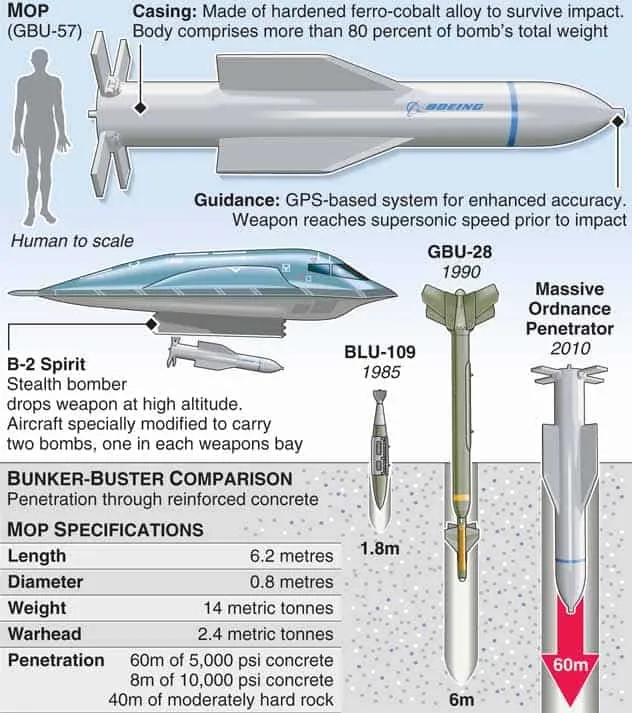
In contrast, the GBU-57 can burrow through over 200 feet of earth and more than 60 feet of reinforced concrete before detonation. Its size and weight require specialized aircraft like the B-2 Spirit stealth bomber for delivery, something the more versatile GBU-28 doesn’t demand.
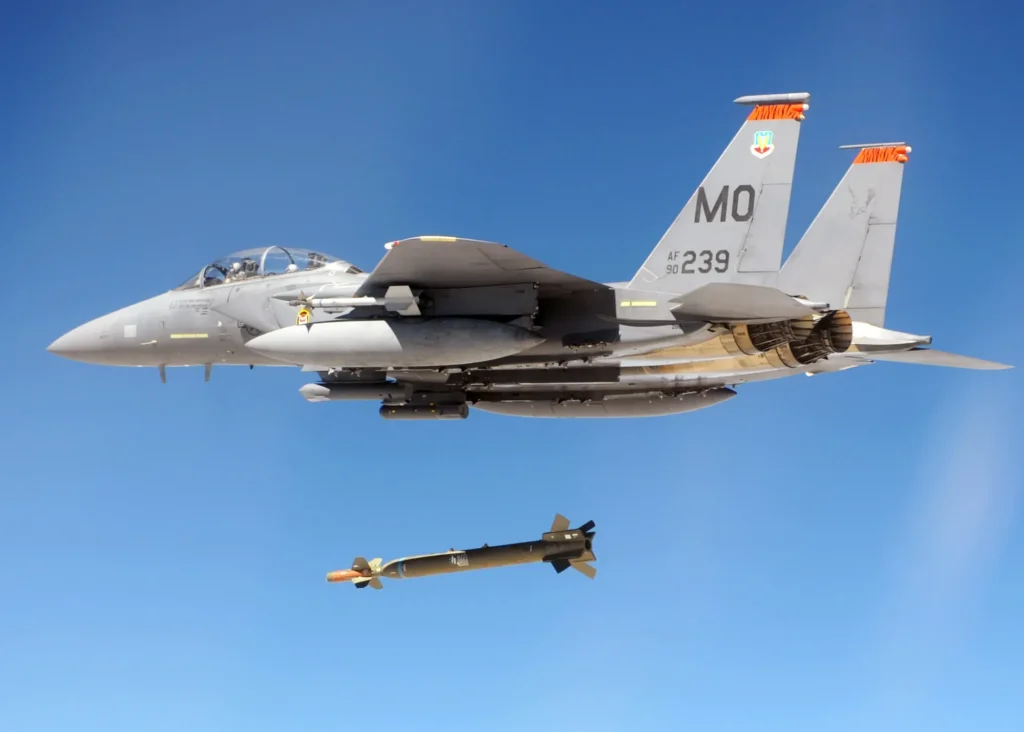
However, the GBU 28 bomb still holds an important place in the U.S. and allied inventory. It’s far more flexible than the MOP and can be deployed by a broader range of aircraft, including F-15Es, F-111Fs, and even modified F-16s. Its smaller size and lower cost (estimated at $200,000 to $500,000 per unit) make it a more practical option for missions that don’t involve extreme fortification.
Plus, modern upgrades—like the Enhanced GBU-28 with dual-mode GPS and laser guidance—have kept this bunker buster bomb relevant even as newer systems emerge. In short, while the GBU-57 may steal the headlines for its brute force, the GBU-28 bunker buster remains a proven, precise, and deployable tool for breaking hardened defenses.

While the GBU-28 bunker buster bomb was developed by the United States for its own strategic needs, its effectiveness quickly attracted the attention of key allies. Given the bomb’s specialized role in defeating deeply buried targets, it’s not a weapon that sees widespread export—but when it is transferred, it’s a signal of strong defense ties and mutual strategic interests.
Israel is perhaps the most well-known foreign operator of the GBU-28 bomb. In the mid-2000s, amid rising concerns about Iran’s nuclear facilities—many of which are protected deep underground—the U.S. approved a sale of GBU-28s to the Israeli Air Force.
These bunker buster bombs became a critical component of Israel’s long-range strike capabilities, specifically tailored for potential pre-emptive strikes on fortified installations in Iran or Syria. While these weapons have not been used in a high-profile strike on Iran, their presence is an integral part of Israel’s deterrence doctrine.
South Korea has also reportedly shown interest in the GBU 28 bunker buster, particularly given North Korea’s extensive network of underground military sites and nuclear test facilities.
Possessing deep-penetrating munitions offers a way to disrupt or destroy hidden command centers and missile launch infrastructure in the event of a high-intensity conflict. Although official delivery of GBU-28s to South Korea has not been confirmed publicly, discussions have emerged in the context of joint U.S.-ROK military planning.
Other nations, including Turkey and Saudi Arabia, have either requested or discussed acquiring the bunker buster bomb to bolster their strategic strike options.
However, due to the sensitive nature of the weapon and the specific mission scenarios in which it’s effective, the U.S. has remained selective in authorizing its export. In every case, the presence of the GBU 28 bunker buster in a nation’s arsenal represents a leap in its ability to counter fortified threats, above all, those buried in hardened concrete and hidden deep beneath the earth.