Follow Us:
Follow Us:

In early 2025, the U.S. Navy signed a $383 million contract with Lockheed Martin to extend the life of the Trident II D5, a submarine-launched ballistic missile first deployed in 1990, keeping it in service until the 2080s. On paper, that’s a remarkable engineering success in which a Cold War weapon is still relevant in the age of hypersonics and AI-driven warfare.
But this milestone comes at a moment of unease. A failed Trident test in January 2024 raised questions about reliability, while political uncertainty, particularly the UK’s dependence on U.S. maintenance and technology. This has exposed just how vulnerable this cornerstone of nuclear deterrence could be if alliances shift.
For some, the program’s continued investment is proof of the Trident’s unmatched strategic value; for others, it’s a costly commitment to an aging system that might not withstand emerging missile defenses and geopolitical shifts.
Debates over its accuracy, long-term reliability, and even the ethics of maintaining such destructive capability have become sharper in recent years, especially after high-profile test failures. In that context, how powerful is a Trident missile really, and how much of that power comes from technology versus the perception of deterrence?
The Trident missile is a submarine-launched ballistic missile (SLBM) designed to carry nuclear warheads over vast distances. In simple terms, it’s the weapon hidden deep inside Trident missile submarines, ready to be launched from beneath the ocean’s surface if deterrence fails.
Unlike land-based missiles, the Trident can move with its submarine, making it much harder for an enemy to find and destroy before it’s fired.

The idea behind the Trident missile system came during the late Cold War, when both the U.S. and the UK were looking for a secure, second-strike nuclear capability. If an adversary ever launched a surprise attack, these missiles could still retaliate.
That survivability became the backbone of strategic deterrence. The U.S. Navy began development in the 1970s, with the UK joining the program in the early 1980s to replace its older Polaris missiles.
Read also: US Advances Nuclear Deterrence with Next-Gen Trident II D5 Missile
There have been two main versions. The Trident I (C4) entered service in 1979, with a range of around 4,600 miles (7,400 km). It was advanced for its time but eventually gave way to the Trident II (D5), introduced in 1990.
The D5 was a leap forward, greater range, improved accuracy, and the ability to carry multiple Trident missile warheads that could be aimed at different targets. This “multiple independently targetable reentry vehicle” (MIRV) capability meant a single missile could hit several high-value sites.
To put it in perspective; if a Trident II submarine is somewhere in the Atlantic, it could, at least in theory, strike deep inside Eurasia without ever coming near the coast. This kind of reach and flexibility is why the missile remains in service today, even as newer technologies emerge.
Still, it’s worth noting that some analysts question whether an aging Cold War-era design, even with upgrades, can continue to outpace modern missile defense systems in the decades ahead.
When people talk about the Trident missile’s destructive power, they often go straight to the warhead. In reality, it’s the combination of warhead, guidance, and launch platform that makes the system what it is.
The Trident II D5 can be fitted with different nuclear warhead types, most notably the W76 and the W88. The W76, depending on the variant, has been reported in the 90–100 kiloton range, while the W88 is significantly larger, around 455 kilotons. There’s also a much smaller option, the W76-2, at roughly 5 kilotons, intended for more limited scenarios.
Read also: Fastest Missile in the World: Top 5 Ranked by 2026
Public sources suggest Trident II missiles can be configured with multiple warheads (MIRVs), but treaty practice and force-planning mean individual missiles typically carry fewer warheads than the theoretical maximum.
Why does that matter? yield gives a rough sense of destructive power, but the operational effect of a Trident system depends on how warheads are used (single large blasts vs. multiple smaller ones), accuracy, and the target type (soft city vs. hardened silo). That nuance is why asking “how powerful is a Trident missile?” can’t be reduced to a single number.

Of course, a warhead is only as effective as its accuracy allows. The Trident missile system uses an astro-inertial guidance (an inertial navigation system periodically corrected by star sightings) developed originally at Draper Laboratory.
This kind of guidance is intended to be robust against jamming or GPS denial, because it does not rely on continuous satellite signals in a contested environment. Some test flights have used GPS for calibration, but most sources assume GPS would not be available or would be treated as unreliable in a real nuclear conflict.
The Trident II also uses a post-boost vehicle (the “bus”) that maneuvers to release multiple reentry vehicles on separate trajectories (MIRVing), which increases flexibility in targeting. Reported circular error probable (CEP) numbers vary in open sources, but the D5 is generally regarded as significantly more accurate than earlier SLBMs, which amplifies its effectiveness against hardened or military targets.
Enhanced accuracy can translate into more military effect per warhead (i.e., the same yield will be more effective if you can aim precisely at a hardened target), which complicates simple comparisons based purely on yield.

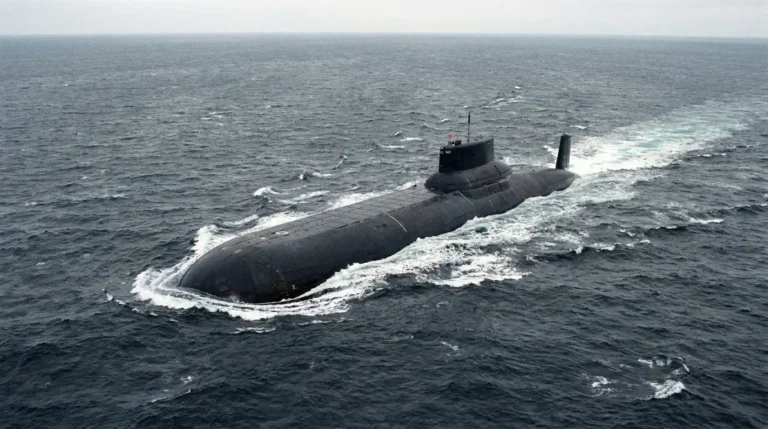
All of this is tied to the platform that launches it: the Ohio-class submarine. Each of these submarines can carry a full complement of Trident missiles, hidden beneath the ocean for months at a time. This stealth is the core of the missile’s strategic value.
A Trident launched from an Ohio-class sub on patrol is extremely difficult to pre-empt, making it a key part of the U.S. and UK’s second-strike capability. In other words, even if an adversary attacked first, these submarines could still respond with devastating force.
Example in practice: during the Cold War and since, SSBN patrols were deliberately dispersed around the oceans so that an enemy could not guarantee eliminating the submarine force in a first strike. That survivability is what gives a Trident-armed Ohio boat its strategic value—the weapon system’s destructive potential is inseparable from its covert launch platform.
Recent operational debates (e.g., force posture, life-extension budgets, and the political dependence between allies) show how platform choices and politics shape how much of that theoretical power is actually available.
Seen together, the warhead flexibility, precision guidance, and stealthy launch platform give the Trident nuclear missile its enduring reputation. But it’s worth remembering that much of this power exists on paper and in planning documents.
In practice, real-world effectiveness depends on maintenance, training, political decisions, and whether this Cold War–era system can keep pace with modern missile defenses in the decades ahead.
Answering this isn’t as simple as giving a single number. The power of a Trident missile comes from several interlocking factors; its explosive yield, the number and type of warheads it can carry, how it’s delivered, and the range and speed at which it strikes. Looking at each of these in detail helps put its real-world capability into perspective.
As explained earlier, The Trident II D5 can carry different types of warheads, the most powerful being the W88, estimated at around 455 kilotons. To put that into perspective, the bomb dropped on Hiroshima in 1945 was roughly 15 kilotons. That means a single W88 warhead could produce an explosion over 30 times more powerful, with a blast radius and heat wave capable of flattening an entire urban area and causing lethal burns miles from the detonation point.
Even the smaller W76 warhead, at roughly 90–100 kilotons, is about six times the power of Hiroshima. The low-yield W76-2, at about 5 kilotons, is closer to tactical nuclear weapons—intended, in theory, for more “limited” strikes—though its use would still cause massive destruction.
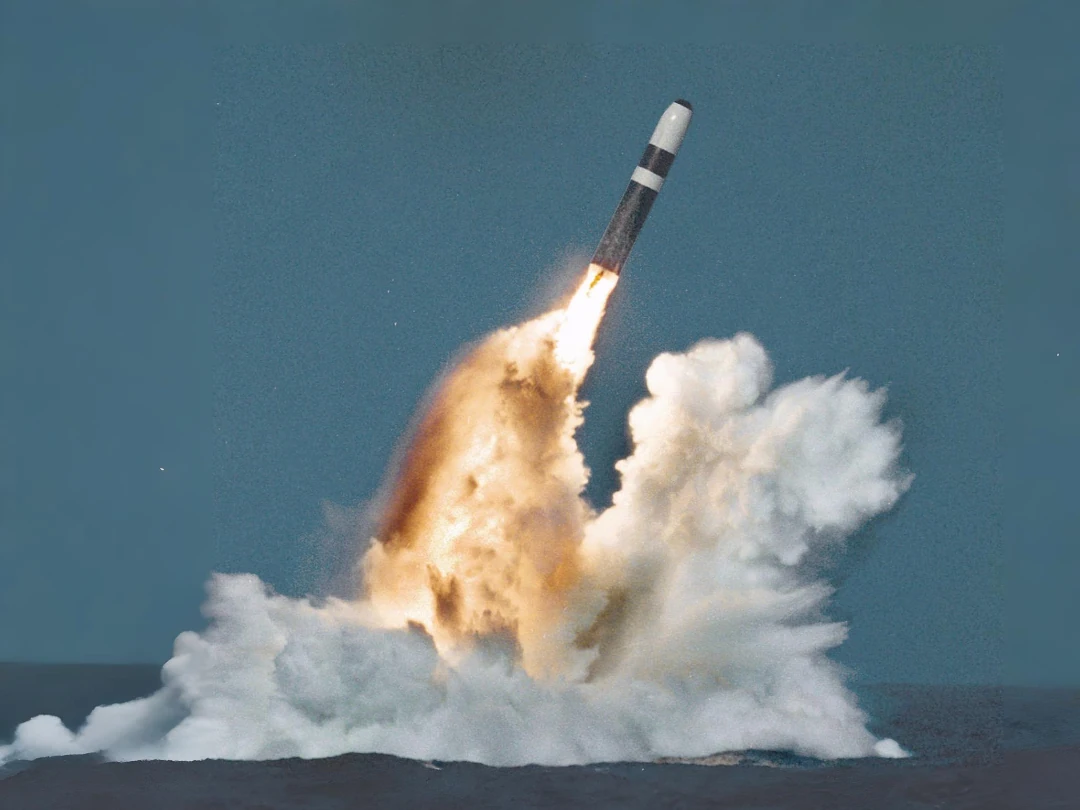
Then there’s the matter of how many warheads can be carried. A single Trident missile can hold up to eight MIRVs, allowing each warhead to strike a different location. This means that instead of concentrating damage in one spot, a single launch could hit multiple cities, airbases, or command centers in quick succession. From a strategic standpoint, that’s a force multiplier, overwhelming defenses and magnifying the weapon’s deterrent effect.
The way the missile is delivered further amplifies its power. Unlike land-based missiles, which can be targeted in a first strike, the Trident is a submarine-launched ballistic missile (SLBM). It’s fired from stealthy Ohio-class submarines (U.S.) or Vanguard-class submarines (UK) that can hide deep beneath the oceans for months.
This makes it nearly impossible for an adversary to know where the next missile might come from, ensuring that even if a nation’s land-based forces were destroyed, a retaliatory strike could still be launched. That “second-strike capability” is the backbone of nuclear deterrence and the reason the Trident missile system has remained in service for decades.
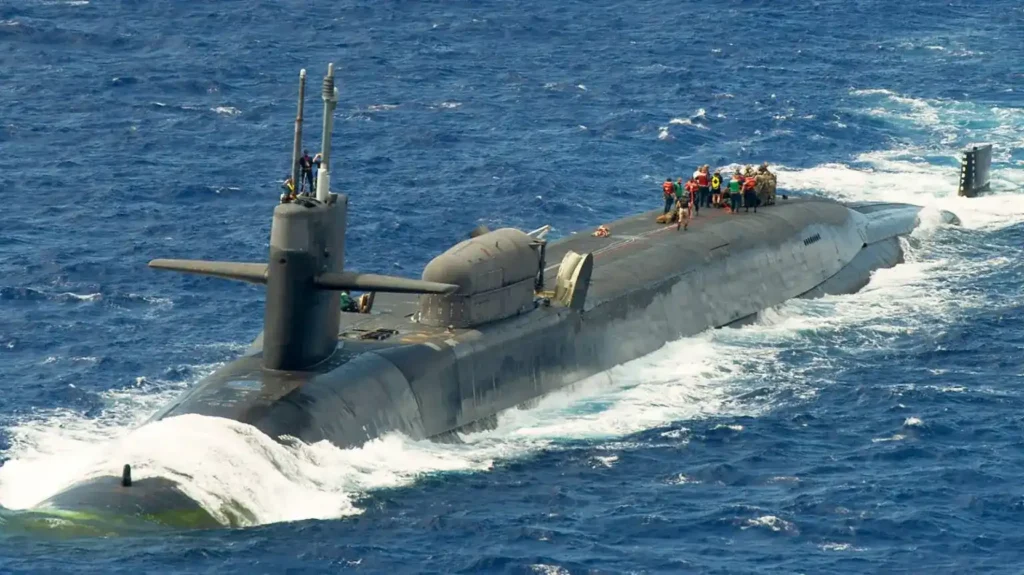
The Trident II D5 is reported to have a range exceeding 7,000 miles (11,000+ km), which means it could be launched from somewhere in the Atlantic and still hit deep inside Eurasia. Its speed is equally striking: during reentry, the warheads can exceed Mach 20 (over 15,000 mph).
At that velocity, they reach their targets in minutes, leaving virtually no time for defensive systems to respond. This combination of long reach and high speed means a Trident missile could, at least in theory, strike almost any target on Earth without warning.
Taken together, these factors suggest that the Trident missile’s power lies in the combination of destructive potential, flexibility in targeting, stealthy delivery, and near-global reach that makes it one of the most enduring and controversial strategic weapons in the world today.
Yet it’s worth remembering that much of this remains theoretical; the actual effectiveness in a real conflict would depend on political decisions, system readiness, and the unpredictable dynamics of nuclear war.
In both the United States and the United Kingdom, the Trident missile system sits at the heart of national nuclear deterrence. For the U.S., it’s one leg of the so-called nuclear triad, alongside land-based intercontinental ballistic missiles (ICBMs) like the Minuteman III and strategic bombers.
For the UK, it’s even more central, effectively the entire nuclear arsenal is based on Trident missile submarines. That means if the UK ever needed to respond to a nuclear threat, it would do so exclusively from beneath the ocean’s surface.
The logic behind this reliance is simple but sobering. Submarine-launched ballistic missiles like the Trident are extremely difficult to detect, track, and destroy before they launch. While land-based ICBMs are fixed targets and could be neutralized in a first strike, a ballistic missile submarine can be anywhere in the world’s oceans, hidden under thousands of feet of water.
This stealth ensures that even if an adversary managed to cripple a country’s land-based forces, the surviving submarines could still retaliate. From a deterrence standpoint, that lingering threat is meant to make any nuclear attack on the U.S. or UK an unthinkable gamble.
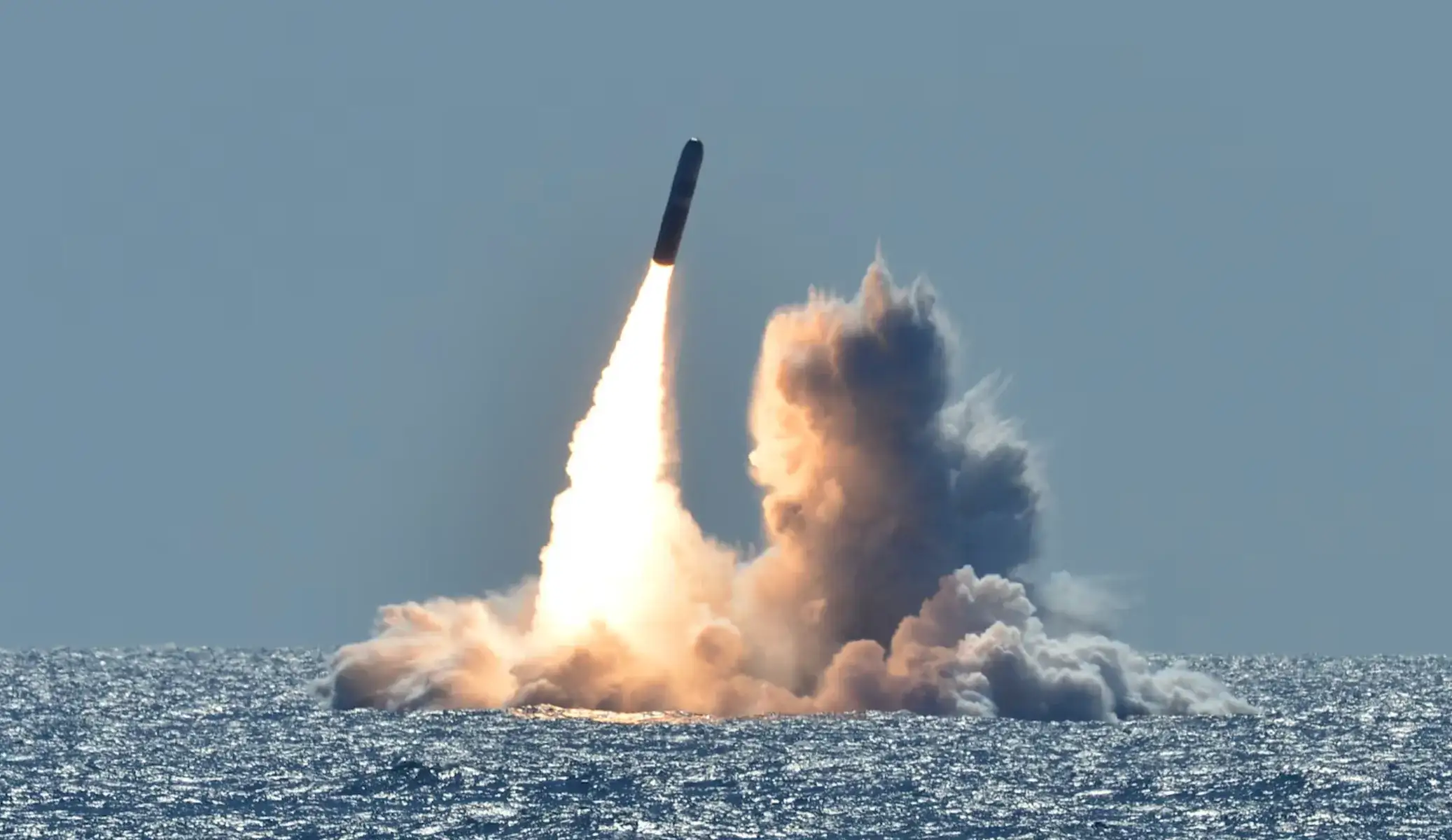
Compared to other strategic weapons, the Trident offers a different balance of strengths and trade-offs. The Minuteman III, for example, is a powerful U.S. ICBM with a range of about 8,000 miles and rapid launch capability, but it’s launched from silos whose locations are well known.
Russian systems like the RS-28 Sarmat boast enormous payload capacity and advanced counter-measures, but they operate in a geopolitical and strategic context very different from that of the Trident.
By contrast, the Trident missile doesn’t necessarily match the largest Russian warheads in raw yield, but its combination of long range, multiple independently targetable warheads (MIRVs), and the persistent invisibility of its launch platform has kept it one of the most credible and survivable deterrents in service.
That said, deterrence is as much about perception as it is about capability. Supporters argue the Trident missile’s unmatched survivability makes it indispensable, while critics question whether such an expensive and destructive system is still justified in an era of cyber warfare, hypersonic weapons, and shifting alliances.
Either way, it remains a cornerstone of strategic stability for two nuclear powers and possibly one of the most influential weapons in shaping how states think about the unthinkable.
In the end, the Trident missile is both a feat of engineering and a lightning rod for debate. On paper, its combination of high-yield warheads, global reach, and stealthy submarine-launched delivery makes it one of the most formidable weapons ever built.
But raw specifications don’t tell the whole story. Power in nuclear strategy isn’t just measured in megatons or miles per hour, it’s also about credibility, political will, and the belief that the system will work when it’s needed.
Its relevance, at least for now, seems secure. The Trident missile system offers a survivable, second-strike capability that few rivals can match. Yet questions remain.
Would it be as unstoppable in practice as it appears in theory, especially against emerging missile defenses? Is the cost of keeping it in service until the 2080s justified when security threats are evolving in ways that nuclear weapons may not address?
Critics point to test failures, reliance on decades-old designs, and the moral implications of wielding a weapon capable of wiping out cities in minutes. Supporters counter that as long as nuclear weapons exist, systems like Trident are the best insurance against their use. Perhaps that’s the paradox: the power of the Trident missile lies not only in its ability to destroy, but in the silent, persistent threat that ensures it never has to.