Follow Us:
Follow Us:

The M16 has this way of sitting in two worlds at once, part Cold War legacy, part blueprint for the rifles carried today.
It started as the sleek, lightweight newcomer that tried to drag the U.S. military into a more modern era, and even with its rocky debut in Vietnam, it eventually became the standard that shaped decades of small-arms design.
What’s interesting is how its influence hasn’t faded; it still shows up in today’s debates about accuracy, ergonomics, and what a “modern service rifle” should even look like.
What makes the M16 Rifle stand out now is how much of today’s gear traces back to it. The M4? Direct descendant. Most AR-15-style civilian rifles? Same roots. Even newer platforms, whether American, European, or somewhere in between, tend to borrow its low-recoil handling and modular layout.

And yet, the past never really leaves the conversation. People still bring up the early jamming issues, the rushed fielding, the lessons learned the hard way. But in a way, that contrast, early failure, long-term dominance, makes the M16’s story feel even bigger. It’s not just a rifle that succeeded; it’s one that had to evolve, adapt, and prove itself over time.
If you peel back the history a bit, the M16 rifle didn’t become famous by accident. It kind of showed up in the perfect storm of timing and technology. It came around during the Cold War, when the U.S. was rethinking pretty much everything about how soldiers should fight.
Lighter gear, faster movement, and higher-speed ammo were the big goals, and the M16 rifle fit that vibe almost uncannily well. It looked sleek and modern for its era and that alone made it feel like a leap into the future compared to the big, heavy rifles that came before it.
Its real “fame,” though, kicked off in Vietnam… and honestly, not all of it was positive. The rifle showed up as this cool new tool that was supposed to help U.S. troops work more effectively in thick jungle terrain. But those early versions had some pretty rough reliability issues.
Troops talked about jamming, confusing cleaning instructions, and just general frustration. Those stories spread fast, and they stuck. Even now, people still bring up those early problems almost automatically when the M16 comes up.
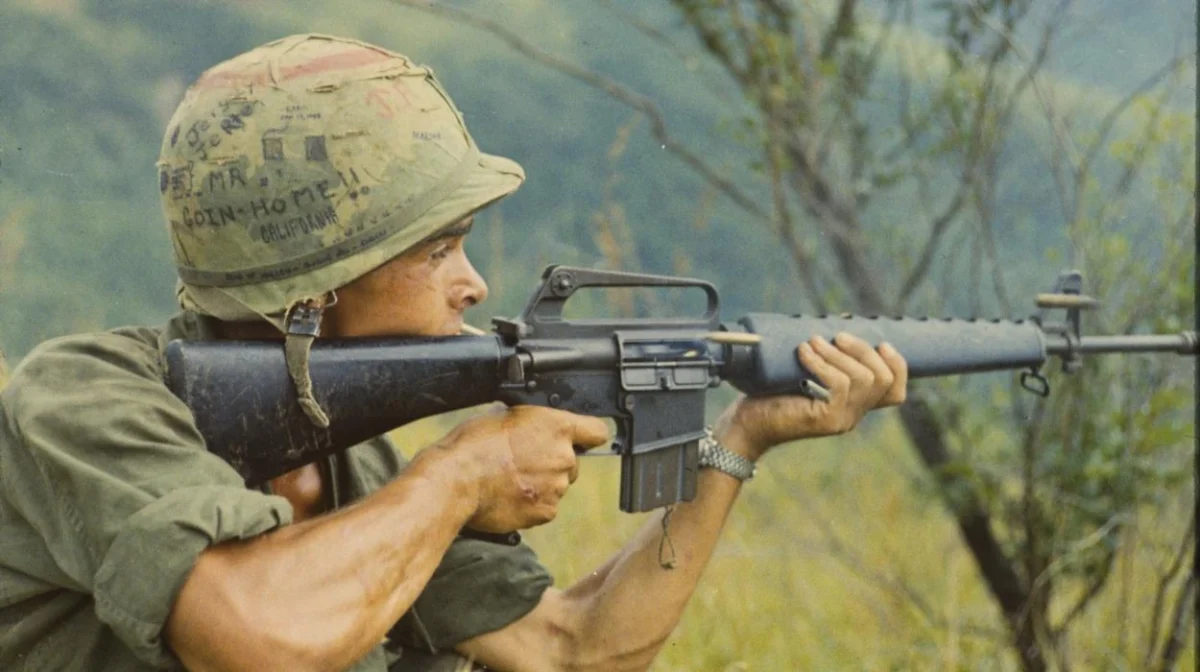
But over the years, the rifle was tweaked, corrected, and improved, and the later versions, especially the A2 and beyond, solved most of the original headaches. With all that, the M16 ended up becoming one of the most recognizable rifles on the planet.
So its fame is really this blend of smart design, early drama, and the fact that it was front and center during one of America’s most talked-about wars.
The M16 fires the 5.56×45mm NATO round, which might seem pretty light compared to older cartridges.
The idea was to give troops something with low recoil, decent range, and the ability to carry way more ammo without adding a ton of weight.
During the Cold War, that combination mattered; mobility and volume of fire were becoming just as important as raw power.
This round stays fast and flat over distance, which helps with accuracy. It also plays nicely with the rifle’s design since the M16 was built around high-velocity performance.
Most people think of the classic 30-round magazine, because that became the standard pretty quickly. But early on, the rifle actually used 20-round mags, and some units still keep those around because they can be easier to use in certain shooting positions.
Outside the military, there’s a huge range of magazine options; 40-round mags, drum mags, and even ultra-compact short mags. So, the capacity can change a lot depending on what someone chooses, but 30 rounds is the everyday norm.
In terms of practical accuracy, an M16 rifle usually feels comfortable out to about 550 yards (~500 meters) for a single target. That number can stretch farther for area fire, but the point-target range is the one most people talk about.
A few things influence how well it performs at distance:
So while the numbers look impressive on paper, the real-world accuracy can shift a bit based on conditions.
| Spec | Details (Typical M16A2/A3/A4) |
| Caliber | 5.56×45mm NATO |
| Standard Magazine Capacity | 30 rounds (older mags held 20) |
| Effective Range | Around 550 yards / ~500 meters for point targets; farther for area targets |
| Barrel Length | About 20 in / 508 mm |
| Overall Weight | Roughly 8.5 lb / ~3.9 kg loaded (varies by version) |
| Rate of Fire | ~700–900 rounds per minute (cyclic) |
When people stack the M16 against the AK-47, the debate almost feels endless, partly because both rifles were built with totally different priorities in mind.
The M16 leans toward accuracy and lighter handling, while the AK is more about brute toughness and raw simplicity. So any honest comparison usually ends with “it depends,” because each rifle shines in different situations.
Read also: AK-47 Kalashnikov: What Makes It So Dangerous
In terms of accuracy, the M16 rifle usually has the edge. Its lighter recoil and straighter design make it easier to keep shots tight, especially at medium to longer ranges.
The AK can still get the job done, of course, but it was never designed around precision. It was designed to keep working in almost any environment.
And that’s where the AK tends to pull ahead: reliability. Its reputation for shrugging off mud, dust, and general abuse is basically legendary.
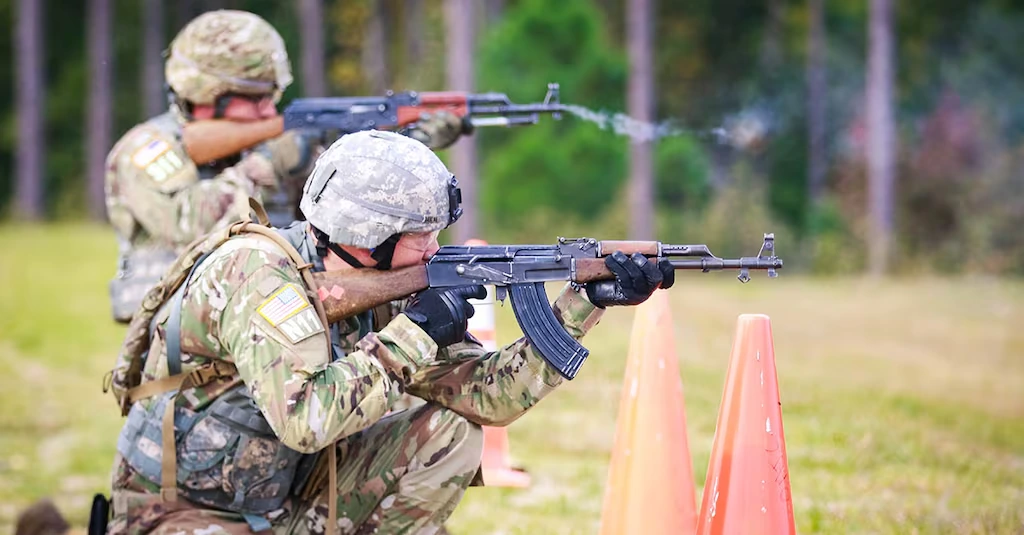
The M16 eventually became very reliable, too, especially in later generations, but the early Vietnam-era issues still hang over the conversation and make people a little cautious when comparing the two.
The feel of the rifles is different as well. The M16 is noticeably smoother to shoot because the 5.56mm round is light and fast, which helps with control during rapid fire.
Read also: M7 Rifle Specs You Should Know & How It Compares to the M4
The AK’s 7.62×39mm round hits harder, and it also kicks a bit more. That heavier round does give the AK more close-range stopping power, though, while the M16 relies on high velocity and fragmentation to do its work, which can be very effective but tends to depend more on distance and ammo type.
If the discussion is about ballistic power, the AK-47’s round generally wins. It’s slower but heavier, and it hits with more energy at close to mid ranges. The M16’s 5.56mm is all about speed and fragmentation, which can be extremely effective, but it’s more dependent on distance and bullet type.
So, which rifle is “better”? It honestly comes down to what someone values. The M16 is a great fit for forces that want accuracy, lighter gear, and modern attachments. If the priority is simplicity, durability, and raw stopping power, the AK platform tends to make more sense.
One of the biggest problems was the ammo change. The rifle was originally designed around a specific type of powder, but the ammunition that ended up being sent to Vietnam used a different powder that burned dirtier.
That meant the rifle was building up carbon way faster than expected, and nobody in the field had been warned about it. On top of that, early M16s didn’t have chrome-lined chambers and barrels, which made them more vulnerable to corrosion and stuck cartridges, especially in the humid jungle environment.
Then there was the issue of cleaning kits or rather, the lack of them. Troops were told the rifle was “self-cleaning,” which, in hindsight, sounds absolutely wild. Many units didn’t receive proper cleaning tools or instructions at first, so soldiers were trying to keep a sensitive new rifle running in some of the harshest conditions on Earth without the gear they needed.
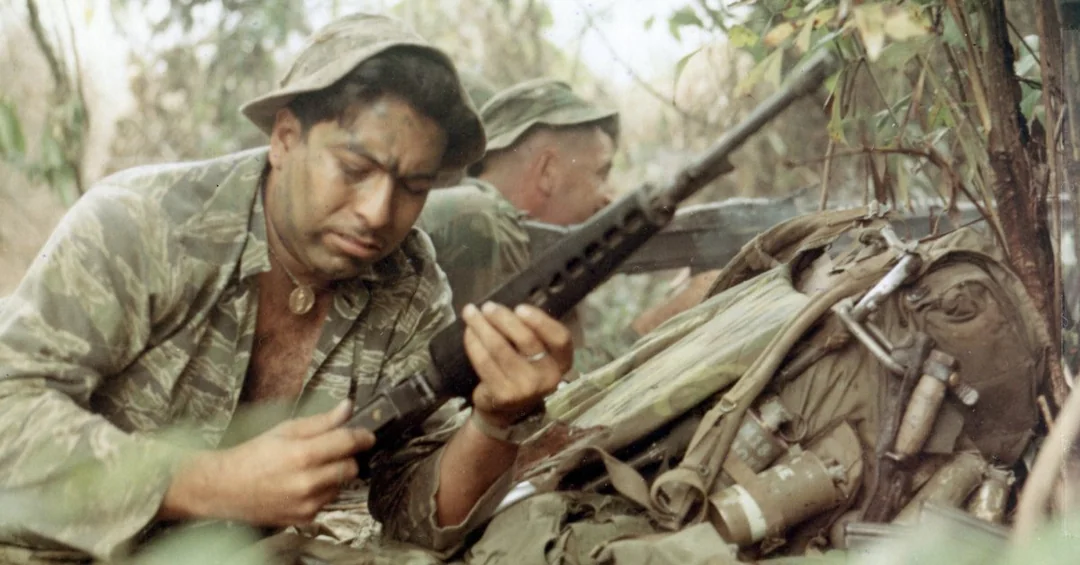
Over time, the fixes started rolling in. Chrome-lined chambers became standard, better powder was used in the ammo, cleaning kits were widely issued, and training changed to emphasize proper maintenance.
Later versions of the M16 ended up being much more reliable, and today most of those early issues are viewed as painful lessons rather than permanent flaws.
The story of why the U.S. military eventually stepped away from the M16 isn’t about the rifle failing. It’s more about the battlefield changing.
Over the years, troops needed weapons that were easier to maneuver in tight spaces, worked better with accessories, and didn’t weigh quite as much once you added all the modern gear on top.
The M16 could still perform, but its long barrel and overall length made it feel a bit out of place in situations where speed and mobility mattered.
The immediate replacement was the M4 carbine, which is basically the M16’s shorter, more flexible descendant. It kept the same general design but trimmed the barrel, lightened the load, and added a fully modernized rail system so optics, lights, and other attachments could be swapped around without much effort.

As fighting shifted more toward urban environments and vehicle-based operations, that shorter profile became a huge advantage.
After that, newer programs like the Next Generation Squad Weapon (NGSW) started exploring what might come next, mostly rifles built around new calibers and lighter materials. So the M4 took over day-to-day duties, while future rifles are being tested for whatever comes after.
Honestly, the big reason is mobility.
The M4 is just easier to handle in tight spaces; inside vehicles, around corners, or in urban areas. Its collapsible stock makes it easier to fit different body types and gear setups, and its shorter barrel still keeps solid performance without feeling unwieldy.
Add in the fact that soldiers could customize it quickly with optics and accessories, and it made sense for the M4 to become the main workhorse.
In simple terms: the M16 set the foundation, but the M4 fit the modern workflow better.