Follow Us:
Follow Us:

Picture this for a second. Two fighter jets streak across the sky at supersonic speed, both designed to dominate modern air combat, both wrapped in secrecy, and both carrying the weight of national pride. That’s the heart of the Su-57 vs F-22 debate. It isn’t just about which aircraft flies faster or turns tighter. It’s a contest between two military philosophies that grew up on opposite sides of the world.
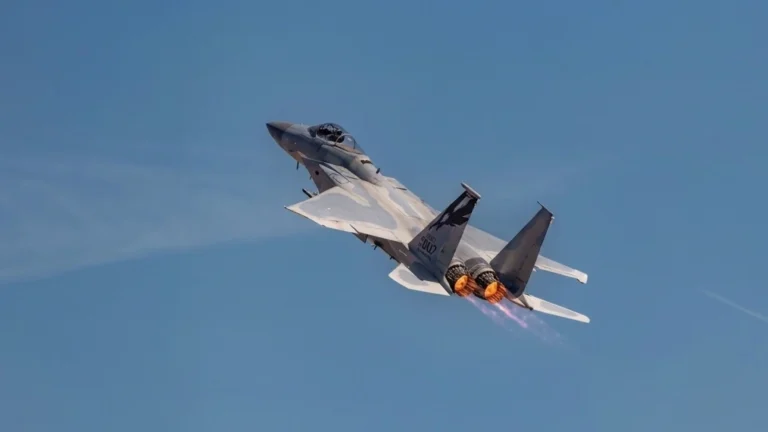
The F-22 Raptor was America’s answer to a simple question: how do you defeat an enemy before they even know you’re there? The result was a stealth-focused air superiority fighter packed with advanced sensors and the ability to cruise at supersonic speeds without afterburners.
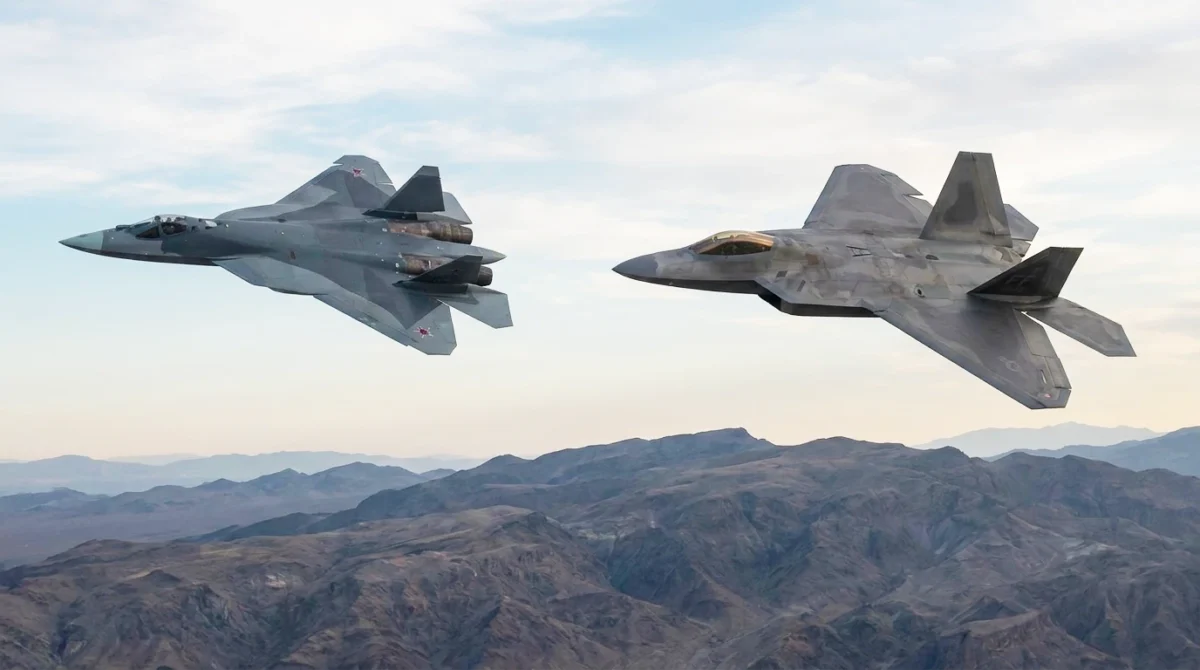
Russia’s Su-57 Felon, meanwhile, followed a different script. Its designers aimed for a fighter that could hunt enemy aircraft, strike ground targets, and perform dramatic high-angle maneuvers that look almost impossible at air shows.
Here’s where things get interesting. Comparing these aircraft isn’t like comparing sports cars on a drag strip. A modern fighter’s success depends on radar coverage, electronic warfare, missile technology, pilot training, maintenance, and even the quality of intelligence feeding into the mission. One jet might have an edge on paper but face very different realities in combat.
Throughout this Su-57 vs F-22 comparison, we’ll cut through the speculation and examine the facts behind their stealth capabilities, speed, maneuverability, avionics, weapons, combat history, and operational roles.
Ask ten aviation enthusiasts about the most important part of the Su-57 vs F-22 comparison, and chances are most will say one word: stealth. It’s easy to see why. In modern air combat, the aircraft that spots its opponent first often gets the first missile launch, and that can decide the fight before either pilot lays eyes on the other.
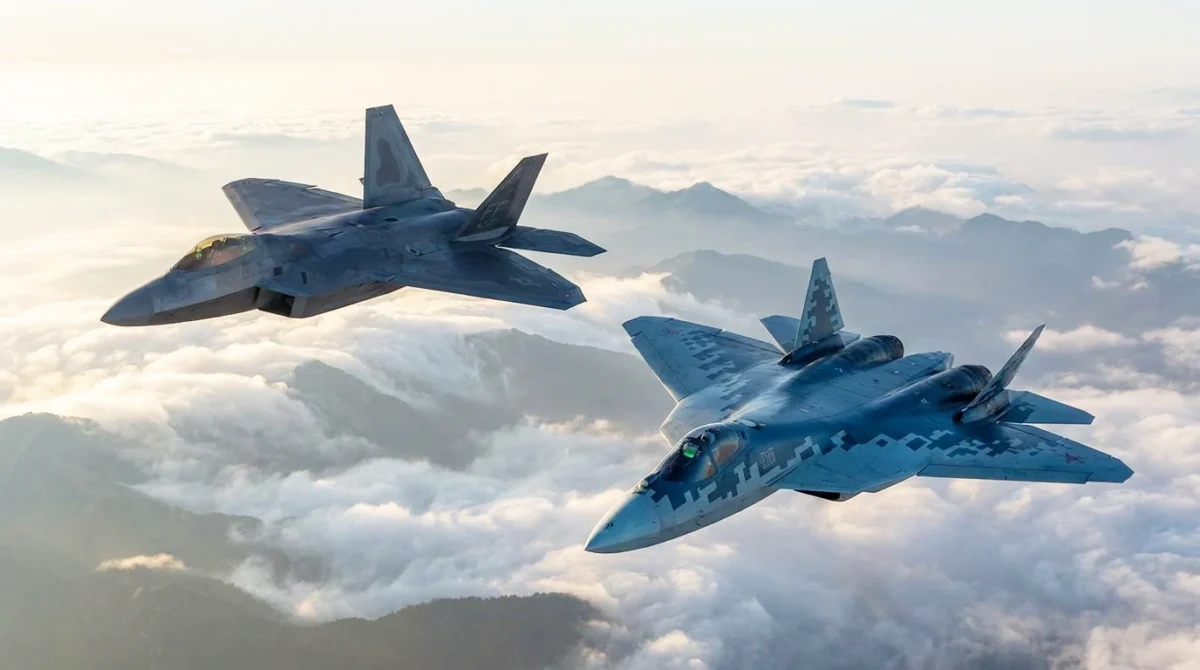
The F-22 Raptor was designed with stealth as a top priority from day one. Its sharply angled fuselage, carefully shaped engine inlets, internal weapons bays, and radar-absorbing materials all work together to reduce its radar cross-section.
Even details that seem minor, like the alignment of panel edges, were engineered to scatter radar waves rather than reflect them back to an enemy sensor.
The Su-57 Felon also incorporates stealth features, but its designers appear to have balanced low observability with other priorities.
The aircraft uses internal weapon bays and radar-absorbing coatings, yet some external design elements, such as exposed engine features and a less aggressively blended airframe, have led many defense analysts to suggest it may not match the F-22’s level of radar concealment.
Stealth, though, isn’t a magical invisibility cloak. A fighter can reduce the distance at which it’s detected, but it can’t disappear completely.
Modern battlefields include ground-based radars, infrared search-and-track systems, satellites, and electronic warfare platforms, all working together to find and track aircraft.
That’s what makes the Su-57 vs F-22 stealth debate so fascinating.
The F-22 appears to prioritize remaining hidden for as long as possible, while the Su-57 combines reduced visibility with active sensors and electronic countermeasures. One strategy aims to avoid being seen.
The other accepts that detection may happen and focuses on complicating the enemy’s ability to respond. In a real conflict, both approaches would be tested by far more than radar alone.
Speed has always captured the imagination. It’s the statistic people remember, the one splashed across headlines. But in the Su-57 vs F-22 debate, raw velocity tells only part of the story.
A modern fighter isn’t trying to win a drag race; it’s trying to arrive at the right place, with enough energy to fight and enough fuel to get home.
| Performance Feature | Su-57 Felon | F-22 Raptor |
| Maximum Speed | Mach 2.0 | Mach 2.25 |
| Supercruise | Estimated Mach 1.3+ | Around Mach 1.8 |
| Combat Radius | ~1,500 km | ~850 km |
| Service Ceiling | ~20,000 m | ~20,000 m |
On paper, the F-22 Raptor enjoys a slight advantage in top speed. More importantly, it’s famous for its supercruise capability, the ability to maintain supersonic flight without using fuel-hungry afterburners. That translates into longer patrol times, reduced infrared signature, and the ability to engage or disengage quickly.
The Su-57 Felon counters with impressive range and endurance. Its larger airframe carries more fuel, giving it a significantly greater combat radius.
For a country with vast geographic distances to cover, that wasn’t an accident. Russian designers valued the ability to operate over long stretches of territory without constant tanker support.
Then there’s agility. Both fighters use thrust-vectoring technology, allowing their engines to help steer the aircraft during extreme maneuvers.
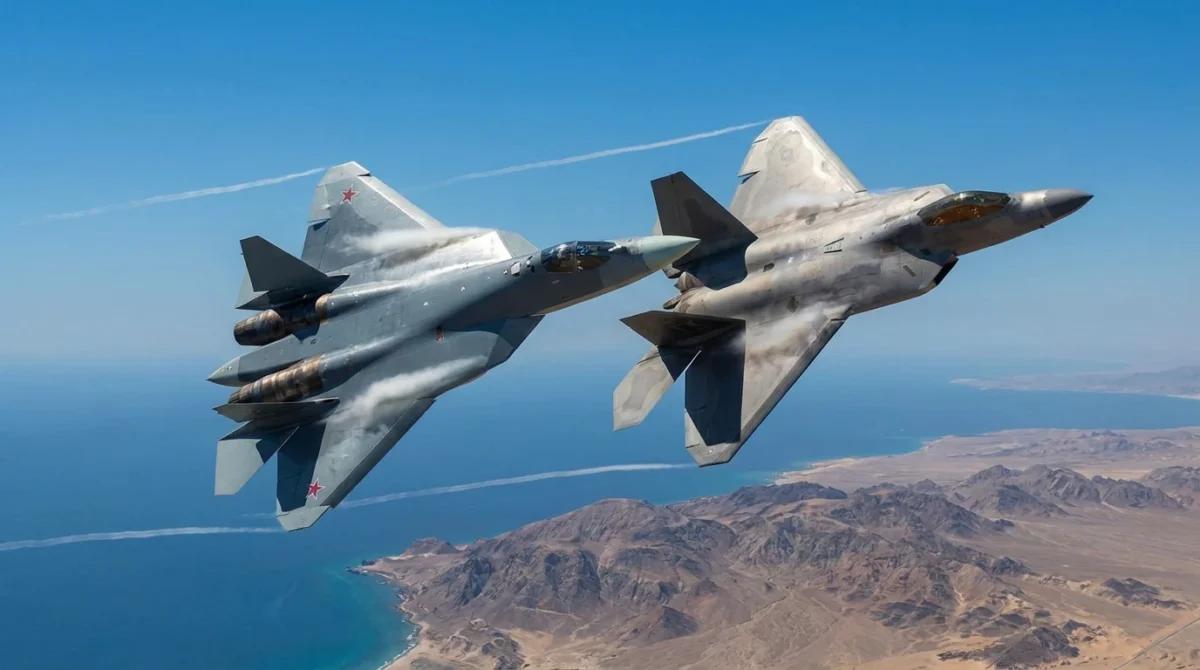
The Su-57’s three-dimensional thrust vectoring is particularly eye-catching during demonstrations, while the F-22 combines two-dimensional vectoring with exceptional energy management at high speeds.
Here’s the catch. In modern air warfare, pilots rarely win by simply flying faster than the other aircraft. Acceleration, sustained performance, fuel efficiency, and the ability to carry speed through a maneuver often matter more than a headline-grabbing top speed.
In the Su-57 vs F-22 comparison, the F-22 appears to favor high-speed air dominance, while the Su-57 trades a bit of outright pace for greater range and operational flexibility, a classic case of different priorities shaping different strengths.
Here’s a hard truth about modern air combat: the best dogfight is the one that never happens. In the Su-57 vs F-22 comparison, radar and avionics may matter even more than speed or maneuverability because they determine who finds the other aircraft first, and who gets the first shot.
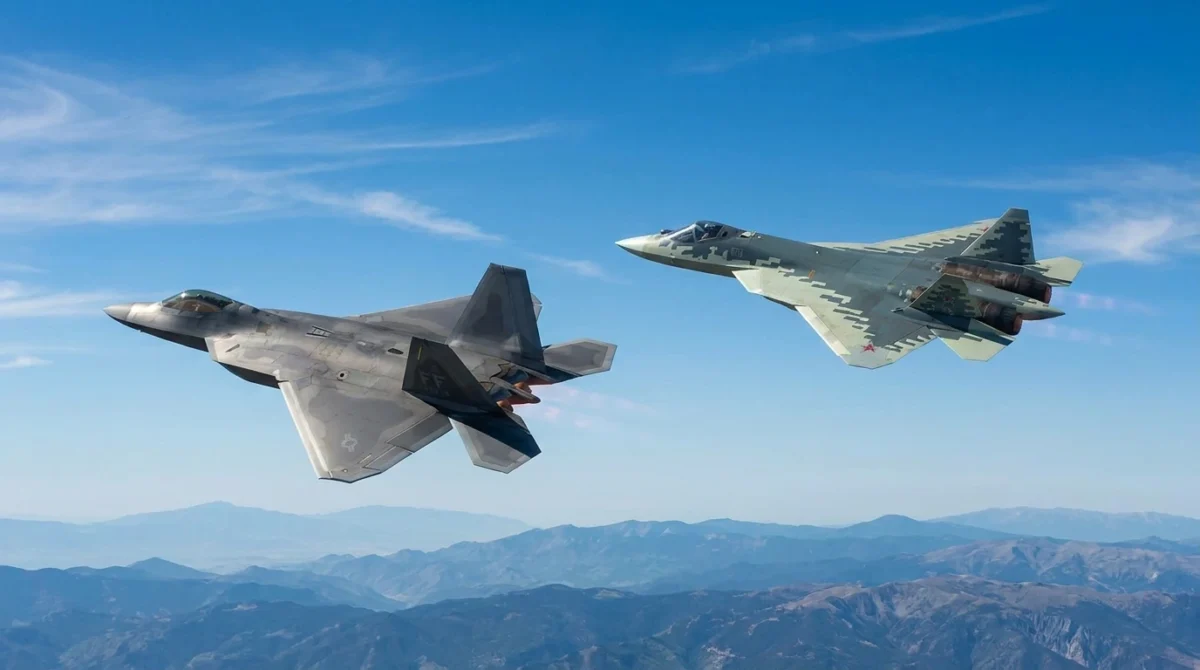
The F-22 Raptor was built around this idea. Its AN/APG-77 active electronically scanned array (AESA) radar can track multiple targets while operating with a low probability of interception, reducing the chance that enemy sensors will detect its emissions.
Add advanced sensor fusion, and the pilot receives information from radar, electronic support systems, and other sources in a single, streamlined picture rather than a flood of separate data.
The Su-57 Felon takes a broader approach. Its N036 Byelka radar suite reportedly combines several AESA arrays positioned around the aircraft, expanding coverage beyond the traditional forward arc.
The jet also incorporates an infrared search-and-track (IRST) system, allowing it to detect heat signatures without relying solely on radar emissions, a useful capability against stealthy opponents.
| Avionics Feature | Su-57 | F-22 |
| AESA Radar | Yes | Yes |
| Sensor Fusion | Advanced | Highly Advanced |
| IRST System | Integrated | Limited Dedicated Capability |
| Electronic Warfare | Comprehensive | Advanced |
| Network-Centric Operations | Yes | Yes |
Think of it this way. Radar is the aircraft’s eyes, but avionics are its brain. A fighter that gathers huge amounts of information but can’t process it quickly is like a driver staring at six GPS screens at once.
The challenge in the Su-57 vs F-22 radar debate is that many of the most important specifications remain classified. Detection ranges, electronic warfare capabilities, and software upgrades are closely guarded military secrets.
Publicly, the F-22 is often credited with exceptionally mature sensor fusion and stealth-focused targeting, while the Su-57 emphasizes a mix of radar, infrared tracking, and electronic warfare to create a layered detection system. Different methods, same objective: spot the enemy first and make sure they never get the chance to return the favor.
A fighter jet can have world-class stealth and dazzling maneuverability, but without effective weapons, it’s little more than an expensive aerobatic machine.
In the Su-57 vs F-22 comparison, both aircraft carry formidable arsenals, though they were designed with different combat philosophies in mind.
One rule shaped both fighters: stealth works best when weapons are hidden. That’s why the F-22 Raptor and Su-57 Felon use internal weapons bays, reducing radar reflections that external missiles and bombs would create. It’s a clever compromise between firepower and survivability.
| Weapons Feature | Su-57 | F-22 |
| Internal Weapons Bays | Yes | Yes |
| Primary Air-to-Air Missile | R-77M | AIM-120 AMRAAM |
| Short-Range Missile | K-74M2 | AIM-9X Sidewinder |
| Internal Cannon | 30 mm | 20 mm |
| Air-to-Ground Capability | Extensive | Limited but Effective |
The F-22 was built primarily for air superiority. Its typical combat load includes AIM-120 AMRAAM missiles for beyond-visual-range engagements and AIM-9 Sidewinders for close combat. If missiles aren’t enough, it also carries a 20 mm M61A2 Vulcan cannon. The aircraft can attack ground targets, but that wasn’t its original calling card.
The Su-57, meanwhile, embraces versatility. Alongside advanced air-to-air missiles such as the R-77M and K-74M2, it was designed to carry a wider variety of precision-guided air-to-ground weapons.
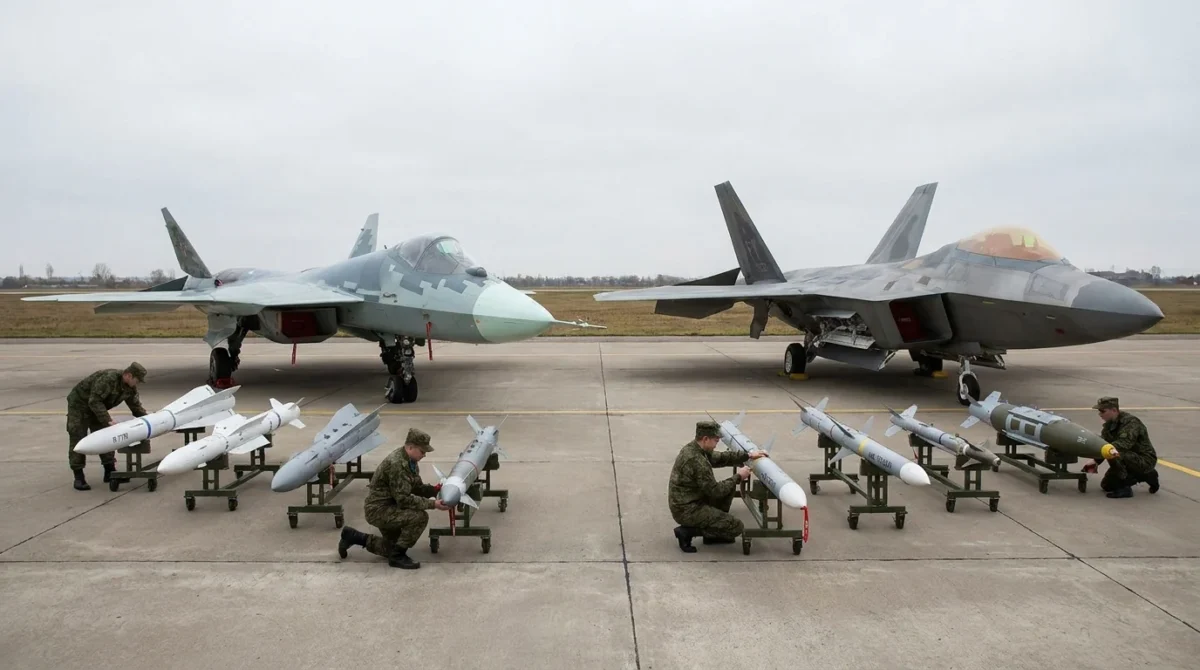
Russia has also discussed integrating next-generation hypersonic and long-range munitions, though the full operational picture continues to evolve.
An interesting twist in the Su-57 vs F-22 weapons debate is that missiles often matter more than the aircraft carrying them.
Modern air combat increasingly revolves around beyond-visual-range engagements, where sensor quality, electronic warfare, and missile guidance can outweigh raw aircraft performance.
In the end, both fighters pack enough firepower to threaten almost any airborne opponent.
The F-22 leans toward precision air dominance, while the Su-57 favors a broader mix of missions and weapon options. It’s another example of two advanced aircraft chasing the same goal through very different design choices.
When people compare the Su-57 vs F-22, they usually focus on stealth, speed, or missiles. Yet there’s another contest happening behind the scenes, one fought in factories, maintenance hangars, and government budgets.
After all, the world’s best fighter isn’t much use if a country can’t afford to build and operate enough of them.
Here’s a side-by-side look at publicly available estimates:
| Category | Su-57 Felon | F-22 Raptor |
| Service Entry | 2020 | 2005 |
| Estimated Unit Cost | $35–50 million | $143 million (flyaway) |
| Estimated Program Cost per Aircraft* | N/A | ~$350 million |
| Aircraft Built | 40+ estimated | 195 total |
| Production Status | Active | Ended in 2012 |
| Export Availability | Potential | Not Available |
At first glance, the Su-57 looks like the bargain of the two.
Russian officials and defense analysts generally estimate its unit cost between $35 million and $50 million, though exact figures are difficult to verify because procurement contracts are rarely transparent. The lower price reflects Russia’s goal of fielding an advanced multirole fighter without matching the enormous expense of some Western programs.
The F-22 Raptor tells a different story. Its flyaway cost, the price of building one additional aircraft, was roughly $143 million near the end of production.
Factor in decades of research and development, and the effective program cost per aircraft climbs to around $350 million. That’s one reason the original production target of more than 700 aircraft was eventually cut to 195.
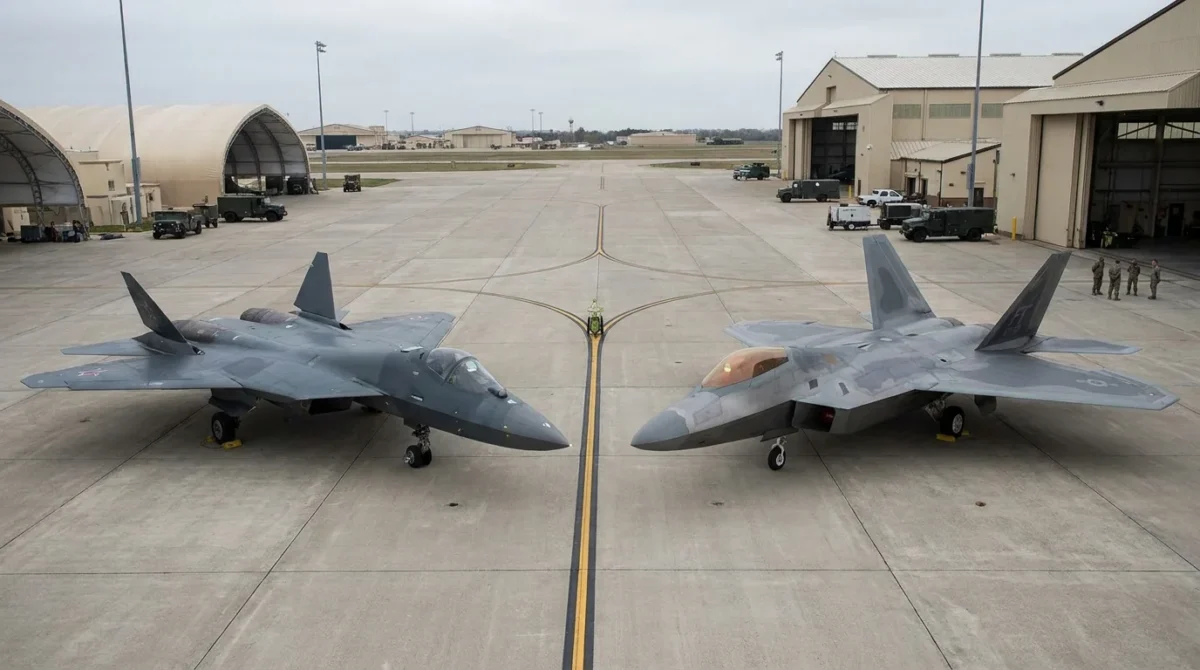
Cost, however, isn’t just about buying the jet. Operating expenses matter too. Estimates suggest the F-22 can cost $80,000–$90,000 per flight hour, reflecting its sophisticated stealth coatings and advanced maintenance requirements. Reliable figures for the Su-57 are scarce, but analysts generally expect lower operating costs due to its design priorities and simpler maintenance philosophy.
The production story is just as revealing. The F-22 line closed in 2012, making every existing aircraft a valuable strategic asset for the U.S. Air Force.
The Su-57, meanwhile, remains in active production, with Russia gradually expanding its fleet and exploring export opportunities.
The real takeaway from the Su-57 vs F-22 cost comparison isn’t that one fighter is “cheap” and the other is “expensive.” It’s that they were built for different economic realities.
The United States invested heavily in achieving unmatched air superiority, while Russia pursued a balance between advanced capability, affordability, and long-term fleet growth.
In military aviation, strategy shapes the budget just as much as technology shapes the aircraft.
This is the question everyone wants answered. Search for “Su-57 vs F-22 dogfight”, and you’ll find endless videos, forum debates, and animated simulations declaring a clear winner.
The reality? Modern air combat is far less dramatic, and far more complicated, than a Hollywood-style turning battle.
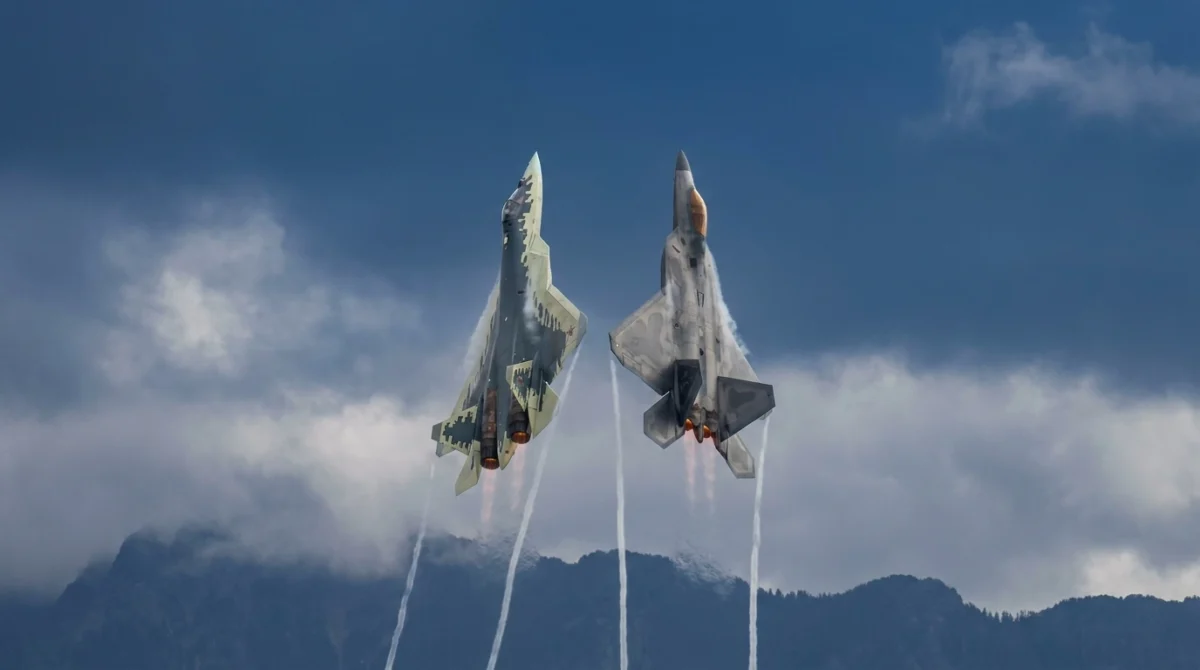
The first thing to understand is that a real engagement would likely begin long before the pilots could see each other. Both aircraft carry advanced sensors and beyond-visual-range (BVR) missiles designed to detect, track, and engage targets from significant distances.
In this phase, the F-22 Raptor’s combination of low observability, mature sensor fusion, and supercruise could provide a meaningful advantage by allowing it to identify threats while remaining difficult to detect.
If the fight moved into visual range, the picture changes. The Su-57 Felon was designed with exceptional agility in mind, featuring three-dimensional thrust vectoring and high-angle-of-attack performance.
Combined with advanced short-range missiles and helmet-mounted targeting systems, these traits could make it a dangerous opponent in close combat.
| Combat Scenario | Potential Edge |
| Beyond Visual Range | F-22 |
| Stealth Engagement | F-22 |
| Extreme Maneuverability | Su-57 |
| Long-Range Operations | Su-57 |
| Operational Experience | F-22 |
| Mission Flexibility | Su-57 |
Here’s the catch that often gets overlooked. Fighter pilots don’t fight alone. Airborne early warning aircraft, satellites, ground-based radar, electronic warfare systems, drones, and even refueling tankers all influence the outcome. A pilot with better information can overcome an opponent with slightly better aircraft performance.
Training also matters. Military history is full of examples where superior tactics defeated superior technology. An experienced crew supported by a well-coordinated network can turn small advantages into decisive victories.
So, who wins the hypothetical Su-57 vs F-22 dogfight? The honest answer is that no one can know with certainty unless the two aircraft meet under real combat conditions, and even then, the result would depend on the mission, the environment, the pilots, and the support around them.
The F-22 appears optimized to avoid a close fight altogether, while the Su-57 offers impressive versatility if the battle becomes unpredictable.
The most realistic verdict isn’t a knockout. It’s that modern air warfare is a team sport, and the aircraft are only one part of the equation.
After comparing stealth, speed, weapons, and combat experience, it’s tempting to ask a simple question: Which fighter has better technology? The trouble is, the answer depends on what “better” means.
In the world of fifth-generation aircraft, technology isn’t a single feature, it’s an ecosystem where sensors, software, engines, and weapons all work together.
A quick comparison helps put things into perspective:
| Technology Category | Advantage |
| Stealth Design | F-22 |
| Sensor Fusion | F-22 |
| Supercruise | F-22 |
| Combat Experience | F-22 |
| Thrust Vectoring | Su-57 |
| Infrared Search and Track | Su-57 |
| Combat Radius | Su-57 |
| Multirole Flexibility | Su-57 |
The F-22 Raptor represents a philosophy of specialization. Its technology is heavily focused on achieving air superiority through stealth, advanced avionics, and networked operations.
Even though the aircraft entered service two decades ago, continuous software and hardware upgrades have helped keep it relevant against emerging threats.
The Su-57 Felon takes a broader approach. Instead of maximizing one characteristic, it balances stealth with maneuverability, long-range operations, electronic warfare, and multirole capability.
The inclusion of an integrated infrared search-and-track system and extensive use of composite materials reflects Russia’s effort to create a fighter that can adapt to a wide variety of missions.
There’s another factor that’s easy to overlook: maturity. A cutting-edge technology isn’t automatically the better technology if it hasn’t been tested extensively under operational conditions.
The F-22 benefits from years of refinement, while the Su-57 continues to evolve as production aircraft enter service and new systems are introduced.
The Su-57 vs F-22 technology race ultimately comes down to priorities. If the mission is to dominate hostile airspace with maximum stealth and situational awareness, the F-22 holds a strong edge. If the goal is to field a flexible multirole fighter with impressive agility, long range, and a diverse sensor suite, the Su-57 presents a compelling alternative.
Perhaps the biggest takeaway is this: neither aircraft was designed to be the perfect fighter for every situation. Each reflects the strategic thinking of the nation that built it, proving that in military aviation, technology is as much about doctrine as it is about engineering.