Follow Us:
Follow Us:

If you spend any time around aviation fans, you’ll eventually hear someone bring up the Douglas A-4 Skyhawk with this mix of fondness and respect that not many jets get.
It’s a small aircraft by modern standards, almost tiny, but it carved out a reputation far bigger than its size. And depending on who you ask, that “little jet that could” attitude is exactly what made it so memorable.
What’s interesting is how often the Skyhawk pops up in unexpected conversations. People might remember it from Top Gun, or from its unmistakable silhouette flying with the Blue Angels, or maybe from old footage of carrier decks packed with these nimble attackers.
And even though the A-4 comes from an earlier era of jet combat, it somehow continues to show up in discussions about training, design philosophy, and what makes a combat aircraft genuinely useful.
Is the A-4 Skyhawk a fighter jet?
Technically speaking, the A-4 Skyhawk the Blue Angels flew wasn’t a fighter jet, even though a lot of people understandably think it was.
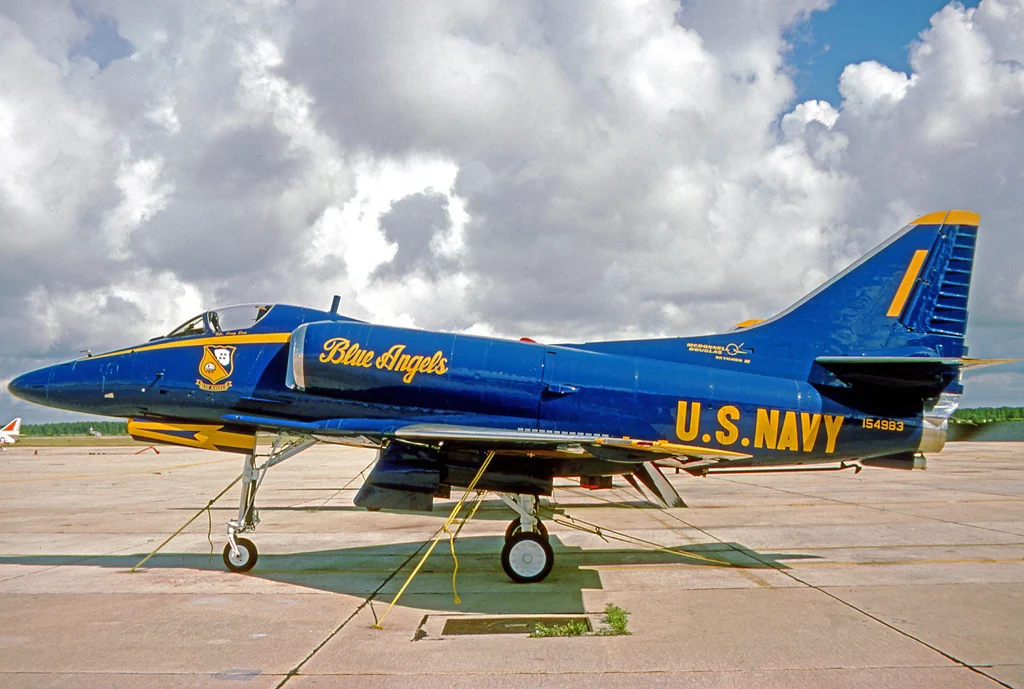
The confusion makes sense: the A-4 is small, fast, and incredibly maneuverable, so when you see it slicing through a formation or pulling tight aerobatic moves, it looks like a pure fighter. But in reality, the Skyhawk was designed from the start as an attack aircraft, something built to carry bombs, rockets, and other strike weapons.
What’s interesting is that this “not actually a fighter” label doesn’t take away from why the Blue Angels chose it. If anything, it highlights how versatile the design was.
The Skyhawk was light, responsive, and forgiving in a way that made it perfect for precision flying. It didn’t have the raw air-to-air capabilities of a true fighter like the F-4 Phantom or F-14 Tomcat, but it didn’t need them. For the Blue Angels, what mattered was agility and predictability, and the A-4 had those in spades.
The Skyhawk’s reputation didn’t come out of nowhere. It was one of those jets that, even at a glance, seemed to punch well above its weight. People often talk about it with a kind of fondness, partly because it looked almost too small to be taken seriously, yet it kept proving that size wasn’t the measure of capability.
Its compact frame, that clean delta-like wing layout, and the overall lightweight construction gave it this nimble, almost spry personality in the air. Pilots often described it as something that did exactly what you asked, without fighting you or overcomplicating things.

In an era when jets were getting bigger and heavier with more complex systems, the A-4 felt refreshingly straightforward, almost minimalist, but still deadly effective.
There’s also this sense that the Skyhawk embodied a certain design philosophy we don’t see as often anymore: simple, rugged, affordable, and easy to maintain. It could haul an impressive amount of ordnance for its size, launch from carriers without needing fancy folding wings, and handle a wide range of missions.
That combination of small footprint and big usefulness made it a kind of Swiss-army-knife jet for the Navy and Marine Corps. And the fact that it stayed in service for decades, well beyond what anyone expected, says something about how well the original concept held up.
If you zoom out and look at the basics, a few quick facts help put its legacy in perspective. The A-4 first took to the air in 1954, which already makes its long career even more remarkable. It officially entered service in 1956, just two years later, and production kept going until 1979.

By the time the last one rolled out, more than 2,900 had been built. For a jet that started as a lightweight, low-cost attack aircraft, it ended up becoming a fixture across multiple countries, a workhorse in Vietnam, and even a training platform for the Blue Angels. When you string all of that together, it becomes easier to see why the Skyhawk is still talked about with such respect.
Read also: LTV A-7 Corsair II: The U.S. Navy’s Most Reliable Attack Jet
So, why was it so iconic? Mostly because it did so much with so little. The Skyhawk was tiny, simple, and almost unassuming, yet it kept proving it could carry heavy loads, take a beating, and handle missions that should’ve been too big for it.
Pilots liked it because it felt honest and responsive, and crews liked it because it didn’t need constant pampering to stay flying. Over time, that mix of reliability, agility, and sheer usefulness turned it into one of those aircraft people remember not just for what it did, but for how it felt to fly and work with.
When you look at how the A-4 Skyhawk actually performed in combat, especially during the Vietnam War, you start to see why it earned such a loyal following.
In Vietnam, it handled everything from close air support to precision bombing runs, often flying low and fast in situations that were by most accounts pretty unforgiving. Its small size and quick handling made it surprisingly tough to hit, and its ability to carry a solid weapons load meant it could genuinely make a difference on the battlefield.
Pilots tended to speak about the A-4 with a kind of fondness you don’t always hear. Many liked how predictable it felt, especially when maneuvering at low altitude or pulling tight turns to avoid ground fire.
And there was also the practical side: it was relatively simple to maintain, which meant squadrons could keep it in the air more consistently than some of the more complex jets of the era. That combination of agility, dependability, and straightforward engineering gave pilots and crews a sense of trust, almost a feeling that the aircraft “looked after them” as much as they looked after it.
What really helped cement the A-4 Skyhawk as a classic was this mix of compact engineering and practical performance that, even today, feels a bit ahead of its time. The airframe itself was intentionally small and lightweight, so much so that people sometimes forget just how tiny it really was compared to other jets of the same era.
It stood roughly 15 feet (4.5 meters) tall, stretched about 40 feet (12 meters) long, and had that distinctive delta-style wing that gave it a sleek, clean shape. Under the skin, most variants ran on a single Pratt & Whitney J52 turbojet, which wasn’t the most powerful engine in the world, but it delivered enough thrust to keep the aircraft quick, responsive, and surprisingly nimble.
In terms of performance, the A-4 may not have chased Mach numbers the way interceptors did, but it still held its own. It could reach around 670 mph (1,078 km/h), which put it just under the speed of sound, and the jet had a range that, depending on fuel tanks and mission load, often stretched several hundred miles.
What’s impressive is how much it could carry for its size: around 9,000 pounds (4,000 kg) of bombs, rockets, or other ordnance. That payload-to-weight ratio was one of the reasons the aircraft became such a workhorse. You almost get the sense that the designers had found this sweet spot between “just enough engine” and “just enough structure” to keep the jet light while still hitting hard.
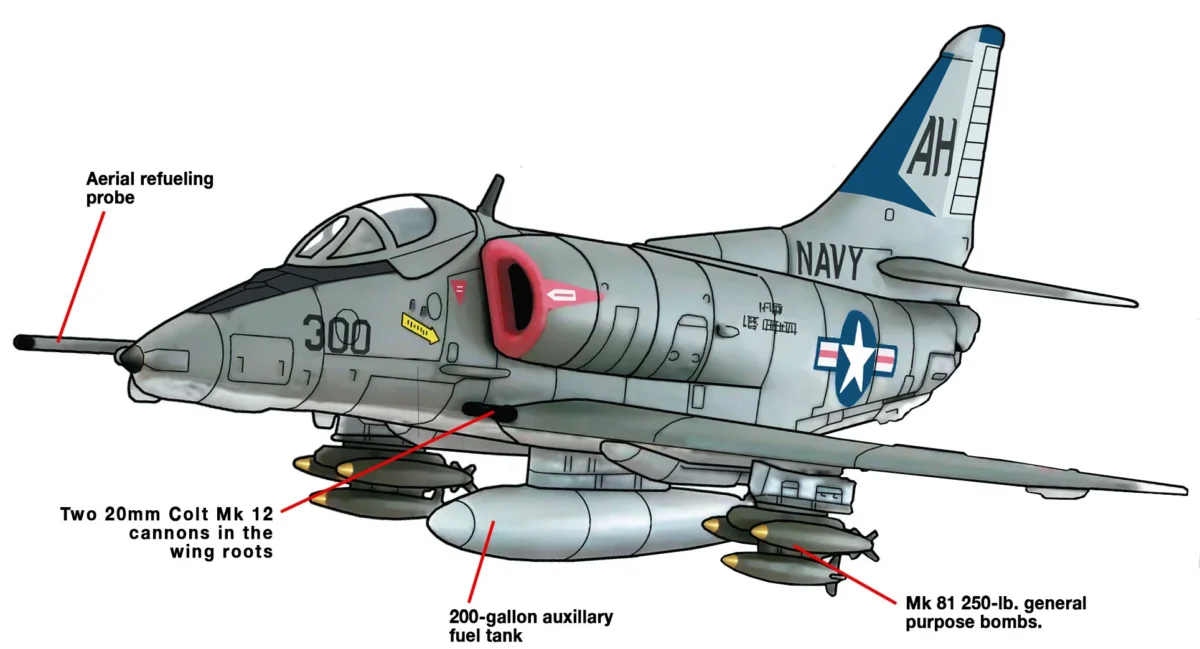
Its weapon systems were also pretty flexible, which likely played a role in its long service life. Most Skyhawks carried two 20mm cannons for strafing runs, along with multiple hardpoints for everything from iron bombs to guided munitions, rockets, and even early forms of smart weapons as the aircraft evolved.
The avionics weren’t especially flashy by modern standards, but they were rugged and easy to update, simple navigation and targeting systems at first, then improved radar and electronics packages in later models. That adaptability probably explains why the A-4 found a home in so many different countries and mission types.
When you look at the A-4’s long life, it almost feels like the jet kept reinventing itself every decade. The early versions were pretty bare-bones, but as time went on, the U.S. Navy and Marine Corps kept tweaking and upgrading it, which probably explains why the Skyhawk stayed relevant far longer than anyone originally expected.
The A-4E and A-4F, for example, brought more powerful engines, better avionics, and extra hardpoints. These upgrades might sound minor today, but at the time they quietly transformed the jet from a simple attack platform into something much more flexible and capable.
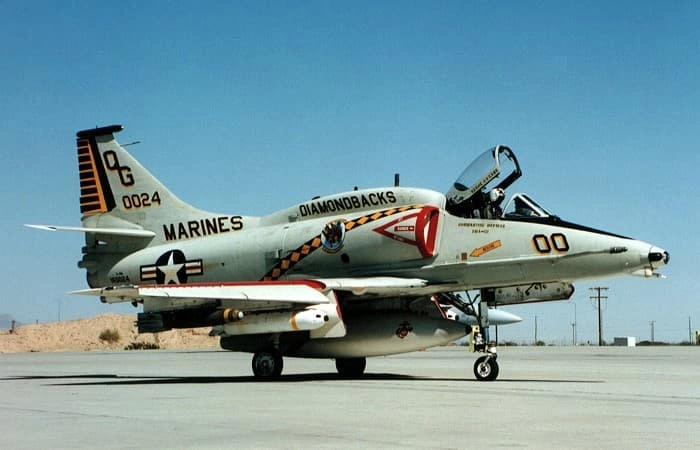
Then there’s the A-4M, which was built with Marine pilots in mind. It had improved cockpit visibility, stronger landing gear, and even better performance at low altitudes, perfect for close air support missions.
By the time the Skyhawk II series came around, the aircraft had lightweight composite materials and modernized systems that gave it a surprisingly fresh feel, even though the basic airframe design hadn’t really changed. It’s one of those cases where incremental improvements added up to something that felt genuinely new.
And of course, the Blue Angels chapter is hard to ignore. Their use of the A-4 in the 1970s and 80s gave the jet a kind of second life in the public eye. The team switched to the Skyhawk because it was small, quick to respond, and forgiving. These are qualities pilots definitely want when flying tight formation aerobatics in front of huge crowds. The aircraft’s size also meant the whole team could operate more efficiently, which was a practical bonus people often overlook.
Even after its frontline days wound down, the A-4 found a comfortable niche in training roles. The Navy used it as an aggressor aircraft to simulate enemy fighters, and several countries continued flying upgraded versions for years. It turns out that a jet that was simple to maintain, tough to break, and easy to fly made for a surprisingly ideal training platform.
In a way, its second career lasted almost as long as the first, which says a lot about the Skyhawk’s underlying design.
As for whether the A-4 Skyhawk is still flying today, surprisingly, yes, though not in frontline military roles. A handful of countries kept them operational into the 2000s, but now you mostly see Skyhawks in the hands of private military contractors and specialized training companies. These groups use them for things like adversary training, radar calibration, and even high-speed chase support.
A few aviation schools and test centers also keep upgraded A-4s around because they’re relatively cheap to maintain and still fly well enough to teach the fundamentals of jet handling. So even though the Skyhawk has officially “retired,” it hasn’t exactly disappeared; it’s just moved into a quieter but still useful second life.
If you look back at the A-4’s career, it quietly stacked up a handful of records and milestones that people sometimes forget about.
One of the earliest bragging rights came from its sheer efficiency: when it first entered service, it was one of the smallest and lightest jets to carry a nuclear weapon, which strange as it sounds today, was considered a major breakthrough in Cold War thinking. The Navy loved that it could take off from carriers without needing folding wings or complex launch gear, and that simplicity became something of a badge of honor among pilots and maintainers.
The Skyhawk also has a place in aviation history for longevity. It served for decades across multiple countries, and some air forces kept it flying far longer than anyone expected. That kind of staying power usually says something about the aircraft’s underlying design, reliable, low-maintenance, and just “good enough” in all the right ways. And on the performance side, it quietly set records for climb rates and carrier suitability in its early test flights, proving that a small jet could still punch above its weight.
Of course, the Blue Angels era added another layer to its legacy. The team flew the A-4 for over a decade, and many fans still look back on that period as one of the most graceful and precise chapters of their aerobatic history.