Follow Us:
Follow Us:

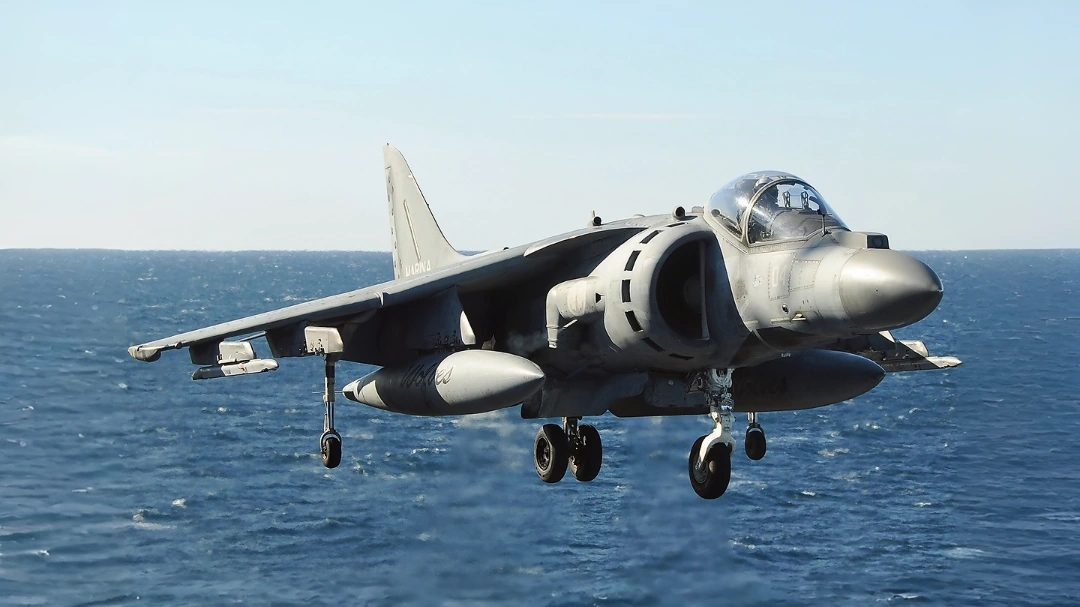
There’s something almost unnatural about watching an AV-8B Harrier II hover in place.
Not fly. Hover.
A 14-ton combat aircraft balancing on columns of thrust like a steel hummingbird, shaking the air, scorching the runway, and making nearby crew members instinctively lean away from the heat blast.
Even today, in an era dominated by stealth fighters and autonomous drones, the Harrier still feels a little rebellious. Like aviation cheating physics.
And honestly? In some ways, it was.
The AV-8B itself was a major leap over earlier Harrier models. Bigger wing. Better payload. Longer range. Smarter avionics. More survivable in combat. It transformed the quirky British-born Harrier concept into a genuinely dangerous multirole strike aircraft used heavily by the U.S. Marine Corps, as well as the Italian and Spanish navies.
And then there’s the combat record.
From Desert Storm to Afghanistan, the AV-8B Harrier II earned a reputation for showing up low, loud, and dangerously close to the fight, exactly where ground troops needed it most.
That’s what made pilots love it.
And maintenance crews occasionally curse it.
Because the Harrier wasn’t easy. Not even close. But aircraft that rewrite the rules rarely are.
The AV-8B Harrier II is one of those aircraft that almost sounds fictional when you explain it to someone for the first time.
“So it’s a fighter jet… that can stop midair, hover like a helicopter, then land vertically on a ship?”
Yeah. Pretty much.

Officially, the aircraft is classified as a V/STOL attack jet, short for Vertical/Short Takeoff and Landing. But pilots and aviation crews usually called it simply “the Harrier” or “the jump jet,” because watching one operate looked less like normal aviation and more like controlled mechanical sorcery.
The story really begins in Britain during the Cold War. NATO planners worried Soviet missile strikes would destroy major runways within hours of war breaking out in Europe.
Read also: LTV A-7 Corsair II: The U.S. Navy’s Most Reliable Attack Jet
Traditional fighters would become stranded. The British solution was unconventional: create an aircraft capable of operating from hidden roads, makeshift forward bases, or tiny improvised launch areas.
That original concept evolved into the Hawker Siddeley Harrier, but the U.S. Marine Corps wanted something more capable. More range. More payload. Better survivability. So McDonnell Douglas partnered with British Aerospace to redesign the aircraft almost from the ground up.
The result became the McDonnell Douglas AV-8B Harrier II.
The Harrier wasn’t meant to dominate dogfights against elite air-superiority fighters. Its real specialty was battlefield support, getting dangerously close to combat zones and delivering precision strikes where Marines needed immediate firepower.
That mission shaped everything about the aircraft.
Its squat stance.
Its oversized intakes.
Even the strange rotating exhaust nozzles that gave the jet its famous hovering ability.
The Harrier looked unusual because it was unusual. There has never really been another combat aircraft quite like it.
Numbers alone rarely capture an aircraft’s personality, but with the AV-8B Harrier II, the specs tell a surprisingly revealing story.
This wasn’t a sleek air-superiority fighter built to sprint across the sky at Mach 2. The Harrier was more like a heavily armed multitool, compact, rugged, adaptable, and designed to operate in ugly conditions where other jets might struggle.
One reason the aircraft performed better than earlier Harriers was its redesigned wing.
McDonnell Douglas engineers gave the AV-8B a larger composite wing made with carbon-fiber materials, reducing weight while increasing fuel storage and payload capacity. That one change quietly transformed the aircraft’s combat usefulness.
Here’s a closer look at the core specifications:
| Specification | AV-8B Harrier II |
| Manufacturer | McDonnell Douglas / British Aerospace |
| Role | V/STOL Attack Aircraft |
| Crew | 1 |
| Length | 46 ft 4 in (14.12 m) |
| Wingspan | 30 ft 4 in (9.25 m) |
| Height | 12 ft 10 in (3.91 m) |
| Engine | Rolls-Royce Pegasus turbofan |
| Maximum Speed | Approx. 670 mph (Mach 0.9) |
| Combat Radius | ~300–400 miles mission dependent |
| Service Ceiling | 50,000+ ft |
| Maximum Takeoff Weight | Around 31,000 lbs |
| Hardpoints | 7 weapon stations |
One quirky reality of Harrier operations: vertical takeoff sounds dramatic, but pilots rarely used a true vertical launch during combat missions. It burned enormous amounts of fuel and limited payload capacity. Instead, the aircraft commonly performed short rolling takeoffs, using a small runway or ship deck to conserve fuel and carry heavier weapons loads.
That practical compromise became central to Harrier doctrine.
Another detail often overlooked is heat management. Hovering generated intense thermal stress beneath the aircraft. On amphibious assault ships, special deck coatings were sometimes required because the downward exhaust blast could literally damage surfaces during repeated operations.

And then there was maintenance.
The Pegasus engine was brilliant but mechanically demanding. Marines joked that Harriers spent part of their life flying and the rest of it “being worked on by three exhausted mechanics holding coffee cups.”
Not entirely unfair, honestly.
Still, despite the complexity, the AV-8B Harrier II achieved something remarkably difficult: it combined strike capability, expeditionary flexibility, and shipboard operations into a single aircraft that could appear almost anywhere a conflict demanded.
Climb into the cockpit of an early Cold War fighter and you’ll notice something immediately: visibility was often terrible.
Thick frames. Narrow canopies. Limited downward sightlines. Pilots sometimes joked they were flying “inside a mailbox with missiles attached.”

The AV-8B Harrier II changed that in a very deliberate way.
Because the aircraft’s primary mission involved close-air support, flying low over chaotic battlefields while identifying friendly and enemy positions, situational awareness became critical. A pilot strafing near ground troops doesn’t have the luxury of poor visibility.
So engineers redesigned the cockpit around the pilot’s eyes.
The Harrier II received a raised cockpit and a large bubble canopy that dramatically improved outward visibility compared to earlier Harrier variants. Pilots could see below and around the aircraft far more effectively during attack runs, hovering operations, and difficult shipboard landings.
That mattered more than most people realize.
A fraction of a second spotting terrain, vehicles, or tracer fire can decide whether a pilot survives a low-altitude mission.
The avionics also evolved significantly over time, especially in later AV-8B Night Attack and AV-8B Harrier II Plus variants.
| System | Capability |
| HUD (Head-Up Display) | Flight & targeting data projected at eye level |
| FLIR (Forward Looking Infrared) | Night operations & thermal targeting |
| LITENING Targeting Pod | Precision-guided strike capability |
| APG-65 Radar (AV-8B+) | Air-to-air & surface targeting |
| INS/GPS Navigation | Improved battlefield navigation |
| Digital Mission Computers | Enhanced weapons integration |
The addition of night attack systems transformed the Harrier from a daytime battlefield aircraft into a true around-the-clock combat platform.
During operations in Iraq and Afghanistan, pilots frequently conducted missions in darkness using infrared targeting systems that allowed them to identify heat signatures on the ground from miles away.
And then there were the flight controls.
Flying normally, the Harrier handled somewhat like a conventional attack jet. But during hovering operations, small reaction-control valves, sometimes nicknamed “puffer jets”, helped stabilize the aircraft by redirecting compressed air through the nose, tail, and wingtips.

Tiny corrections. Constant adjustments. Almost like balancing on a basketball while someone blasts you with a leaf blower.
That workload made Harrier pilots highly respected across naval aviation communities. The aircraft demanded precision, multitasking, and nerves that didn’t fray easily under pressure.
One Marine aviator reportedly described mastering the Harrier this way:
“You don’t really fly it. You negotiate with it.”
The AV-8B Harrier II may have looked unusual, but its weapons loadout was brutally practical.
This wasn’t an aircraft designed for flashy airshow maneuvers or long-range strategic bombing campaigns. The Harrier’s job was much messier: fly close to the battlefield, survive hostile fire, and deliver enough ordnance to ruin somebody’s very bad day.
And it carried more firepower than many people expected.
Thanks to its redesigned wing and stronger hardpoints, the AV-8B could haul a surprisingly diverse mix of weapons despite its relatively compact size. That flexibility became one of the aircraft’s greatest strengths because Marines needed a jet capable of adapting quickly to shifting combat conditions.
One mission might involve close-air support for infantry. Another could require anti-armor strikes, reconnaissance, or limited air defense.
The Harrier handled all of it.
| Weapon Type | Examples |
| Air-to-Air Missiles | AIM-9 Sidewinder, AIM-120 AMRAAM |
| Air-to-Ground Missiles | AGM-65 Maverick |
| Guided Bombs | GBU-series laser-guided bombs |
| Unguided Bombs | Mk 82 / Mk 83 general-purpose bombs |
| Rockets | Hydra 70 rocket pods |
| Gun System | GAU-12 Equalizer 25mm cannon |
| Targeting Systems | LITENING targeting pod |
The GAU-12 Equalizer cannon deserves special mention because it sounded absolutely ferocious. The five-barrel 25mm rotary cannon fired armor-piercing rounds at terrifying speed, giving the Harrier serious close-range punch against vehicles and fortified positions.
Pilots described firing it as feeling like “the aircraft suddenly trying to shake itself apart.”
Not exactly subtle.
During operations in Iraq and Afghanistan, Harriers frequently carried precision-guided bombs paired with targeting pods that allowed pilots to support troops in densely populated urban areas with greater accuracy. That capability became increasingly important as modern warfare shifted toward counterinsurgency operations where minimizing collateral damage mattered enormously.

Still, payload management on the AV-8B Harrier II involved constant compromise.
Heavy weapons reduced fuel efficiency. Vertical operations limited maximum loadout. Hot weather affected lift performance. Every mission became a balancing act between fuel, weapons, environmental conditions, and takeoff requirements.
Harrier pilots sometimes compared mission planning to solving a math problem while someone yelled at you over a jet engine.
Yet despite those constraints, the aircraft proved remarkably adaptable in combat. It wasn’t the fastest jet in the sky or the stealthiest, but when Marines on the ground needed immediate firepower close to the fight, the Harrier built a reputation for showing up fast, and heavily armed.
Comparing the AV-8B Harrier II to the F-35B Lightning II feels a little like comparing a rugged field mechanic’s truck to a modern spacecraft.
Both can get the job done.
But they belong to completely different technological universes.
The F-35B is stealthy, sensor-heavy, networked, and astonishingly advanced. The Harrier, by contrast, came from an era when pilots still relied heavily on instinct, visual flying, and raw hands-on skill. Yet despite the generational gap, the two aircraft are linked by a very specific mission requirement:
Operate from places ordinary fighters can’t.
That’s the lineage connecting them.
| Feature | AV-8B Harrier II | F-35B Lightning II |
| Generation | 2nd/3rd gen attack jet | 5th gen stealth fighter |
| Primary Role | Close-air support | Multirole stealth combat |
| V/STOL Capability | Yes | Yes |
| Stealth | None | Advanced stealth design |
| Top Speed | ~670 mph | ~1,200 mph |
| Sensors | Limited compared to modern jets | Advanced sensor fusion |
| Pilot Workload | Extremely high | Highly automated systems |
| First Service Entry | 1985 | 2015 |
One of the biggest differences lies in pilot workload.
Flying the AV-8B Harrier II demanded constant manual management, especially during hovering operations. Pilots actively balanced thrust vectoring, nozzle angles, aircraft attitude, and fuel considerations all at once. It required intense concentration, and mistakes could become catastrophic quickly.
The F-35B automates much of that complexity through sophisticated flight-control software. Hover transitions that once demanded elite-level skill now happen with far greater computer assistance.
Some older Harrier pilots jokingly describe the difference this way:
“The Harrier wanted to see if you deserved to fly it. The F-35 assumes you probably do.”
Still, the Harrier retains a kind of gritty respect among aviation enthusiasts because it achieved vertical flight capability decades earlier with vastly less computing power. It solved brutally difficult engineering problems using analog-era ingenuity and pilot skill rather than software-heavy automation.

And there’s another point often overlooked:
The Harrier was battle-proven for decades before the F-35B even entered operational service.
From Desert Storm to Afghanistan, the AV-8B accumulated an enormous combat record supporting Marines in real-world expeditionary warfare. It wasn’t theoretical capability. It was tested under fire repeatedly.
The F-35B may ultimately surpass the Harrier in nearly every measurable category, stealth, survivability, networking, sensor fusion, speed, but the Harrier deserves credit for proving the entire V/STOL combat concept could work operationally on a large scale.
Without the AV-8B, the F-35B probably doesn’t exist in its current form.
The AV-8B Harrier II spent decades doing something few combat aircraft could manage: staying relevant long after experts predicted its decline.
But eventually, time catches everything. Even jump jets.
By the late 2010s, the Harrier faced mounting problems. Maintenance costs climbed sharply, spare parts became harder to source, and modern air-defense systems made non-stealth aircraft increasingly vulnerable. The jet still performed well in close-air-support missions, yet military aviation had entered a new era dominated by sensor fusion, stealth technology, and networked warfare.
That shift opened the door for the F-35B Lightning II.
Unlike the Harrier, the F-35B combines V/STOL capability with stealth and advanced battlefield awareness. For the U.S. Marine Corps, replacing the AV-8B became less about abandoning the Harrier’s mission, and more about modernizing it.
Still, retirement came slowly because the Harrier’s strengths remained unique.
| Legacy Area | Impact |
| V/STOL Combat Operations | Proved vertical jets could succeed in warfare |
| Expeditionary Doctrine | Redefined frontline air support concepts |
| Naval Aviation | Expanded capability of small assault ships |
| Aircraft Design | Influenced development of the F-35B |
The Harrier’s biggest legacy may be philosophical. It challenged traditional assumptions about where combat aircraft could operate from, and that idea continues shaping military aviation today.
Strange aircraft sometimes leave the deepest marks.