Follow Us:
Follow Us:

It’s loud, heavy, and temperamental, but when the M60 machine gun started roaring, everyone knew to keep their heads down. This was the gun that defined the sound of American firepower from Vietnam to the Persian Gulf. They called it “The Pig,” not out of malice, but because it devoured ammo and demanded constant care, yet when it worked, it was a beast.
What made it so memorable wasn’t just its firepower, though. The M60 gave infantry units something they’d never really had before: a portable, belt-fed weapon that could pour out suppressive fire while still being carried through mud, jungle, or desert.
Even after all these years, the M60 just won’t die. In 2024, the U.S. Army quietly inked a $15 million deal with U.S. Ordnance to build new M60s, the upgraded E4 and E6 variants, long after the weapon was supposed to be history.
The details were vague, and that’s what made people talk. Was it for training? Foreign aid? Or something a bit more shadowy, tucked behind the curtain of special operations? Whatever the reason, it was proof that the “Pig” still had some fight left in it.
And it’s not just the U.S. keeping it alive. On the battlefields of Ukraine, photos have surfaced showing battered M60s back in action. For a gun born in the 1950s, that kind of staying power says everything about its strange, stubborn legacy.
If you want to understand the M60, forget the diagrams for a second and imagine the scene: humid jungle, early-morning mist, a squad moving slow and quiet. Then the world changes, a long, rhythmic clatter cuts through the trees, a steady, metallic bark that tells everyone exactly what’s happening. That sound is the M60. It’s not elegant. It’s not polite. But it’s unmistakable and for decades it meant American firepower.

If you ask any Vietnam veteran about the M60 machine gun, you’ll probably get a grin first, then a sigh. The stories usually start the same way; about the weight, the noise, and the smoke.
Read also: M2 Browning: Inside the Ultimate Heavy Machine Gun
The M60 grew out of post-World War II thinking to give small infantry units the sort of sustained, belt-fed fire that previously only large crew-served guns could deliver.
Technically, it’s chambered for the 7.62×51mm NATO round, and it borrows some basic design ideas from older German and early Cold War weapons, but it was built to be carried by squads, mounted on jeeps, or strapped to helicopters.
Introduced in the late 1950s and widely adopted in the 1960s, it became the U.S. military’s standard general-purpose machine gun through Vietnam and for years after.
Two big reasons. First, the role it filled: the M60 let small groups lay down sustained suppressive fire without needing an entire vehicle or a heavy crew. In chaotic fights its ability to keep bullets going for minutes at a time could blunt an enemy assault or give a squad the breathing room to maneuver.
Second, the image and the sound. Film and news footage from Vietnam fixed that roll of percussion in the public imagination, the M60’s bark became shorthand for American combat power. Put bluntly, when the M60 spoke, people listened. That combination of portability + continuous firepower + an iconic sound, is why it’s as much a symbol as a tool.
Movies later made that sound iconic; think of the roar in First Blood or Apocalypse Now. To the public, it became a symbol of U.S. military muscle; to the soldiers, it was equal parts lifeline and curse.
Yet, and this is important, many nicknamed it with affection. That particular lethal, noisy, high-maintenance personality saved lives often enough that crews tended to forgive its foibles. When it worked, it was a lifeline, and troops developed a rough love for it.
After World War II the U.S. wanted a general-purpose machine gun that squads could actually move with: something with the sustained punch of a crew-served gun but small enough to lug through rice paddies and scrub. Designers looked at wartime ideas, kept the best bits, and tried to make a one-weapon answer for everything from a foxhole to a helicopter door.
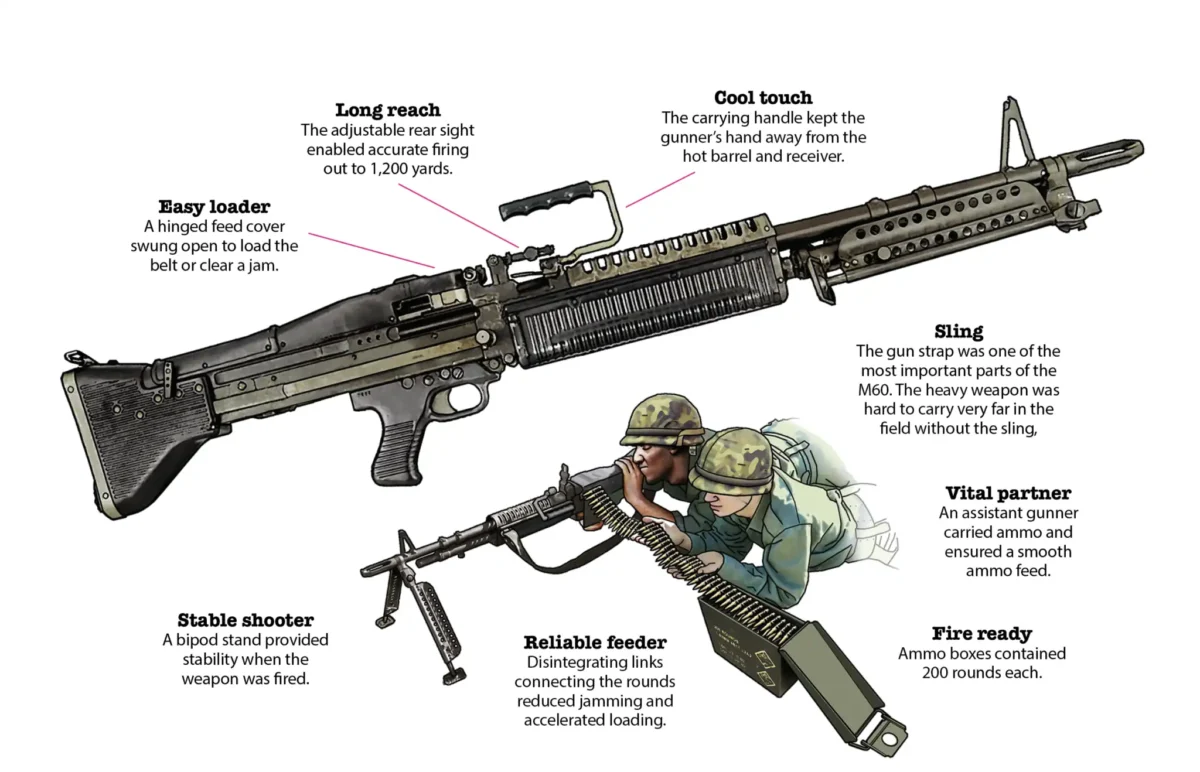
So how was it built? Think of it as a tough little engine: gas-operated, fires from an open bolt (that helps keep it from overheating and cooking off rounds), and eats linked belts of 7.62×51mm NATO ammo. It’s air-cooled, which keeps it simpler and lighter than water-cooled antiques, but that also means barrels get screaming hot fast, hence the quick-change barrel system crews lived with.
The receiver and feed tray are straightforward: pop the top cover, feed the belt, slam it shut, and the gun begins its relentless chatter.
So, too heavy to carry? Yes, it’s heavy. If you hand it to someone used to an M16, they’ll feel every inch of that weight. But armies design roles around tools.
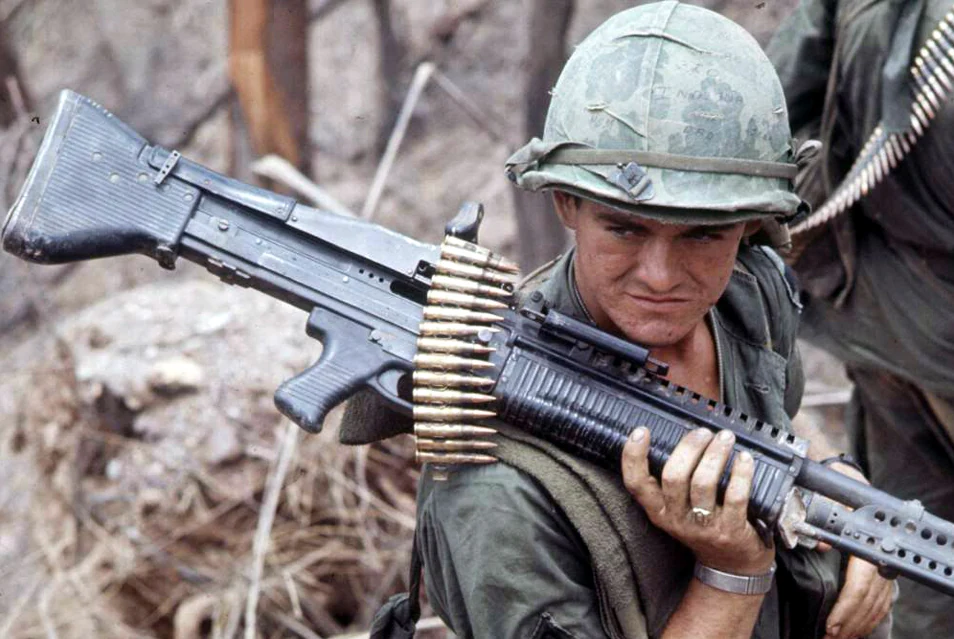
The M60 wasn’t meant to be carried like a patrol rifle all day; it was a squad automatic weapon. Real teams split the burden: the gunner carried the weapon and maybe one belt, the assistant carried spare barrels and extra belts, and the rest of the squad hauled the rest of the ammo or covered movement. On long marches, the M60 could feel like dead weight, but when a firefight started that weight suddenly looked like salvation.
Life with an M60 in combat was about endurance. The gun wasn’t a tidy piece of gear you carried like a rifle; it was a commitment. Every grunt who drew that job knew the sound, the weight, and the stubborn will of “The Pig.”
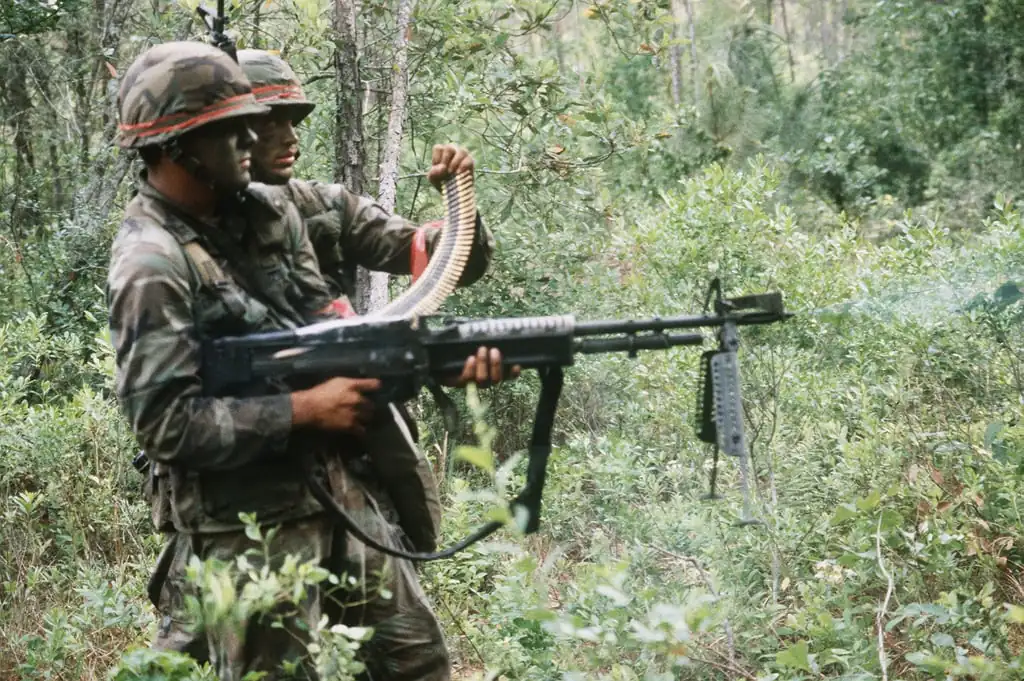
In Vietnam, the M60 gunner usually sat low, tucked into a foxhole or behind a fallen log, belt draped over an arm, the assistant gunner crouched nearby feeding rounds into the tray. When a firefight erupted, the rhythm kicked in, two-to three-second bursts, quick pause, adjust, repeat.
The noise filled the air like thunder. That deep, stuttering roar could drown out fear faster than anything else on the battlefield. Whole platoons took comfort in that sound because it meant someone had the enemy’s head down.
Every burst came with a price. The gun heated fast, barrels glowing cherry-red after a few hundred rounds. The assistant gunner swapped them out using thick gloves or an asbestos pad, tossing the old one into the dirt to cool while fresh belts clinked into place. Hands blistered, shoulders bruised, but the M60 kept going as long as the team did.
The weapon’s strengths were obvious. It gave small units a voice that could dominate the fight. Mounted on helicopters or jeeps, it turned light vehicles into mobile firestorms. In ambushes or defensive lines, the M60’s suppressive fire often decided who made it home.
But its flaws were infamous too. Mud, sand, or even humidity could turn the gun temperamental. A single jam at the wrong moment could cost lives.
The feed tray and gas system demanded constant cleaning, and the gun’s bulk made long patrols exhausting. Soldiers often joked that it wasn’t so much carried as dragged through the jungle, but when it roared to life, every ounce of that weight felt worth it.
Could anyone really handle firing 500 rounds per minute? Not for long. The M60 could technically do it, sure, but no one in their right mind held the trigger that long. Sustained fire meant bursts, disciplined, short, deliberate. The trick was control: enough rounds to pin the enemy, not so many that the gun melted itself into silence. In combat, that balance was everything.
Gunners often talked about the M60 like a living thing. They’re loud, unpredictable, and powerful. It demanded respect, punished carelessness, and rewarded skill. When it jammed, hearts dropped. When it fired clean, morale shot through the roof.
For the soldiers who lived with it, the M60, it was the heartbeat of the squad, the mechanical voice of survival in the noise and chaos of battle.
For all its fame, the M60 machine gun didn’t earn its reputation without a fair share of grumbling. Behind the noise and glory was a weapon that could make or break a mission, sometimes both on the same day.
From the start, the M60 carried a few design quirks that never quite went away. It borrowed parts of its blueprint from older German guns, which sounded clever on paper but didn’t always translate well into American field conditions.
The barrel locking system, for instance, required a bit of finesse to swap under fire, and if it wasn’t seated just right, the gun could seize up. The bipod, awkwardly attached to the barrel instead of the receiver, had to come off every time a barrel was changed. This is a maddening design for soldiers working under pressure.
In theory, it was a versatile, powerful machine gun. In practice, it could be temperamental. Gunners had to clean it constantly; mud, humidity, or a bit of bad luck could jam the feed mechanism. The trigger group wore out faster than anyone liked, and some units learned to keep spare pins and parts stuffed into pockets just to keep their M60s alive. One soldier once joked that the gun had “two speeds: perfect and broken.”
That mix of love and frustration made the M60 controversial in the ranks. To outsiders, it symbolized American firepower; the booming soundtrack of Vietnam and later conflicts. To the troops, it was a relationship that required patience. Some swore by it, calling it a lifesaver when it worked right. Others swore at it, usually while trying to clear a jammed round with enemy fire getting closer. Maintenance wasn’t optional; it was survival.
When newer guns came along, the contrast was hard to ignore. The Belgian-designed FN MAG, adopted by the U.S. as the M240, felt like a breath of fresh air. It was heavier, yes, but built like a tank and far more reliable. It could take abuse (e.g., sand, rain, cold) and still run smoothly.
Compared side by side, the M60 felt like an old sports car: fast and fierce when tuned perfectly, but liable to break down if you didn’t baby it.
Read also: M240 Machine Gun: Key Features That Make It So Powerful

Even today, the debate lingers. Some veterans remember the M60 as the soul of the squad. Others remember the frustration of field repairs, the jams, and the endless cleaning sessions that made it both legend and liability. That tension between admiration and aggravation is exactly why the M60 remains one of the most talked-about weapons in American military history.
Long after M60 left the front lines, it still shows up in documentaries, in museum displays, even in pop culture, usually carried by a sweaty, determined soldier in some old war film, firing in long, thundering bursts. But behind the Hollywood image are lessons that still echo in how modern armies think about firepower.
The M60 taught one hard truth that power isn’t enough. You can build a gun that spits hundreds of rounds a minute, but if it breaks down when the weather turns bad or the barrel overheats, it becomes a burden.
The M60 could dominate a firefight, but it demanded constant care; it needed the gunner, the assistant, and the whole squad working together to keep it fed and running. That dependency shaped how the U.S. thought about squad tactics. The idea of a “team weapon,” one that defines the rhythm of a fight, owes a lot to the M60’s lessons, both good and bad.
Modern designs, from the M240 to the lighter M249 and now the new generation of polymer-cased and smart-controlled weapons, all carry a bit of that DNA. They aim for what the M60 never quite achieved: the same punch, but with fewer headaches. Stronger materials, modular parts, and easier maintenance, all built from decades of watching how the M60 performed under real pressure.
And yet, despite all its flaws, the M60 remains iconic. Maybe it’s the sound, that slow, steady thunder that once rolled across jungles and deserts. Maybe it’s the look, that long barrel and the belt of brass spilling out like a snake. Or maybe it’s what it represented: raw American firepower, imperfect but determined. It was a weapon that reflected its era; ambitious, over-engineered, and a little bit wild.
The M60’s legacy isn’t just about metal and mechanics. It’s about the soldiers who learned to trust it, curse it, and keep it alive when it mattered most. It reminds us that in war, reliability can mean as much as firepower, and that every great machine carries a little bit of its human story inside.