Follow Us:
Follow Us:

Imagine being able to watch an entire country breathe, roads lighting up as convoys move, ships crawling across dark seas, airfields slowly waking under the morning sun. That’s essentially what the RQ-4 Global Hawk, a high-altitude, long-endurance (HALE) drone, gave military commanders: a god’s-eye view that simply didn’t exist before.
For decades, intelligence gathering was a stop-and-go affair. A U-2 spy plane could sweep across enemy territory, or a satellite could pass overhead every few hours, but coverage was patchy.
The Global Hawk rewrote the rulebook. It could stay aloft for over 30 hours straight, cruising above 60,000 feet, high enough to avoid most weather, yet low enough to capture razor-sharp imagery and track subtle movements on the ground.
This combination, endurance and precision, is why it earned its crown as the “King of ISR” (Intelligence, Surveillance, Reconnaissance). Think of it like Netflix binging versus old-school cable TV. Satellites gave you occasional episodes; the Global Hawk streamed the whole season without pause.
But endurance alone isn’t what made it legendary. Its sensor suite could sweep 40,000 square miles in a single day, an area larger than Iceland, while zooming in close enough to spot a single pickup truck. That kind of persistent “stare” allowed analysts to watch patterns develop in real time: supply lines forming, radar sites powering up, or a convoy hiding under camouflage nets.
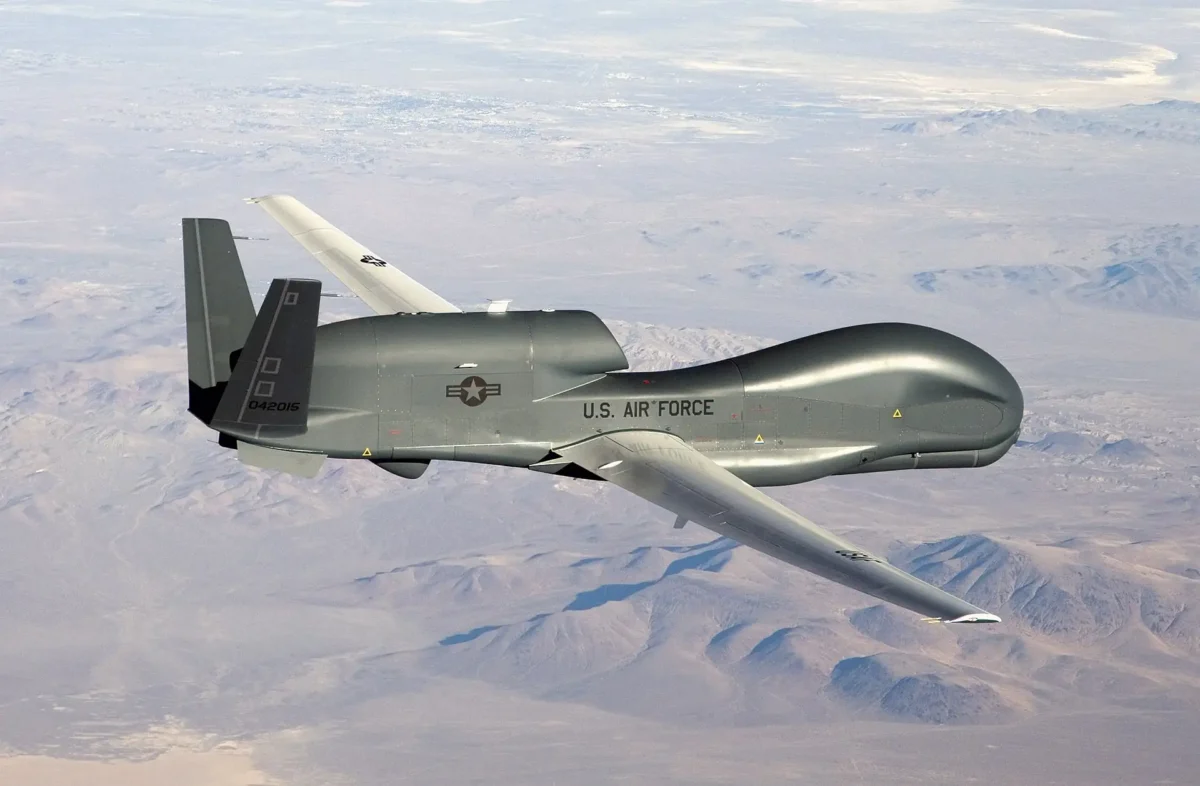
The RQ-4 Global Hawk didn’t just gather intelligence; it changed how nations thought about surveillance. It blurred the line between reconnaissance aircraft and satellites, becoming a bridge technology that let commanders peer continuously into contested spaces without risking pilots.
The RQ-4 Global Hawk wasn’t born in a vacuum. Its roots trace back to a U.S. Air Force experiment in the mid-1990s called Tier II+, a program to test whether an unmanned system could do what spy planes and satellites did, but cheaper and without risking lives.
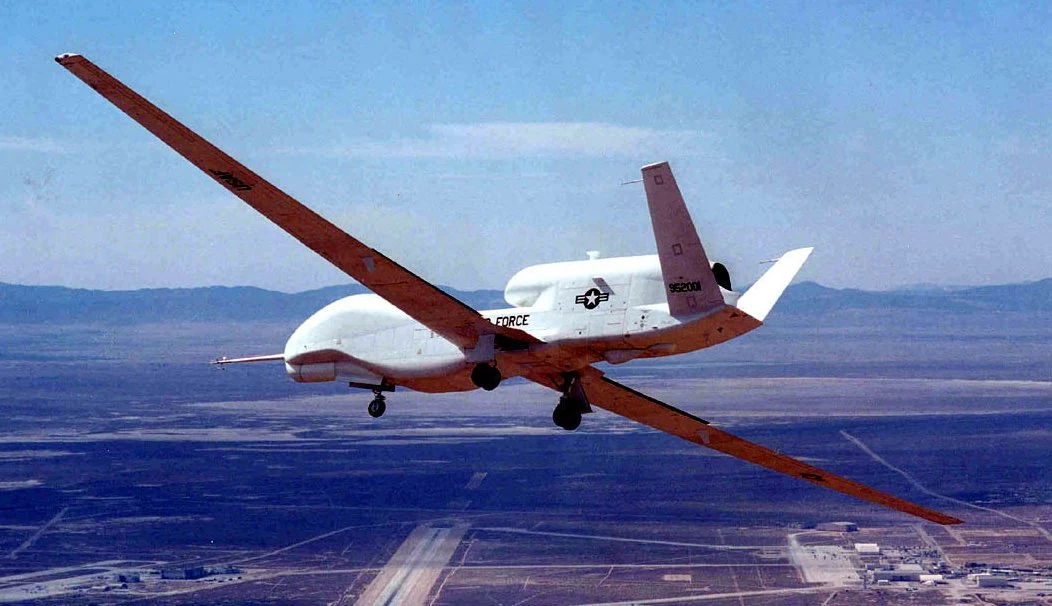
At the time, drones were still seen as fragile toys; most people associated them with small, short-range craft buzzing at low altitudes. The idea of a massive, jet-powered unmanned aircraft cruising at 60,000 feet for more than a day sounded closer to science fiction.
But DARPA (the Defense Advanced Research Projects Agency) had other ideas. They handed the contract to Ryan Aeronautical, a company with a long history of odd but effective reconnaissance aircraft. When Northrop Grumman later acquired Ryan, the project accelerated, reshaped, refined, and reborn as the Global Hawk.
The first prototype, the RQ-4A, flew in 1998. It was basic, a proof-of-concept more than a polished warplane, but it set endurance records right out of the gate. Less than three years later, after 9/11, the Global Hawk went from experiment to urgent operational need.
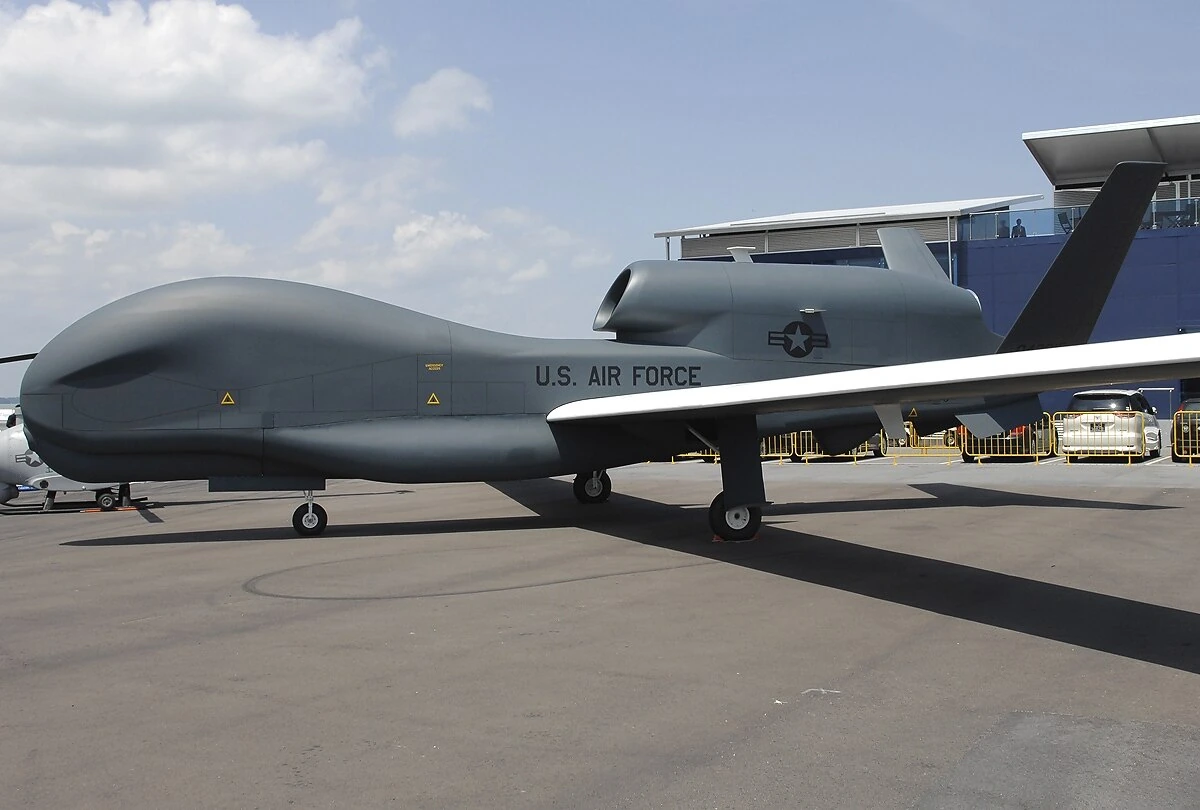
Early airframes were deployed to the Middle East in what the Air Force called “operational demos.” They weren’t even officially fielded, yet they were already mapping battlefields in Afghanistan and later Iraq.
As the platform matured, new “blocks” arrived:
Each step wasn’t just incremental, it represented a shift in how the Air Force saw unmanned flight. By the late 2000s, the RQ-4 wasn’t just “experimental tech.” It was a cornerstone of U.S. strategic reconnaissance, trusted to cover regions satellites couldn’t reach in time.
In less than a decade, the Global Hawk evolved from a DARPA sketch into a workhorse of modern warfare. A quiet revolution had taken place: the spy plane no longer needed a pilot.
Plenty of drones can fly. A handful can linger for hours. But the RQ-4 Global Hawk carved out its reputation because it could do both, and carry one of the most formidable sensor suites ever strapped to an unmanned airframe.
Let’s start with the raw performance numbers. This HALE (High-Altitude, Long-Endurance) giant cruises at 60,000 feet, higher than commercial jets, beyond most weather systems, and in thin air where engines sip fuel efficiently.
Up there, it can loiter for 30 to 34 hours, enough time to cross an ocean, circle a region, and still have gas to spare. While other aircraft rotate in and out like shifts at a factory, a single Global Hawk can watch a battlespace unfold continuously.
Then comes the payload, the real crown jewels. Imagine combining a high-definition camera, a night-vision scope, and a powerful radar, all on one platform, with coverage wide enough to scan 40,000 square miles a day. That’s like watching the entire state of Kentucky in real time.
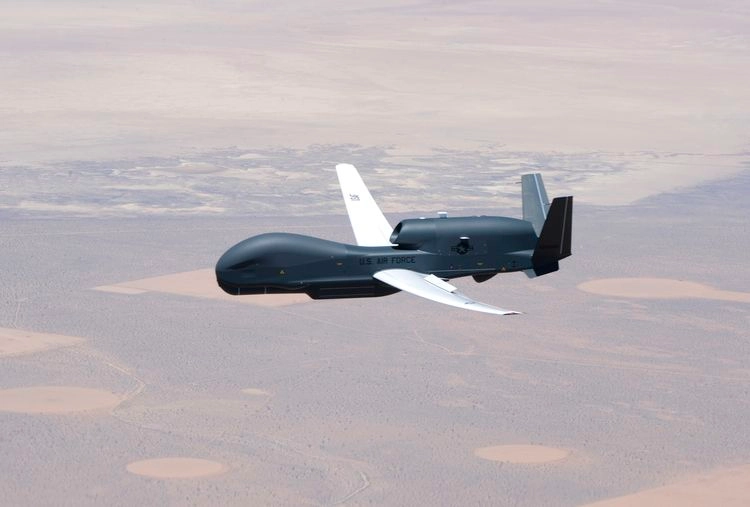
Key sensor highlights:
But the magic isn’t just in the sensors, it’s in how they work together. The Global Hawk isn’t a one-trick pony; it’s a flying data fusion center. Analysts on the ground can overlay radar tracks on thermal imagery, then cross-reference with intercepted comms, all from a single mission.
To put it in perspective: satellites offer a snapshot; manned aircraft bring detail but risk pilots; the RQ-4 Global Hawk bridged that gap by giving both persistence and precision. That blend is why military planners leaned on it so heavily in Iraq, Afghanistan, and beyond. It didn’t just watch events, it let commanders anticipate them.
Numbers don’t tell the whole story, but with the RQ-4 Global Hawk, they do paint a picture of just how unusual this drone really was. Most unmanned aircraft are small, nimble, and cheap.
The Global Hawk? It’s practically a flying billboard, huge, expensive, and built for the long haul.
Below is a consolidated snapshot of its most important specifications across the major production blocks:
| Feature / Metric | RQ-4A (Prototype) | RQ-4B Block 30 | RQ-4B Block 40 |
| Wingspan | 116 ft (35 m) | 131 ft (40 m) | 131 ft (40 m) |
| Length | 44 ft (13.4 m) | 47.6 ft (14.5 m) | 47.6 ft (14.5 m) |
| Height | 15.2 ft (4.6 m) | 15.2 ft (4.6 m) | 15.2 ft (4.6 m) |
| Engine | Rolls-Royce AE 3007H turbofan | Same | Same |
| Ceiling | 60,000 ft | 60,000 ft | 60,000 ft |
| Endurance | 28–30 hrs | 32+ hrs | 34+ hrs |
| Range | ~8,700 nm | ~12,300 nm | ~12,300 nm |
| Speed (Cruise) | ~357 mph (575 km/h) | ~391 mph (629 km/h) | ~391 mph |
| Payload Capacity | ~2,000 lbs | 3,000+ lbs | 3,000+ lbs |
| Primary Sensors | EO/IR + SAR | EO/IR, SAR, SIGINT | MP-RTIP radar (plus EO/IR backup) |
What jumps out here is balance. The Global Hawk wasn’t about speed or maneuverability. It was about time and space: hours in the air, thousands of miles of range, and wide-area sensors that could soak up intelligence without pause.
Another oddity, despite its sheer size (wingspan nearly as wide as a football field), it only carried about 3,000 pounds of payload. Compare that to a fighter jet, which can haul more than twice that in weapons. But the Global Hawk didn’t need bombs. Its “weapon” was data.
These numbers explain why commanders valued it so highly: it could cross oceans, hover over regions of interest, and provide continuous intelligence streams while other aircraft cycled in and out.
The RQ-4 Global Hawk didn’t spend its career as a hangar queen, it flew hard, often in places where information meant the difference between chaos and clarity. From deserts to oceans, it proved that a single drone could map entire wars.
One of its earliest real-world tests came after 9/11. Barely out of its prototype stage, the Global Hawk was rushed into service over Afghanistan. It flew missions that normally would’ve required multiple U-2 sorties, capturing wide swaths of mountainous terrain where Taliban forces hid in caves and valleys.
A U.S. commander at the time described the effect as “turning the lights on in a dark room.” Suddenly, analysts had a continuous picture of movements across the battlefield rather than fragmented snapshots.
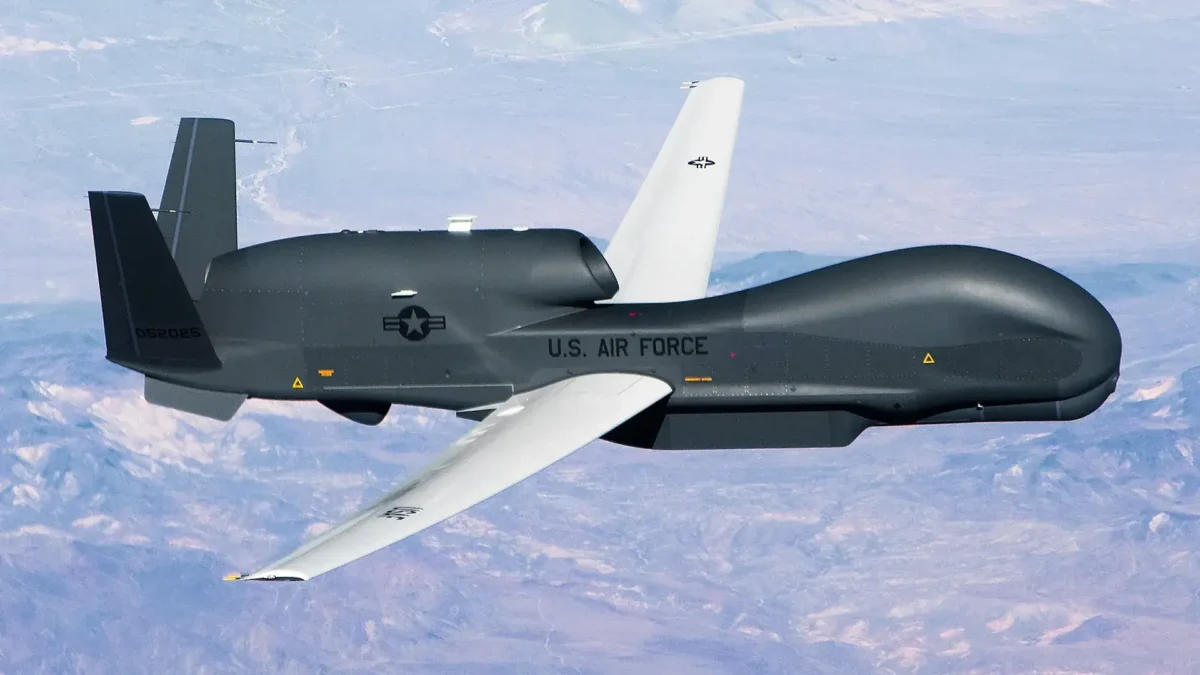
Later, in Iraq, Global Hawks played a quiet but crucial role before and during the 2003 invasion. By mapping air defense radars, command centers, and troop concentrations, they gave commanders a clear sense of the battlefield chessboard. The ability to loiter for 30 hours meant the drone wasn’t just a scout, it was a sentinel, circling above long after other aircraft had to refuel.
Perhaps the most famous incident, though, was in June 2019, when Iran shot down a U.S. Navy Global Hawk over the Strait of Hormuz. The strike, carried out by a surface-to-air missile, underscored both the value and vulnerability of the aircraft. Washington nearly responded with airstrikes, a stark reminder that an unmanned craft could still trigger geopolitical ripples.
Outside combat, the Global Hawk has taken on unusual jobs. NASA uses modified versions for atmospheric research, tracking hurricanes and studying climate change. It turns out that an aircraft designed to follow enemy convoys is also perfect for chasing typhoons across the Pacific.
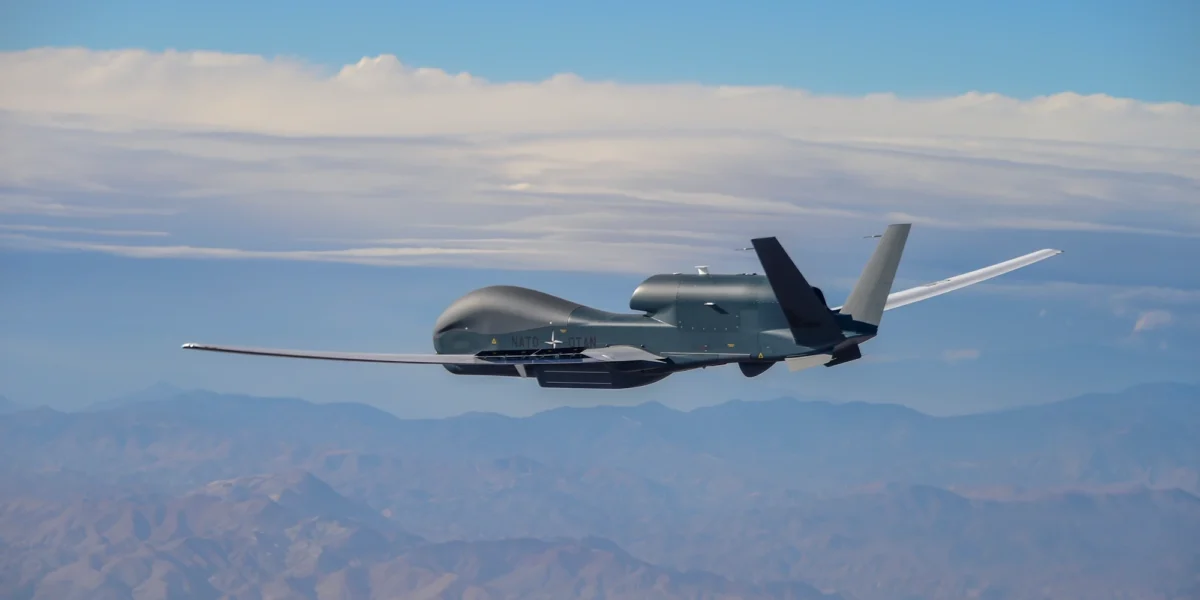
And then there’s NATO’s RQ-4D “Phoenix”, based on the Block 40 airframe. Operated out of Sigonella, Italy, it provides all 32 alliance members with shared surveillance data. In practice, this means a single flight over the Baltic can inform not just U.S. commanders but also decision-makers in Warsaw, Berlin, or Brussels simultaneously.
Each case study reveals the same theme: persistence equals power. The RQ-4 Global Hawk didn’t just capture images, it gave decision-makers time, the one resource you can’t manufacture.
Whenever the RQ-4 Global Hawk is mentioned, skeptics often ask: “But why not just use the U-2, or a Reaper drone, or even satellites?” Fair question. On paper, all of these platforms gather intelligence. In reality, each plays a very different role, and Global Hawk carved out a niche no one else could quite fill.
The U-2 spy plane has been around since the Eisenhower era, and remarkably, it still flies today. Pilots in pressure suits cruise at altitudes rivaling the Global Hawk, and the aircraft carries phenomenal sensors.
But here’s the catch: the U-2 requires a highly trained pilot, enormous support infrastructure, and can’t loiter nearly as long as the Global Hawk. Think of the U-2 as a sprinter, blazing in, grabbing imagery, then heading home. The RQ-4, in contrast, was a marathon runner.
The MQ-9 Reaper dominates headlines because of its armed strike capability, but its ISR role is just as critical. The Reaper can patrol for about 20–30 hours, which is impressive, but it flies at much lower altitudes (around 25,000–30,000 feet). That means smaller coverage areas and more vulnerability to air defenses.
Global Hawk’s 60,000-foot cruising altitude gave it not just a wider view but also relative safety in contested zones. The Reaper is your tactical street cop; the Global Hawk is more like an orbital telescope peering down on a city.
Talking about the RQ-4 Global Hawk isn’t just about performance, it’s also about price. This aircraft was never cheap.
A single airframe cost roughly $130 million (depending on the block and year of purchase), and that’s before adding the sensors, ground stations, and years of maintenance. To put it in perspective, that’s about the price of three or four F-16 fighters, or enough to buy a fleet of MQ-9 Reapers with change left over.
At its peak, the U.S. Air Force operated more than 40 Global Hawks, spread mainly between Beale Air Force Base in California and Grand Forks in North Dakota. From these hubs, missions stretched across the globe, from the Middle East to the Pacific, often relayed via satellite links to distributed analyst teams. Despite the high sticker price, commanders kept requesting more sorties. The value of constant eyes on target outweighed the costs.
Sustainment, however, was another story. The Global Hawk’s massive wingspan (131 feet, almost as wide as a Boeing 737) and unique systems demanded specialized hangars, parts, and training pipelines. Technicians had to master not only the airframe itself but also its sophisticated radar and sensor packages.
Unlike a fighter that could share logistics across a large fleet, the Global Hawk was a boutique aircraft. That boutique status meant high operating costs: estimates ran close to $33,000 per flight hour, a figure that made budget officers wince.
Still, international partners saw the value. NATO pooled resources to buy five RQ-4D “Phoenix” aircraft, basing them at Sigonella, Italy.
Instead of each member nation shouldering the burden of building its own ISR fleet, the alliance collectively tapped into the Global Hawk’s reach. For them, the sustainment cost was balanced by shared benefit, one aircraft’s intelligence product could feed 32 capitals in real time.
For all its achievements, the RQ-4 Global Hawk was never immune to criticism. Some of the sharpest debates about the drone weren’t about what it could do, but what it couldn’t.
The first major limitation was survivability. At 60,000 feet, the Global Hawk was above most short-range air defenses, but not above modern, long-range systems like the Russian S-400 or even Iran’s domestically built missiles.
The 2019 incident over the Strait of Hormuz, when a U.S. Navy Global Hawk was shot down, made it painfully clear: in contested airspace, this aircraft is a giant, slow-moving target. Critics argued that relying on such a visible platform in a peer conflict would be reckless.
Then there was the weather problem. Unlike a rugged U-2, which has pilots adjusting in real time, the Global Hawk’s unmanned nature meant heavy dependence on preprogrammed flight paths and satellite links. Severe storms or icing conditions could force mission cancellations. And while its radar could see through clouds, the aircraft itself wasn’t immune to the physics of turbulence and icing.
Another flashpoint was cost-effectiveness. As mentioned, the Global Hawk racked up operating costs around $30,000+ per flight hour. That sparked congressional hearings in the 2010s, where skeptics asked if unmanned really was cheaper.
Some analysts pointed out that for the same price, fleets of MQ-9 Reapers could provide localized surveillance with greater flexibility. Supporters countered that no other platform could match the Global Hawk’s altitude, endurance, and sheer coverage.
There were also airspace challenges. Getting permission to fly a drone the size of a regional jet in civilian skies was no small feat.
In Europe, NATO’s RQ-4D fleet had to undergo years of certification and safety checks before being allowed to operate freely alongside commercial traffic. Critics argued the slow integration process showed how cumbersome it was to deploy outside combat zones.
Finally, the drone faced criticism for over-promising and under-delivering early in its career. Some of the Block 30 “multi-intelligence” configurations struggled with reliability, leading to gaps in coverage. These hiccups gave fuel to detractors who called the program a money pit.