Follow Us:
Follow Us:


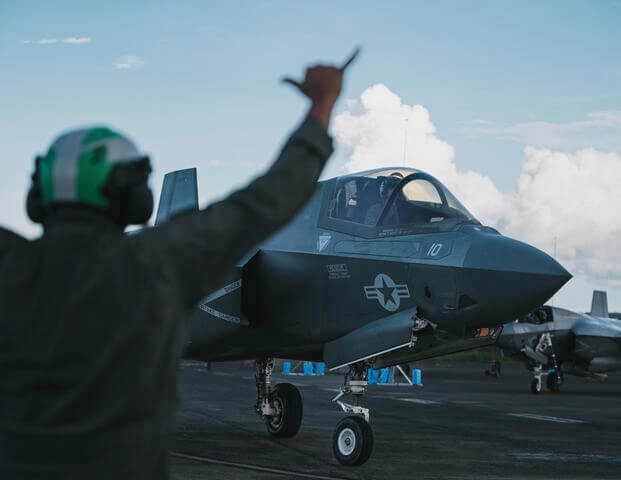
Defense Feeds – U.S. Marines Deploy F-35Bs to strengthen advanced airpower operations under the U.S. Southern Command (USSOUTHCOM), reinforcing regional defense across Latin America and the Caribbean.
On October 28, 2025, the fifth-generation stealth fighters executed flight missions from a classified location, signaling a renewed effort to counter transnational threats and bolster homeland protection.
According to the U.S. Department of War, these operations are part of a broader defense initiative overseen by the President, focused on continuous surveillance, deterrence, and joint-security cooperation throughout the Southern Hemisphere.
The deployment underscores Washington’s commitment to regional stability and demonstrates America’s ability to project precision-based military power across extended distances.
F-35B Lightning II is the centerpiece of the U.S. Marine Corps’ expeditionary combat capabilities, specifically designed to excel in amphibious and rapid deployment operations.
Its unique short takeoff and vertical landing (STOVL) ability enables it to launch from amphibious assault ships, forward operating bases, or quickly established airstrips, allowing the Marines to project airpower in austere environments where conventional runways are unavailable.
Equipped with the sophisticated AN/APG-81 AESA radar and Distributed Aperture System, the F-35B integrates multiple sensor inputs into a unified tactical display.
This fusion significantly enhances pilot situational awareness and enables seamless real-time data sharing with U.S. Navy and Air Force units, reinforcing joint operations across multiple domains.
The aircraft’s stealth design paired with advanced electronic warfare systems grants it the capability to operate effectively in contested or denied airspace.
This ensures commanders have an unparalleled tool for persistent surveillance and interdiction in strategically critical maritime corridors, many of which are exploited by narcotics traffickers and other illicit actors.
Moreover, the F-35B’s networked architecture allows it to operate in synergy with assets like the P-8A Poseidon maritime patrol aircraft, E-2D Hawkeye early warning platforms, and Aegis-equipped naval vessels, creating a layered defense network essential for protecting U.S. interests and partners in the Southern Command region.
Its versatility, endurance, and cutting-edge technology ensure the Marine Corps can rapidly respond to regional crises, conduct sustained operations, and maintain air superiority in both conventional and unconventional conflict scenarios.
This aircraft exemplifies the modern expeditionary combat ethos by combining stealth, sensor fusion, and operational flexibility to maintain dominance across all battle domains.
The presence of Marine F-35Bs contributes to multinational operations such as Operation Martillo, a cooperative effort between the United States and regional allies aimed at countering drug trafficking and unlawful maritime movement.
These sorties integrate with wider U.S. regional operations, combining manned aircraft, unmanned aerial systems, and surface vessels to create a unified surveillance and deterrence network across the Caribbean and Central American waters.
By maintaining a rotational presence, USSOUTHCOM ensures a rapid reaction capability to humanitarian crises, natural disasters, or maritime emergencies.
A Southern Command spokesperson emphasized that these missions build trust and resilience among partner nations, reaffirming the United States’ dedication to regional security cooperation.
The routine use of fifth-generation aircraft also sends a clear message of deterrence to potential adversaries while deepening joint operational interoperability.
The introduction of fifth-generation strike fighters such as the F-35B within Southern Command reflects a larger transformation in U.S. defense posture.
The Department of Defense is increasingly focused on agile, technology-driven warfare that integrates air, sea, and cyber capabilities.
The F-35B’s endurance and open-architecture network enable smooth coordination with P-8A Poseidon maritime patrol aircraft, E-2D Hawkeye early-warning platforms, and Aegis-equipped naval vessels.
This integration creates a real-time flow of operational data vital for modern multi-domain operations.
By blending stealth, electronic warfare capability, and precision strike potential, the F-35B enhances the U.S. military’s ability to address both conventional and asymmetric challenges across the Western Hemisphere.
With shifting strategic priorities, Washington’s decision to position stealth fighters within USSOUTHCOM demonstrates an ongoing dedication to multilayered defense, aimed at protecting U.S. territory and fostering regional cooperation.