Follow Us:
Follow Us:

Out in the grey chop of the North Atlantic, there’s a ship that looks less like a vessel and more like a floating city. Two towering islands rise from a vast flight deck. Fighter jets sit ready like coiled springs. Radar quietly sweeps the horizon.
That ship is HMS Prince of Wales, one of the most powerful warships the United Kingdom has ever put to sea.
But here’s the interesting bit: this aircraft carrier isn’t just a military platform. It’s a symbol of how modern naval power works in the 21st century, flexible, multinational, and heavily dependent on technology.
When HMS Prince of Wales (R09) sails with its carrier strike group, it’s essentially a mobile airbase capable of operating almost anywhere on the planet.
Commissioned into the Royal Navy in 2019, the HMS Prince of Wales aircraft carrier belongs to the Queen Elizabeth–class, the largest warships ever built for Britain.
At around 65,000 tons displacement, it dwarfs most naval vessels and can carry a mix of stealth fighters, helicopters, and hundreds of crew members who keep the floating ecosystem running day and night.
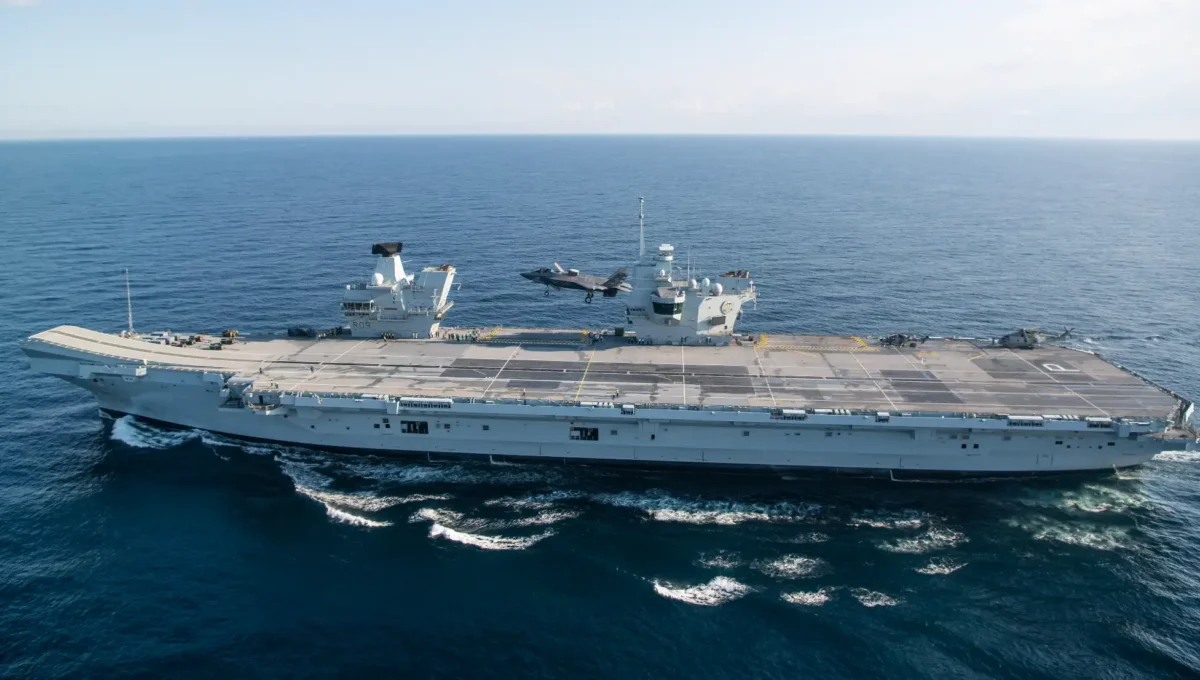
What makes HMS Prince of Wales particularly fascinating is how it blends brute scale with cutting-edge aviation. It was designed around the F-35B Lightning II, a stealth fighter that can take off from a ski-jump ramp and land vertically on the deck.
In other words, this carrier isn’t just big, it’s built for a very specific future of naval warfare. And that future is already unfolding at sea.
If you were standing on the flight deck of HMS Prince of Wales, you might forget, just for a second, that you’re actually on a ship. The deck stretches out like a small airport runway. Helicopters thrum overhead. Technicians in colored vests move with quiet urgency. Somewhere below, thousands of systems hum away inside the hull.
At its core, HMS Prince of Wales (R09) is the Royal Navy’s second Queen Elizabeth-class aircraft carrier, designed to project air power far from British shores. Think of it as a floating airbase, one that can move across oceans, operate without relying on foreign territory, and deploy fighter jets within minutes.
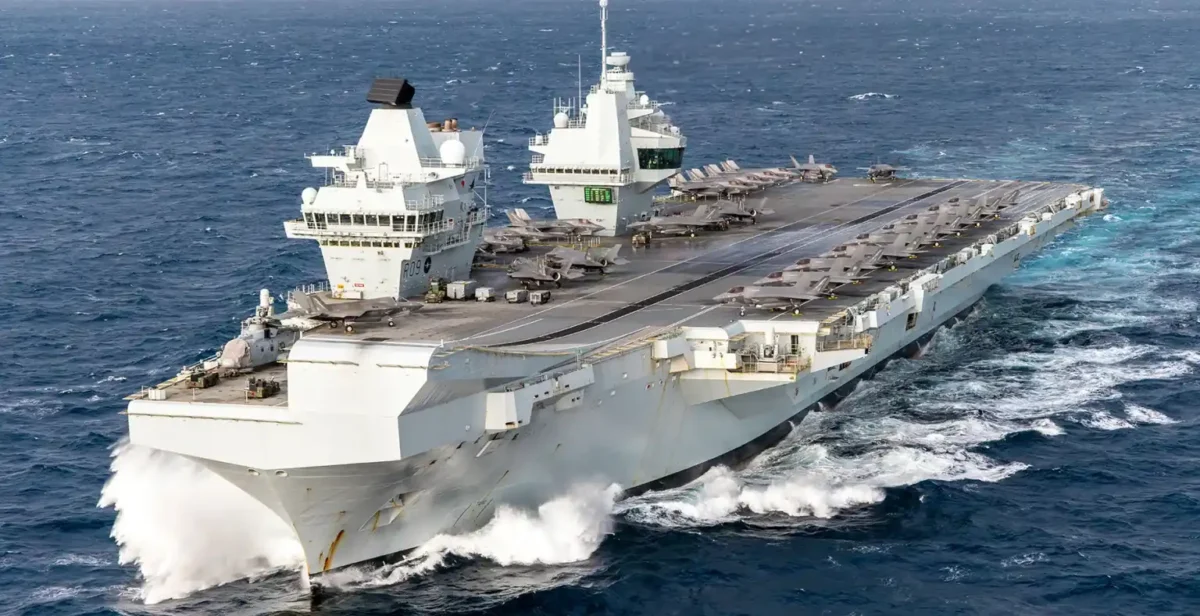
But the carrier isn’t meant to operate alone. Far from it.
Modern naval strategy revolves around what’s known as a Carrier Strike Group (CSG). When HMS Prince of Wales sails on deployment, it’s typically surrounded by a protective network of ships and aircraft. Destroyers provide air defense. Frigates hunt submarines. Supply ships keep fuel and food flowing. Submarines lurk quietly nearby.
All together, they form a mobile military ecosystem.
Read also: Charles de Gaulle: France’s Nuclear-Powered Aircraft Carrier
The HMS Prince of Wales aircraft carrier also serves another role that’s less obvious but equally important: diplomacy. Port visits, joint exercises, and multinational deployments send a subtle message that the UK can still operate globally alongside allies like the United States and NATO partners.
And interestingly, the ship sometimes acts as a NATO command platform, meaning multinational forces can coordinate operations directly from its high-tech command center.
So yes, HMS Prince of Wales is a warship. But it’s also a strategic tool, a floating headquarters, and occasionally even a symbol of international cooperation on the open sea.
At first glance, HMS Prince of Wales looks unusual compared with most aircraft carriers. Two island structures rise from the flight deck instead of one. The bow curves upward into a ski-jump ramp. The deck itself feels enormous, almost minimalist, wide and clean like a futuristic runway.
None of this is accidental. Every detail in the HMS Prince of Wales aircraft carrier design reflects decades of experimentation in naval aviation.
Let’s start with the most obvious feature: the twin-island layout.
Unlike traditional carriers with a single command tower, this ship splits responsibilities between two structures. One island manages navigation and ship control, while the other handles air operations. Separating those tasks reduces congestion and improves visibility for pilots landing on deck.
| Design Feature | Purpose |
| Twin Islands | Separate navigation and flight operations |
| Ski-Jump Ramp | Enables short takeoff for F-35B jets |
| Large Flight Deck | Allows simultaneous aircraft movement |
| Hangar Deck | Aircraft storage and maintenance |
| Advanced Radar Systems | Airspace and threat monitoring |
The ski-jump ramp deserves a quick spotlight. Instead of catapults launching aircraft like American carriers use, the ramp gives the F-35B an upward boost during takeoff. That extra lift helps jets leave the deck carrying more fuel and weapons.
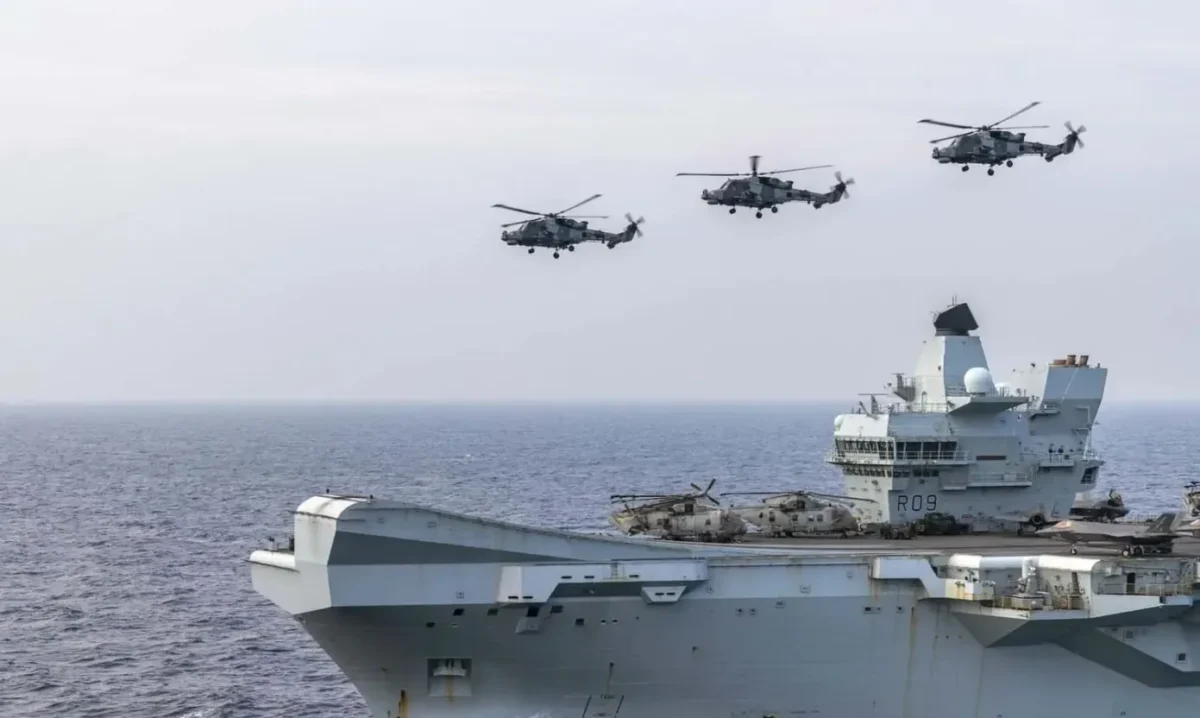
Below the flight deck lies an enormous hangar, large enough to house multiple aircraft at once while engineers perform maintenance. Massive aircraft lifts, essentially industrial elevators, move jets between the hangar and the flight deck.
And then there’s the ship’s brain.
HMS Prince of Wales (R09) is packed with sensors, communications systems, and radar networks that feed data into its operations center. The carrier can track aircraft, surface vessels, and potential missile threats simultaneously.
The ship also uses an integrated electric propulsion system, where gas turbines and diesel generators produce electricity that powers both the ship and its propulsion motors. It’s quieter, efficient, and reduces mechanical complexity compared with older carrier designs.
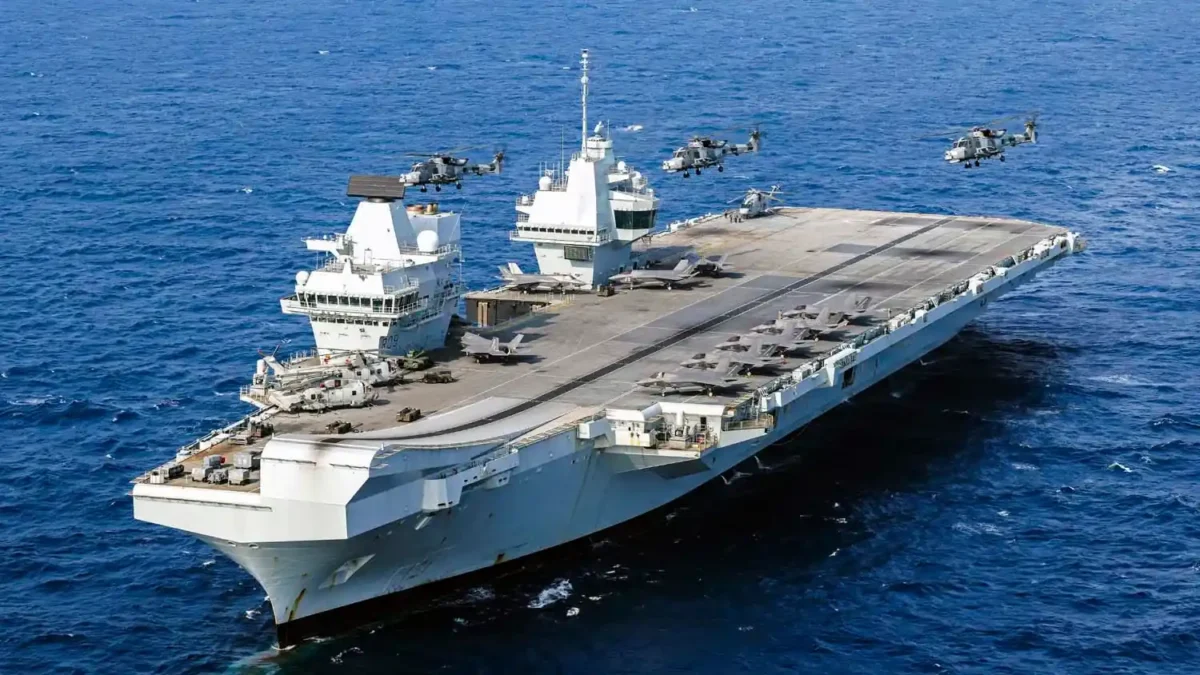
In short, this isn’t just a large warship.
It’s a floating piece of high-tech infrastructure, part airport, part command center, part power station, engineered to keep aircraft flying far from land.
Numbers tell part of the story of HMS Prince of Wales, but they don’t quite capture the scale until you start imagining them in real life.
This ship is roughly the length of three football fields placed end to end, with a flight deck large enough to handle continuous aircraft operations for days at sea.
Designed as a Queen Elizabeth–class aircraft carrier, the vessel blends traditional naval engineering with modern aviation requirements. It’s not nuclear-powered like many American carriers, yet it still manages impressive endurance thanks to an integrated electric propulsion system.
Here’s a clear look at the core specifications of HMS Prince of Wales (R09):
| Specification | Details |
| Ship Type | Aircraft Carrier |
| Class | Queen Elizabeth-class |
| Pennant Number | R09 |
| Length | 280 meters (919 ft) |
| Beam | ~70 meters flight deck |
| Displacement | ~65,000 tons |
| Top Speed | Over 25 knots |
| Range | Approx. 10,000 nautical miles |
| Propulsion | Integrated electric propulsion system |
| Commissioned | 2019 |
What really defines the ship, though, is its air wing.
Unlike traditional carriers that rely on catapults and arrestor wires, HMS Prince of Wales aircraft carrier operations revolve around STOVL aircraft, Short Takeoff and Vertical Landing.
The flight deck features a distinctive ski-jump ramp, allowing stealth fighters to launch with a short takeoff before climbing into the sky.
Typical aircraft carried include:
| Aircraft | Role |
| F-35B Lightning II | Stealth multirole fighter |
| Merlin HM2 | Anti-submarine warfare helicopter |
| Merlin Crowsnest | Airborne early warning |
| Wildcat HMA2 | Surveillance and maritime strike |
In a full combat configuration, the carrier can support around 36 F-35B jets plus helicopters, though the exact number varies by mission.
Another fascinating detail? The ship was designed with automation in mind, allowing it to operate with fewer crew than older carriers of similar size. Roughly 700 sailors run the ship itself, while the total onboard population can climb to 1,600 when the full air group and command staff are embarked.
It’s a careful balance of scale, technology, and efficiency, one that reflects how naval warfare has evolved.
Every warship has a story before it ever touches the ocean, and the story of HMS Prince of Wales began long before its first wave hit the hull.
In the early 2000s, the United Kingdom faced a strategic crossroads.
The Cold War fleet had shrunk, older aircraft carriers were retiring, and military planners knew something important: modern conflicts required air power that could travel with the fleet. The answer became the Queen Elizabeth-class carriers, the largest naval construction program in modern British history.
Construction of HMS Prince of Wales (R09) officially started in 2011 at Rosyth Dockyard in Scotland. But unlike traditional shipbuilding, this carrier was assembled like a giant floating puzzle. Major sections, called “blocks”, were built in shipyards across the UK and then transported to Rosyth where they were joined together.
Piece by massive piece, the carrier slowly took shape.
One of the biggest milestones came in December 2017, when the ship was floated out of the dry dock for the first time. Imagine thousands of workers watching a 65,000-ton vessel finally meet the water, it was a moment that marked years of engineering effort finally paying off.
A few key milestones in the ship’s journey:
| Year | Milestone |
| 2011 | Construction begins |
| 2017 | Ship floated out at Rosyth |
| 2019 | Sea trials begin |
| 2019 | Officially commissioned into the Royal Navy |
| 2021 | Conducts first operational deployments |
Sea trials were… eventful. Like many complex ships, HMS Prince of Wales aircraft carrier trials uncovered technical issues that needed fixing. Engineers worked through propulsion adjustments, systems checks, and aviation testing.
And then came one of the most satisfying moments for naval crews: the first landing of an F-35B stealth fighter on the deck. Watching the jet descend vertically onto the carrier proved the entire concept worked.
By the early 2020s, HMS Prince of Wales had moved from shipyard project to operational centerpiece of Britain’s modern carrier fleet, a role that continues to evolve with every deployment.
For most of the 20th century, naval power was measured by battleships, massive guns, thick armor, and fleets built around brute force. Those days are long gone.
Today, the centerpiece of modern sea power is the aircraft carrier, and HMS Prince of Wales sits right at the heart of the United Kingdom’s strategy.
The logic is surprisingly simple: whoever controls the skies controls the sea below.
With its fleet of stealth fighters and helicopters, the HMS Prince of Wales aircraft carrier allows Britain to project air power without needing land bases nearby. That matters in regions where friendly airfields might be unavailable, politically sensitive, or simply too far away.
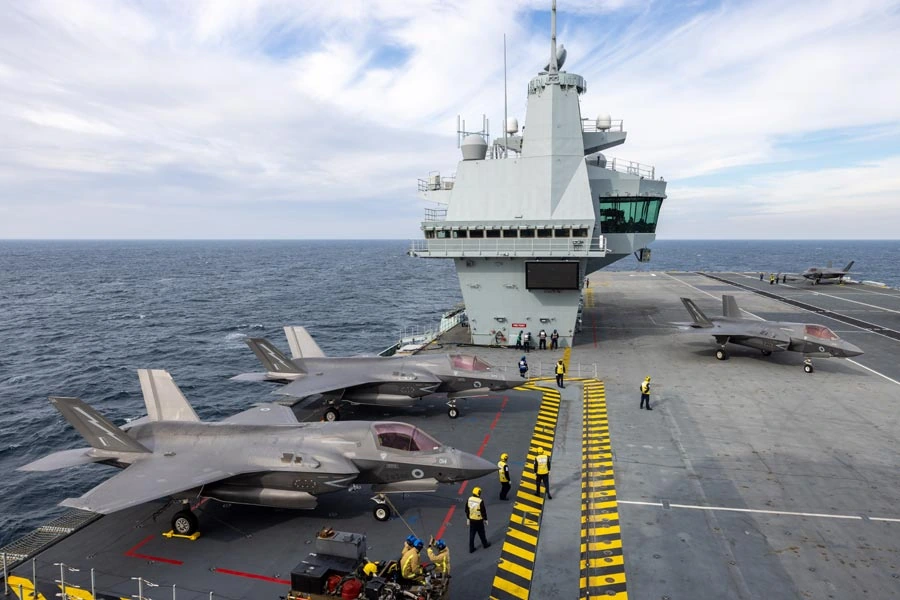
Instead, the carrier becomes the runway.
The real game-changer is the F-35B Lightning II, a fifth-generation stealth jet designed for short takeoffs and vertical landings. Operating from the ski-jump ramp on the carrier’s deck, these aircraft can conduct surveillance, strike missions, and air defense, all from a ship moving across the ocean.
Here’s how the carrier contributes to modern warfare:
| Capability | Operational Impact |
| Stealth Air Strikes | Attack targets while avoiding radar detection |
| Air Defense | Protect fleets from aircraft or missiles |
| Anti-Submarine Warfare | Helicopters track underwater threats |
| Intelligence & Surveillance | Long-range monitoring of conflict zones |
| Rapid Response | Deploy air power without overseas bases |
Another less obvious role? Command and control.
Deep inside HMS Prince of Wales, a high-tech operations center monitors aircraft, ships, satellites, and radar feeds simultaneously. During multinational missions, commanders can coordinate allied forces directly from the carrier, effectively turning it into a floating battlefield headquarters.
And then there’s humanitarian work. Carriers like this can deliver helicopters, medical support, and logistical aid after disasters. Massive storage capacity means they can transport food, equipment, and emergency supplies quickly.
So while HMS Prince of Wales is undeniably a warship, its real power lies in flexibility.
Strike platform one day. Disaster response hub the next.
In modern naval strategy, adaptability is everything, and this carrier was built for exactly that.
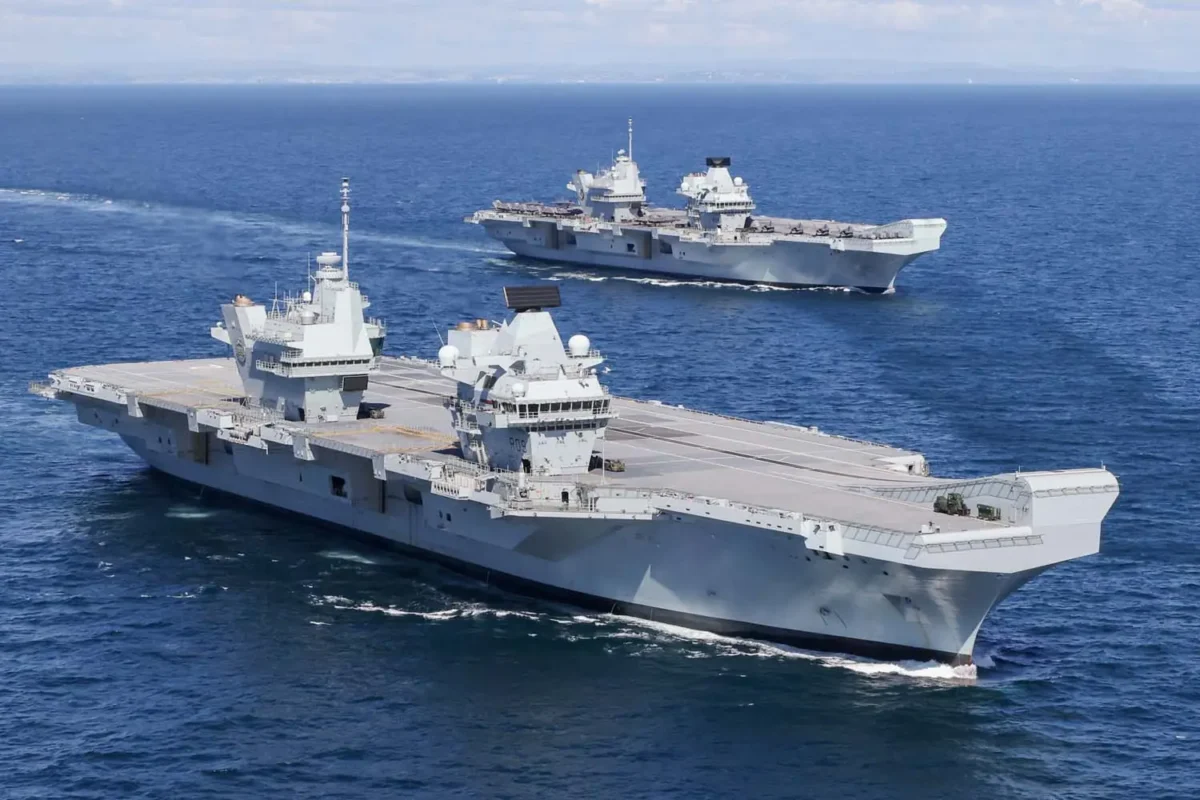
At a glance, HMS Prince of Wales and HMS Queen Elizabeth look almost identical. Same towering twin islands. Same sweeping ski-jump ramp. Same enormous 65,000-ton footprint cutting through the ocean.
That’s because they belong to the same family: the Queen Elizabeth-class aircraft carriers, the backbone of Britain’s modern naval aviation.

But here’s where it gets interesting. While the two ships share nearly the same design, their roles sometimes diverge depending on deployment schedules, upgrades, and operational priorities.
Think of them less as twins, and more like two interchangeable command platforms for the Royal Navy.
Below is a quick side-by-side comparison of the two carriers:
| Feature | HMS Prince of Wales (R09) | HMS Queen Elizabeth (R08) |
| Commissioned | 2019 | 2017 |
| Class | Queen Elizabeth-class | Queen Elizabeth-class |
| Displacement | ~65,000 tons | ~65,000 tons |
| Aircraft Type | F-35B Lightning II | F-35B Lightning II |
| Flight Deck | Ski-jump STOVL design | Ski-jump STOVL design |
| Primary Role | Carrier Strike / NATO operations | Carrier Strike flagship |
Operationally, the Royal Navy often rotates the two ships. One carrier may be deployed or leading an exercise while the other undergoes maintenance, training, or upgrades. This ensures the UK maintains a continuous carrier strike capability, a key strategic goal after years without large carriers in service.
Another subtle difference lies in how each vessel has been used during early deployments. HMS Queen Elizabeth led the UK’s first major Carrier Strike Group deployment to the Indo-Pacific in 2021, while HMS Prince of Wales aircraft carrier operations have frequently focused on NATO exercises in the Atlantic and European waters.
Yet in terms of raw capability? They’re virtually equals.
Both ships can launch stealth fighters, command multinational naval forces, and sustain long deployments at sea. Together, they form a two-carrier system designed to keep British naval aviation active for decades.
Put simply: when one carrier sails, the other stands ready.