Follow Us:
Follow Us:

For years, the Gepard was just another museum piece, a Cold War artifact with no real place in modern warfare. But that changed in 2022. When drones began harassing Ukraine’s power plants and cities, Germany sent the tank back into service. Its twin 35 mm Oerlikon cannons, designed decades ago for jet intercepts, proved unexpectedly good at swatting down cheap Iranian Shaheds. It was never built for a war like this.
Back in the 1970s, the Gepard was meant to guard NATO tank convoys from Soviet jets racing across the plains of Europe. Now it’s chasing something entirely different; small, fast, and cheap drones that cost less than a single burst from its guns. High-tech missile systems may run out or miss their mark, but this old self-propelled anti-aircraft gun (SPAAG) just keeps firing, guided by its radar and the stubbornness of the crews behind it.
By March 2025, Germany had sent additional Gepard units to Ukraine, together with tens of thousands of 35 mm shells. The deliveries strengthened the system’s reputation on the front lines as one of the few Western weapons that consistently performs under pressure.
A month later, Ukrainian officers publicly called it “one of the most reliable German weapons in service.”But how reliable is the Flakpanzer Gepard in today’s battlefield really?
Long before it was swatting drones over Ukraine, the Gepard had a very different job. It was built in the 1970s, when NATO expected the next war to be fought on the plains of West Germany.
The threat at that time wasn’t drones or loitering munitions, it was Soviet jets coming in low and fast. Out of that anxiety came the Flakpanzer Gepard, a tank with radar eyes and twin guns meant to shield armored columns from the air.
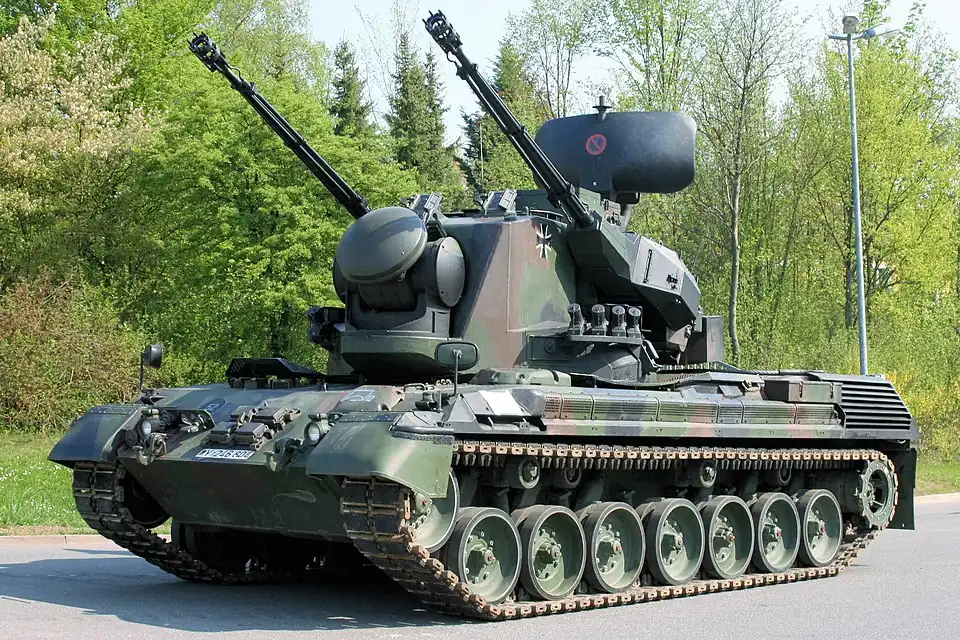
What the Bundeswehr needed in the 1970s was speed, armor, and accuracy in one package; something that could move with tank formations and still shoot down aircraft. Their answer was a self-propelled gun built on the Leopard 1 tank chassis.
The engineers fitted it with a turret that could turn a full circle and carry two 35 mm Oerlikon KDA cannons. The setup could fire over a thousand rounds a minute (up to 1,100 rounds). One radar searched the skies out to about fifteen kilometers; another handled tracking so the guns could stay fixed on target. For its time, it was an impressive blend of analog engineering and early automation (a sort of mechanical intelligence long before the digital era).
Mobility gave the Gepard its edge. With the Leopard 1’s engine and running gear underneath, it could push across rough terrain, shift positions fast and stay close to the armored spearheads it was meant to defend. Crews of three kept it running (commander, gunner, driver), and they could shift position in minutes. It wasn’t perfect protection, but the mix of mobility and punch made it something frontline units actually trusted.
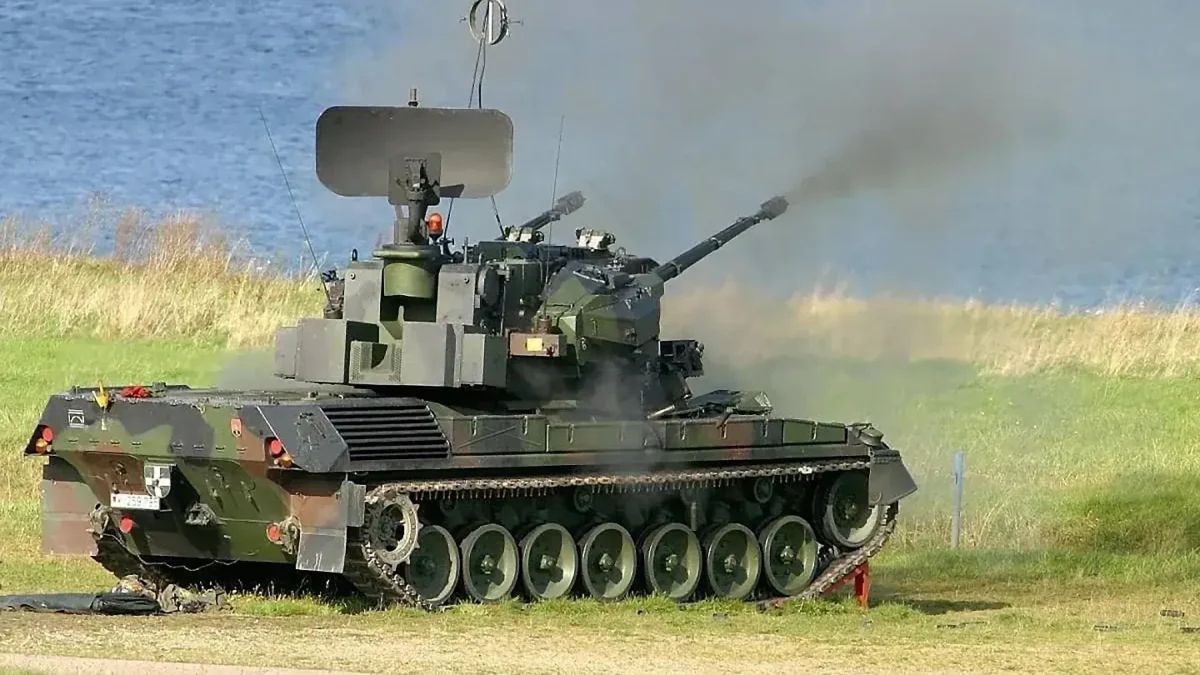
Among NATO’s air-defense vehicles, the Gepard had a personality of its own. The Americans fielded the M163 Vulcan Air Defense System, a tracked gun system with a 20 mm Gatling cannon that could throw out a lot of rounds fast, but not very far, and not always with precision.
The British went the missile route, first with Blowpipe and later with Rapier. Those could hit targets farther out, though they weren’t as quick to react. The Gepard sat somewhere in between: fast enough to keep pace with tanks, yet sharp enough to swat down anything that came in low and close.
The design philosophy behind it was pure Cold War logic; overwhelming firepower, mechanical reliability, and radar precision. Yet ironically, those same traits are exactly what make the Gepard so effective today, half a century later, in a completely different kind of war.
When Russia’s full-scale invasion began in early 2022, the Gepard wasn’t exactly on anyone’s shortlist of “weapons that could change the war.” Germany itself had retired the system years earlier, and most of its remaining units sat in depots or were sold off. But as Russian cruise missiles and Iranian-made Shahed drones started hitting Ukrainian cities, something became clear that Ukraine needed volume firepower, something mobile, simple, and proven.
That’s when Berlin made a decision that surprised even its own defense circles. In April 2022, Germany announced it would send the first batch of Flakpanzer Gepards to Ukraine, marking the first time a major NATO power supplied such a weapon to Kyiv. Initially, the plan called for about 30 vehicles, drawn from retired Bundeswehr stocks. But it wasn’t that simple.
The biggest obstacle was ammunition. The Gepard’s 35 mm shells were no longer produced in Germany, and the Swiss company that originally made them refused to authorize re-exports to a war zone.
For months, the tanks sat idle, ready but silent, because Berlin couldn’t find anyone to supply the ammo. It became a symbolic embarrassment for Germany: the decision to help Ukraine was bold, but the follow-through revealed the logistical hangovers of decades of disarmament.
Eventually, Rheinmetall, one of Germany’s largest defense firms, stepped in. The company reopened a dedicated 35 mm production line in its Unterlüß facility and started building new rounds specifically for Ukraine.
By mid-2023, the supply problem began to ease, and Ukraine’s Gepards were finally fighting. Nobody really expected much from Gepard at first. But once it got to the front, stories started to spread; how it picked drones out of the sky, how it just kept running.
By 2024, deliveries kept coming, roughly sixty from Germany and old stocks in Belgium and the Netherlands were quietly raided for whatever components could be salvaged. Alongside these, Berlin also financed the production of tens of thousands of 35 mm shells, which was seen as an industrial effort that reawakened a dormant capability just to keep these 50-year-old vehicles in the fight.
Still, the story isn’t without criticism. The Gepard deliveries were at first delayed by bureaucracy and political hesitation. Germany’s initial reluctance to arm Ukraine more heavily made the Gepard decision both groundbreaking and controversial. Some argued it was too little, too late. Others saw it as the moment Germany finally began to shed its postwar caution and re-enter the reality of European defense politics.
When the first Gepards arrived from Germany in 2022, no one really thought they’d matter much. “A few old tanks with guns” that’s maybe how many saw them. But by early 2025, their record spoke for itself. Ukrainian units praised them for doing exactly what expensive missile systems sometimes couldn’t.
These days, the Gepards mostly watch over power grids and transport links. It’s positioned near power substations, logistics hubs, and key urban centers like outside Kyiv, down by Odesa, near Dnipro too. Anywhere drones or missiles tend to show up, there’s usually one nearby, tracking the sky.
Their twin 35 mm Oerlikon KDA autocannons, guided by search and tracking radars, form a highly responsive shield against low-flying threats.
In a war dominated by Iranian-made Shahed drones and cruise missile attacks, the Gepard’s ability to react instantly and fire continuously has made it indispensable. Unlike high-end missile systems that rely on expensive interceptors, the Gepard simply keeps shooting, round after round, as long as its ammunition holds.
That reliability, both mechanical and operational, has become a recurring theme in Ukrainian feedback. In April 2025, Ukrainian commanders publicly described the Gepard as “one of the most reliable German weapons in service.” Crews report that the system is easy to maintain and intuitive to operate. This is a crucial advantage when compared to more complex Western air-defense platforms that require specialized logistics and software integration.
In the field, Gepards have achieved consistent success rates against Shahed drones, with several confirmed shootdowns during nighttime raids when radar-guided guns have proven faster and more adaptable than optical or missile-based systems.
Some Ukrainian reports even describe Gepards occasionally bringing down cruise missiles at close range, which is a rare feat for a gun-based platform.
Statistically, the results are backed by Germany’s own actions. Recognizing the Gepard’s battlefield value, Berlin has continued to expand support.
By March 2025, Germany had delivered around 60 Gepard units to Ukraine, along with tens of thousands of 35 mm rounds. The ammunition issue, once the system’s biggest Achilles’ heel, is finally being addressed.
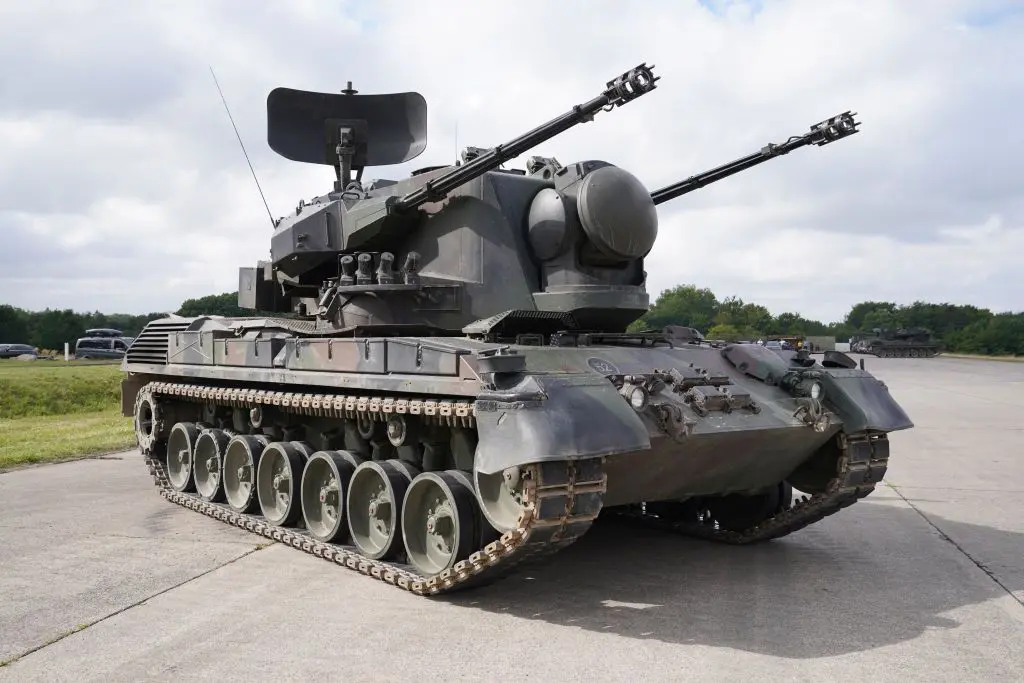
Rheinmetall reopened a 35 mm ammunition production line in its Unterlüß plant and secured a new contract to deliver around 180,000 rounds, with shipments expected through 2026. Without that renewed industrial effort, the Gepard’s frontline success would have been short-lived.
Yet the story isn’t without complications. The Gepard is effective, but it’s not a miracle weapon. Its range and radar coverage are limited, meaning it can only protect a relatively small area at a time. Against massed attacks, like Russia’s coordinated drone and missile barrages, Gepards can be overwhelmed simply by volume.
They are most effective as part of a layered defense network, complementing medium- and long-range systems like IRIS-T and Patriot batteries. Used correctly, they act as the lower tier, intercepting drones and low-altitude threats that would otherwise waste expensive missile interceptors.
Critically, the system’s sustainability depends on ammunition flow. Each engagement consumes dozens of rounds, and in prolonged barrages, even a fleet of Gepards can run dry if resupply lags. That’s why Rheinmetall’s new contracts are more than logistical details.
Here’s also the question of modernization; while the Gepard’s original radar and fire-control systems were advanced for their time, modern drones present smaller radar signatures and employ electronic countermeasures.
German manufacturer KNDS has proposed upgrades to enhance radar tracking, integrate GPS and laser rangefinders, and improve communication systems, but these enhancements are still proposals, not field realities.
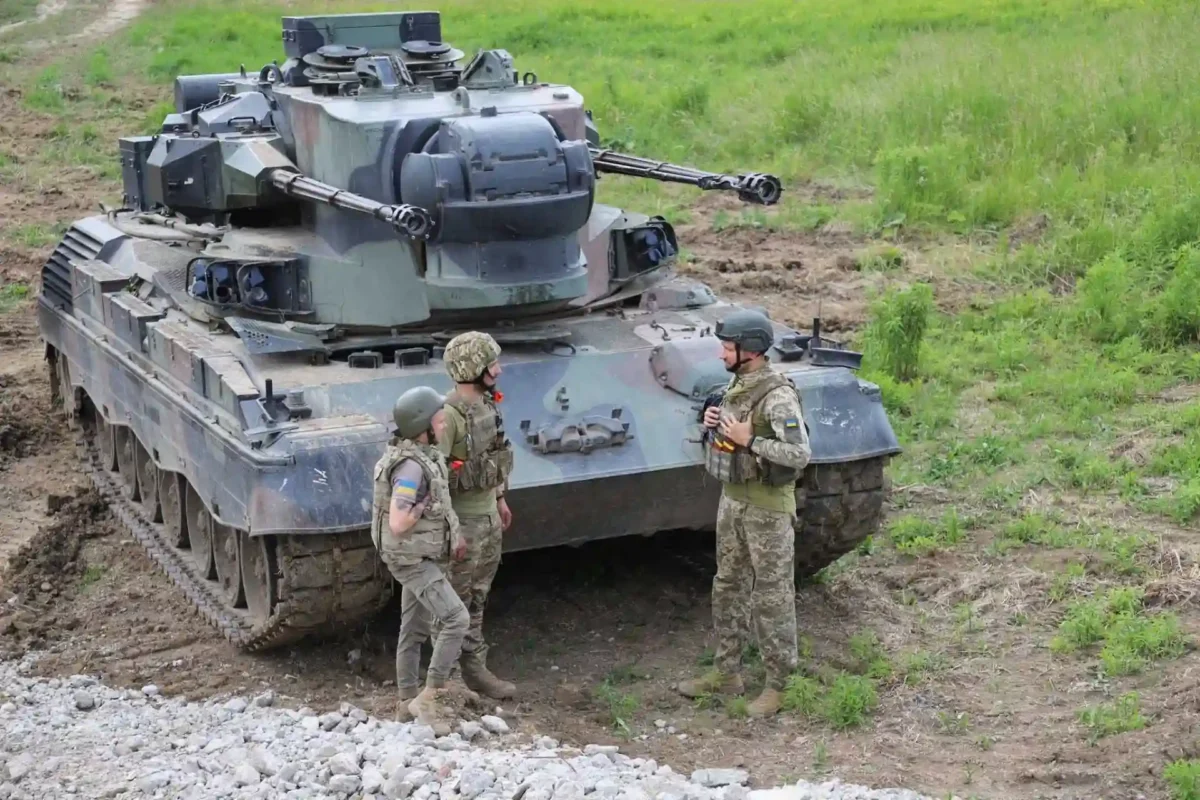
What does that tell us, really? Mostly that the Gepard has proved itself the hard way by showing up, day after day, and doing the job. The system saved power grids, covered cities, and did it all for a fraction of the cost of fancy missile batteries. Somehow, a machine built for the Cold War turned out to be exactly what this kind of drone war needed.
Still, it’s important to see the bigger picture. The Gepard is a tactical success, not a strategic solution. Its impact is powerful but localized; its endurance depends on supply chains and aging platforms. Yet that may be the most revealing lesson of all; in a conflict defined by innovation, it’s the rediscovered, reengineered relics of the past that are proving the most dependable.
Most people would call the Flakpanzer Gepard a relic; a leftover from the Cold War, built for a kind of battle that doesn’t exist anymore (Big guns, analog radar, all steel and noise). But watch what it’s done in Ukraine and that label starts to fall apart. It’s not fancy, not cutting-edge, just a machine that does what it’s meant to do.
Part of what keeps the Gepard relevant is how its old systems still work together so well. Those twin 35 mm Oerlikon guns might date back decades, but they’re fast (about 550 rounds a minute per barrel) and surprisingly accurate.
The radar setup ties it all together, spotting and tracking targets before the crew even reacts. Against low, slow drones like the Shahed-136, that mix of quick detection and steady firepower has turned out to be exactly what’s needed.
The system’s cost and maintainability are arguably just as important as its firepower. A single Gepard engagement costs only a fraction of what firing a missile would. Each 35 mm round is inexpensive compared to the six-figure price tags of interceptors used by systems like Patriot or NASAMS.
Moreover, the Gepard’s mechanical simplicity; a diesel engine, hydraulic turret, analog radar systems, means it’s far easier to keep running in the field.
Table. Estimated Cost per Aerial Target Intercept (2025)
| System / Weapon | Interceptor Type | Approx. Cost per Round / Missile | Rounds Needed per Kill (avg.) | Estimated Cost per Kill (USD) | Typical Target Type |
| Flakpanzer Gepard | 35 mm HEI / AHEAD shells | $250–$300 per round | 20–40 | $5,000–$12,000 | Shahed-136 / Orlan-10 drones |
| NASAMS | AIM-120 AMRAAM missile | $1 million+ | 1 | $1,000,000+ | Cruise missile / drone |
| IRIS-T SLM | IRIS-T missile | $430,000–$450,000 | 1 | $430,000+ | Drone / aircraft |
| Patriot PAC-3 | Hit-to-kill missile | $3–$4 million | 1 | $3,000,000–$4,000,000 | Cruise missile / aircraft |
| Shahed-136 Drone (Target) | Loitering munition | $20,000–$40,000 | — | — | — |
For Ukraine, where maintenance resources are often stretched thin, that’s no small advantage. Crews have described the Gepard as “sturdy” and “forgiving,” traits that make it ideal for a war of attrition where sustainability often matters more than cutting-edge sophistication.
That said, one has to acknowledge that the Gepard’s design is rooted in a different era and that can be both a strength and a limitation. It wasn’t built for the complex, multi-domain warfare of the 21st century. Its radar, while capable, can struggle to detect very small or stealthy drones, especially in cluttered environments or under electronic interference.
And its range, roughly 4 kilometers effective for air targets, makes it a short-range tool by modern standards. These limits mean it can’t stand alone; it works best when layered beneath missile-based defenses that handle the higher, faster threats.
Yet even this limitation arguably underscores why the Gepard remains relevant. Modern warfare increasingly requires layered, complementary defense systems, not just a single high-tech shield. The Gepard fills a niche that no missile system can do cheaply or continuously; shooting down what’s close, what’s cheap, and what’s persistent.
In a world where small drones can cost just a few thousand dollars, spending hundreds of thousands to intercept them is economically unsustainable. The Gepard offers a practical middle ground: a dependable, repeatable, and scalable defense option.
If there’s a fair critique, it might be that Germany and NATO were too quick to retire systems like the Gepard before fully considering how the drone revolution would change air defense priorities. The war in Ukraine has forced many militaries to reconsider that logic.
Rheinmetall’s recent push to revive production of 35 mm AHEAD airburst ammunition, designed to destroy drones with precision shrapnel , shows how Cold War hardware can evolve when paired with modern munitions.
Some experts even suggest that upgrading old Gepards with digital fire-control systems and electro-optical sensors could extend their operational life for another decade or more.