Follow Us:

Follow Us:

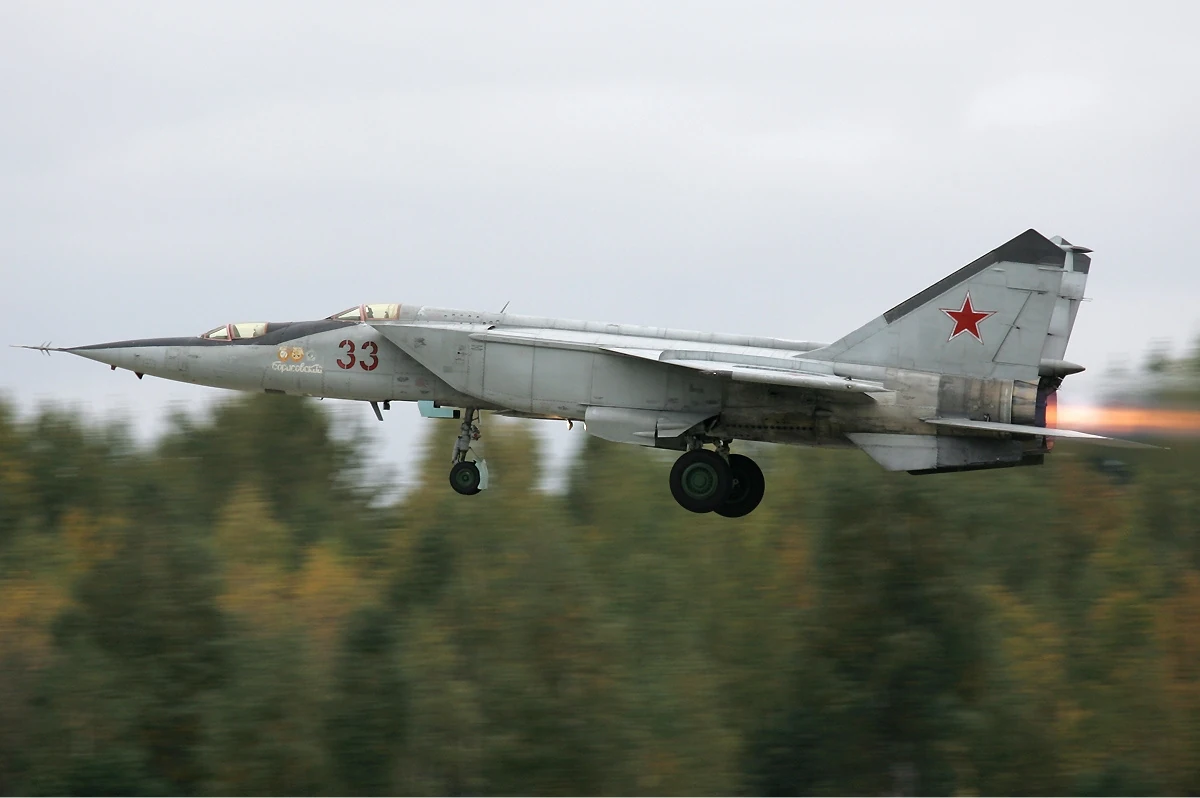
Imagine a jet so fast that Western pilots weren’t sure anything could catch it. That’s the MiG-25 Foxbat—a Soviet interceptor that burst onto the scene in the early 1970s and sent shockwaves through NATO intelligence.
This wasn’t just another fighter. The Foxbat was a Cold War predator built to chase down the fastest intruders in the sky, like America’s SR-71 Blackbird and high-altitude bombers, before they could even think about striking Soviet territory.
With its towering twin tail fins, massive air intakes, and two roaring Tumansky R-15B-300 turbojets, the MiG-25 could reach speeds near Mach 2.8 in combat. In a pinch, pilots could push it past Mach 3, but doing so risked frying the engines.
At a time when most Western jets struggled to sustain Mach 2, the Foxbat was on another level. NATO gave it the codename “Foxbat,” a name that sounded harmless enough, until you realized it was a purpose-built hunter designed to operate where few others could fly. It could soar to 70,000 feet, snapping photos of enemy bases or intercepting incoming threats before they knew what hit them.
But the MiG-25’s story isn’t just about raw performance. When Soviet pilot Viktor Belenko famously defected to Japan in 1976, the West got its first real look under the hood.
What they found was surprising, while the Foxbat’s speed and altitude were unmatched, it wasn’t the agile, all-powerful machine many feared. Its design relied on stainless steel to handle the heat of high-speed flight, its avionics were simpler than expected, and its turning ability was limited.

Still, the Foxbat earned its place in aviation history. It forced the United States to speed up development of the F-15 Eagle, proved the Soviets could build a jet that could out-climb and outrun almost anything, and left a legacy that carried over into its successor, the MiG-31.
Decades later, the MiG-25 remains an icon, part myth, part marvel. Whether you admire it for its engineering or its role in Cold War drama, one thing is certain: the Foxbat was built to impress, and it still does.
The MiG-25 Foxbat wasn’t born out of guesswork, it was the Soviet Union’s answer to a very real threat. In the late 1950s and early 1960s, US aircraft like the B-58 Hustler bomber and the then-secret SR-71 Blackbird were setting speed and altitude records that no Soviet fighter could match.
The Kremlin wanted an interceptor that could catch them in their tracks, and Mikoyan-Gurevich, the famed aircraft design bureau, got the call.
The result was a jet unlike anything in the Soviet arsenal. From the start, engineers faced one major problem: how to keep a plane together at speeds pushing Mach 3. Most fighters of the era were built with aluminum, but at those speeds the heat generated from air friction could weaken or warp the metal.
The Foxbat’s designers went with a rugged solution, 80% stainless steel, some nickel alloy, and just enough titanium to save weight where it mattered.

Under the hood, the MiG-25 carried two massive Tumansky R-15B-300 turbojet engines. These were powerful, but they weren’t built for efficiency, at full throttle, they burned fuel at an astonishing rate. That didn’t matter much to Soviet planners; the Foxbat wasn’t meant for long-range patrols. Its mission was simple: scramble fast, climb higher than anything else, intercept the target, and return to base.
The Foxbat’s design was all about extremes. Huge air intakes fed the engines enough air to keep them alive at high speeds. The twin vertical stabilizers gave it stability at altitudes over 70,000 feet. Its large, straight wings provided lift in the thin upper atmosphere, though they made the jet less nimble at low altitudes.
By 1964, prototypes known as the YE-155 series were already flying, and by 1970, the MiG-25P interceptor variant was in service. It was fast, intimidating, and exactly what Soviet leaders had in mind, a blunt, high-speed instrument of air defense.
The Foxbat wasn’t a dogfighter. It was a sprinting heavyweight designed for one punch, and it hit hard.
While the MiG-25 Foxbat is remembered for its jaw-dropping speed and climb rate, the real story comes through in the numbers. Every figure tells you this jet was built with a single-minded purpose: get to the target fast, take the shot, and get out before the enemy could react.
Manufacturer: Mikoyan-Gurevich Design Bureau
Role: Interceptor / Reconnaissance Aircraft
First Flight: 1964 (YE-155 prototypes)
Service Entry: 1970
Number Built: About 1,186 units
Dimensions
Weight
Powerplant
Performance
Armament (Interceptor Variants)
Sensors
These specs made the MiG-25 a world-class interceptor on paper, and in certain roles, it lived up to every promise. While it couldn’t twist and turn like a nimble dogfighter, no one could deny that its straight-line dash and high-altitude reach were unmatched in its era. In fact, some of its climb and altitude records remain unbeaten by any other jet-powered aircraft to this day.
If the MiG-25 Foxbat had one claim to fame, it was speed, raw, blistering, straight-line speed. In operational flights, the Foxbat could hit Mach 2.8 without breaking a sweat. In emergencies, Soviet pilots sometimes pushed it past Mach 3, but that came at a cost. At those extremes, the engines could overheat so badly they were essentially destroyed after the flight.
Altitude was another weapon in the Foxbat’s arsenal. It could climb to around 70,000 feet during missions, and in test flights it went even higher.
In 1977, a specially prepared MiG-25 set an official world record by reaching over 123,000 feet (37.6 km) in a ballistic climb, a record that still stands for a jet-powered aircraft. That’s high enough for pilots to see the curvature of the Earth and the dark edge of space.
The Foxbat also had an incredible climb rate. It could rocket from ground level to 65,000 feet in under four minutes, a performance that stunned Western analysts when the aircraft first appeared. Against high-flying reconnaissance planes or bombers, that kind of acceleration meant the difference between interception and a missed opportunity.
But speed came with trade-offs. The MiG-25’s airframe could handle incredible stress in the thin upper atmosphere, but at lower altitudes and tighter turns it was far from nimble. Pilots knew not to get dragged into a dogfight against something like an F-4 Phantom or later an F-15 Eagle. Its design was about chasing, not dancing.
Read also: Top 5 Fastest Fighter Jets Ever Built in the World
Despite these limitations, the Foxbat’s records made headlines. It held 29 world records for speed, altitude, and time-to-climb during its heyday. While later jets surpassed some of these numbers, the Foxbat’s legacy as one of the fastest and highest-flying military aircraft ever built remains untouched in the minds of aviation enthusiasts.
When it came to getting somewhere fast, nothing short of an SR-71 could leave the Foxbat behind, and even then, not by much.
The MiG-25 Foxbat may have been designed with a single mission in mind, chasing down intruders, but over time, it evolved into a family of specialized aircraft. Each variant carried the same intimidating frame and powerful engines, but the Soviets tailored them for different jobs in the air.
The original MiG-25P (NATO: Foxbat-A) was the pure interceptor. It was built to climb fast, fly high, and fire its weapons from a distance. Its arsenal usually included four massive R-40 (AA-6 “Acrid”) air-to-air missiles, the largest missiles ever carried by a fighter. These came in infrared- and radar-guided versions, giving the Foxbat a fighting chance against maneuvering targets even at high speeds.
Then came the MiG-25R (Foxbat-B), a reconnaissance variant. Instead of missiles, it carried high-resolution cameras and electronic sensors, perfect for photographing NATO bases or mapping enemy air defenses. Operating above most interceptor ranges, the MiG-25R was one of the few aircraft in the world that could fly deep into hostile airspace and return with hard intelligence.

The MiG-25PU (Foxbat-C) was a two-seat trainer. It let new pilots experience the Foxbat’s unique handling and extreme performance before flying solo.
One of the most significant upgrades was the MiG-25PD (Foxbat-E), introduced after Soviet planners realized Western fighters like the F-15 Eagle could potentially outmatch the older Foxbat. The PD model came with improved radar, better avionics, and slightly more powerful engines.
Each variant kept the same core strengths, altitude, speed, and climb rate, while trading out equipment for its specific mission. Whether armed with missiles or cameras, the MiG-25 was a blunt but effective tool. Its weapons were heavy, its sensors reliable, and its performance still intimidating years after it first entered service.
The Foxbat never pretended to be a multirole fighter like its Western counterparts. Instead, it stuck to what it did best, hitting hard, hitting fast, and disappearing before the enemy could respond.

The MiG-25 Foxbat entered service in 1970 at the height of the Cold War, and almost immediately it became a source of fascination and fear in the West. NATO pilots knew about it through grainy reconnaissance photos and radar sightings, but its true performance was a mystery. That uncertainty worked in the Soviets’ favor, at least for a while.
One of the most famous moments in Foxbat history came in 1976, when Soviet pilot Viktor Belenko defected to Japan, landing his MiG-25P at Hakodate Airport. The event shocked the world. For the first time, Western engineers could take the jet apart and see how it worked. What they found was both impressive and surprising.
The Foxbat’s top speed and altitude were real, but its avionics were simpler than expected, and its agility was limited. Still, the revelation didn’t erase its reputation, it had already influenced Western aircraft design, most notably speeding up the development of the F-15 Eagle.
In Soviet service, the MiG-25 was primarily stationed near key borders, ready to intercept intruders like the SR-71 Blackbird or high-flying reconnaissance drones. It was also exported to allies, including India, Iraq, Syria, Libya, and Algeria, where it saw combat in various conflicts.

Iraqi MiG-25s engaged Iranian aircraft during the Iran–Iraq War, with mixed results. In at least one instance, a Foxbat shot down an American F/A-18 during the Gulf War in 1991, one of the few confirmed air-to-air kills by the type.
Reconnaissance variants proved particularly valuable. During tense moments, they flew deep over enemy territory at altitudes that made interception nearly impossible. Indian Air Force MiG-25Rs, for example, famously photographed Pakistani military installations in the 1990s without being challenged.
Over its career, the Foxbat wasn’t just an aircraft, it was a statement. It told the world the Soviet Union could build something that could outrun almost anything, even if it wasn’t the most agile or sophisticated. Its successor, the MiG-31 Foxhound, carried forward much of its DNA, but the Foxbat’s mix of mystery, speed, and raw power left an impression that still lingers in aviation history.
The MiG-25 Foxbat may have been built for a very specific job, but its legacy has stretched far beyond its original mission. For decades, it stood as both a symbol of Soviet engineering ambition and a reminder of how fear can shape military strategy.
In the West, the Foxbat’s early appearances in the late 1960s and early 1970s caused near panic. Intelligence analysts assumed it was not only fast but also highly agile, potentially outclassing anything the United States or NATO had in service.
This perception helped push the development of the F-15 Eagle, a fighter designed specifically to counter the Foxbat threat. When Viktor Belenko’s defection in 1976 revealed the jet’s actual strengths and weaknesses, it shifted that narrative, but by then, the Foxbat had already left its mark on Western defense planning.
Within the Soviet Union, the MiG-25 became a point of pride. It was proof the USSR could produce an aircraft that could match and sometimes exceed American technology in certain performance metrics. It also gave Soviet allies a psychological boost, owning Foxbats signaled you had cutting-edge hardware, even if its capabilities were narrowly focused.
Beyond military circles, the Foxbat captured the imagination of aviation enthusiasts. Its sharp angles, massive engines, and raw speed made it an icon in books, documentaries, and airshows. It earned nicknames like the “Flying Brick” for its straight-line power and lack of agility, but even that added to its mystique, it was unapologetically built for speed, not elegance.
Today, surviving MiG-25s can still be seen in museums and in limited service with a few nations. While its successor, the MiG-31 Foxhound, refined and expanded its capabilities, the original Foxbat remains one of the fastest military aircraft ever built. It stands as a reminder that sometimes brute force, when applied to a single goal, can make history.
The Foxbat’s story blends myth, Cold War politics, and record-breaking performance into one package. Decades later, it’s still discussed with a mix of respect, awe, and curiosity, a fitting legacy for a machine that once seemed unstoppable.