Follow Us:
Follow Us:

Not long ago, Russian media pushed out fresh clips of a Tu-22M3 bomber flying as part of military drills. At first glance, it’s just another grainy clip of a big grey aircraft, nothing unusual. But the details make people pause.
This bomber design has been flying since the late 1970s, and yet here it is, still being rolled out as part of Moscow’s show of strength.
It also hit a nerve for another reason: this same aircraft type was badly damaged just last year when Ukraine managed to strike one on the ground. For a bomber that Moscow likes to parade as a symbol of reach and power, that was an embarrassing moment.
Fast forward to this September, and the Tu-22M3 is back in the headlines, this time during the joint Zapad 2025 exercises with Belarus. Footage showed the bombers flying long patrols and even simulating strike missions.
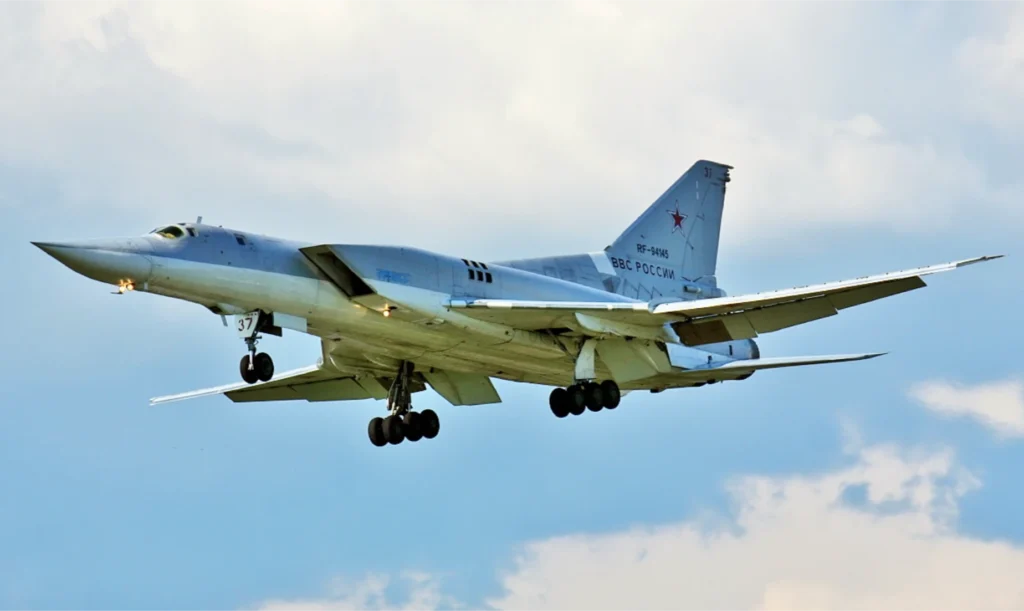
What makes it interesting is the contradiction. The Tu-22M3 isn’t a stealth jet, and it certainly doesn’t have the sleek, futuristic look of newer bombers. But people who follow military aviation keep pointing out that it can still outrun a lot of Western aircraft, and it carries enough payload to do real damage if it gets close.
That mix of aging airframe and surprising capability is what keeps it in the news and keeps analysts arguing over whether it’s a serious threat or just Cold War hardware being stretched past its prime.
The Tu-22M3 came out of a problem. By the late 1960s, American carrier groups were pushing closer to Soviet shores, and the older Tu-22M bomber, meant to counter this threat, simply wasn’t up to the task. It was fast in a straight line, but clumsy, short-legged, poor range and had handling issues that frustrated its crews. If Moscow wanted to keep pace, something had to change.
That’s when Tupolev’s designers set about building a bomber with a very specific job. It had to reach U.S. carriers far out at sea, carry heavy cruise missiles, and still be quick enough to slip through NATO defenses.

To make that possible, the engineers gave it variable-sweep wings—straight for efficiency on long patrols, swept back for speed in an attack run.
They also added more powerful engines, which gave it the muscle to hit supersonic speeds when needed. And they designed the airframe around a large payload bay and external hardpoints, so the aircraft could haul not just bombs but also long-range missiles.
When this new design began to appear in the 1970s, Western intelligence took notice. NATO gave it the codename “Backfire.” The name carried a certain irony; it was meant to mark the bomber as a response to U.S. power, but it also hinted at the risks of escalation.
| Item | Value |
| Crew | 4 (pilot, co-pilot, navigator, weapon systems officer). |
| Length | 42.46 m (139 ft 4 in). |
| Wingspan | 34.28 m (spread, 20° sweep) — 23.3 m when swept (65°). |
| Height | 11.05 m. |
| Empty / Gross weight | ~58,000 kg empty; ~112,000 kg gross. |
| Powerplant | 2 × Kuznetsov NK-25 afterburning turbofans (~245 kN / ~55,000 lbf thrust each with afterburner). |
| Top speed | Around Mach 2 / ~1,900–2,000 km/h (dash speed at altitude). |
| Combat radius | Typically quoted ~2,500 km with a ~10,000 kg weapons load; ferry range up to ~6,800–7,000 km. |
| Internal/external payload | Internal weapons bay + wing/fuselage pylons; total carriage capacity ~24,000 kg; can carry combinations of Kh-22 / Kh-32 / Kh-15 missiles, free-fall bombs, mines, and has nuclear delivery capability. |
| Defensive / gun | 1 × remotely controlled 23 mm GSh-23 tail cannon (tail turret). |
| Avionics/upgrades | Older analogue/legacy avionics on early airframes; later upgrades (SVP-24-22, NV-45 radar, Tu-22M3M modernization) add digital navigation, improved bombing/sight computing, GLONASS, and modernized cockpit/electronics. |
What does this mean?
The shape tells the story: long fuselage, swing (variable-sweep) wings and a big internal bay, means this is a plane built to be flexible.
The swing wing lets the aircraft behave like two different planes: wings swept forward for efficient cruising on long patrols, swept back for a fast, low-level dash in an attack. The result is an aircraft that can loiter reasonably far out and then convert speed into a short, punishing strike profile.
Those two NK-25s are brute engines for their era. With roughly 245 kN of thrust apiece, the Tu-22M3 can push into supersonic territory (useful for quick ingress/egress and for outrunning some threats).
The trade-off is fuel burn: the engines drink a lot of fuel when pushed, so full-speed dashes shorten time on station and increase reliance on ferry range or midair refuelling (the latter was removed under SALT II and only reintroduced in late upgrade plans).
Top speed near Mach 2 is a headline grabber. It lets the bomber close quickly and complicates interception at high altitude. Combat radius figures (roughly 2,500 km on a loaded strike) show how the platform was built to reach carrier groups and distant littoral targets without constant tanker support.
Ferry ranges in the 6,800–7,000 km band mean long transits are possible, but practical combat sorties are still constrained by weapons weight, flight profile and threat environment. Means: fast enough to be dangerous, but not a magic solution for prolonged loiter or precision CAS.

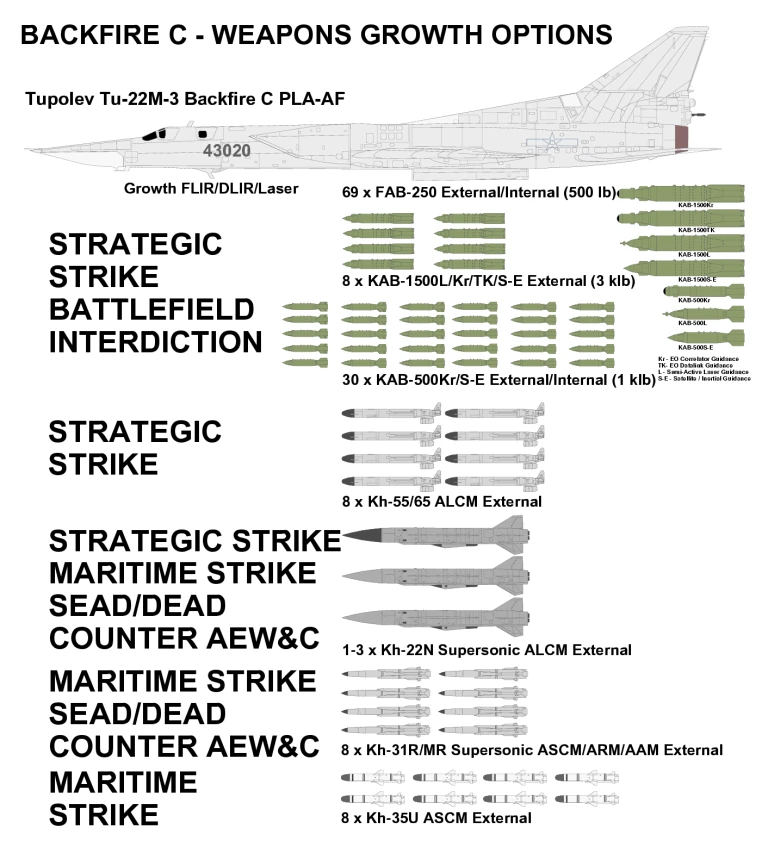
The internal bay plus pylons and a 24-ton carriage capacity make the Tu-22M3 essentially a missile truck that can also drop big bombs.
Long-range anti-ship missiles such as the Kh-22/Kh-32 or the smaller Kh-15 give it the ability to threaten ships from standoff distances; heavier free-fall bombs or multiple missiles increase destructive potential against land targets.
Nuclear delivery was part of the design calculus, so the platform’s role ranges from conventional maritime strike to strategic deterrence depending on loadout. That flexibility is why the airframe kept being used and modernized.
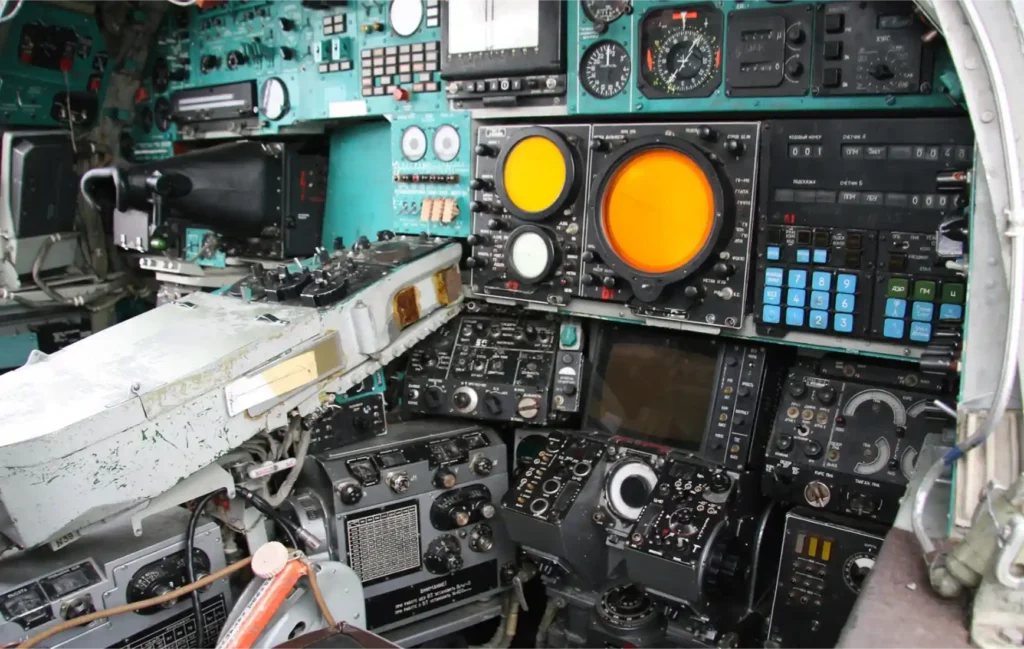
Original cockpits and nav/attack systems were 1970s vintage—serviceable then, dated now. Modernization efforts (SVP-24-22, NV-45, newer navigation and digital processing packages and, for M3M, a more modern glass cockpit and GLONASS integration) aim to close that gap.
The net effect: improved bombing accuracy, better situational awareness and the ability to carry newer missiles. Still, only a portion of the fleet has full upgrades, so operational effectiveness varies by airframe.
| Area | Tu-22 (baseline) | Tu-22M3M / modernized |
| Avionics & navigation | 1970s-era analogue gauges, older radar, and bombing aids | Digital navigation, GLONASS, SVP-24-22 computing, new NV-45 radar or improved radar; glass-cockpit elements. |
| Sensors & targeting | Cruder bombing/aiming accuracy; limited precision weapon support | Precision bombing support from SVP-24 family; ability to use modern guided weapons (improved aiming, data processing). |
| Engines & flight controls | NK-25 engines, original controls | Same basic engines on many M3Ms, but some proposals to use improved engine controls or NK-32-derived systems on select airframes; flight-control and engine management modernized. |
| Weapons & payload | Kh-22, Kh-15, dumb bombs; limited precision standoff options | Compatibility with Kh-32, potential carriage of hypersonic/kīnzhāl family, improved wiring/pylons for modern missiles; precision conventional options. |
| Defensive systems | Tail gun, older ECM suites | Modern ECM/self-defence packs, plans to replace tail guns with electronic countermeasures on some upgrades. |
| Service life & maintainability | Aging airframes, patchwork upgrades | Life-extension work, expected service-life extension (decades) and better sortie reliability for upgraded aircraft. |
The upgrades take an old missile truck and give it a modern brain. It goes from “big dumb bomber” to “stand-off strike platform with precision options.”
The original Tu-22M, analogue navigation and bombing systems, the SVP-24 family and NV-45 radar bring computerized aiming, satellite navigation and much better data handling. That means the same airframe can now drop weapons with far greater accuracy, cue long-range missiles more reliably, and do it while feeding modern sensors into the crew’s displays.
Upgraded avionics also make mission planning and multi-leg flights easier. GLONASS integration and modern flight-computers reduce navigational error on long sorties, so effective combat radius in realistic missions improves even if raw fuel numbers don’t change. Better onboard processing also allows faster reactions to changing threats, for example, rerouting a run or switching to different weapon profiles mid-mission.
Replacing or supplementing the old tail gun with electronic warfare gear shifts the protection model. Instead of trying to shoot down a fighter or missile with a gun, the aircraft tries to confuse incoming threats and avoid detection.
The modernization of the Tu-22M3 into the Tu-22M3M shows up most clearly in how the aircraft performs its missions. One of the biggest gains comes from the SVP-24 computing system, which sharply reduces bombing errors compared to the old analogue sights.
Unlike the old analogue sights, which often left bomb runs imprecise, the digital suite calculates release points with far greater accuracy. This means conventional strikes can now be used effectively against hardened or point targets without relying solely on nuclear or massive payloads. In practice, fewer bombs are wasted and the bomber no longer needs to make several risky passes over the same area.
The NV-45 radar and digital cockpit displays also improve the crew’s ability to detect and track targets, giving faster updates and clearer information during flight. These changes not only increase situational awareness but also make the aircraft more adaptable in fast-moving engagements.
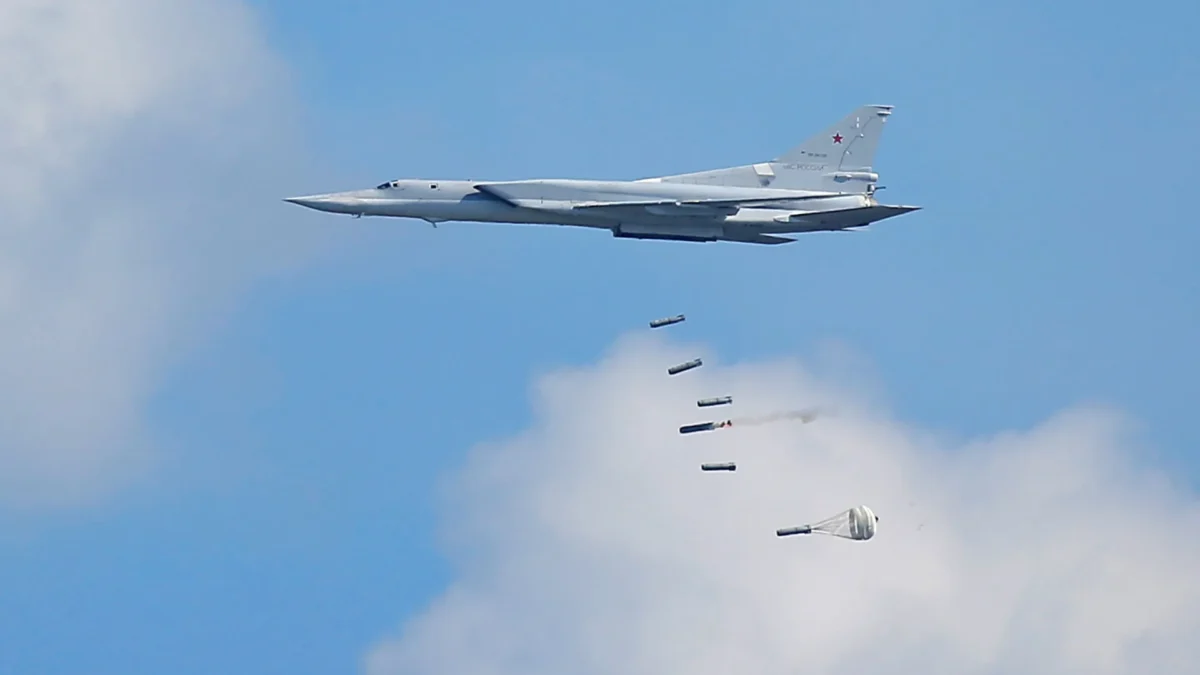
Just as important is the expansion in weapons flexibility. One clear upgrade is the weapons load. The Tu-22M3M can fire newer missiles, including the Kh-32. That means it doesn’t have to get close to heavy air defenses. It can strike from far out and still threaten big targets.
The other change is less flashy but just as important. The airframes have been worked over to last longer, and the avionics are updated. Means, they can fly more often and stay operational longer than their older variants.
In Russia’s long list of military assets, the Tu-22M3 holds an unusual place. It isn’t a front-line fighter, nor is it the massive intercontinental bomber that headlines Moscow’s nuclear arsenal.
Instead, it sits somewhere in the middle. While not formally counted as part of Russia’s official nuclear delivery force like the Tu-95 or Tu-160, the Tu-22M3 has long been equipped to carry nuclear weapons if needed. This gives it a flexible role: conventional strikes in regional wars, with the option of nuclear delivery if tensions ever spiral far enough.
Its real value, though, is tested against the problem of modern air defenses. The bomber was meant to break through the layers of NATO protection around carrier groups, but modern air-defence networks are much tougher than in the Cold War. Left to itself, a Tu-22M3 would have a hard time surviving inside those umbrellas.
The upgrades change that picture. Carrying stand-off missiles such as the Kh-32 lets the plane fire from far away instead of flying into the densest defences. Launched from the edges of contested airspace, those missiles force defenders to spread out and worry about threats coming from different directions.
| Feature | Tu-22M3 (Backfire-C) | B-1B Lancer |
| First Flight | 1977 | 1974 |
| Role | Long-range bomber, maritime strike | Long-range strategic bomber |
| Engines | 2 × Kuznetsov NK-25 turbojets | 4 × General Electric F101 turbofans |
| Top Speed | Mach 1.88 (≈ 2,000 km/h) | Mach 1.25 (≈ 1,335 km/h) |
| Combat Radius | ~2,400 km | ~5,500 km |
| Payload Capacity | ~24,000 kg | ~34,000 kg |
| Primary Weapons | Kh-22/Kh-32 cruise missiles, bombs, nuclear option | Precision-guided bombs, cruise missiles (conventional only after 1990s) |
| Nuclear Capability | Yes (retained) | Removed (START treaty limits) |
| NATO Codename | Backfire | Bone |
What the Comparison Tells Us…
The numbers point to a clear trade-off. The Tu-22M3 is faster, built to dash in and out of regional battles, especially against NATO fleets. Its supersonic speed and heavy missile armament make it a direct threat in Europe and the surrounding seas. But this comes at the cost of range; it simply can’t reach as far as the American bomber.
The B-1B Lancer flips the balance. The B-1B doesn’t fly as fast as the Tu-22M3. Instead, it was rebuilt to focus on range and how much it can carry. It can travel much deeper into enemy territory, which makes it useful as a global strike bomber rather than something limited to nearby regions. The design leans on hauling a huge load of weapons and dropping them accurately, which fits a style of long campaigns instead of quick hit-and-run raids.
The nuclear side is important too. The Tu-22M3 can still carry those weapons, which makes it a flexible but sometimes controversial tool for Russia. The B-1B is different. Its nuclear role was removed under treaties, so it now focuses only on conventional missions. That change narrowed what it could do, but also made it easier for the U.S. to use it in regular wars without sending the wrong signal.
So, which is better?
It’s hard to pin down which bomber is “better,” because they were never really built for the same fight. The Tu-22M3 is more of a sprinter; fast, loud, meant to lunge at NATO fleets or nearby bases and get out before defenses close in. In that narrow role it can still be nasty, especially with long-range missiles bolted underneath.
The B-1B feels completely different. It doesn’t have the same speed, but it can carry more weapons a lot further, which makes it useful for global reach and sustained campaigns. Its far longer range and heavier payload allow it to strike targets across continents without relying on nearby bases. While slower, it fits into the U.S. strategy of power projection anywhere in the world.
So, “better” depends entirely on the job being asked of the bomber. Near Russia’s borders, the Tu-22M3 might look more dangerous. For anything global, the B-1B probably wins out. They’re both products of the strategies behind them; one built to guard the homeland, the other to project power everywhere else.