Follow Us:
Follow Us:

Ever heard of a bomb so big it’s nicknamed the Mother of All Bombs? That’s exactly what the GBU-43/B MOAB is—a giant of modern warfare that made headlines around the world. Officially called the Massive Ordnance Air Blast, this isn’t your average bomb. It’s the most powerful non-nuclear weapon ever used in combat by the United States.
Built for maximum shock and awe, the MOAB bomb weighs over 21,000 pounds and stretches nearly 30 feet long. It’s so massive that it can’t even be dropped from a regular bomber. Instead, it’s rolled out the back of a specially modified MC-130 aircraft. Once released, it uses GPS guidance to strike its target with precision—and when it hits, the results are devastating.
The most famous use of the GBU-43/B came in April 2017, when the U.S. military dropped one on an ISIS tunnel complex in eastern Afghanistan. The blast radius? Over a mile wide. That’s what you call a statement. The explosion killed nearly 100 militants and sent a clear message to enemies around the world.
But the MOAB isn’t just about destruction. It’s also a symbol of technological muscle. Unlike older bombs like the BLU-82 Daisy Cutter, the MOAB was built with modern guidance systems, giving it both power and precision. It’s a bomb that’s as strategic as it is intimidating.
In this post, we’ll take you deeper into what makes the GBU-43/B MOAB so unique—from its specs and design to its combat use and global impact.
The GBU-43/B MOAB, short for Massive Ordnance Air Blast, is a one-of-a-kind weapon in the U.S. Air Force arsenal. Nicknamed the Mother of All Bombs, this giant explosive was designed to deliver a massive concussive blast over a wide area—without crossing the line into nuclear warfare.
But what exactly is it? The MOAB bomb is a large-yield, GPS-guided air-delivered weapon. Unlike typical munitions that penetrate before detonating, the MOAB is engineered to explode mid-air, maximizing surface damage through shockwaves and overpressure. That’s what makes the GBU-43/B massive ordnance air blast MOAB especially effective against soft targets like enemy personnel, cave systems, and lightly fortified bunkers.
It was first built in 2003 by the Air Force Research Laboratory (AFRL) as a successor to the older BLU-82 “Daisy Cutter”. Its creation was rushed in just a few months as the U.S. prepared for the Iraq War. The design aimed to send a clear message: overwhelming force delivered with surgical precision. And with the GBU-43/B MOAB weight clocking in at 21,600 pounds, that message is hard to ignore.
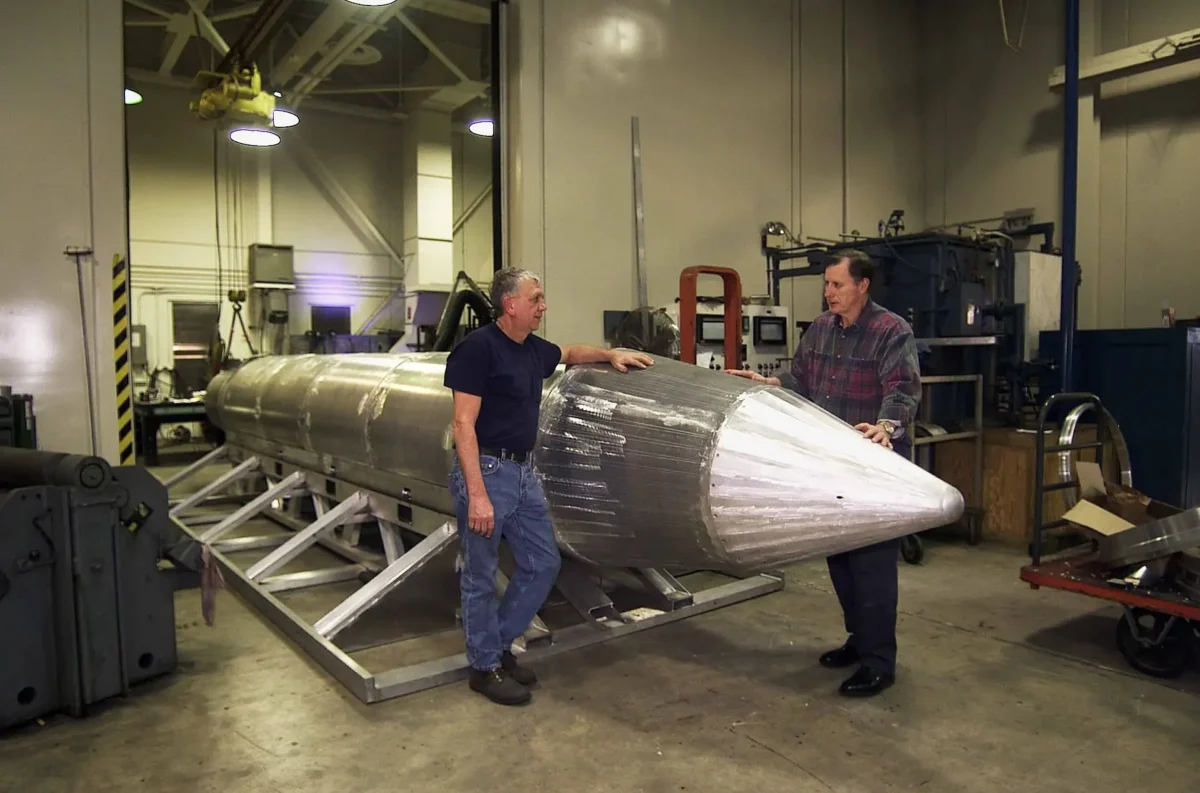
The bomb is guided by an inertial navigation system paired with GPS, giving it precise accuracy despite its massive size. It carries nearly 19,000 pounds of H-6 explosive—an extremely powerful mix used in other high-blast munitions. When detonated, the MOAB blast radius stretches more than a mile, making it ideal for clearing large swaths of terrain or underground tunnel networks in a single strike.
Because of its sheer size, the massive air ordnance bomb can’t be released from standard bombers. Instead, it’s launched from the rear of a cargo plane like the C-130 Hercules, guided to the target by fins and onboard systems. Once in motion, there’s no turning back—it’s a one-way delivery of unmatched explosive force.
From its nickname to its destructive power, the GBU-43 MOAB isn’t just another piece of military hardware. It’s a symbol of psychological dominance, engineered to strike fear and ensure results with one enormous blast.
What makes the GBU-43/B MOAB so powerful isn’t just its size—it’s the combination of massive payload, precise targeting, and efficient delivery. Let’s break down what’s under the hood of this fearsome bomb.
The MOAB bomb weighs in at approximately 21,600 pounds (9,800 kg), with around 18,700 pounds of H-6 explosive packed inside. That’s an enormous amount of firepower—enough to produce a shockwave that flattens structures, collapses tunnels, and disables personnel across a wide area. This H-6 explosive is a highly energetic compound made from RDX, TNT, and aluminum powder, used in other military-grade ordnance for its intense blast output.
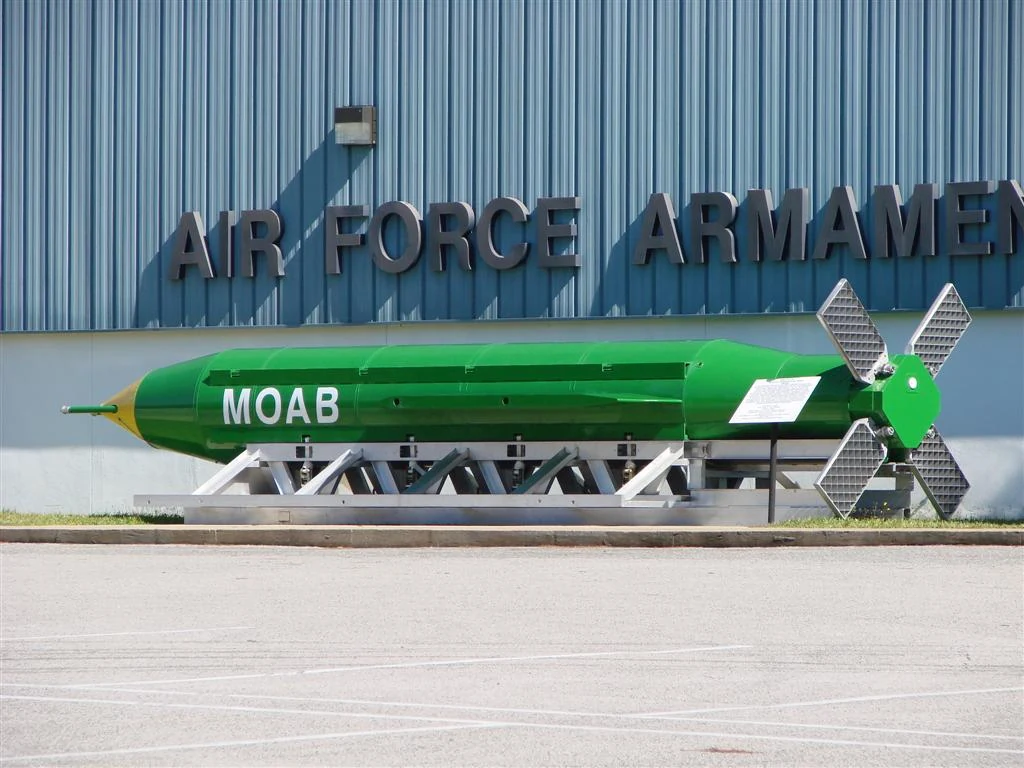
Physically, the bomb measures 30 feet long and just over 40 inches in diameter, making it one of the longest and heaviest conventional bombs ever produced. Due to its size, it can’t be carried internally by a typical aircraft. Instead, it’s launched from the cargo hold of an MC-130 aircraft using a cradle and parachute-assisted system that safely deploys it in midair.
Despite its bulk, the MOAB isn’t a mindless brute—it’s smart. It’s equipped with an Inertial Navigation System (INS) and GPS guidance, which ensures it hits within a few meters of its intended target. This blend of size and precision allows the GBU-43/B Massive Ordnance Air Blast (MOAB) to be used in environments where accuracy is critical, such as mountainous terrain, tunnel-rich zones, or near civilian infrastructure.
The bomb is designed for airburst detonation, meaning it explodes just before hitting the ground. This maximizes the horizontal spread of overpressure and ensures maximum damage across a broad area. The GBU-43/B MOAB blast radius is estimated to be more than 1 mile (1.6 kilometers), depending on terrain and atmospheric conditions—far beyond most conventional bombs.
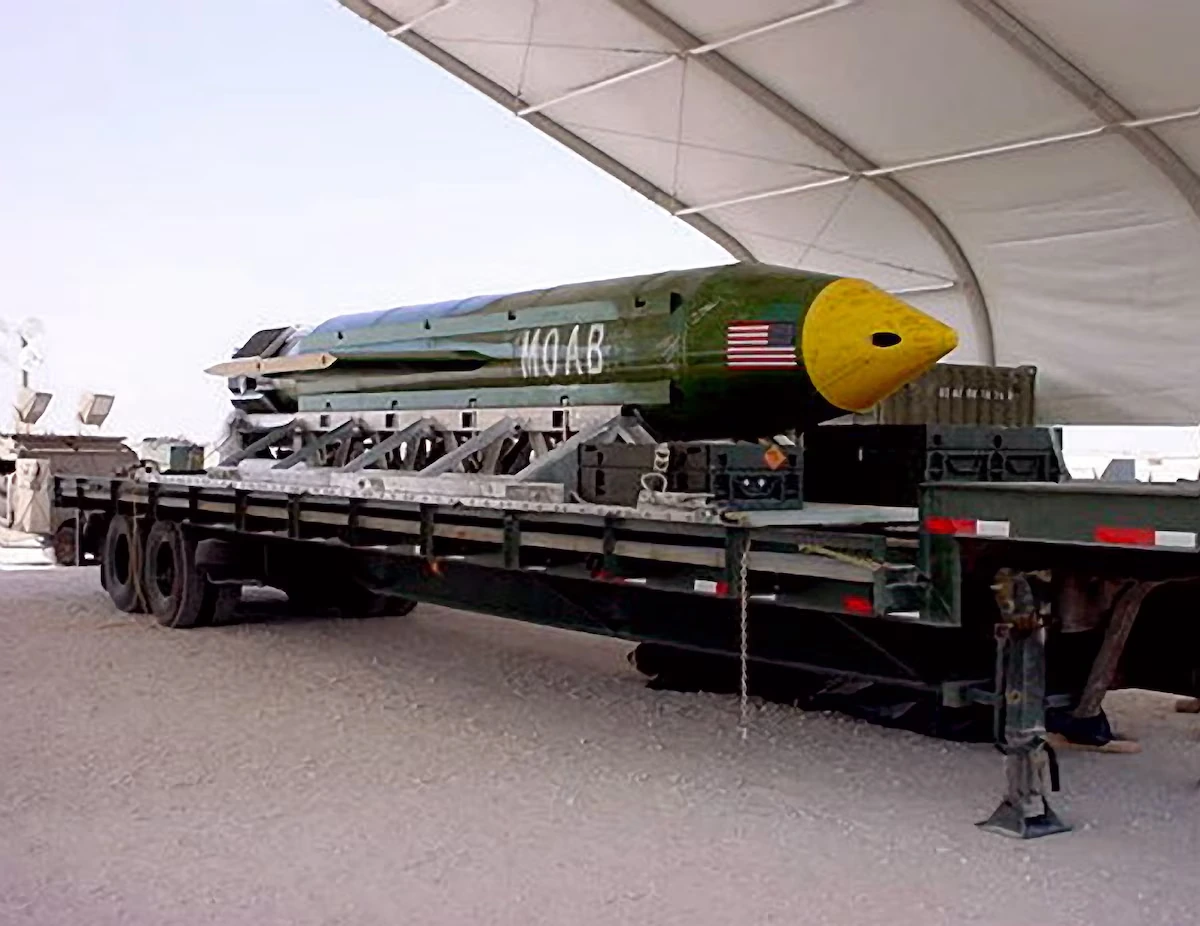
Visually, it’s hard to mistake. Painted olive green and mounted on a launch frame, the MOAB mother of all bombs, looks more like a missile than a typical bomb. But make no mistake—this is a weapon of mass disruption, engineered for effectiveness on the battlefield and psychological impact off it.
In terms of modern military tech, the GBU-43/B MOAB stands alone: massive, precise, and undeniably intimidating.
The story of the GBU-43/B MOAB begins in the early 2000s, during a time when the U.S. military was rapidly modernizing its arsenal for conflicts in the Middle East. The goal? Build a bomb so powerful and psychologically effective that it could devastate enemies both physically and mentally—without resorting to nuclear weapons.
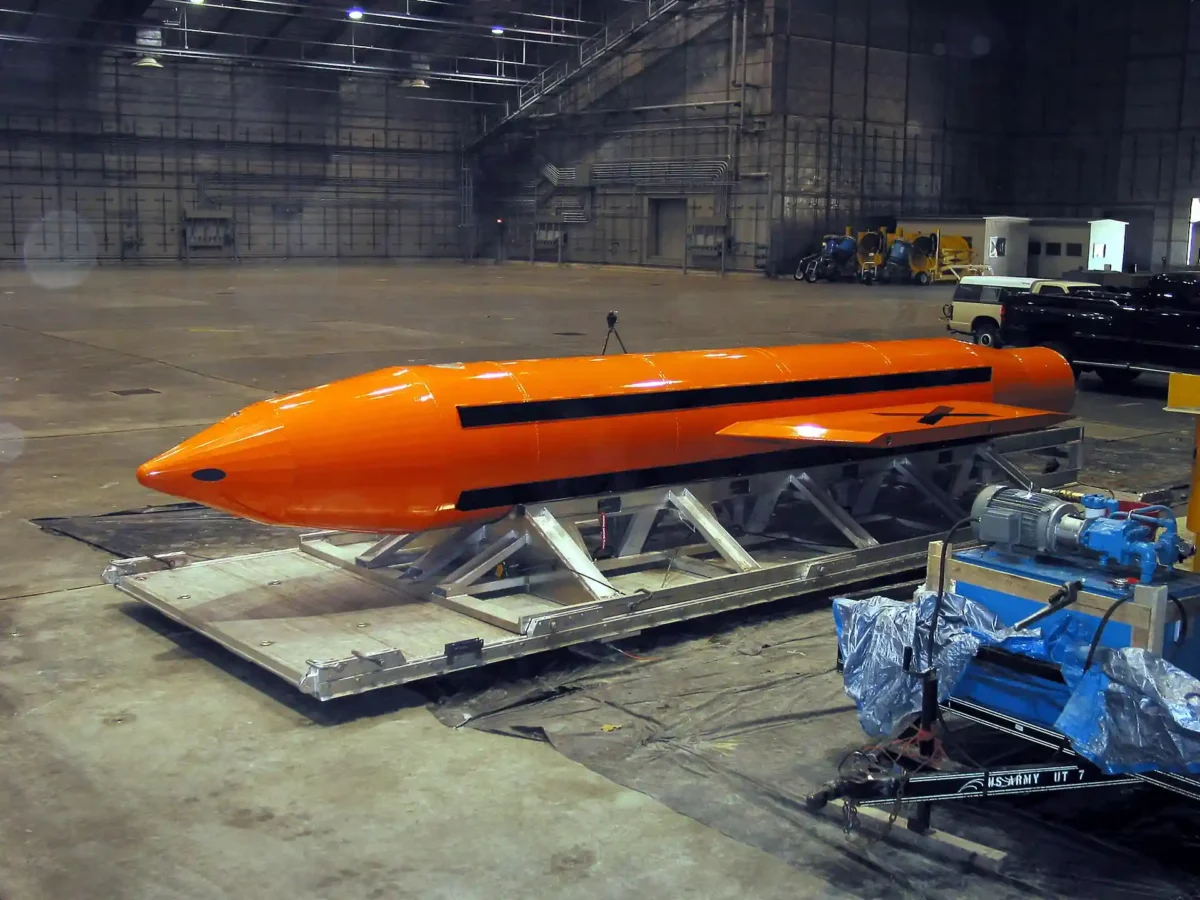
Development kicked off in 2002 at the Air Force Research Laboratory (AFRL) at Eglin Air Force Base in Florida. The project was led by Albert L. Weimorts Jr., a senior Air Force engineer known for pushing the boundaries of air-delivered weapons. Within just nine months, the MOAB went from concept to testing—a remarkably fast timeline for a weapon of this scale.
The MOAB was developed as a replacement for the BLU-82 “Daisy Cutter,” which had been used since the Vietnam War to clear jungle for helicopter landings and to shock enemy troops. But where the Daisy Cutter relied on brute force and older delivery systems, the GBU-43/B added modern GPS guidance, better blast efficiency, and a more streamlined aerodynamic design.
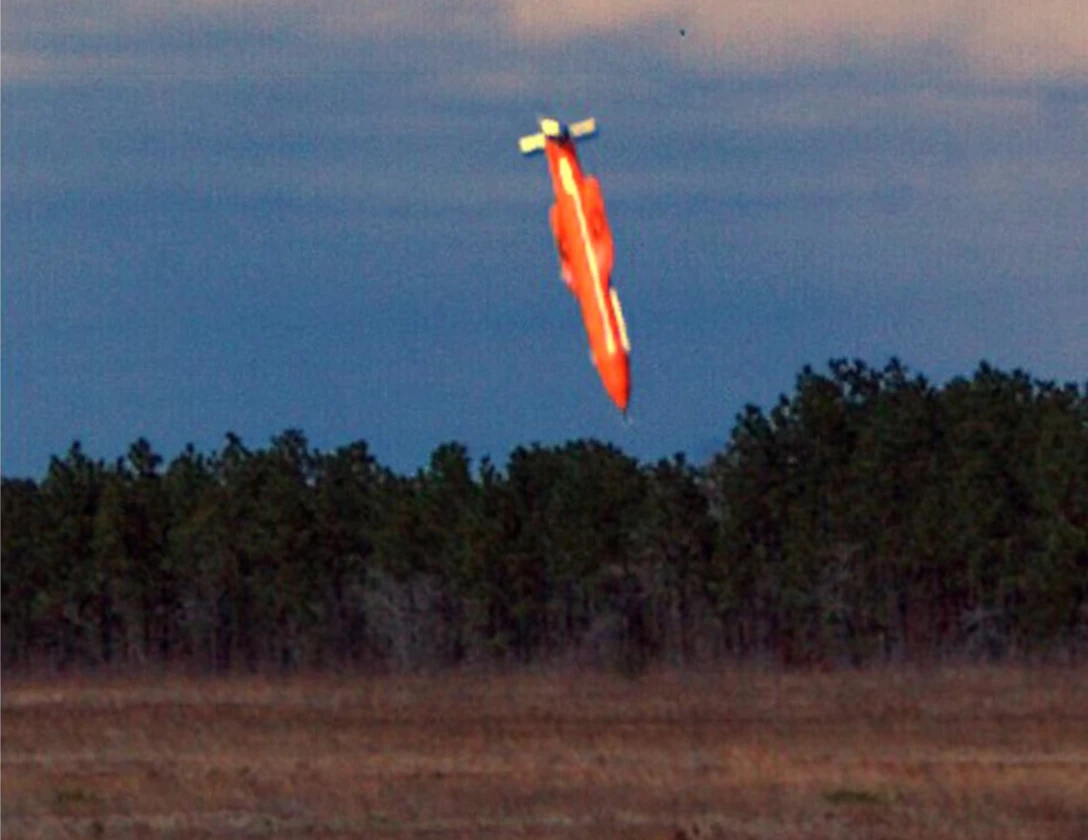
Official testing began in March 2003, just weeks before the start of the Iraq War. In those tests, the GBU-43 explosion proved to be incredibly effective—producing an enormous blast, visible shockwaves, and devastating surface damage. Though the bomb was ready for operational use in Iraq, it was never dropped during that campaign. Instead, its existence served as a strategic deterrent, a visible symbol of overwhelming force that U.S. forces could unleash at will.
Only a small number of MOAB bombs were produced, with estimates ranging from 15 to 20 units. Manufacturing was handled by the McAlester Army Ammunition Plant in Oklahoma, one of the few facilities capable of handling weapons of this size and complexity.
Because of its cost—estimated at $16 million per bomb—and its specialized role, the MOAB mother of all bombs was never mass-produced. It remains a niche weapon, used sparingly but effectively when conditions demand maximum impact with minimal risk to U.S. personnel.
The GBU-43/B massive air ordnance bomb wasn’t just built to destroy targets. It was built to change the psychology of the battlefield—and from its first deployment, it did exactly that.
The GBU-43/B MOAB was thrust into the global spotlight on April 13, 2017, when the U.S. military used it for the first—and so far only—time in combat. The target was a fortified ISIS-K tunnel network in Achin District, Nangarhar Province, Afghanistan. This area was a stronghold for the Islamic State’s local affiliate, and the rugged terrain made traditional strikes ineffective.
At 7:32 PM local time, a U.S. MC-130 aircraft dropped the MOAB bomb from high altitude. Guided by GPS, the bomb descended smoothly before detonating above the ground in a massive airburst. The resulting GBU-43 explosion was immense—shockwaves flattened everything in the vicinity, and a fireball lit up the surrounding mountains.
The MOAB blast radius stretched more than a mile, with the explosion shaking nearby villages and creating a mushroom-like cloud visible for miles. The pressure wave swept through the tunnels, collapsing hideouts and killing militants inside without needing to penetrate the ground. The weapon’s concussive force was particularly effective in such subterranean environments.
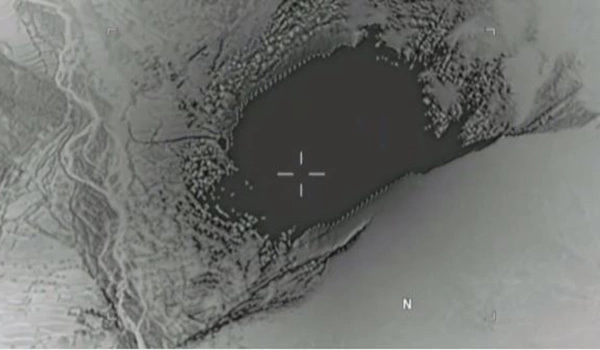
The Pentagon reported that 94 ISIS fighters were killed in the strike, including key commanders. No U.S. or Afghan forces were harmed during the operation. The strike also destroyed weapons caches, bunkers, and defensive positions that had made ground offensives in the region slow and dangerous. It was hailed as a tactical success—and a message.
But the use of the mother of all bombs wasn’t just about battlefield efficiency. It was strategic signaling. Dropping the largest conventional bomb in the U.S. arsenal sent a warning not just to ISIS, but to global adversaries watching closely, including North Korea and Iran. It was proof that the U.S. military could escalate without going nuclear.
When it comes to raw explosive force, few conventional weapons come close to the GBU-43/B MOAB. This isn’t just a big bomb—it’s a tactical game changer. Designed to level everything within its reach, the MOAB bomb delivers destruction on a scale unmatched by any other non-nuclear weapon in the U.S. arsenal.
The heart of the bomb lies in its nearly 18,700 pounds of H-6 explosive, a powerful mix of RDX, TNT, and powdered aluminum. This chemical cocktail creates a high-velocity blast that’s designed not just to destroy, but to pulverize. The explosive yield is roughly 11 tons of TNT, enough to cause a shockwave that travels well beyond the immediate impact zone.
What makes the GBU-43/B MOAB blast radius so effective is the airburst detonation. Unlike ground-penetrating bombs that explode after impact, the MOAB is set to detonate in mid-air, maximizing the horizontal spread of its blast. This technique ensures that the overpressure wave—a massive surge of compressed air—radiates outward in all directions, crushing bunkers, collapsing caves, toppling trees, and incapacitating enemy fighters hiding in the open.
Estimates of the MOAB blast radius vary depending on terrain, weather, and target type, but it’s widely accepted that the destructive zone extends at least 1 mile (1.6 kilometers) in diameter. That’s an area large enough to wipe out a military compound, obliterate a reinforced tunnel system, or clear a landing zone through dense forest in a single strike.
And the effects aren’t just physical—they’re deeply psychological. Witnesses to the GBU-43 explosion in Afghanistan in 2017 described the ground shaking like an earthquake, a deafening roar, and a fireball that lit up the sky. Afghan villagers miles away felt the shockwave and mistook it for an air raid or a natural disaster.
These psychological effects are no accident. The mother of all bombs was designed to terrify as much as it was to destroy. It’s a weapon of intimidation, aimed at breaking the will of enemy forces before a single U.S. boot hits the ground.
In the end, the massive air ordnance bomb doesn’t just destroy what’s in its path—it sends a powerful message: resistance will be met with overwhelming, unstoppable force.
The GBU-43/B MOAB is not just a weapon—it’s a statement. In modern warfare, power projection isn’t only about what you destroy, but also what you communicate. The MOAB speaks loudly. Its sheer size, dramatic detonation, and psychological impact make it a tool of deterrence just as much as destruction.
Strategically, the MOAB bomb fills a unique gap in U.S. military capabilities. It’s not a nuclear weapon, yet it delivers a level of damage that can render fortified enemy positions unusable. It’s ideal for situations where you need overwhelming firepower without escalating into weapons of mass destruction. That’s why it was chosen for the 2017 Afghanistan strike—where dense terrain, underground tunnels, and hardened fighters made conventional options ineffective.
But while the GBU-43/B massive ordnance air blast MOAB is powerful, it’s also highly specialized. Its size means it can only be dropped from specific aircraft like the MC-130, and it requires a clear, open area for release. It’s not meant for urban warfare or precision urban strikes—this is a bomb you use when you want the whole region to feel it.
In terms of comparisons, many often ask how the MOAB mother of all bombs stacks up against similar weapons. Russia, for instance, claims to have developed the FOAB (Father of All Bombs), a thermobaric device that reportedly has four times the yield of the MOAB.
However, much of the data surrounding the FOAB is unverified, and many analysts question the validity of its claimed power. The MOAB, by contrast, has been publicly tested and used in combat, with its effects well-documented.
Another U.S. counterpart is the GBU-57A/B Massive Ordnance Penetrator (MOP). While the names are similar, their functions differ. The MOP is designed to penetrate deep underground facilities, not cause surface-level destruction. The MOAB, on the other hand, is all about area blast effect, creating a pressure wave to crush structures, collapse tunnels, and clear out enemies over a wide radius.
In short, the GBU-43 MOAB exists not to replace other weapons, but to give commanders a powerful middle ground: massive, conventional force with strategic precision. And in the realm of psychological warfare, nothing quite compares to the sound of the mother of all bombs falling from the sky.
The GBU-43/B MOAB is more than just the largest non-nuclear weapon in the U.S. arsenal—it’s a symbol of overwhelming force and tactical dominance. Engineered to deliver maximum destruction with precision, the MOAB represents the evolution of conventional warfare in an era where psychological impact is just as important as physical damage.
With a blast yield equivalent to 11 tons of TNT and a blast radius over one mile, the GBU-43/B massive ordnance air blast MOAB is capable of wiping out tunnel networks, fortified compounds, and wide-area enemy concentrations in a single strike. Its successful use in Afghanistan demonstrated both its destructive capability and its strategic value in modern conflicts.
Yet, despite its power, the MOAB is used sparingly. Its cost, size, and the sheer scale of destruction make it a tool of last resort—reserved for the toughest, most entrenched targets. Whether viewed as a technological marvel or a symbol of deterrence, the MOAB bomb leaves a lasting impression on friend and foe alike.
In the world of air-delivered weapons, the GBU-43 MOAB remains unmatched—a bomb that earns its nickname not by hype, but by the hard truth of what it can do.