Follow Us:
Follow Us:

You’ve probably seen some chatter lately about the CH-53E Super Stallion helicopter, especially after a big transport chopper went up in flames during routine operations at a Marine base in California back in August, forcing the crew to bail out safely while crews put out the fire.
Thankfully, no one was hurt, but it’s a reminder that even these beasts aren’t immune to the kind of wear-and-tear that comes with heavy use.
That kind of news can make you wonder what makes the Sikorsky CH-53E Super Stallion such a staple in the U.S. Marine Corps’ aviation fleet in the first place. It isn’t the newest helicopter on the block, but for decades it’s hauled troops, gear, even vehicles in and out of rough spots around the world.
From combat zones to humanitarian missions, the Super Stallion’s role has been a mix of sheer muscle and adaptability, and even as newer models like the CH-53K King Stallion start to replace it, the E variant still has plenty of stories left to tell.
At a basic level, the CH-53E Super Stallion helicopter is a heavy-lift transport helicopter, and when people say “heavy,” they really mean it.
This thing was designed to move large numbers of troops, oversized cargo, and heavy equipment that most helicopters simply can’t handle. It’s primarily operated by the U.S. Marine Corps, where it’s been a workhorse for decades, especially in expeditionary and ship-based operations.
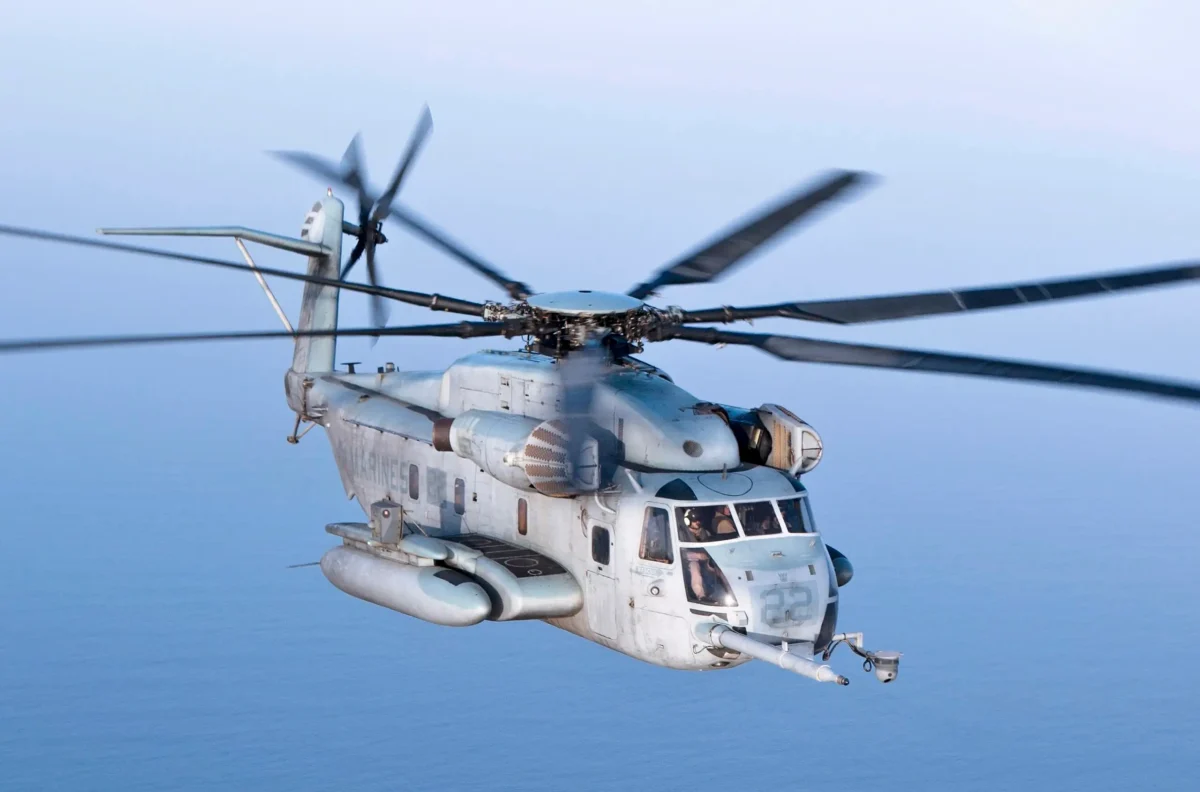
The aircraft is built by Sikorsky, a company with a long history of making big, rugged military helicopters. With the Sikorsky CH-53E Super Stallion, the focus was pretty clear: maximum lifting power, long-range transport, and the ability to operate in tough environments, whether that’s from amphibious assault ships, forward bases, or disaster zones.
The “Stallion” part comes from earlier CH-53 variants, but the “Super” wasn’t just marketing fluff. Compared to its predecessors, the CH-53E added a third engine, a larger rotor system, and a much higher lift capacity. Those upgrades dramatically boosted how much it could carry and how far it could go, especially in hot, high, or dusty conditions.
So the name kind of stuck because it fit. The Super Stallion is basically the beefed-up version of an already powerful helicopter, stronger, heavier, and built to haul serious loads.
Even today, when people talk about heavy-lift helicopters, the CH-53E still tends to come up as a benchmark, which says a lot about how well the nickname has aged.
The CH-53E Super Stallion runs on three powerful turboshaft engines, each producing roughly 4,000–4,300 shaft horsepower.
Having three engines gives the aircraft a solid redundancy safety net (if one fails, you still have two) and extra oomph for lifting heavy loads, especially at high altitudes or in hot weather where performance naturally drops off.
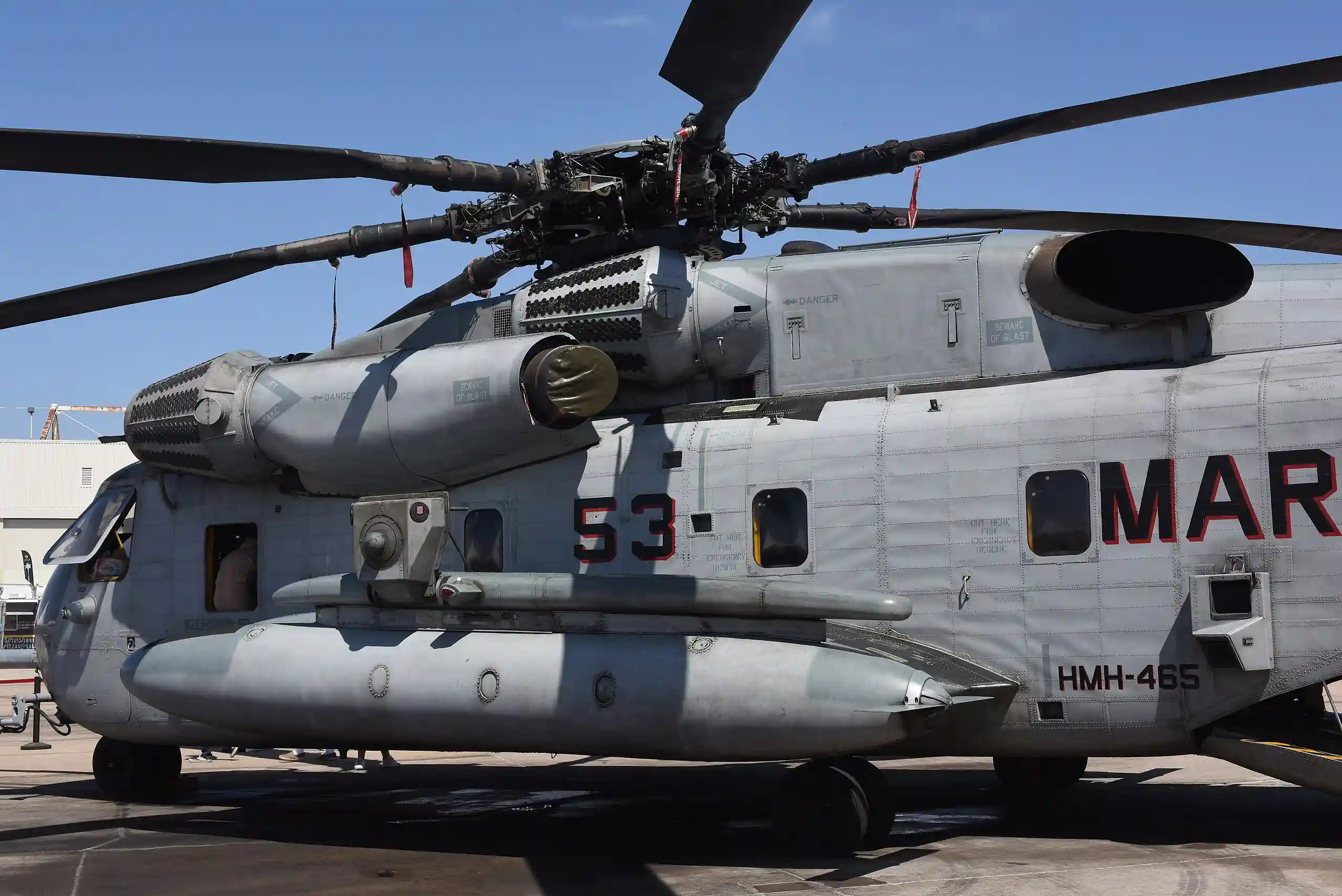
How much can this beast actually lift? Pretty impressive for a helicopter. Internally, it can carry roughly 7,000 kg (15,400 lb) of cargo, think vehicles, pallets, or other gear.
On a sling load beneath the aircraft, it’s estimated to be around 14,000 kg (30,800 lb). That’s the sort of weight that lets it move artillery pieces, light armored vehicles, or even other helicopters in a pinch.
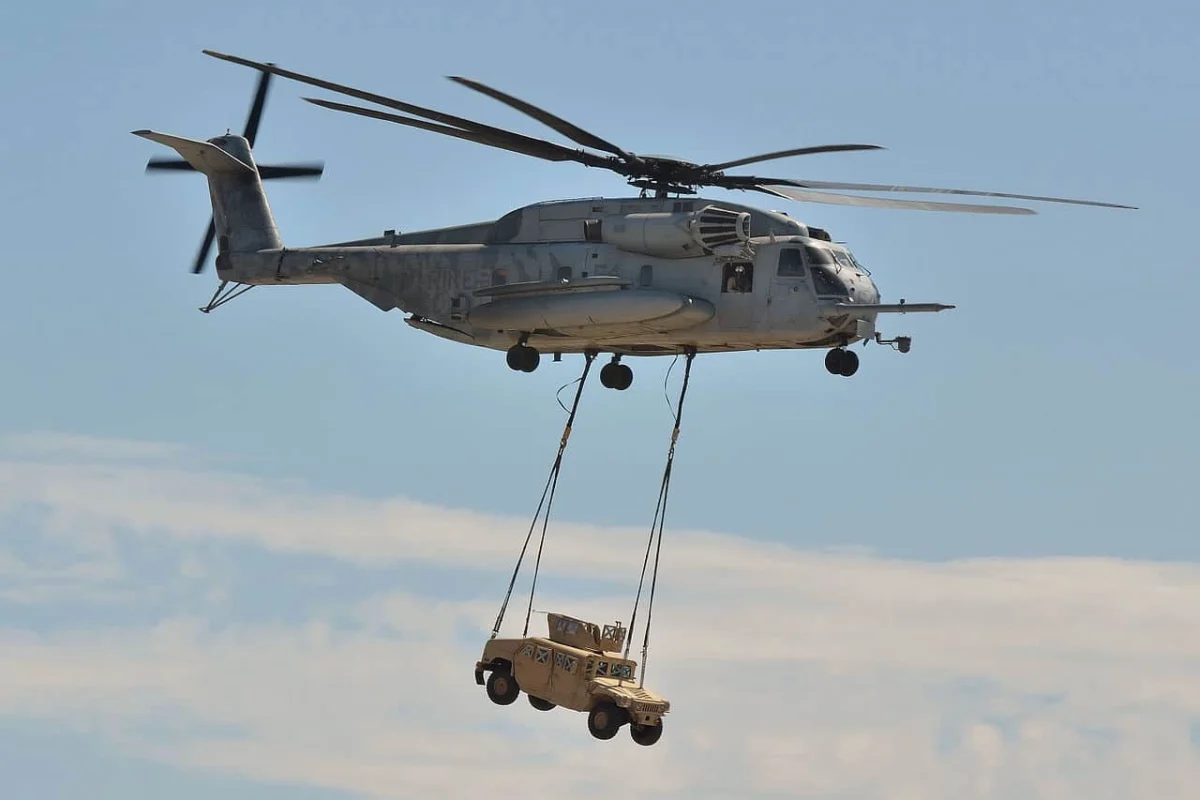
In a typical troop-transport setup, you’re looking at about 37 Marines, but in high-density seating, when the goal is “get as many aboard as possible,” numbers north of 50 troops aren’t unheard of. That’s cushioned seats when you can have them, or shoulder-to-shoulder seating when you really need capacity.
With a maximum gross takeoff weight of around 33,000 kg (72,750 lb) and a rotor span pushing ~24 m (79 ft), the Super Stallion is a big helicopter.
That size translates directly into lifting muscle and stability, long rotor blades generate lift, a large fuselage carries cargo, and overall bulk means it can handle rugged conditions without feeling too fragile.
Is it speedy? It’s certainly respectable for a heavy-lift rotorcraft.
Top speed is around 315 km/h (196 mph), with cruise speeds usually closer to 260 km/h (162 mph). Range-wise, in a typical mission profile, you might see around 850 km (530 miles) of combat radius, though that varies with load and flight conditions.
In its world, those numbers make it a reliable mover, fast enough to reposition quickly, but really built for hauling rather than racing.
| Engines | 3 × turboshaft engines (~4,000–4,300 shp each) |
| Max Takeoff Weight | ~33,000 kg (72,750 lb) |
| Rotor Diameter | ~24 m (79 ft) |
| Fuselage Length | ~30 m (98 ft) |
| Max Speed | ~315 km/h (196 mph) |
| Cruise Speed | ~260 km/h (162 mph) |
| Combat Range | ~850 km (530 miles) |
| Internal Payload | ~7,000 kg (15,400 lb) |
| External (Sling) Load | ~14,000 kg (30,800 lb) |
| Crew | Typically 5 (pilot, co-pilot, 3 crew) |
| Troop Capacity | ~37–55 Marines |
The CH-53E Super Stallion is mostly used as a heavy-lift workhorse, especially when the job involves moving a lot of people or very heavy gear in a short amount of time. Its most common role is troop transport and logistics, hauling Marines, supplies, and equipment between bases or straight into forward areas where runways just aren’t an option.
Where the Super Stallion really stands out, though, is in heavy equipment and vehicle transport. It’s one of the few helicopters that can sling-load artillery, trucks, generators, or construction equipment underneath and still fly a useful distance. That ability makes it invaluable in situations where ground routes are dangerous, damaged, or simply nonexistent.
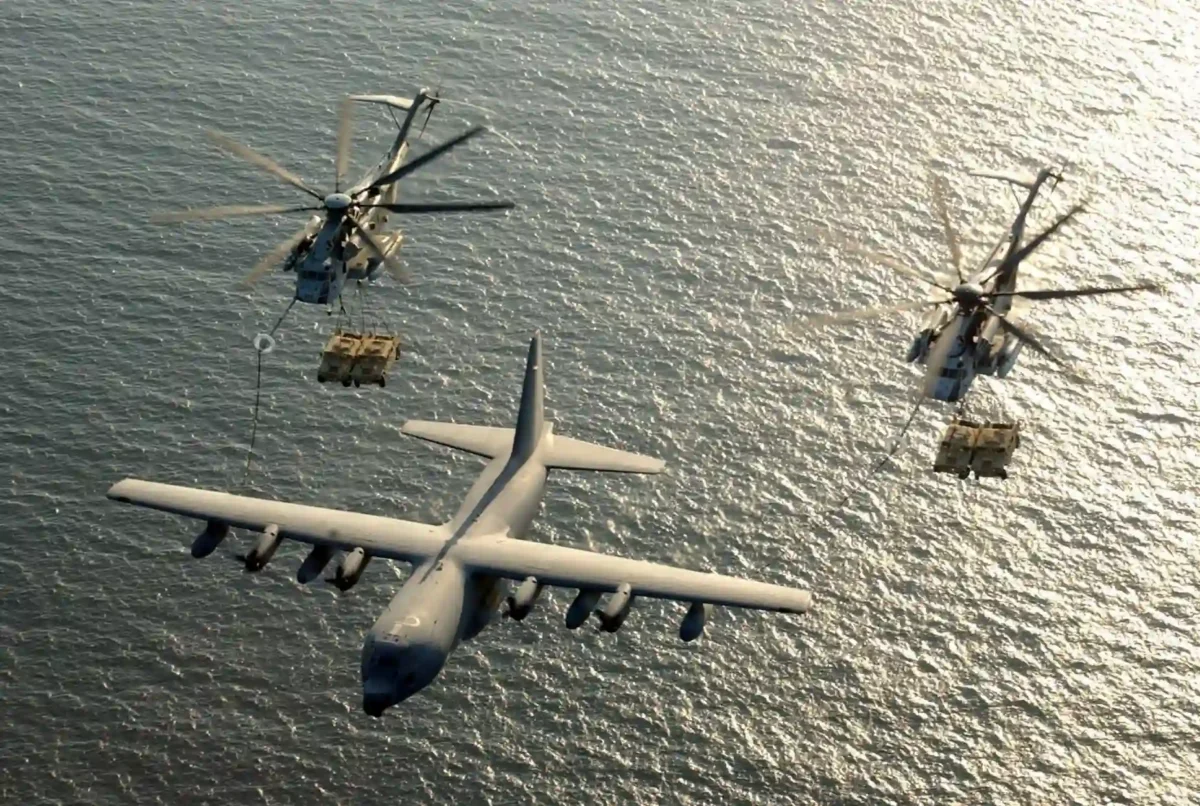
The CH-53E also shows up a lot in disaster relief and humanitarian missions. After earthquakes, floods, or typhoons, it can move food, water, medical supplies, and rescue teams into areas that are completely cut off. Because it can lift so much in a single trip, it’s often one of the fastest ways to get meaningful aid on the ground.
And finally, there’s its classic ship-to-shore role with the U.S. Marine Corps. Operating from amphibious assault ships, the Super Stallion ferries troops and cargo inland, helping Marines establish a foothold without needing ports or airfields.
Yes, the CH-53E Super Stallion has definitely been used in combat, and pretty extensively too. It’s been deployed across Iraq, Afghanistan, and other parts of the Middle East.
In those environments, it routinely moved troops, ammunition, fuel, and oversized equipment into forward areas, often under tough conditions and sometimes while taking fire.
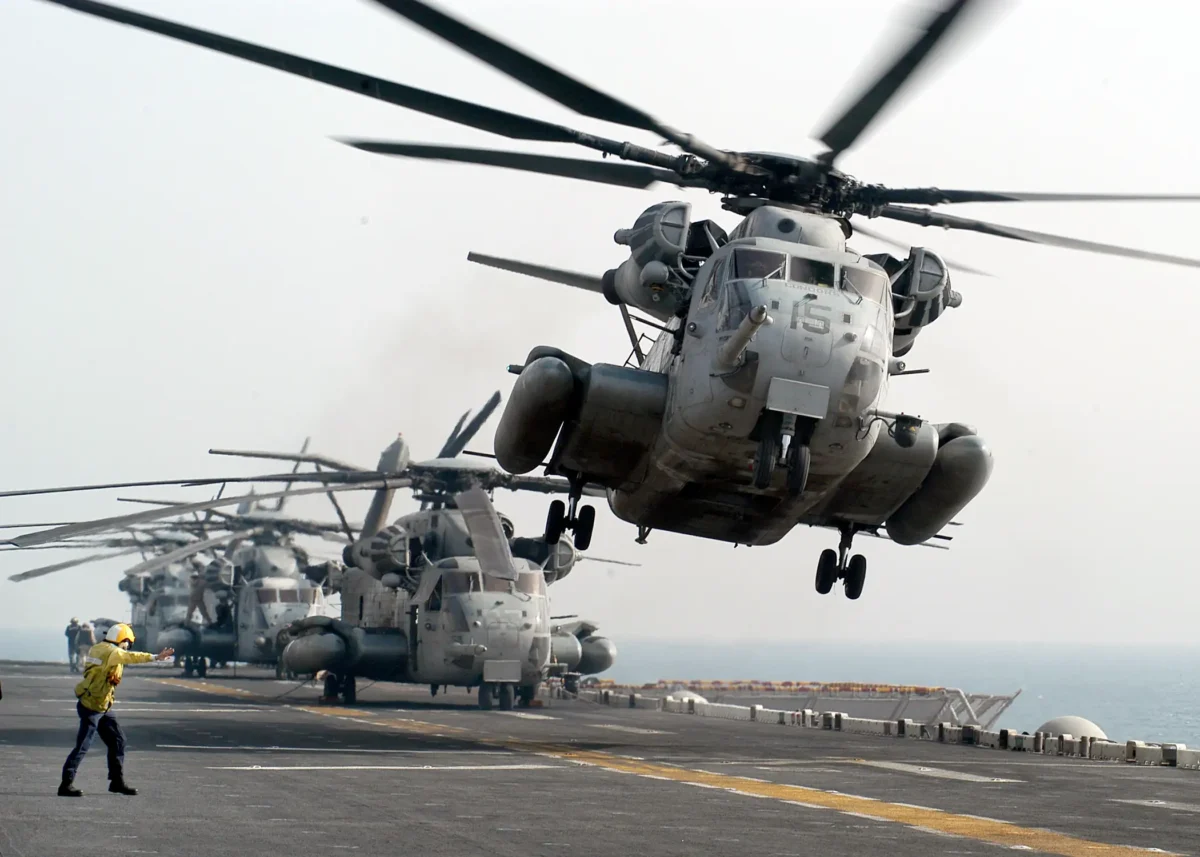
In Afghanistan, especially, the Super Stallion proved its value in high-altitude, hot environments where performance really matters. It was often tasked with supplying remote bases in mountainous terrain that ground convoys couldn’t safely reach. There were also missions involving rapid troop insertions, casualty evacuations, and emergency resupply.
What’s interesting is that while the CH-53E isn’t a gunship in the traditional sense, its combat record is still strong because it enables everything around it.
Many operational success stories don’t make headlines, but commanders have consistently relied on the Super Stallion when missions required reliability, payload, and range under combat pressure.
In that sense, it’s more a backbone aircraft and combat operations would look very different without it.
When the CH-53E Super Stallion was still in production, the unit cost was generally estimated in the ballpark of USD $20–25 million per helicopter at the time. That figure can feel surprisingly modest compared to modern aircraft prices, but it reflects the era it was built in and the fact that it was produced in reasonable numbers.
Still, even back then, it wasn’t cheap; you were paying for sheer lifting power, size, and military-grade durability rather than cutting-edge stealth or avionics.

Where the costs really add up is operation and maintenance. The CH-53E has a reputation for being expensive to keep flying, with high maintenance hours per flight hour. Its three engines, massive rotor system, and aging airframes all demand constant attention.
As the fleet got older, sourcing parts and keeping everything within safety limits became more challenging and more costly, which is one reason the Marine Corps has been eager to transition to the newer CH-53K.
Heavy-lift helicopters like the Super Stallion are expensive to sustain mainly because everything about them is big, complex, and stressed hard.
Large rotors, gearboxes, and engines operate under enormous loads, and that wear shows up quickly in maintenance cycles. Add saltwater operations from ships, dusty combat environments, and extreme heat, and components tend to wear faster than on smaller helicopters.
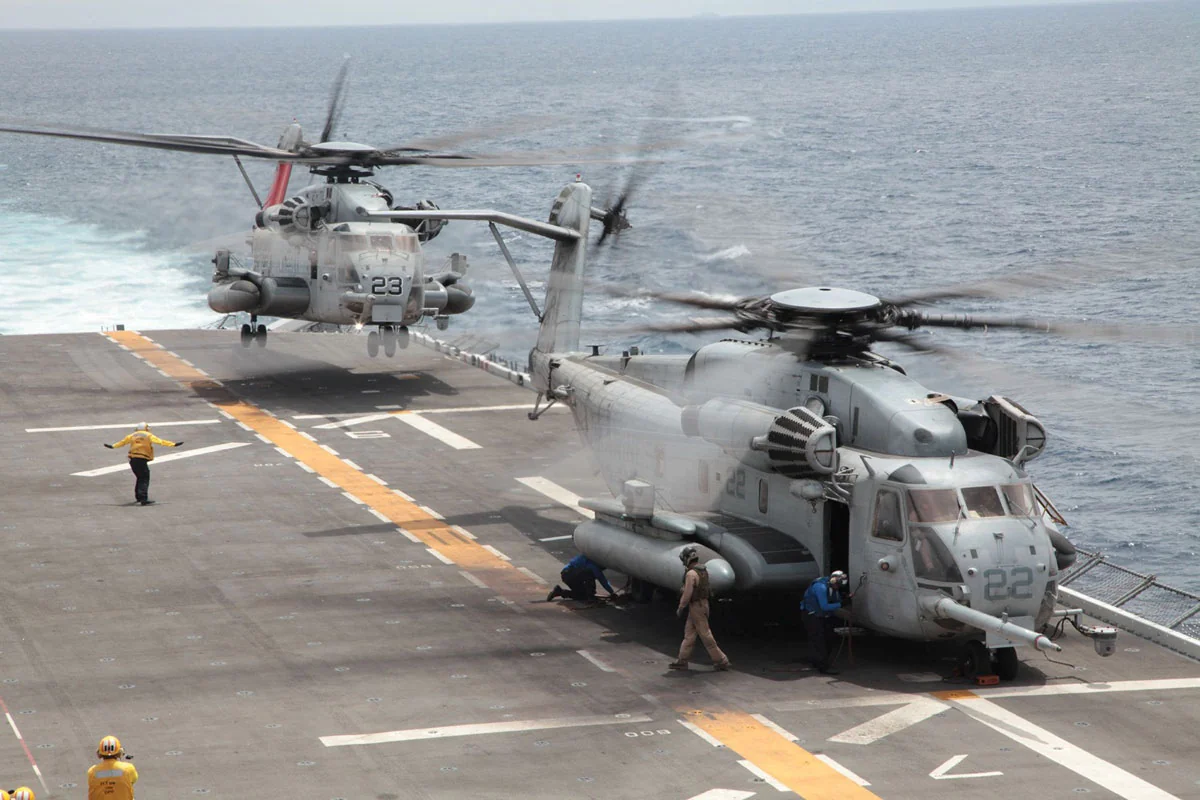
There’s also the human side of the equation. These aircraft require highly trained crews and maintenance teams, plus longer inspection and repair times. So even if a heavy-lift helicopter isn’t flying every day, it’s still consuming resources.
The CH-53K King Stallion is essentially what happens when the Marine Corps takes everything it learned from decades of operating the CH-53E and starts fresh.
While it looks similar at a glance, almost everything under the skin is new. It was designed from the ground up to lift more, fly farther in hot-and-high conditions, and integrate smoothly into modern, networked battlefields.
The biggest change is the engines.
The CH-53K’s GE T408 engines deliver nearly twice the power of the Super Stallion’s engines, which translates directly into better lift performance and fewer compromises during demanding missions. Pair that with modern avionics and fly-by-wire controls, and pilots get a helicopter that’s not just stronger, but easier and safer to operate.
In terms of engines, the jump is dramatic.
The CH-53E was powerful for its time, but the CH-53K pushes heavy loads with far more margin, especially in extreme environments. Avionics are another major leap, the King Stallion replaces older analog systems with fully digital cockpits, advanced sensors, and automated flight controls that reduce pilot workload.
Lift capacity is where the difference really shows operationally. The CH-53K can carry heavier loads farther and in worse conditions than the CH-53E ever could. That means fewer trips, less exposure to threats, and more flexibility for commanders on the ground.
| Category | CH-53E Super Stallion | CH-53K King Stallion |
| Generation | Legacy heavy-lift helicopter | Next-generation heavy-lift helicopter |
| Engines | 3 × T64 turboshaft engines | 3 × GE T408 turboshaft engines |
| Engine Power | ~4,000–4,300 shp each | ~7,500 shp each |
| Avionics | Analog / early digital mix | Fully digital, fly-by-wire |
| Lift Capacity (External) | ~14,000 kg (30,800 lb) | ~16,300+ kg (36,000 lb) |
| Max Takeoff Weight | ~33,000 kg (72,750 lb) | ~39,900 kg (88,000 lb) |
| Maintenance | High, labor-intensive | Designed to be easier to sustain |
| Service Era | 1980s–present | 2020s and beyond |
The short answer is that the CH-53E has reached the practical limits of what it can do. As airframes age, maintenance costs rise, availability drops, and upgrades become harder to justify.
The CH-53K King Stallion offers more lift, better reliability, and modern systems designed to last for decades, which makes it a smarter long-term investment.
So while the Super Stallion earned its reputation through years of hard service, the King Stallion is about keeping that heavy-lift capability relevant in a future where missions are more demanding and margins are thinner.
The CH-53E Super Stallion still matters today mainly because it continues to do a job very few helicopters can fully replace right now. Even as the CH-53K comes online, the Super Stallion is still moving heavy equipment, vehicles, and large numbers of Marines in real-world operations.
That kind of lift capacity isn’t something you can swap out overnight, so the CH-53E remains a critical bridge between past and future capability.
It also matters because it’s a known, proven platform. Decades of combat, ship-based operations, and disaster relief missions have shown what it can handle and commanders understand its strengths and limits.
Finally, the CH-53E’s legacy shapes what comes next. The lessons learned from operating it, from maintenance challenges to performance in extreme conditions, directly influenced the design of the CH-53K.