Follow Us:
Follow Us:

Defense Feeds – Bern. The Switzerland Selects AGM Artillery System to Replace M109 Fleet decision marks a major step in the modernization of the Swiss Armed Forces as the country moves to strengthen its long-range fire support capabilities with a new generation of self-propelled artillery.
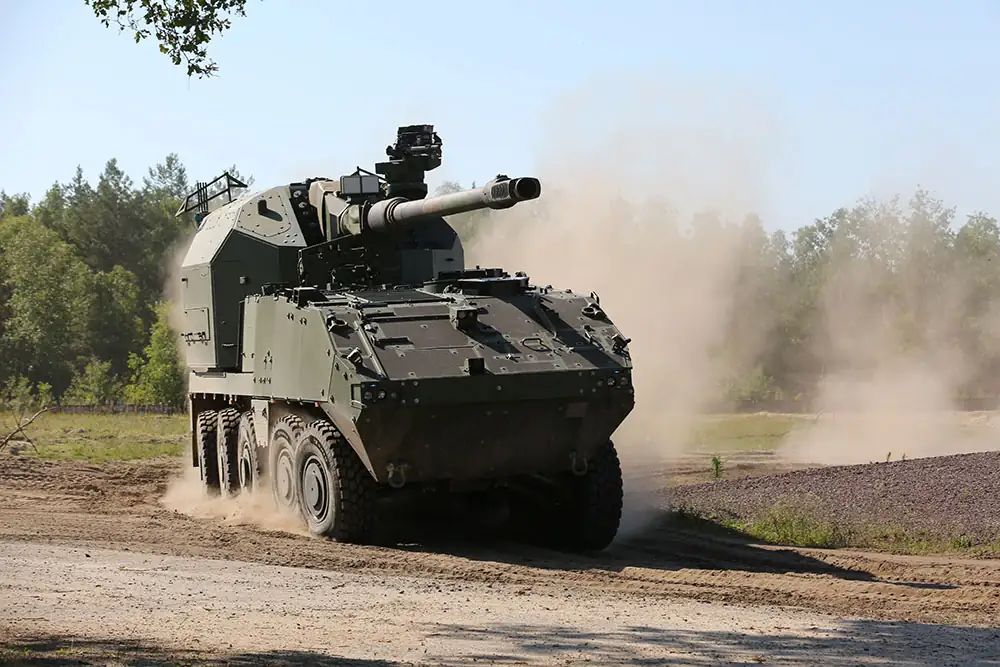
Swiss defense authorities have chosen 32 AGM 155mm self-propelled howitzers mounted on Piranha IV wheeled armored vehicles to replace the military’s aging M109 artillery fleet. The procurement reflects a broader effort to improve battlefield mobility, firepower and operational flexibility while ensuring Switzerland’s artillery forces remain effective against evolving security challenges.
The move comes as European militaries increasingly invest in modern artillery systems following lessons from recent conflicts, particularly the war in Ukraine, where long-range fires have played a decisive role in shaping battlefield outcomes.
Military analysts view the acquisition as one of the most significant upgrades to Switzerland’s land forces in recent years, reinforcing the country’s ability to maintain credible defense capabilities while adapting to modern warfare requirements.
The new artillery platform combines the highly automated Artillery Gun Module (AGM) developed by European defense manufacturer KNDS Deutschland with the Swiss-built Piranha IV armored vehicle platform produced by General Dynamics European Land Systems.
This combination creates a highly mobile self-propelled artillery system capable of delivering NATO-standard 155mm fire support while maintaining the flexibility of a wheeled vehicle. Compared with traditional tracked artillery systems, wheeled platforms generally offer greater road mobility, lower maintenance requirements and faster deployment across large operational areas.
One of the AGM’s key features is its high level of automation. The system is designed to reduce crew workload while enabling rapid target engagement and efficient ammunition handling. Such capabilities are becoming increasingly important as modern battlefields demand faster reaction times and greater operational efficiency.
Defense experts note that artillery units must now be able to relocate quickly after firing in order to avoid detection by drones, counterbattery radars and precision-guided weapons. The mobility provided by the Piranha IV chassis directly supports this requirement.
The new platform is expected to provide Swiss artillery forces with improved responsiveness and survivability compared with the older M109 systems currently in service.
The decision to replace the M109 fleet reflects broader modernization efforts underway across the Swiss Armed Forces.
Although Switzerland maintains a policy of military neutrality, the changing security environment in Europe has prompted renewed focus on defense readiness and capability development. The conflict in Ukraine has demonstrated the continued importance of artillery, air defense and rapid-response forces in modern warfare.
Swiss military planners have increasingly emphasized the need for systems capable of operating effectively in highly dynamic and technologically advanced combat environments. This includes investments in digital command networks, improved mobility and more sophisticated weapons platforms.
The replacement of the M109, a system that has served for decades, represents a significant component of that strategy. While the M109 remains one of the most widely used self-propelled howitzers in the world, newer systems offer greater automation, improved survivability and enhanced operational flexibility.
Military observers note that modern artillery modernization programs are no longer focused solely on firepower. Mobility, connectivity and integration with broader battlefield networks have become equally important considerations.
The AGM-Piranha IV solution appears designed to address those evolving requirements while supporting Switzerland’s long-term defense objectives.
The procurement highlights a broader trend affecting militaries throughout Europe and beyond.
Recent conflicts have underscored the enduring importance of artillery despite advances in drones, cyber warfare and precision-guided munitions. Long-range fires remain critical for suppressing enemy positions, disrupting logistics networks and supporting maneuver operations.
At the same time, battlefield transparency has increased dramatically due to widespread drone surveillance and advanced sensor technologies. Artillery systems must therefore be capable of firing rapidly and relocating before enemy forces can respond.
Automated systems such as the AGM are increasingly attractive because they allow artillery units to operate more efficiently while reducing exposure to counterbattery threats. Wheeled platforms further enhance flexibility by enabling faster movement across road networks and reducing logistical burdens.
For Switzerland, the acquisition provides a modern artillery capability aligned with the demands of contemporary warfare. It also strengthens the domestic defense industry through continued use of the Swiss-developed Piranha vehicle platform.
As European nations continue reassessing military requirements in response to a changing security landscape, investments in advanced artillery systems are becoming a central part of modernization efforts. Switzerland’s decision to field AGM howitzers on Piranha IV vehicles reflects that reality, ensuring its artillery forces remain capable, mobile and prepared for future operational challenges.