Follow Us:
Follow Us:

Imagine a ghost in the hangar, a jet that technically doesn’t “exist” yet, but is already expected to rewrite the rules of aerial warfare.
We’re talking about the F/A-XX fighter program, the Navy’s secretive leap into the next generation. While most of the world is focused on current tech, the Navy NGAD program is prepping for a future where pilots might be managing swarms of drones from the cockpit of a Navy F/A-XX.
It’s potentially the most expensive “maybe” in military history. While we wait for a definitive F/A-XX announcement, the tension behind the scenes is palpable.
Will we see a Boeing F/A-XX take the lead, or will the F/A-XX Northrop Grumman partnership pull a fast one?
A surprising amount of the project remains classified, but with the F/A-XX contract award looming, the industry is bracing for a shakeup.
So, what exactly is the F/A-XX program?
In the simplest terms, it’s the Navy’s blueprint for its next superstar carrier jet. Think of it as the centerpiece of the Navy NGAD program (Next Generation Air Dominance). Instead of just being a “cool new plane,” it’s meant to be the “quarterback” of the skies.
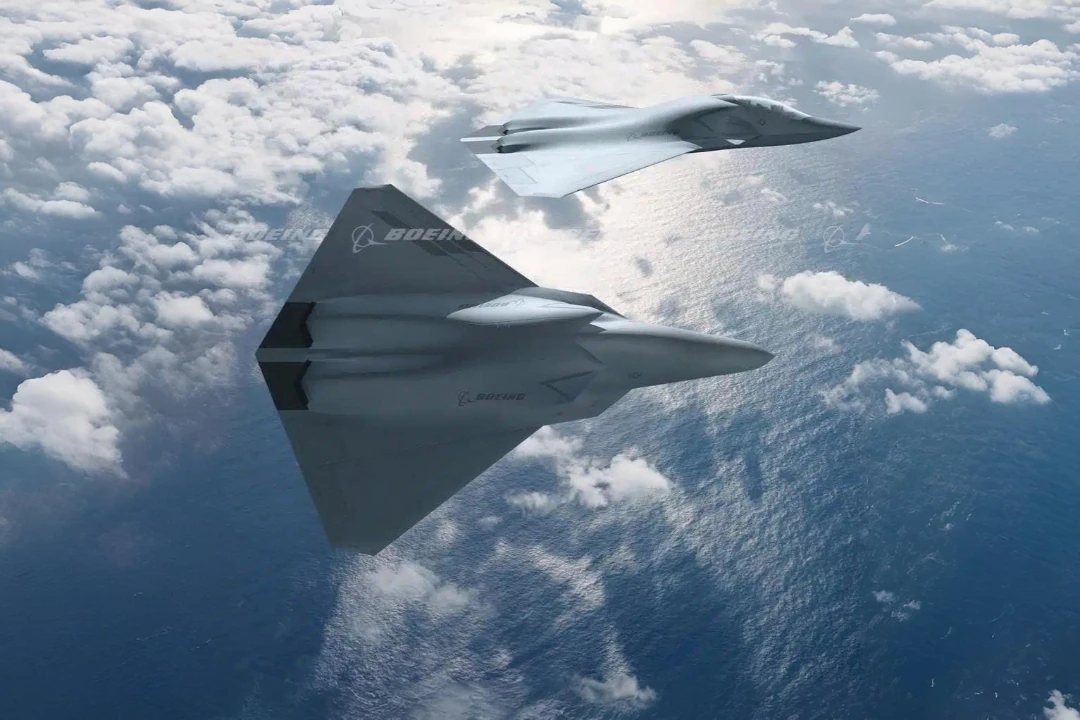
It seems like the plan is for this F/A-XX fighter to fly alongside both human-piloted jets and those high-tech “loyal wingman” drones everyone is talking about. It’s basically designed to ensure that future carrier air wings have the muscle and the brains to handle whatever comes their way in the 2030s and beyond.
You might be wondering, “Wait, don’t we already have great planes?” Well, the current workhorse, the F/A-18E/F Super Hornet, has been a legend, but it’s starting to show its age.
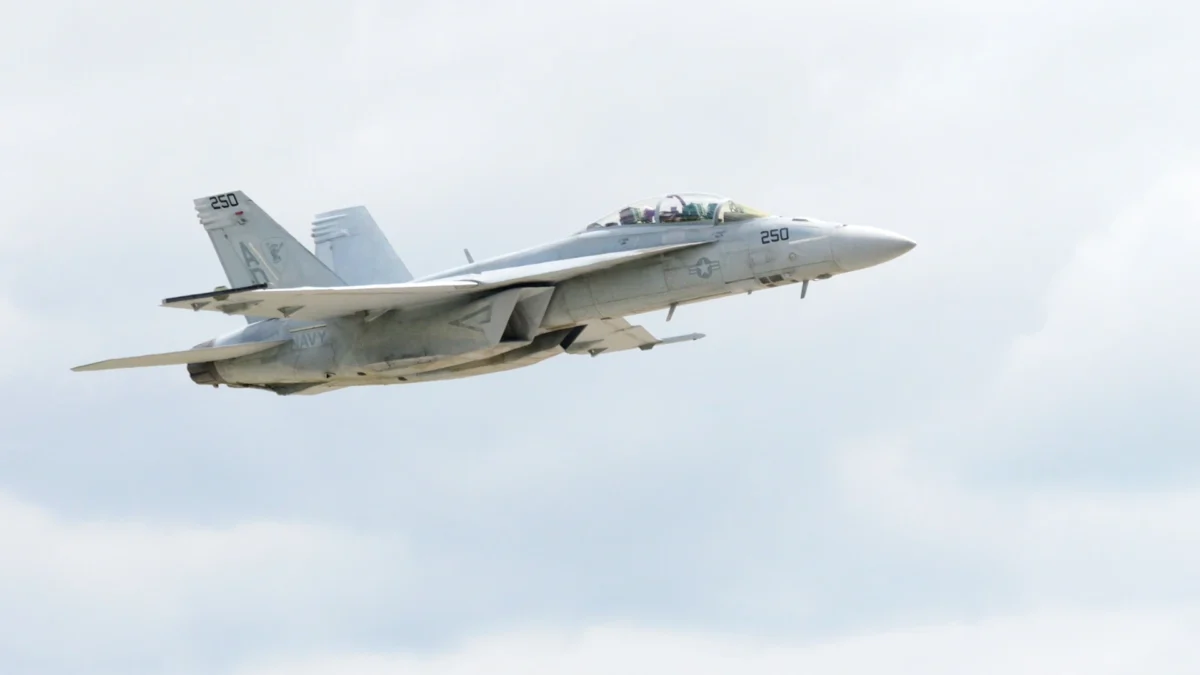
The world is getting a bit more complicated, and the threats out there are becoming more advanced, which creates some “operational gaps” or, in plain terms, things the old jets just might not be able to handle anymore.
The Navy is likely looking for something with much more range and better “stealthiness” to survive in tricky environments.
To stay ahead, they need a Navy F/A-XX that can fly further and carry more advanced tech than the Super Hornet ever could. It’s basically about making sure the fleet isn’t bringing a knife to a laser fight.
For a while, it was a three-way battle between the giants, but the field has narrowed down significantly.
Believe it or not, Lockheed Martin, the company behind the F-35, was reportedly knocked out of the running earlier in 2025. It’s a bit of a curveball, but it seems their design didn’t quite hit the mark for what the Navy specifically wanted.
Boeing is leaning heavily on its “hometown advantage.” They’ve spent decades perfecting the F/A-18 Super Hornet, and their Boeing F/A-XX concept reflects that deep understanding of the brutal carrier environment. Their latest renderings suggest a sleek, tailless design that might actually share some “DNA” with the Air Force’s F-47.
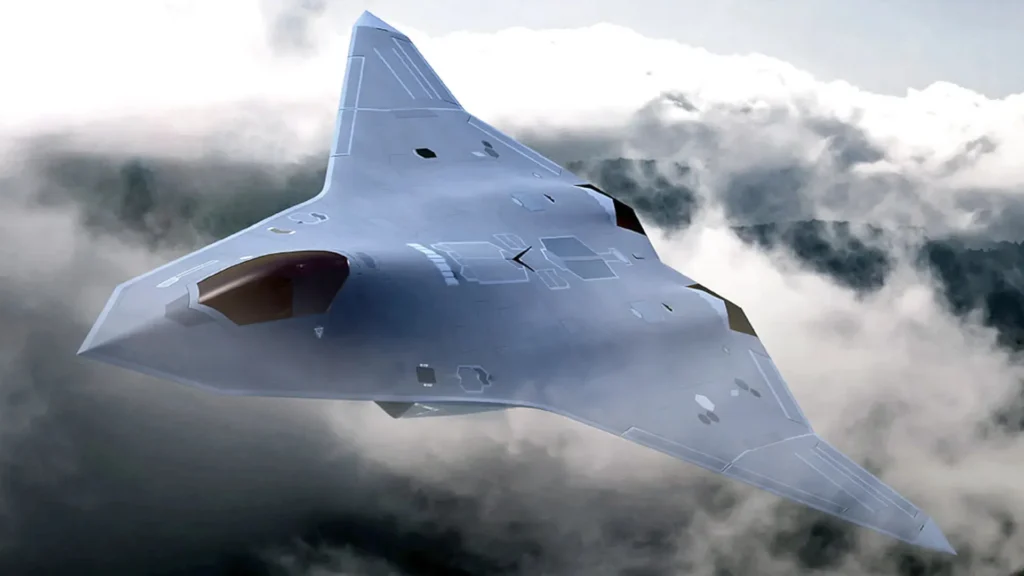
Boeing’s pitch is essentially: “We know carriers better than anyone, and we’ve already built a massive new $1.8 billion factory in St. Louis just for this jet.” They are positioning themselves as the reliable choice that can bridge the gap between today’s fleet and tomorrow’s tech.
Northrop Grumman, on the other hand, is the “stealth specialist.” They haven’t built a carrier fighter since the F-14 Tomcat, but they are the masterminds behind the B-2 Spirit and the new B-21 Raider.
The F/A-XX Northrop Grumman proposal seems to focus on “next-level” invisibility. Their concept art shows a futuristic, cranked-wing design with a massive internal belly, perfect for carrying heavy, long-range missiles while staying completely off enemy radar.
For Northrop, it’s not just about building a plane; it’s about miniaturizing the world-class stealth of a bomber into a high-speed fighter.
As for the F/A-XX contract award, it has been a total “will-they-won’t-they” saga. We were supposed to have a winner by mid-2025, but the Pentagon has been dragging its feet, likely because they’re worried about the “industrial base”—basically, they aren’t sure if one company can handle the stress of building these complex jets without a massive price hike.
While Defense Secretary Lloyd Austin reportedly gave the green light to move forward recently, we’re still waiting for that final F/A-XX announcement.
The Navy is currently weighing things like AI integration and how well the jets “talk” to drones, but most insiders expect a definitive answer by early 2026.
If you’re looking for a specific date for the F/A-XX contract award, you might have to hang tight. It feels like we’ve been “weeks away” from an official F/A-XX announcement for months now.
March 2025: Rumors flew that the F/A-XX contract award was “days away.” Then, Lockheed Martin was reportedly dropped from the race, leaving it as a two-way fight between Boeing and Northrop Grumman.
December 2025 (Current Status): Congress just approved the 2026 National Defense Authorization Act (NDAA).
When you’re designing a jet that’s meant to dominate the skies for the next forty years, the “to-do” list is basically a mountain of high-stakes challenges.
It’s not just about making a faster plane; it’s about navigating a political and financial minefield that has claimed plenty of ambitious projects in the past.
1. Timeline delays
If I’m being honest, the timeline has been a bit of a mess. One week the Pentagon says the program is “on ice,” and the next week the Navy is saying it’s “ready for a down-select” (meaning they’re ready to pick a winner). It’s hard for the companies to keep their best engineers on the project when the funding feels like a flickering lightbulb.
The “De Facto Cancellation” Risk: Some former pilots and analysts warn that if the F/A-XX announcement is delayed by even two or three more years, the current bids from Boeing and Northrop might expire. If that happens, the Navy might have to start the whole competition over from scratch, which would be a disaster for the 2030s timeline.
2. Price tags
The biggest hurdle right now is the price tag. Building a sixth-generation fighter is eye-wateringly expensive, and the F/A-XX program is currently locked in a “budget brawl” with the Air Force’s F-47.
In late 2025, the Pentagon made the controversial move to slash Navy funding to a meager $74 million. It’s an 84% cut to prioritize the Air Force.
The fear is that the U.S. industrial base; the engineers, the specialized factories, and the supply chains, simply can’t handle two massive “super-jet” programs at the exact same time without both of them falling behind schedule.
3. Technological gaps
Beyond the money, there are massive technological gaps to bridge. We aren’t just talking about better stealth; we’re talking about integrating “loyal wingman” drones that can think for themselves, AI-driven cockpits, and possibly even directed-energy weapons (lasers). History has shown us how hard this can be.
Look at the F-35: it tried to be a “jack-of-all-trades” for every branch of the military, and it ended up years behind schedule and billions over budget.

The Navy is desperate to avoid that “one-size-fits-all” trap, but by going its own way, it risks being the first thing on the chopping block when the government looks to save cash.
We’ve also seen what happens when you “under-buy.” The F-22 Raptor is arguably the best dogfighter ever made, but because the program was cut short due to high costs, we only have 180ish of them.
The Navy is terrified of a repeat where they develop this incredible Navy F/A-XX, only for the government to get cold feet halfway through production, leaving the fleet with a handful of “silver bullets” instead of a full arsenal.
It’s a delicate balance: innovate fast enough to beat the competition (like China’s J-50), but keep the project stable enough that it doesn’t collapse under its own complexity.
When you look at what this jet will actually do, we’re talking about a massive jump in capability. The F/A-XX fighter is being designed as a “quarterback” for the future of naval warfare. One of the coolest (and most classified) features is its role in “manned-unmanned teaming.”
The idea is that a single pilot in a Navy F/A-XX could be controlling a whole small squad of high-tech drones, or “Collaborative Combat Aircraft” (CCAs), to do the dangerous work, like scouting ahead or carrying extra missiles, while the main jet stays hidden.
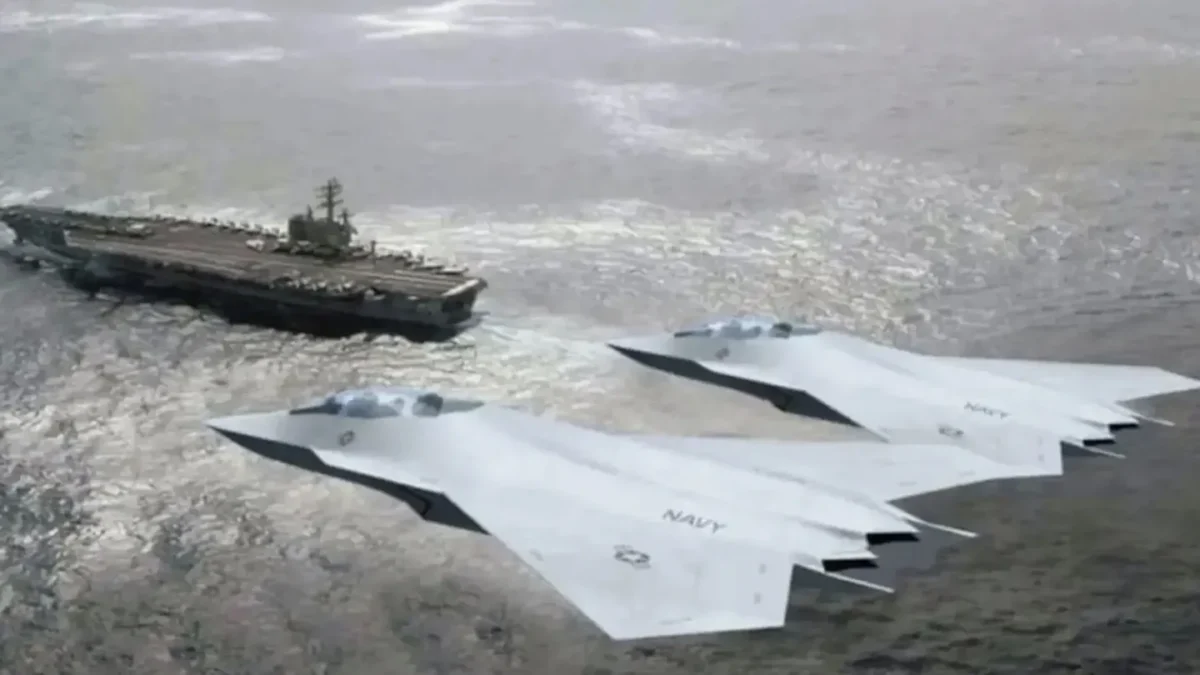
Speaking of staying hidden, the stealth on this thing is expected to be on another level compared to the F-35. We’re likely looking at a “tailless” or “semi-tailless” design, which basically makes the plane look like a smooth, blended wing. It’s meant to make the jet nearly invisible to a wider range of enemy radars.
Plus, the Navy NGAD program is reportedly pushing for “smart skins,” basically covering the jet in sensors so it has a 360-degree view of everything around it, essentially giving the pilot “god mode” awareness in a dogfight.
The engine situation is actually where the Navy F/A-XX and the Air Force’s F-47 start to drift apart.
While the Air Force is going all-in on “Adaptive Cycle” e. engines (which can switch between high-speed and fuel-efficient modes like a hybrid car), the Navy seems to be leaning toward a “derivative” engine. It might be a bit more conservative, but it’s still expected to give the jet about 25% more range than the current Super Hornets.
This extra distance is a big deal because it allows our carriers to stay further away from enemy “anti-ship” missiles while still being able to strike back.
On the weapons front, the F/A-XX fighter program is preparing for some serious futuristic tech:
You might hear people comparing the F/A-XX vs F-47 (the Air Force’s version of NGAD). It’s easy to get them confused, but they are definitely different beasts:
While they might share some “under-the-hood” tech (like engines or software), the Navy is adamant that they don’t want a “one size fits all” jet this time. They want a specialist.
| Feature | Navy F/A-XX | Air Force F-47 |
| Primary Mission | Multi-role Strike Fighter (Surface attack + Air superiority) | Air Superiority (High-speed hunting + Long-range strike) |
| Base of Ops | Aircraft Carriers (CVN) | Land-based runways |
| Current Status | Contract Pending (Boeing vs. Northrop) | Contract Awarded (Boeing, March 2025) |
| Design Focus | Tailored for carrier landings; saltwater durability | Tailless for maximum stealth; extreme speed/altitude |
| Engines | High-performance “derivative” engines | New “Adaptive” variable-cycle engines (NGAP) |
| Range | Approx. 25% more than F/A-18 Super Hornet | Massive combat radius (>1,000 nautical miles) |
| Drone Teaming | Integrated with Navy CCAs | “Quarterback” for 2–5 drone wingmen |
| Budget Status | Heavily Cut ($74M in 2026); on “life support.” | Fully Funded ($2.6B in 2026); Presidential priority |