Follow Us:
Follow Us:

Ever stand on a flight line and feel the ground humming under your boots before you even see the aircraft? That low, steady vibration that basically says, “Something massive is coming your way.”
That’s the feeling behind the C-5 Galaxy vs C-17 Globemaster debate, two machines so enormous, so unapologetically powerful, that comparing them feels a bit like trying to size up mountains.
But here’s the thing: despite being grouped together in military-airlift conversations, these two aircraft were never meant to play the same role.
Not really. Sure, they both haul gear across continents and drop supplies where they’re needed most, but the way they do it, the style, the purpose, the quiet design logic baked into each bolt, is wildly different. And strangely enough, most articles gloss over that difference.
They stick to the usual payload numbers and length measurements, almost like checking specs on a pickup truck. Useful, yes, but not the real story.

So this guide approaches the comparison from a different angle. Less “Which one is bigger?” and more “Why does each aircraft matter?” Think of it as the aviation equivalent of comparing a long-distance freight train to a short-run bullet transport: not competitors, but partners with sharply different superpowers.
By the time you’re done with this section-by-section deep dive, you’ll not only know how the C-5 and C-17 differ, you’ll understand why those differences were engineered, how they shape real missions, and why the Air Force still relies on both in a world obsessed with speed and precision.
If you really want to understand the C-5 Galaxy vs C-17 Globemaster divide, you have to go back to the intentions behind each aircraft, what problems the designers were trying to solve long before a single bolt was machined.
Big planes don’t just “happen.” They’re responses to pressure, politics, budgets, and the kind of logistical puzzles that keep military planners awake at 3 a.m.
The C-5’s story starts in the late Cold War era, when the United States needed something almost absurdly large. Not just big-for-its-time, big enough to haul tanks, missile components, entire mobile command systems, and whatever else might be needed halfway across the world with no time to spare.
At the time, strategists were obsessed with reach. Global reach.
The ability to surge enormous equipment loads from domestic bases to remote theaters without relying on foreign infrastructure.
That’s why the aircraft ended up with that cavernous cargo hold, front-and-rear opening doors, and a wingspan that looks like it should belong to a fictional movie aircraft. It wasn’t built for personality. It was built for raw strategic might.
The C-17’s birth was almost the opposite. Instead of thinking “How much can we carry?” the question became “How fast can we get it where it actually matters?”
After decades of conflicts proving that wars don’t always come with neat, paved runways, planners wanted something that could blast into shorter strips, twist through valleys, drop supplies mid-flight, and still haul a significant load. A kind of hybrid—part airlifter, part battlefield problem-solver.
Two aircraft. Two philosophies. One mission: move the world when it needs moving.
If aircraft had personalities, the C-5 Galaxy would be the quiet giant who shows up, lifts a house, and strolls away without breaking a sweat.
The C-17 Globemaster would be the athletic cousin who may not be the tallest in the room but can sprint, jump, twist, and somehow land on a strip barely longer than a shopping mall parking lot. Their specs—those cold, tidy numbers—actually tell that story better than any dramatic description could.
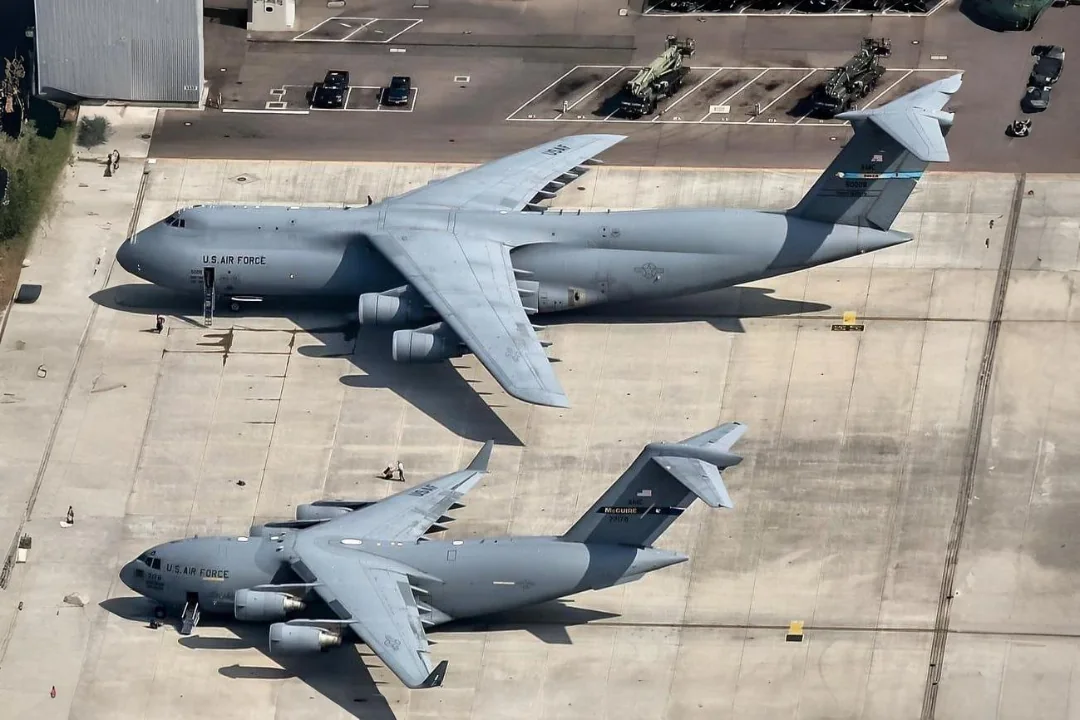
Let’s start with sheer size. The C-5 stretches out to roughly 247 feet in length, with a wingspan that could cast a shadow across half a football field. Its cargo bay feels more like a warehouse aisle, long enough to swallow multiple armored vehicles nose-to-tail.
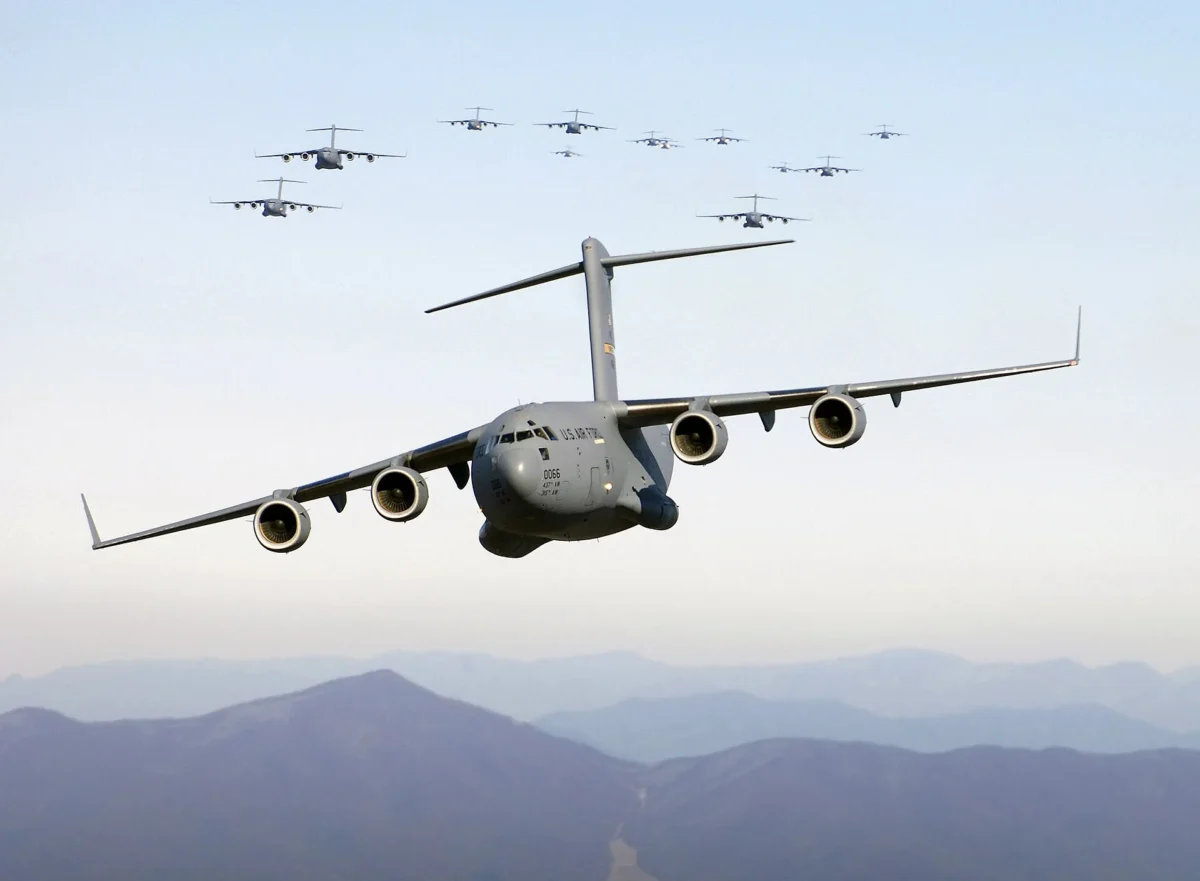
By comparison, the C-17’s 174-foot frame looks… well, practically compact, even though it would dwarf most commercial jets on the ramp. What the C-17 loses in length, it makes up for in width and clever interior design, letting crews reconfigure tie-downs and rollers in minutes.

Payload is where the split becomes crystal clear.
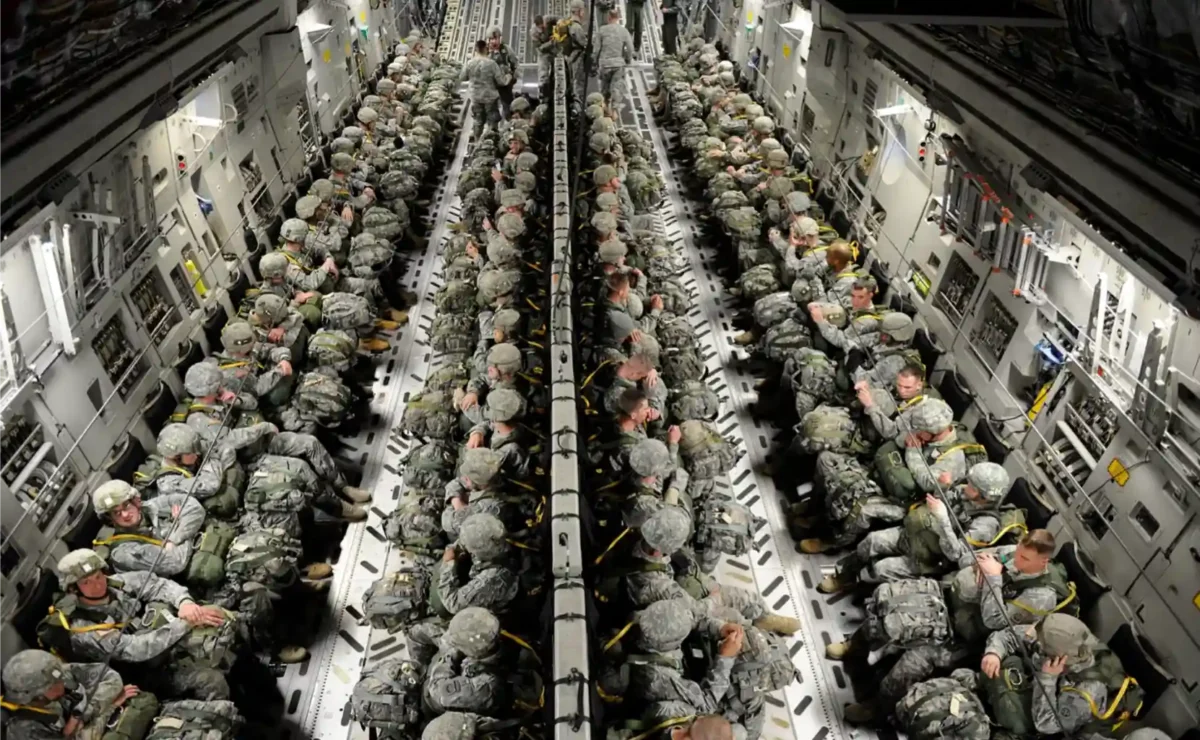
The C-5 can haul about 281,000 pounds, a number so large it almost seems like a typo until you watch it carry two Abrams tanks. The C-17 tops out around 170,900 pounds—still massive, just more balanced for mixed cargo, vehicles, and troops.
Range tells another part of the story: the C-5’s long-haul endurance versus the C-17’s medium-range flexibility. And beneath the wings, the engine philosophies diverge too—four powerplants on each aircraft, but tuned for entirely different roles: marathon vs. mixed-terrain sprint.
These aren’t just specs. They’re the fingerprints of two airlifters built for different worlds.
Sometimes, the only way to make sense of the C-5 Galaxy vs C-17 Globemaster conversation is to stack the numbers directly next to each other and let them speak for themselves.
Specs aren’t everything, but they’re a kind of truth serum—no drama, no emotion, just raw capability laid out in neat rows. And when you look at them this way, the personalities of both aircraft pop right off the page.
Here’s a clean, reader-friendly table you can skim in a heartbeat or dig into for planning-level detail:
| Specification | C-5 Galaxy | C-17 Globemaster III |
| Length | ~247 ft | ~174 ft |
| Wingspan | ~222 ft | ~170 ft |
| Height | ~65 ft | ~55 ft |
| Max Payload | ~281,000 lb | ~170,900 lb |
| Cargo Bay (L × W × H) | ~121 ft × 19 ft × 13.5 ft | ~88 ft × 18 ft × 12.3 ft |
| Range (Unrefueled) | ~5,500+ miles | ~2,400–3,000 miles (load-dependent) |
| Cruise Speed | Mach ~0.77 | Mach ~0.74 |
| Runway Requirement | Long, fully prepared | Short, semi-prepared capable |
| Crew Size | Larger (varies by mission) | Smaller, streamlined crew |
| Primary Mission | Strategic heavy airlift | Tactical + strategic hybrid |
What’s striking isn’t just the size difference—it’s the way the dimensional and performance gaps line up with their intended missions.
The C-5’s enormous cargo hold and marathon range scream “intercontinental heavy lifter,” while the C-17’s shorter frame, flexible cargo bay, and friendlier runway requirements whisper “tactical workhorse with strategic reach.”
If you’re the kind of person who loves comparing engines or imagining cargo layouts (no judgment, I get it), this table is the perfect reference point before diving into the final insights and FAQs.
Here’s where the C-5 Galaxy vs C-17 Globemaster comparison stops being about numbers and starts sounding more like a tale of two specialists.
You can line up specs all day long, but the real difference emerges when these machines hit the operational world—dusty runways, tight timelines, weather that refuses to cooperate, and missions that shift midair.
The C-5 thrives in the long-haul, big-cargo universe. It’s the aircraft planners’ call when they need to move something enormous from Point A to very-far-away Point B without playing hopscotch across the globe.
Think multi-day deployments, massive humanitarian surges, or shifting the backbone of an armored brigade. Its cargo hold is so long and unobstructed that crews can load equipment in a straight-through line, almost like sliding furniture down a hallway. It’s not flashy, but it’s irreplaceable.

The tradeoff? It needs space. Long, prepared runways. Predictable environments. The C-5 isn’t fond of improvisation.
The C-17, meanwhile, practically lives for improvisation. It can dive into short, rough, sometimes eyebrow-raising airstrips with a kind of confidence that doesn’t seem natural for a jet of its size.
Many pilots talk about landing a C-17 on remote gravel strips as casually as parking a pickup truck in a field, still serious, still skill-intensive, but intentionally designed to make it possible. Add to that its ability to perform combat offloads, airdrops, and tight tactical approaches, and you get an aircraft that feels almost mischievously capable.
If the C-5 is the heavyweight world traveler, the C-17 is the agile field operator—the one you send when the mission refuses to fit inside the neat, paved bounds of a traditional airfield.
If you want to see the C-5 Galaxy vs C-17 Globemaster contrast play out in real life, forget the hangar and look at the missions. That’s where their personalities show, out in the wild, under pressure, moving things no one else can move to places no one else can reach.
Take the C-5 first. Its missions often read like logistics dares. One crew might be hauling satellite components the size of small cottages to a launch facility. Another might be carrying entire rotary-wing aircraft, blades attached, because there’s actually room for that.
During major troop rotations or humanitarian responses, the C-5 becomes a kind of airborne conveyor belt, delivering generators, field hospitals, or engineering vehicles in loads so large they almost feel theatrical. There’s something oddly calm about the C-5’s work: slow, deliberate operations, more chess than checkers.
Then there’s the C-17, whose mission logs are practically adrenaline journals.
Picture this: a dusty strip in Afghanistan, only a few thousand feet long, boxed in by mountains. A C-17 drops in, reverses its engines like an angry vacuum cleaner, swings around, and offloads pallets directly onto dirt.
No fancy infrastructure. No warm welcome committee. Just raw, tactical delivery.
In natural disasters, the C-17 is usually first on scene, delivering search-and-rescue teams, forklifts, relief supplies, even rescue boats. Its airdrop operations are another world entirely, precision bundles fluttering down into remote valleys or coastal zones where landing isn’t an option.
If the C-5 is the global backbone, the C-17 is the frontline fixer, the aircraft that refuses to say, “We can’t get there.”
Talking about the C-5 Galaxy vs C-17 Globemaster comparison without touching cost and maintenance would be like comparing two sports cars and ignoring fuel consumption. These aircraft don’t just lift jaw-dropping amounts of cargo—they also carry serious financial footprints, and the differences between them are pretty revealing.
Let’s start with the C-5, the elder statesman of the heavy-lift world. Maintaining a fleet of aircraft that first flew when rotary phones were still standard isn’t exactly cheap.
Over the decades, the Galaxy has gone through deep modernization cycles, and “deep” is putting it lightly.
The C-5M Super Galaxy upgrade, for example, basically gave the aircraft a second life: new engines, modern avionics, structural reinforcement, the works.
That transformation slashed maintenance hours and boosted reliability, but let’s be honest, the C-5 is still a big, complex machine with a maintenance appetite to match. It’s like owning a classic luxury SUV that just had a full engine rebuild: better than ever, but still not a low-maintenance affair.
The C-17, meanwhile, belongs to a newer, more efficiency-minded generation. It’s easier to turn around, quicker to service, and intentionally built with maintainers in mind. Panels come off without requiring an engineering degree; built-in diagnostics help crews troubleshoot faster; and the aircraft’s modular systems reduce downtime.
Still, “easy” is relative. Every hour in the air for a cargo jet is a small engineering miracle, and the C-17 racks up cycles quickly thanks to its high-tempo tactical missions.
Here’s the twist: even with the cost differences, the Air Force can’t simply choose one over the other. The missions are too different, and the world still needs both types of lifting power.
At this point in the C-5 Galaxy vs C-17 Globemaster comparison, the big question becomes surprisingly simple: If you had to choose one for a specific mission, which one actually fits?
Think less like an armchair analyst and more like an operations planner staring at a whiteboard full of arrows, deadlines, and one vehicle that absolutely has to arrive intact.
Let’s start with the obvious: if you need to move something enormous, something that makes people step back and whistle when they see it, the C-5 is your pick.
Think two M1 Abrams tanks, a pair of heavy helicopters, or giant infrastructure components like generators the size of shipping containers. If it’s oversized, heavy, and going far, the C-5 is basically the only tool in the shed.
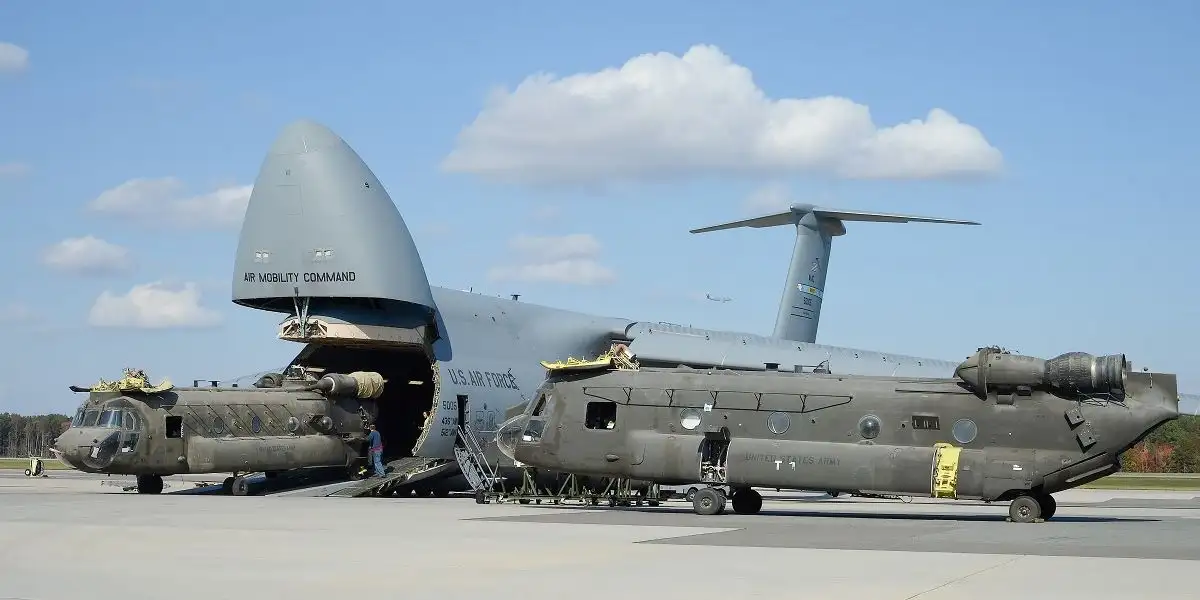
The catch? You’ll need a long, prepared runway and a smooth logistical lead-in, because the Galaxy isn’t the type to drop into a tight spot on a whim.
Now flip the scenario.
The situation is urgent, terrain is rough, and the receiving airfield doesn’t exactly look like a postcard. Maybe it’s a humanitarian zone with one battered runway, or a frontline operating base where dust hangs in the air like a curtain.
This is pure C-17 territory. It can land short, brake hard, unload fast, and get airborne again before the dust settles. It’s the kind of aircraft you choose when the question isn’t “How much can we deliver?” but “How quickly can we get it where it matters?”
In other words, the choice isn’t about which aircraft is better. It’s about which one solves the mission puzzle in front of you.