Follow Us:
Follow Us:

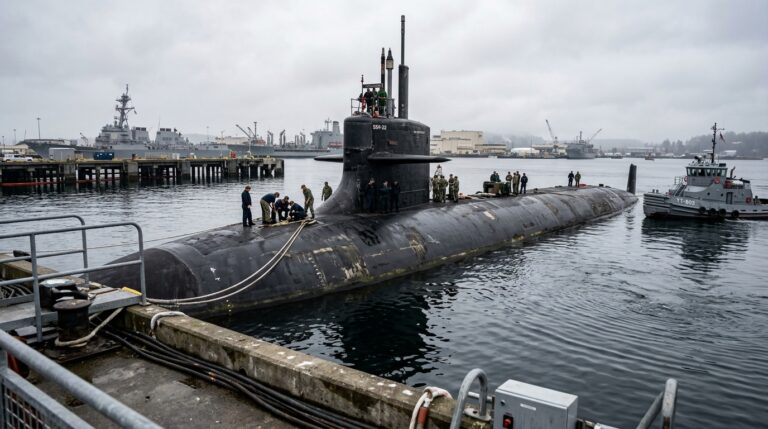
In April 2025, the USS Ohio (SSGN‑726), an Ohio-class submarine converted for cruise missiles and special forces, pulled into Naval Base Guam.
Photographs released in May show the submarine surfaced in Apra Harbor, engaging in joint exercises with U.S. Marines. Analysts believe it was a rare and deliberate display of presence in the Western Pacific.
In a follow-up move, USS Ohio executed the first-ever visit of an Ohio‑class submarine to Brisbane, Australia, mooring alongside the submarine tender USS Frank Cable in late July 2025.
This visit, in celebration of the 80th anniversary of Victory in the Pacific, underscores growing operational collaboration under the AUKUS framework and signals the coming era of Australian nuclear submarine capability
But what makes this development so intriguing is that the US Navy submarines involved were not all carrying ballistic missiles. Some were SSGNs, refitted to launch cruise missiles and deploy special forces.
This dual capability, strategic nuclear deterrence and tactical strike, is precisely what keeps the Ohio-class nuclear submarine relevant in an age increasingly dominated by hypersonics, AI, and drone warfare.
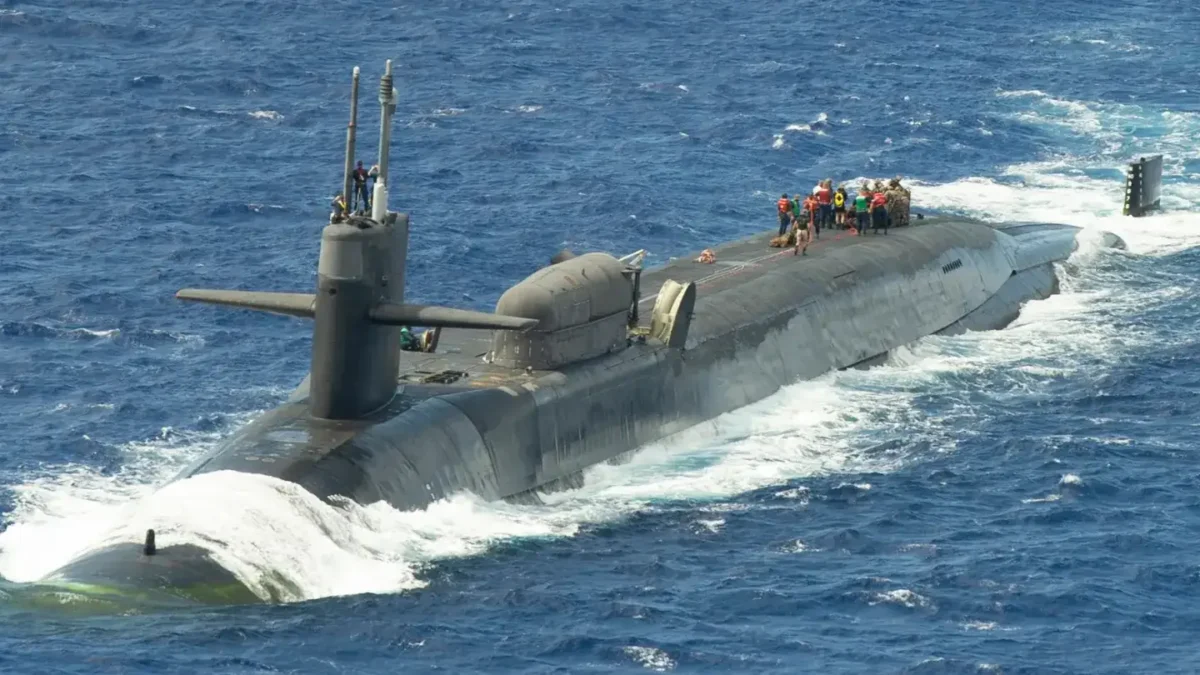
On the surface, they may seem like relics of the Cold War, but the Ohio-class has evolved into something far more versatile.
Despite being over four decades old, these nuclear-powered submarines still form the backbone of America’s sea-based nuclear deterrence, quietly lurking in oceans worldwide with enough firepower to end civilization as we know it, or to carry out precision strikes without ever being seen. But how relevant are these aging submarines in the context of modern warfare?
The story of the Ohio-class submarine begins at the height of the Cold War, a time when the threat of nuclear conflict between the U.S. and the Soviet Union loomed large.
The first of the class, USS Ohio (SSBN‑726), was commissioned in 1981, designed as a direct response to the need for a more powerful and survivable ballistic missile submarine fleet.
At the time, U.S. military planners believed that nuclear deterrence required submarines capable of carrying more missiles, staying hidden longer, and patrolling farther than anything before. And the Ohio-class delivered.
These submarines were massive, over 170 meters long and displacing around 18,750 tons submerged. Yet despite their size, they were built for stealth. Powered by a nuclear reactor, each Ohio-class nuclear submarine can operate underwater for months at a time without refueling.
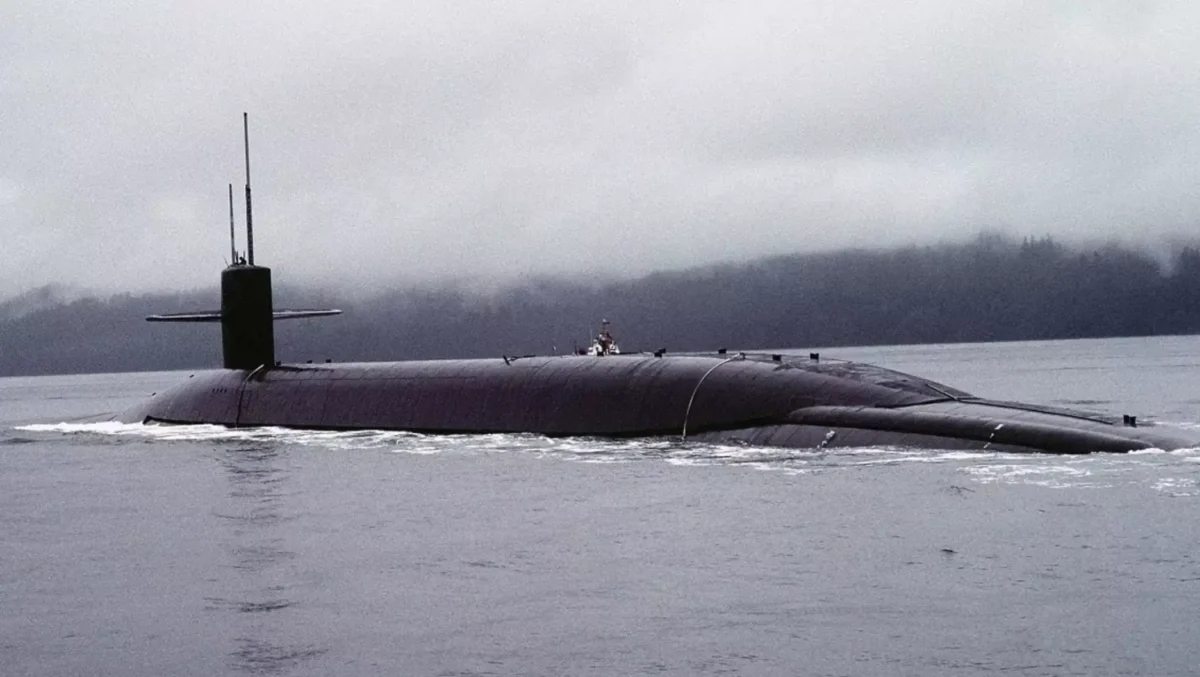
In fact, their endurance is so great that the main limiting factor is food. With a crew of about 155 sailors, they typically stay at sea for 70 to 90 days, though some patrols have reportedly stretched even longer under special conditions.
Initially, all 18 Ohio-class boats were constructed as SSBNs or ballistic missile submarines, each capable of carrying up to 24 Trident missiles. These Trident submarines formed the backbone of America’s sea-based nuclear deterrent, often referred to as the “invisible leg” of the nuclear triad due to their ability to stay hidden in vast oceans for extended periods.
Read also: Type 094 Submarine: The Quiet Backbone of China’s Nuclear Deterrent
But after the Cold War ended and strategic arms treaties took effect, the U.S. Navy saw an opportunity to adapt. Rather than retire four of the subs early, they converted them into SSGNs, guided missile submarines, capable of launching Tomahawk cruise missiles and supporting special operations forces.
These Ohio SSGN submarines can now carry up to 154 cruise missiles and host 66 special operators, giving them a unique role in conventional conflicts, such as striking high-value targets or covertly inserting SEAL teams behind enemy lines. So while the original goal was nuclear deterrence, the Ohio-class has evolved into a multi-mission platform.
To understand why the Ohio-class submarine is still so important today, it helps to first look at something called the nuclear triad. This is the U.S. military’s three-pronged strategy for delivering nuclear weapons:
Each “leg” of the triad has its strengths. But when it comes to survivability, most experts agree that US Navy submarines, specifically SSBN submarines like the Ohio-class, offer the most reliable way to ensure a second-strike capability.
In other words, even if an enemy were to launch a devastating surprise attack, chances are very high that one or more Ohio-class nuclear submarines would still be hidden somewhere deep in the ocean, ready to respond.
That’s part of what makes them such a powerful deterrent. Because they are nuclear-powered submarines, they can stay submerged for months at a time, moving silently and unpredictably. They don’t need to surface for fuel, and they rarely reveal their location, even to friendly forces.
In most cases, even U.S. naval commanders won’t know exactly where these submarines are during a patrol. That level of stealth is by design. The idea is simple: “if no one can find them, no one can destroy them”.
And while land-based missiles and bombers might be vulnerable to preemptive strikes or detection, Ohio-class submarines offer something more elusive, assured retaliation. That’s the heart of what’s called second-strike capability. It’s the ability to hit back, even after being hit first.
The mere knowledge that such a response is virtually guaranteed may be enough to make adversaries think twice before ever launching an attack.
Read also: What Makes Virginia-Class Submarines So Powerful?
It’s also worth noting that Trident submarines, like the Ohio-class SSBNs, carry missiles that can be launched from underwater with remarkable speed and accuracy. These ballistic missile submarines are armed with some of the most advanced nuclear weapons systems in the U.S. arsenal.
So, while some might assume that older submarines like these are past their prime, their role in maintaining sea-based nuclear deterrence remains just as critical as ever—perhaps even more so in today’s unpredictable strategic environment.
One of the main reasons the Ohio-class submarine is still considered a cornerstone of the US nuclear submarine fleet, even decades after it was first introduced, is because of how well it can stay hidden. In fact, its stealth and survivability are what make it so difficult to track and so dangerous if ignored.
Acoustic quieting is a major contributor. Submarines are often compared to underwater ghosts, not because they look scary, but because they’re incredibly hard to detect.
And the Ohio-class is no exception. From the start, these submarines were built with special design features and sound-dampening technology meant to reduce the noise they make underwater.
The less noise a sub produces, the harder it is for enemy sonar to detect it. While it’s hard to say just how quiet the Ohio-class is (since much of that information is classified), some analysts believe it remains among the quietest in the world, though newer submarines like the Columbia-class or Virginia-class may eventually surpass it.
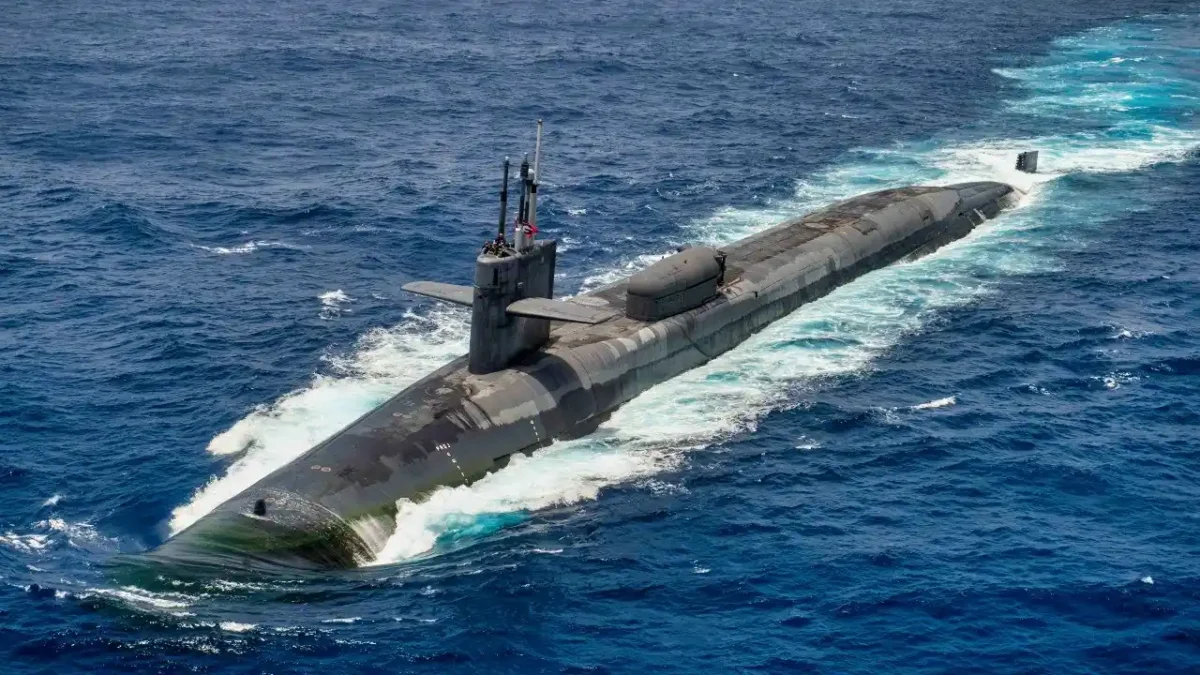
Another key factor is its deep-sea endurance. Because the Ohio-class submarine is nuclear-powered, it doesn’t need to refuel like a diesel-electric sub. It can stay submerged for months at a time, limited mainly by how much food and supplies the crew can carry.
This makes it extremely hard to predict where the sub might be at any given time. And the longer it can stay hidden, the harder it is for adversaries to plan around it. Some patrols reportedly last up to 90 days or more, and thanks to its size and robust support systems, the submarine can house over 150 crew members comfortably enough for these long missions.
Finally, the Ohio-class has global patrol coverage. These submarines are constantly on the move, operating across the Atlantic, Pacific, and even parts of the Indian Ocean. The U.S. Navy ensures that, at any given time, at least a few SSBN submarines are out on patrol, ready to respond if needed. No one knows exactly where they are, not even most of the U.S. military.
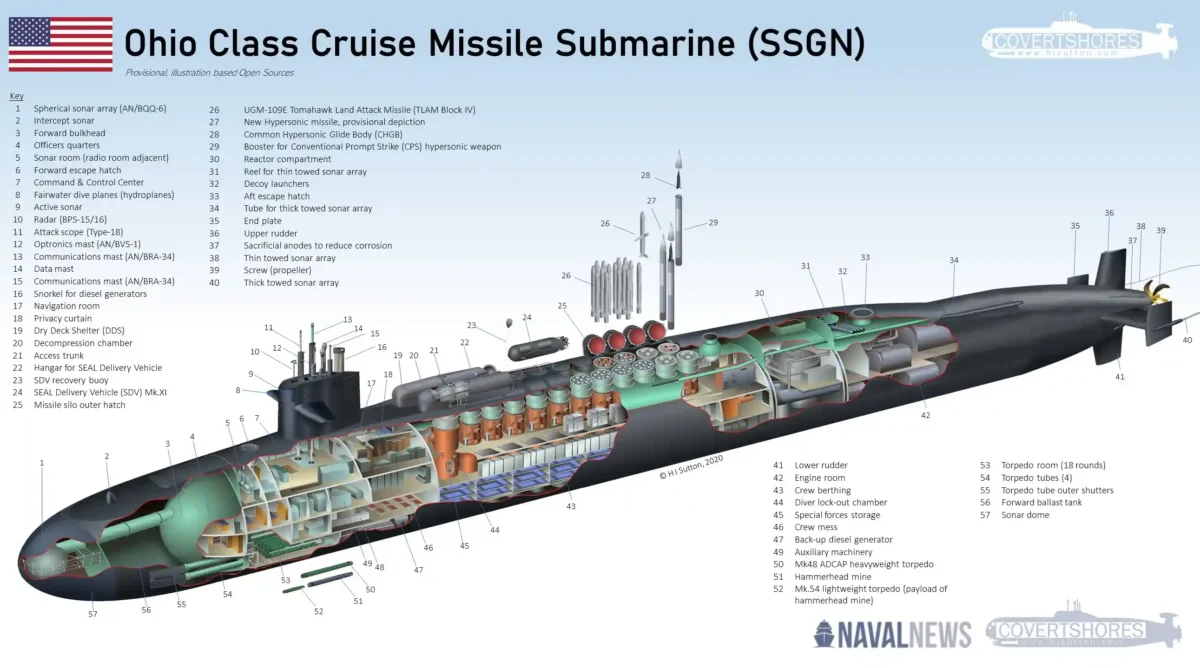
If there’s one thing that truly sets the Ohio-class submarine apart, it’s the amount of firepower it can quietly carry beneath the waves. At the heart of their power is the Trident II D5 submarine-launched ballistic missile (SLBM). This is one of the most advanced nuclear missiles in the U.S. arsenal.
A single Ohio-class SSBN submarine can carry up to 24 Trident II D5 missiles, though current arms control agreements like New START may limit the number of deployed launch tubes. Still, even at partial load, each submarine can potentially carry enough nuclear weapons to destroy dozens of major cities.
Each Trident missile has a range of about 7,500 miles (over 12,000 kilometers), allowing it to hit targets across the globe from nearly anywhere in the ocean.
The Trident II D5 is also equipped with Multiple Independently Targetable Reentry Vehicles (MIRVs), which means each missile can carry up to 12 nuclear warheads, each capable of striking a different target.
In practice, the number of warheads per missile is usually lower (often 4 to 8), to comply with treaties or strategic balance considerations.
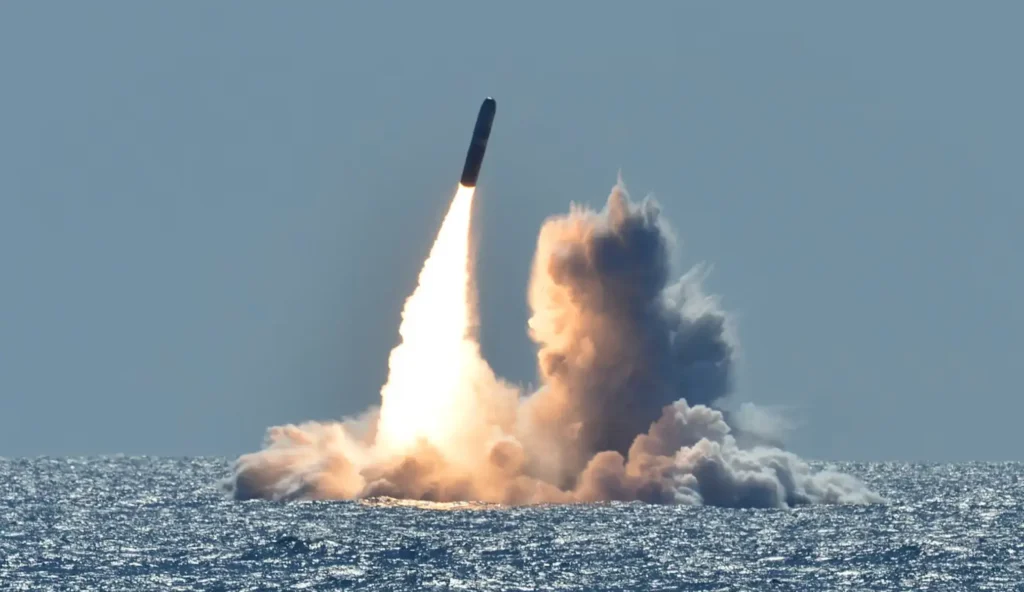
These warheads are highly accurate too. The Trident II has an estimated circular error probable (CEP) of less than 100 meters, which means it can strike within a football field of its target.
This is impressive for something launched from deep underwater and traveling halfway around the world. That level of precision makes it suitable for targeting hardened military facilities as well, should U.S. policy ever call for it.
To put things into perspective, one Ohio-class nuclear submarine, loaded with Trident missiles, could theoretically carry more nuclear firepower than was used in every war in human history—combined. Of course, that’s not its intended purpose.
The goal of deterrence is to prevent war by making the cost of nuclear aggression unthinkably high. And in that role, the Ohio-class remains incredibly effective.
Still, as powerful as it is, this system isn’t without its challenges. Some critics argue that relying so heavily on large, centralized platforms like the Ohio-class could become riskier as anti-submarine warfare capabilities improve.
But for now, the combination of long range, multiple warheads, and extreme accuracy makes the Trident-armed Ohio-class one of the most potent strategic tools in the US Navy submarine fleet.
The Ohio-class submarine isn’t designed to fight battles; it’s designed to prevent them. Its role is deterrence, and that mission happens quietly, day in and day out, beneath the surface of the ocean. While the concept may sound abstract, the way these submarines operate in practice gives it real meaning.
One of the most important features of the Ohio-class SSBN is its constant, unpredictable patrol schedule. At any given time, several of these ballistic missile submarines are on undisclosed patrols across the globe, deep beneath the Atlantic, Pacific, or even the Arctic.
As mentioned earlier, the US Navy submarines don’t broadcast where they’re going or when they’ll return, and most of their missions are classified. This unpredictability is strategic. If no one knows where a submarine is, then no one can confidently target it. And if an enemy can’t be sure they’ve eliminated the U.S.’s ability to respond, they’re far less likely to strike in the first place.
During the Cold War, this logic played out in a very real way. In the 1980s, when tensions with the Soviet Union peaked, Ohio-class nuclear submarines were already patrolling silently in the world’s oceans, each one carrying dozens of Trident submarine-launched ballistic missiles.
Their ability to guarantee a second-strike capability, meaning the U.S. could still retaliate after a nuclear attack, was considered a major reason why neither side ever pushed the button. Many experts credit the Ohio-class and its predecessors for helping to keep nuclear peace during one of history’s most dangerous standoffs.
After 9/11, the strategic environment changed. While traditional state-based threats didn’t disappear, new concerns, like rogue states and non-state actors, emerged.
Even though terrorist groups don’t operate submarines or nuclear arsenals, nations that might consider giving them such weapons, or threatening U.S. allies, still had to factor in the presence of a nearby US nuclear submarine, possibly just miles offshore, but completely undetectable. That alone can shape a country’s decisions behind closed doors.
And then there’s the psychological effect. For adversaries, the knowledge that a single Ohio-class submarine could be anywhere, carrying enough nuclear firepower to obliterate multiple targets, is a powerful mental deterrent.
It forces them to think twice, not just in moments of crisis, but as part of long-term strategic planning. Even rising powers like China and Russia, who are investing heavily in anti-submarine warfare and nuclear capabilities, must constantly consider the silent threat lurking beneath the waves.
More recently, in 2025, when the USS Ohio surfaced near Guam and later made a rare appearance in Brisbane, it was likely meant as a signal. While the U.S. doesn’t officially confirm its deterrence posture, many observers saw it as a reminder that sea-based nuclear deterrence is still very much active and global.