Follow Us:
Follow Us:

The Boeing F-15EX Eagle II might not be stealthy, but it’s arguably the most capable non-stealth fighter the U.S. has ever fielded.
Designed as a highly upgraded version of the iconic F-15 Eagle, the F-15EX is turning heads not just for what it adds, like next-gen avionics and record-breaking payload capacity, but also for what it revives.
In a surprising twist, the U.S. Air Force is leaning heavily on this 4.5 generation fighter jet at a time when many assumed the future was all about stealth and fifth-gen platforms.
In fact, recent defense budgets show a quiet but significant shift: the planned fleet size has jumped from 98 to 129 jets, a move some interpret as a hedge against delays and cost issues in fifth-gen programs like the F-35.
Meanwhile, the F-15EX, despite its Cold War lineage, is being outfitted with 21st-century weapons, electronic warfare systems, and a digital backbone designed to outlast many of its sleeker peers. How powerful is it really?
To understand the Boeing F-15EX Eagle II, it helps to rewind a bit, to the roots of the F-15 Eagle itself. Originally developed in the early 1970s by McDonnell Douglas (now part of Boeing), the F-15 was built with a singular purpose: air superiority.
And for decades, it delivered. With an unmatched kill ratio and no air-to-air combat losses, the F-15 earned a reputation as one of the most successful fighter jets in history.
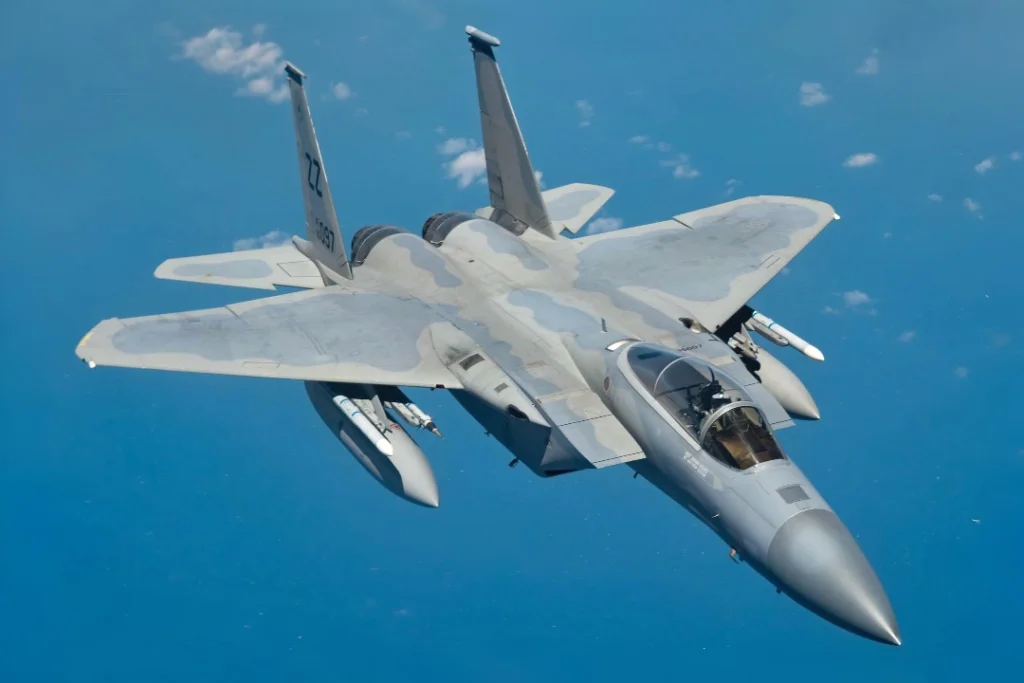
But even legends age. By the 2010s, the U.S. Air Force’s fleet of F-15C and D models, most of them built during the Cold War was starting to show its age. Cracks in airframes, outdated radar systems, and growing maintenance costs all signaled that a replacement was becoming less of a “nice to have” and more of a necessity.
Although many assumed stealth platforms like the F-22 or F-35 would take over entirely, those jets came with limitations of their own, namely, high costs, limited weapons payload, and production delays.
That’s where Boeing re-enters the picture. After absorbing McDonnell Douglas in the 1990s, Boeing continued evolving the F-15 platform for international customers.
Countries like Saudi Arabia and Qatar were already operating newer, more advanced versions of the jet—featuring digital cockpits, improved engines, and expanded weapons capacity. Seeing this, Boeing pitched a bold idea to the U.S. Air Force: What if you brought back the F-15, but made it smarter, tougher, and future-ready?
The USAF listened. Around 2018, discussions turned serious, especially as the Air Force needed a rapid, cost-effective replacement for the aging F-15C/D fleet.
The result was the USAF F-15EX program, a plan to buy a new variant that would build on export-proven upgrades, but integrate them into a U.S.-specific airframe optimized for homeland defense, tactical missions, and long-term sustainment.
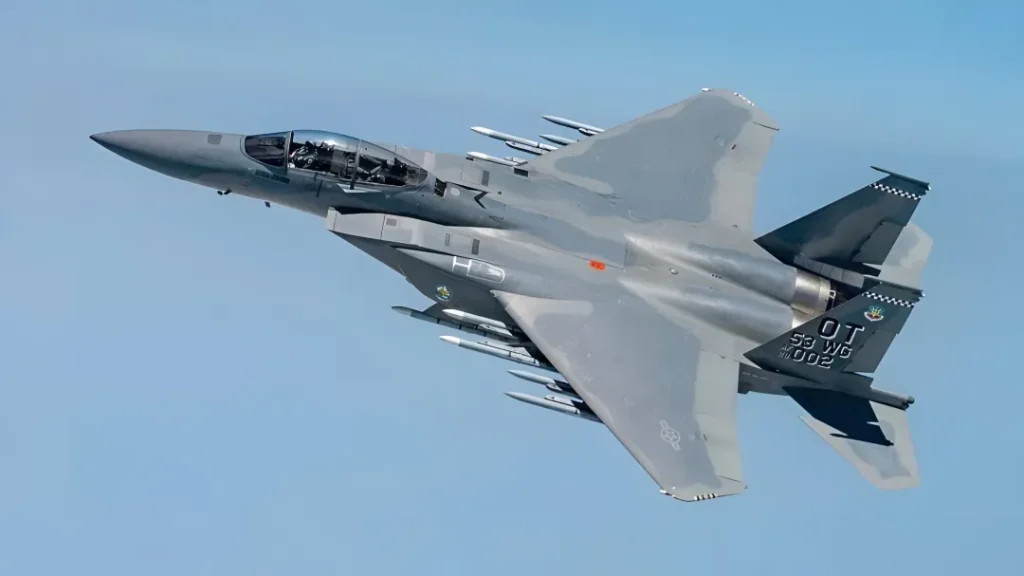
And so, the F-15EX Eagle II was born. It’s sometimes described as a “bridge” fighter—a 4.5 generation fighter jet designed to fill capability gaps until sixth-gen programs mature. But more than that, it reflects a practical mindset: instead of chasing revolutionary change, the Air Force opted for evolutionary power.
Boeing’s modernization goals focused on extending the jet’s lifespan, integrating cutting-edge tech like the F-15EX cockpit and F-15EX radar, and allowing it to carry more weapons than any other U.S. fighter—up to 13.6 tons of munitions, in fact.
So while the Eagle II carries the DNA of a 1970s icon, its mission is entirely 21st-century: stay ready, fly longer, and bring overwhelming firepower when it’s needed most.
When it comes to raw power and versatility, the Boeing F-15EX Eagle II arguably sets a new standard among Boeing fighter jets. While it’s often referred to as a 4.5 generation fighter jet, just shy of stealth-enabled fifth-gen aircraft like the F-35, it brings to the table a blend of sheer performance, adaptability, and combat readiness that’s hard to overlook.
Let’s start with its physical capabilities.
The F-15EX top speed is estimated at Mach 2.5, roughly 3,000 km/h, putting it among the fastest fighters still in service. That speed alone might not mean everything in modern air combat, but it gives the Eagle II a significant edge in interception missions or time-critical responses.
Its combat range, around 1,100 miles (1,770 km) without refueling, is also impressive for a non-stealth fighter, particularly when compared to the F-35A, which tops out around 650 miles.
Where the F-15EX really shines is in its payload capacity. It can carry up to 29,500 pounds (13,400 kg) of munitions—reportedly the highest of any U.S. fighter jet. That includes air-to-air missiles like the AIM-120 AMRAAM, but also hypersonic or long-range stand-off weapons.
In fact, some sources suggest it may be the only fighter currently capable of carrying larger hypersonic missiles externally, like the AGM-183 ARRW, though operational deployment of those weapons remains uncertain.
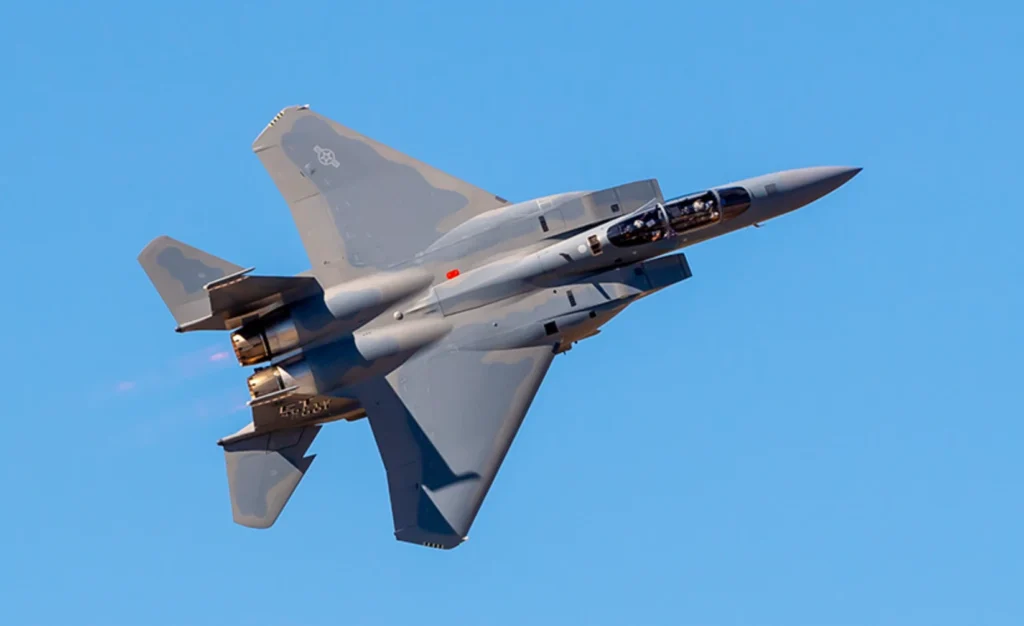
The F-15EX radar system, the AN/APG-82(V)1 AESA radar, represents another leap forward. It builds upon technology used in the Strike Eagle (F-15E), but offers sharper resolution, greater range, and more simultaneous target tracking, possibly enabling the Eagle II to detect and engage threats before being detected itself (at least in non-stealth scenarios).
Paired with its EPAWSS (Eagle Passive/Active Warning and Survivability System), the F-15EX electronic warfare suite is designed to sense, jam, and counter threats across multiple spectrums—an increasingly vital feature in contested airspace.
Under the hood, it’s powered by twin F110-GE-129 engines, each producing around 29,000 pounds of thrust. Twin-engine reliability has long been a hallmark of the F-15 Eagle, offering redundancy and raw thrust, especially valuable during high-speed maneuvers or long-range escort missions.
Compared to single-engine jets like the F-35A, this can be seen as a strategic advantage, though it does come with higher maintenance and fuel demands.
Read also: F-15 Eagle: Legendary Fighter Jet with 100+ Air Victories
And then there’s the F-15EX cockpit, which feels more like a digital command center than a traditional fighter canopy. It features a large-area touchscreen display, helmet-mounted cueing systems, and an open mission systems architecture, essentially allowing faster integration of new software, sensors, or weapons.
For a fighter expected to stay in service into the 2040s, that level of digital flexibility could prove crucial.
| Specification | F-15EX Eagle II |
| Role | Multirole Air Superiority / Strike Fighter |
| Generation | 4.5 Generation Fighter Jet |
| Top Speed | Mach 2.5 (approx. 3,000 km/h) |
| Combat Range | ~1,100 miles (1,770 km) |
| Ferry Range | ~2,600 miles (4,200 km) with external fuel tanks |
| Service Ceiling | 60,000 ft (18,300 m) |
| Payload Capacity | Up to 29,500 lbs (13,400 kg) |
| Missile Capacity | 12+ air-to-air missiles (AIM-9X, AIM-120), plus air-to-ground munitions |
| Radar System | AN/APG-82(V)1 AESA Radar |
| Electronic Warfare Suite | EPAWSS (Eagle Passive/Active Warning Survivability System) |
| Engines | 2 × F110-GE-129 (or optionally F100-PW-229), ~29,000 lbf each |
| Avionics & Cockpit | Large Area Display (LAD), fly-by-wire, helmet-mounted cueing |
| Crew | 1 or 2 (configurable; 2-seat standard) |
| Unit Cost (FY25 Estimate) | ~$93 million (flyaway cost) |
| Primary Operators | United States Air Force (planned: 129 aircraft) |
The Boeing F-15EX Eagle II is a kind of battlefield “heavy lifter” that brings both firepower and flexibility to the U.S. Air Force’s evolving strategy.
While it might lack the radar-evading stealth of the F-35 or F-22, it compensates with sheer payload, rapid adaptability, and multi-mission capability—making it particularly valuable in a high-threat, high-demand airspace environment.
One of the F-15EX’s most talked-about features is its missile capacity. It can reportedly carry up to 22 air-to-air missiles, more than any other U.S. fighter jet.
For context, an F-35A typically carries four internally (and more externally if stealth is sacrificed). This makes the Eagle II especially useful in air dominance missions, where sheer volume of firepower could tip the scales in a beyond-visual-range engagement.
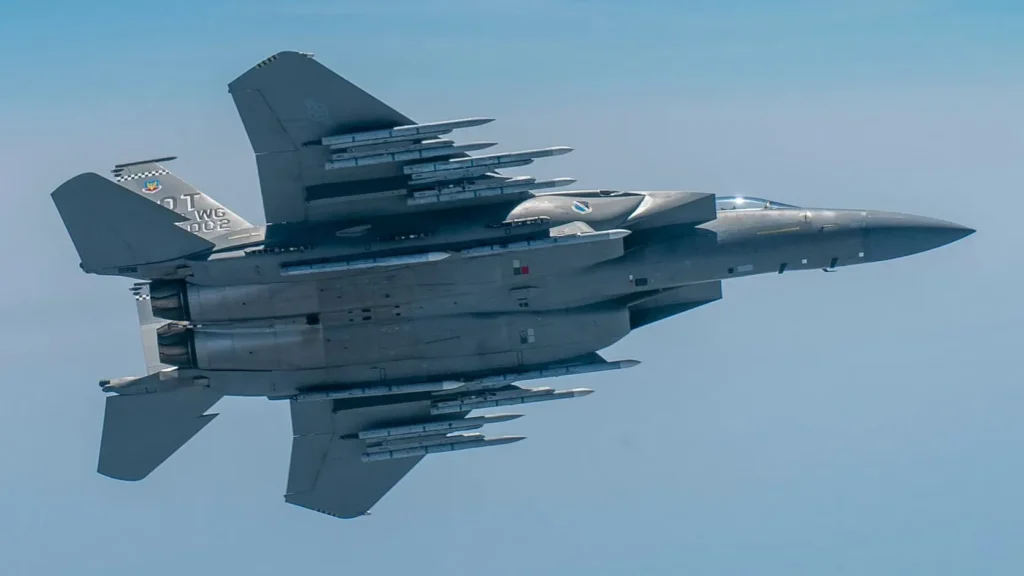
In exercises like Northern Edge in Alaska (May 2023), simulated mixed formations of F-15s and F-35s demonstrated how the F-15EX can act as a missile truck, supporting stealth jets by launching weapons designated by the more sensor-advanced fifth-gen platforms.
That’s where interoperability becomes key. While the F-15EX Eagle II doesn’t have stealth, it does have the range, sensors, and open mission systems architecture to integrate seamlessly with stealth platforms.
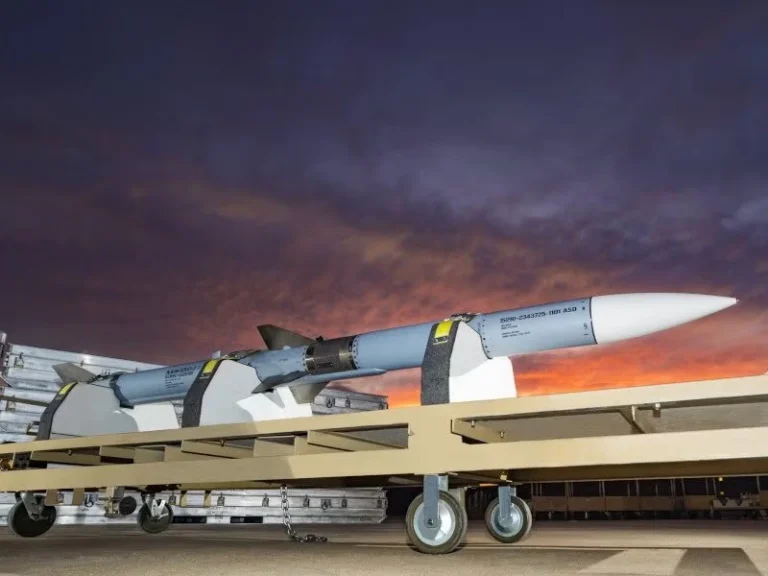
It can receive target data via Link 16 and other secure datalinks from an F-35 or F-22, allowing it to fire long-range missiles, like theAIM-120D AMRAAM, without directly exposing itself to enemy radars. This kind of cooperative engagement approach is at the heart of the U.S. Air Force’s “distributed lethality” concept.
On the air-to-ground side, the Eagle II carries a massive variety of munitions: JDAMs, Small Diameter Bombs (SDBs), and potentially even hypersonic weapons. The Air Force has tested the F-15EX for carriage of outsized munitions like the AGM-183 ARRW, although deployment timelines for that system remain fluid.
till, the ability to launch a hypersonic missile, even if only theoretically for now, gives the F-15EX an unmatched potential role in penetrating strike or time-sensitive target scenarios.
Survivability also deserves attention. While it can’t disappear from radar like an F-35, the F-15EX features the EPAWSS electronic warfare suite, which is designed to detect, deceive, and jam enemy radar and missile systems.
In a non-stealth platform, this suite could prove essential for operating in semi-contested environments—especially in places like Eastern Europe or the Indo-Pacific, where advanced surface-to-air threats are becoming more common.
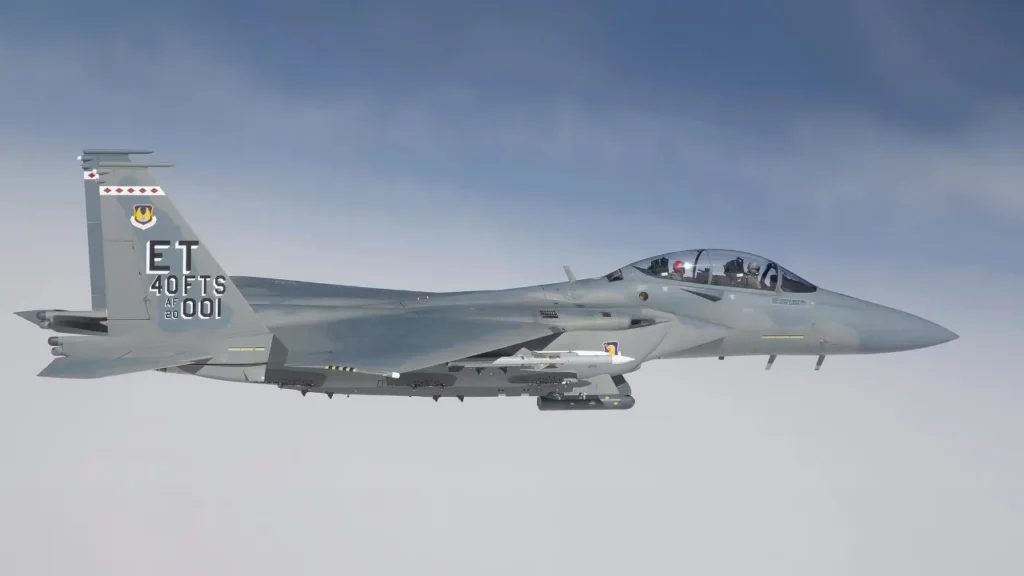
From a strategic standpoint, what arguably makes the USAF F-15EX program most appealing is its cost-efficiency. With a flyaway cost of around $93 million, the Eagle II is cheaper than the F-35A in both procurement and maintenance, while also offering a longer projected service life (around 20,000 flight hours).
For missions like homeland defense, no-fly zone enforcement, or deterrence patrols—where stealth may not be necessary—the F-15EX offers a practical and robust alternative.
From the start, the USAF F-15EX program has been shaped as much by budget constraints as by battlefield needs. While stealthy fifth-gen jets like the F-35 dominate headlines, the F-15EX Eagle II quietly gained traction as a more affordable and immediate answer to a critical problem: aging F-15C/Ds and overstretched airframes.
At around $90–93 million per unit (flyaway cost), the F-15EX might not be “cheap” in absolute terms—but it’s significantly more cost-effective than developing an entirely new platform or ramping up additional F-35 buys for roles that don’t require stealth.
Moreover, its projected lifetime of 20,000 flight hours, roughly double that of older airframes, means lower long-term costs per hour of operation.
The story of its procurement is one of gradual, yet expanding commitment. Initially, the U.S. Air Force envisioned buying just 80 to 104 jets. That changed in June 2025, when the Pentagon’s FY26 budget proposal revealed a notable shift: the Air Force is now seeking to increase its F-15EX fleet to 129 aircraft, allocating around $3.3 billion for continued procurement.
The decision, which may reflect ongoing concerns about F-35 sustainment costs and production bottlenecks, signals a deeper reliance on the Eagle II as a frontline workhorse—not just a stopgap.
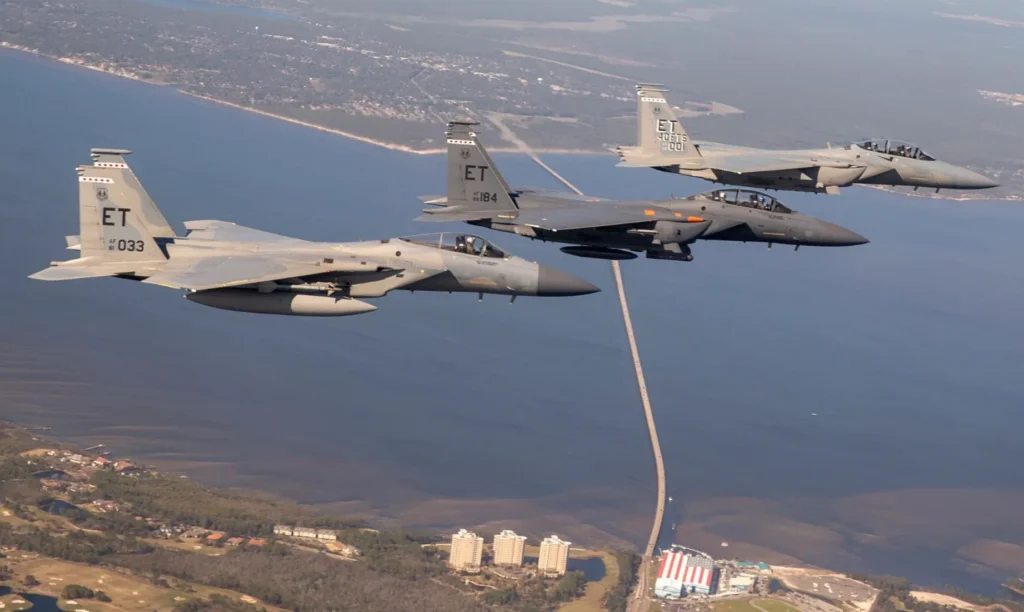
As for production, Boeing began ramping up deliveries with Lot 1 aircraft, including the first two units handed over to Eglin AFB in 2021. By May 2025, Boeing delivered its ninth F-15EX to the Oregon Air National Guard’s 142nd Fighter Wing, marking the start of Lot 2 deliveries.
Production is currently centered at Boeing’s St. Louis facility, with final assembly and checkout (FACO) operations expected to support roughly two jets per month by late 2026, depending on supply chain stability and demand.
Read also: F-15E Strike Eagle: Why It Still Dominates Modern Air Combat
These jets are replacing F-15Cs one-to-one, particularly in Air National Guard units responsible for homeland defense and air sovereignty missions. Their rapid introduction, without the lengthy development cycle of a brand-new fighter, makes them particularly useful for maintaining force readiness in the near term.
That said, procurement isn’t without its complexities. The Government Accountability Office (GAO) has flagged potential challenges in supply chain risk management, especially for parts related to the F-15EX cockpit displays and electronic warfare systems. There’s also the question of how the jet fits into longer-term modernization plans, especially as the Next Generation Air Dominance (NGAD) program moves forward.
Still, the F-15EX’s ability to deliver capability now, without waiting for future tech to mature, makes it an attractive option. For a jet with deep Cold War roots, the fact that it’s now being ordered in growing numbers is something few could have predicted even a decade ago.
The Boeing F-15EX Eagle II may not carry the stealth shroud of a fifth-generation fighter, but its place in the U.S. Air Force’s modernization strategy is far more calculated than it might initially seem.
Rather than being a relic of the past, the Eagle II could be seen as a bridge, a platform designed to reinforce U.S. airpower during a period of rapid technological shift and strategic uncertainty.
At its core, the F-15EX plays a practical role. The Air Force faces an ongoing challenge: maintaining readiness while fielding a balanced mix of 4.5 generation fighter jets, stealth aircraft, and increasingly autonomous systems.
The F-15EX fits snugly into that equation, replacing aging F-15C/D airframes with a jet that’s familiar, proven, but far more advanced under the skin. With open mission systems architecture, a digital backbone, and weapons capacity unmatched by any U.S. fighter, the Eagle II might serve as a crucial enabler for fifth-gen aircraft like the F-35 and F-22, especially in high-volume operations.
Its interoperability could prove decisive.
In future battle networks, the F-15EX may function as a “missile truck,” operating in tandem with stealthier, more sensor-heavy platforms. In this role, it wouldn’t need to penetrate deep into denied airspace on its own, instead, it could launch long-range weapons like the AIM-260 missile or potentially even hypersonic missiles based on targeting data from stealth jets or unmanned systems. This kind of collaborative combat is increasingly being seen as the blueprint for the U.S. military’s next-generation air dominance strategy.
There’s also the matter of export potential. While the F-15EX was developed primarily for the USAF, its lineage is rooted in export success.
Boeing has already sold advanced variants of the F-15 to Saudi Arabia, Qatar, South Korea, and Singapore, and the F-15EX, with its upgraded avionics, F-15EX radar (AN/APG-82), and enhanced survivability, could potentially appeal to allies who want a heavy fighter but don’t have access to stealth technology.
Countries looking to modernize their fleets without fully depending on U.S. stealth exports may see the Eagle II as a highly capable compromise.
That said, its long-term viability in a battlefield dominated by 5th-gen fighters and drones raises important questions. Can a non-stealth fighter survive in heavily contested airspace? Possibly, but likely only with significant support from EW platforms, jammers, and offboard sensors.
In the coming decades, the F-15EX might shift further into support roles: launching standoff weapons, defending airspace, or even operating alongside loyal wingman drones as part of a manned-unmanned teaming strategy. Its two-seat configuration might even give it an edge here, allowing one crew member to manage complex data or drone operations mid-mission.