Follow Us:
Follow Us:

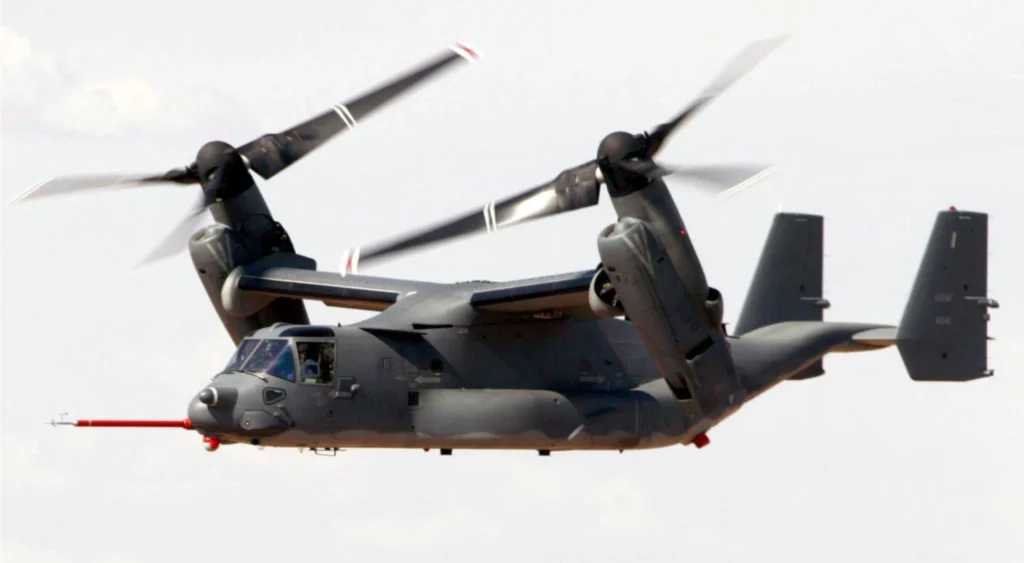
Ever wondered what happens when you mix the vertical takeoff power of a helicopter with the speed of a turboprop plane? You get the Bell Boeing V-22 Osprey, one of the most unique and game-changing aircraft in modern military aviation. It doesn’t just take off straight up like a chopper; it tilts its rotors mid-flight to cruise like a plane at over 270 mph. Pretty wild, right?
The V-22 Osprey was built to do what other aircraft simply can’t. Whether it’s dropping troops into a tight combat zone, rescuing wounded soldiers under fire, or flying supplies into disaster areas, the Osprey gets it done, fast, far, and flexibly. It’s a true hybrid, combining the best features of helicopters and airplanes in one powerful platform.
Under the hood—or more accurately, under the nacelles, it runs on Rolls-Royce AE1107C engines, giving it the muscle to lift off vertically then shift mid-air into high-speed flight. Its top speed hits 276 mph, and it has a max range of over 1,000 nautical miles, far outclassing traditional helicopters like the Black Hawk.
Step inside the V-22 Osprey cockpit, and it’s clear this is no ordinary ride. With digital flight controls, multi-screen displays, and advanced avionics, pilots need to master both fixed-wing and rotary-wing skills. That dual-flight nature makes training intense, but the payoff is unmatched versatility.
Sure, the V-22 Osprey cost isn’t cheap, clocking in around $71 million per aircraft, and it hasn’t been without controversy.
A series of V-22 Osprey accidents early on raised safety concerns. But after years of upgrades, it’s now a proven workhorse for the U.S. Marines, Navy, and Air Force.
So, is the V-22 worth the hype (and the price tag)? Let’s take a deeper look at how this tiltrotor came to be, what it can do, and why it’s still one of the most talked-about aircraft in the skies today.
The story of the V-22 Osprey goes back more than 40 years. In the aftermath of the failed 1980 Iran hostage rescue mission, where helicopters couldn’t complete the job, the U.S. military realized it needed something better. It needed an aircraft that could take off like a helicopter but fly like a plane. That’s when the idea for a tiltrotor aircraft really took off.
Development of the Osprey officially began in 1981 as a joint project between Bell Helicopter and Boeing.
The goal was ambitious: create an aircraft that could replace older helicopters like the CH-46 Sea Knight and handle missions across the Marines, Air Force, and Navy.
The first prototype took flight in 1989, but things didn’t go smoothly after that.
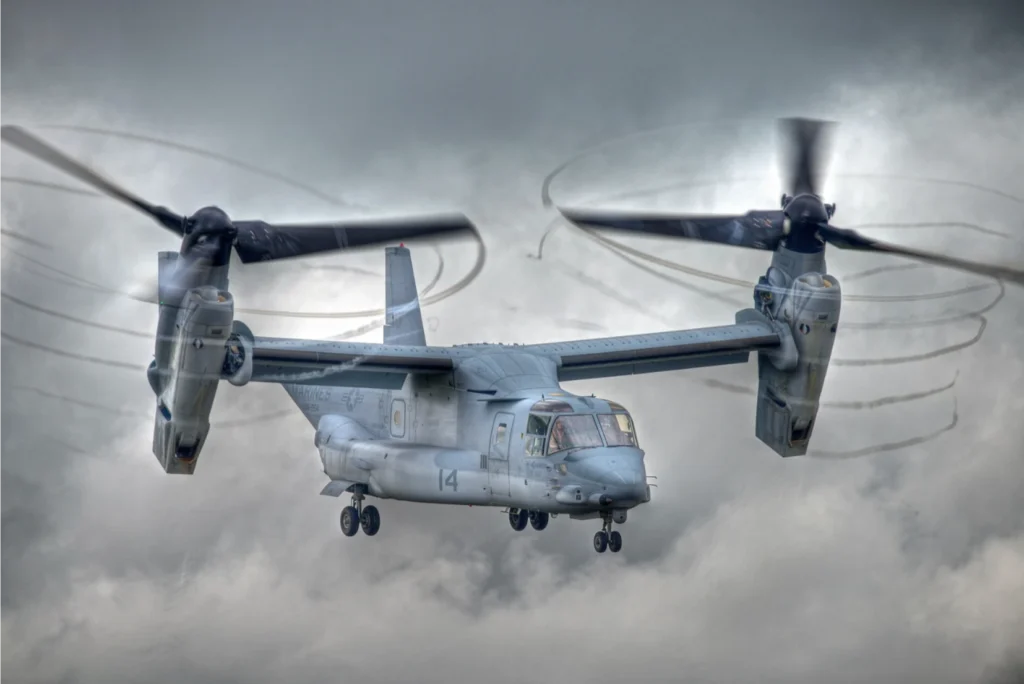
The V-22’s early years were full of problems. Mechanical failures, delays, and rising costs plagued the program. Worse, there were several deadly V-22 Osprey accidents during testing.
Between 1991 and 2000, four crashes killed 30 people, leading to major investigations and public criticism. Some even called the aircraft a “widow-maker.”
Despite the setbacks, the military stuck with it. Engineers made thousands of improvements, from overhauling the V-22 Osprey engine nacelles to redesigning flight software and training. After nearly two decades of development, the Osprey was declared operational in 2007 by the U.S. Marine Corps.
From there, things started to turn around.
The Osprey proved itself in combat zones like Iraq and Afghanistan, flying faster and farther than traditional helicopters. Its ability to quickly move troops, perform medical evacuations, and deliver supplies in rough terrain made it invaluable.
Today, the Bell Boeing V-22 Osprey serves in multiple branches and continues to evolve. New upgrades aim to extend its lifespan and improve maintenance.
While it took a rocky path to get here, the Osprey’s journey from troubled prototype to essential military workhorse shows just how far innovation can go, even when the odds are stacked against it.
The V-22 Osprey isn’t a one-size-fits-all aircraft. Over the years, it has evolved into three main variants, each tailored for a specific branch of the U.S. military.
While all versions share the same tiltrotor design and performance core, their missions, avionics, and internal configurations differ significantly.
The MV-22B is the most widely used version, developed for the U.S. Marine Corps.
This variant replaces the aging CH-46 Sea Knight and is primarily tasked with assault support, think troop transport, medevac, and resupply missions. It’s built to operate in forward-deployed environments, often flying Marines into combat zones from amphibious assault ships.
The MV-22’s ability to land vertically in tight spaces and still outrun most helicopters gives it a huge tactical edge.
Inside, it can carry up to 24 combat-ready troops or around 20,000 pounds of internal cargo. It also has a ramp at the rear for quick loading and unloading, and a defensive M240 machine gun or GAU-17 minigun can be mounted for suppressive fire.
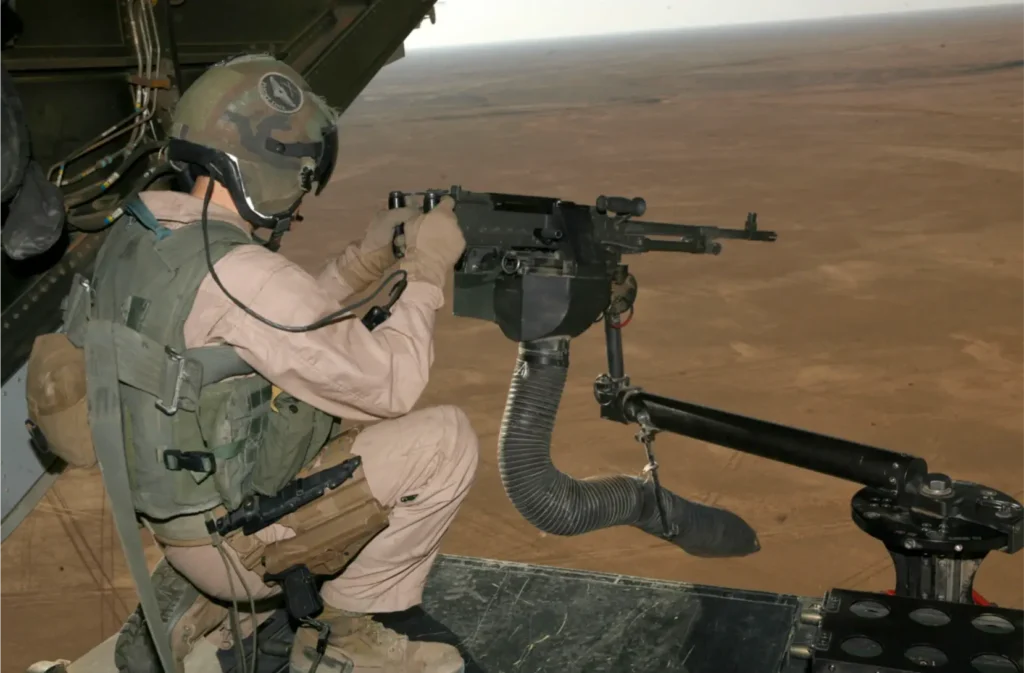
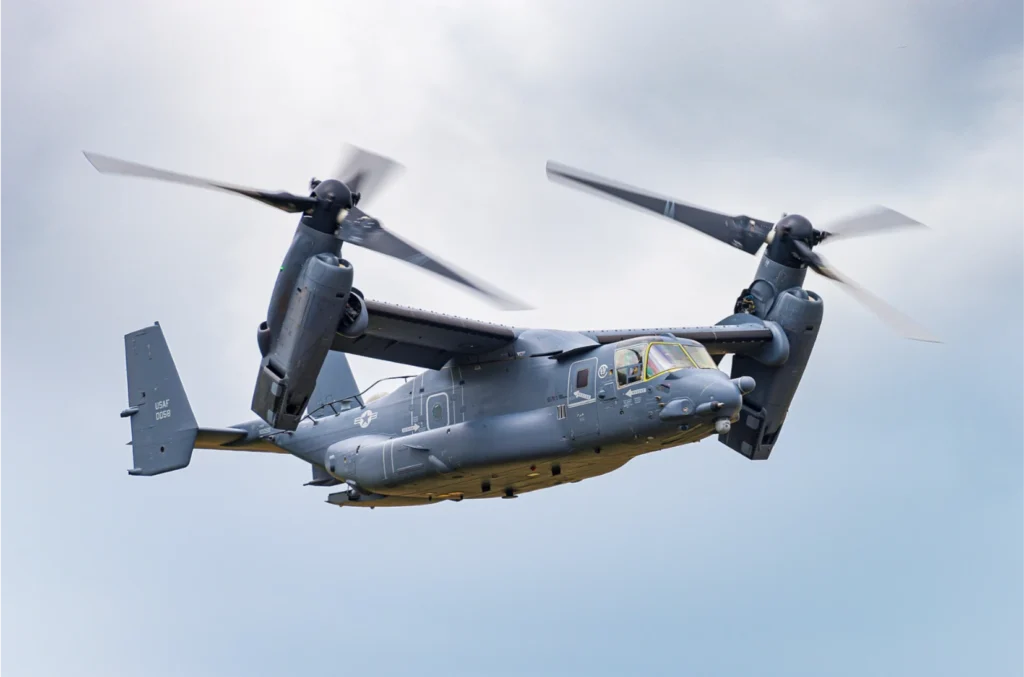
Next up is the CV-22B, developed for U.S. Air Force Special Operations Command.
This version focuses on long-range infiltration and exfiltration of special forces teams. It includes extra fuel tanks for extended range, advanced radar for low-level flying in bad weather, and enhanced electronic warfare systems for survivability in hostile airspace.
The CV-22 is often used in missions where speed, range, and stealth are critical. It’s been deployed in operations worldwide, from Africa to the Middle East, getting elite units in and out of hot zones quickly.
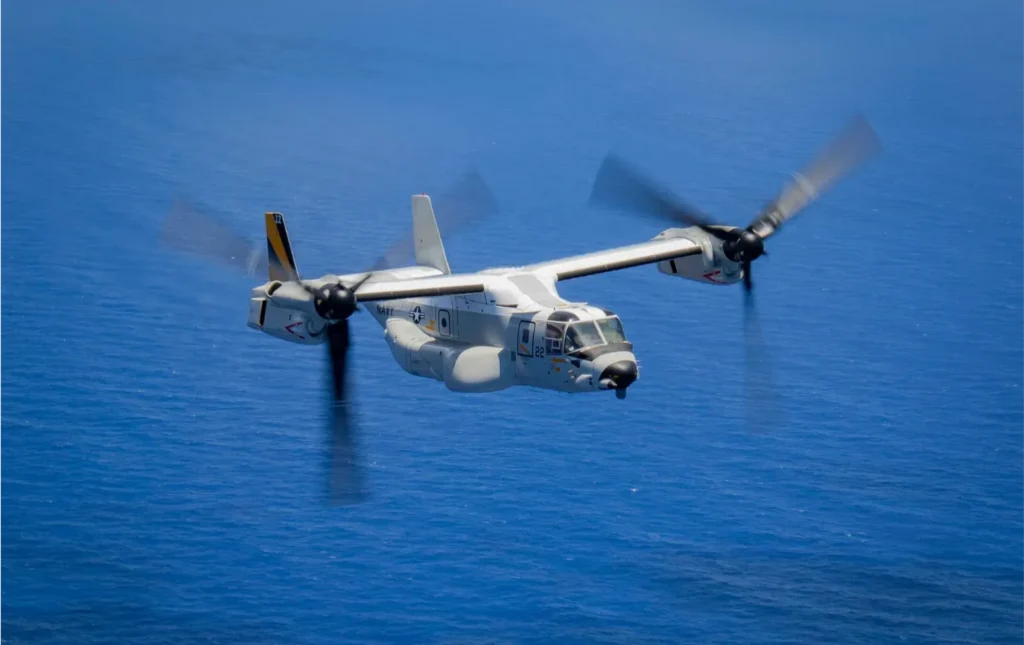
Lastly, there’s the CMV-22B, designed for the U.S. Navy to replace the aging C-2 Greyhound for carrier onboard delivery (COD).
This version brings critical parts, personnel, and supplies to and from aircraft carriers at sea. It features an extended range, improved communications systems, and the ability to carry larger payloads like the F-35 engine module, something no previous COD aircraft could manage.
So whether it’s flying Marines into combat, sneaking special ops behind enemy lines, or delivering high-value cargo to a carrier, there’s a Bell Boeing V-22 Osprey variant ready for the mission.
What really sets the V-22 Osprey apart from traditional aircraft is its groundbreaking tiltrotor design, a true hybrid between helicopter and airplane. Instead of relying solely on rotor blades or fixed wings, the Osprey uses massive rotating nacelles at the ends of its wings.
These nacelles house the Rolls-Royce AE1107C Liberty engines, each capable of producing over 6,000 shaft horsepower, and can rotate 90 degrees in flight.
This innovative configuration allows the Osprey to take off and land vertically like a helicopter, then tilt the engines forward to fly horizontally at high speeds like a turboprop plane. It eliminates the limitations of helicopters, especially in range and speed, while still retaining the flexibility to land in tight spots or unprepared terrain.
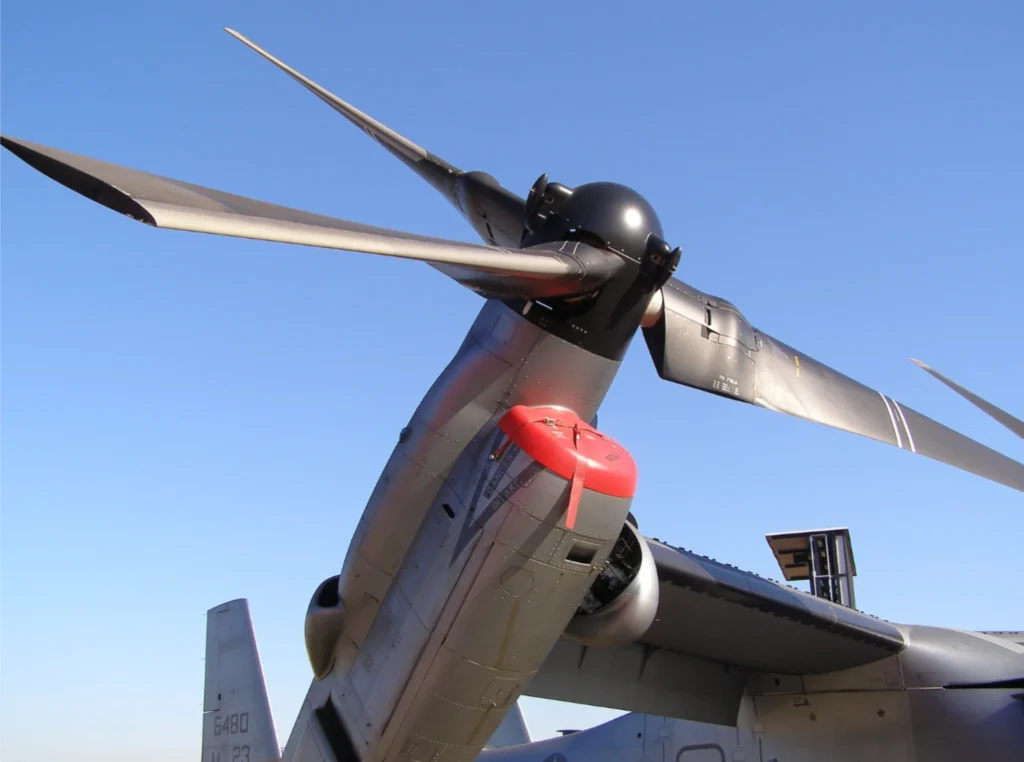
In terms of size, the V-22 measures nearly 58 feet long, with a wingspan of 45 feet when in flight mode. Its proprotors span 38 feet in diameter, each one larger than most helicopter rotors, giving it the lift needed to carry heavy loads.
When stowed for storage on ships, the wings and rotor blades fold automatically, saving space on aircraft carriers and amphibious vessels.
Read also: Bell MV-75 Cheyenne II – The Future of U.S. Army Air Assault
Inside the V-22 Osprey cockpit, pilots manage one of the most complex aircraft in the military.
The flight control system is fully fly-by-wire, meaning computers interpret the pilot’s commands and adjust the aircraft’s control surfaces automatically for smoother and safer flight.
This is essential when transitioning between helicopter and airplane modes, a process that takes just 12 seconds and requires seamless coordination.
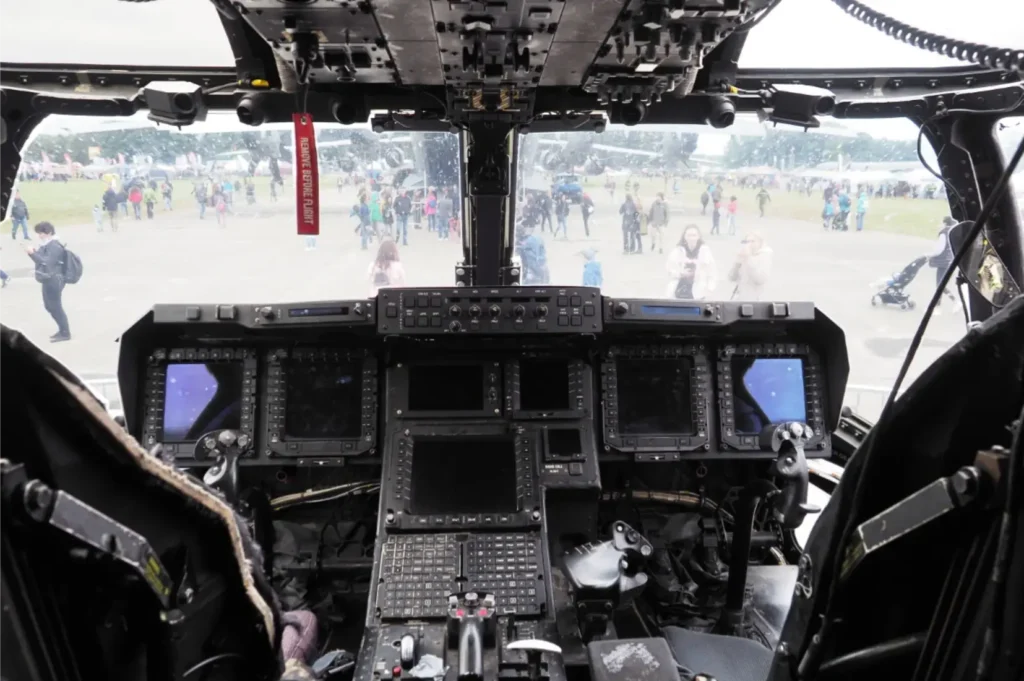
Another unique feature is the interconnected drivetrain. If one engine fails, power is transmitted across the wings through a central driveshaft, allowing the remaining engine to power both rotors. That kind of built-in redundancy greatly increases the aircraft’s survivability in combat.
From its high-lift wings to its swiveling nacelles and advanced avionics, the V-22 Osprey helicopter is unlike anything else flying today. It’s not just a clever design, it’s a game-changer in aerial mobility.
When it comes to raw performance, the Bell Boeing V-22 Osprey leaves traditional helicopters in the dust. Built for speed, range, and versatility, this tiltrotor aircraft doesn’t just meet military transport demands—it blows past them.
Let’s start with top speed.
The V-22 can fly at 276 mph (444 km/h) in airplane mode, nearly twice as fast as most utility helicopters like the UH-60 Black Hawk. That means troops can reach the battlefield faster, missions wrap up quicker, and vulnerable time in the air is significantly reduced. Speed isn’t just about efficiency—it’s about survivability.
Read also: CH-47 Chinook Helicopter Capabilities: What Makes It So Reliable?
The V-22 Osprey range is another standout stat. With an unrefueled range of over 1,000 nautical miles, it can fly missions far beyond the reach of standard helicopters.
For longer operations, the aircraft is also equipped for in-air refueling, extending its reach even more, critical for long-haul special ops or resupply missions over oceanic or enemy-controlled areas.
In terms of payload, the Osprey doesn’t disappoint. It can carry up to 20,000 pounds internally or externally, depending on mission needs. That includes 24 fully loaded troops, stretchers, and medics for medical evacuation, or bulky cargo for humanitarian relief. It’s even been used to haul vehicles and artillery in some missions.
Altitude capability also puts it ahead of the curve.
The Osprey can reach a service ceiling of 25,000 feet, which helps it operate above small-arms fire zones and in rugged, mountainous terrain. And when it needs to hover, it can do so steadily, even in rough weather or low-visibility situations.
One of its lesser-known capabilities is how it operates in maritime environments. From U.S. Navy carriers and amphibious assault ships, the V-22 can be launched and recovered with ease, thanks to its folding wings and rotors.
The CMV-22 variant, in particular, is crucial for carrier onboard delivery, able to transport vital parts like F-35 engines across oceans at high speeds.
In short, the V-22 Osprey helicopter offers the best of both worlds—speed like a plane, lift like a chopper, and reach like a jet. Whether it’s combat insertion or rescue ops, its capabilities make it one of the most valuable assets in the military’s air fleet.
The V-22 Osprey isn’t just a technological marvel, it’s a proven performer on the battlefield and beyond.
Since entering service, it has been deployed in a wide range of combat missions, humanitarian operations, and special forces insertions. Its ability to fly long distances quickly, land almost anywhere, and carry heavy loads makes it a go-to platform for missions where time and terrain are serious obstacles.
In Iraq and Afghanistan, the MV-22 Osprey became a key asset for the U.S. Marine Corps.
It replaced the older CH-46 Sea Knight in frontline support roles, flying troops and equipment across rugged terrain where helicopters would’ve struggled or taken too long. Its top speed and range meant fewer refueling stops and quicker mission turnaround, even in areas with limited landing zones.

The CV-22 Osprey, used by Air Force Special Operations Command, has played a quieter but equally critical role. It’s been deployed in covert operations in Africa, the Middle East, and Asia, where its long reach and ability to operate at low altitude under radar have allowed it to insert and extract special operations forces deep in hostile territory. It also played a role in high-profile hostage rescues and counterterrorism raids—though many of those missions remain classified.
Beyond war zones, the Osprey has shown its worth in humanitarian crises. After the 2010 earthquake in Haiti, V-22s delivered emergency supplies to remote areas where roads were destroyed.
In the Philippines, they assisted in typhoon relief, reaching islands that fixed-wing aircraft and ground vehicles couldn’t access.
The CMV-22 version has also proven its strategic value, replacing the Navy’s aging C-2 Greyhound for carrier deliveries. With its extended range and ability to land vertically, it transports critical parts, like the F-35 engine module, between ships and shore bases faster and with more flexibility than ever before.
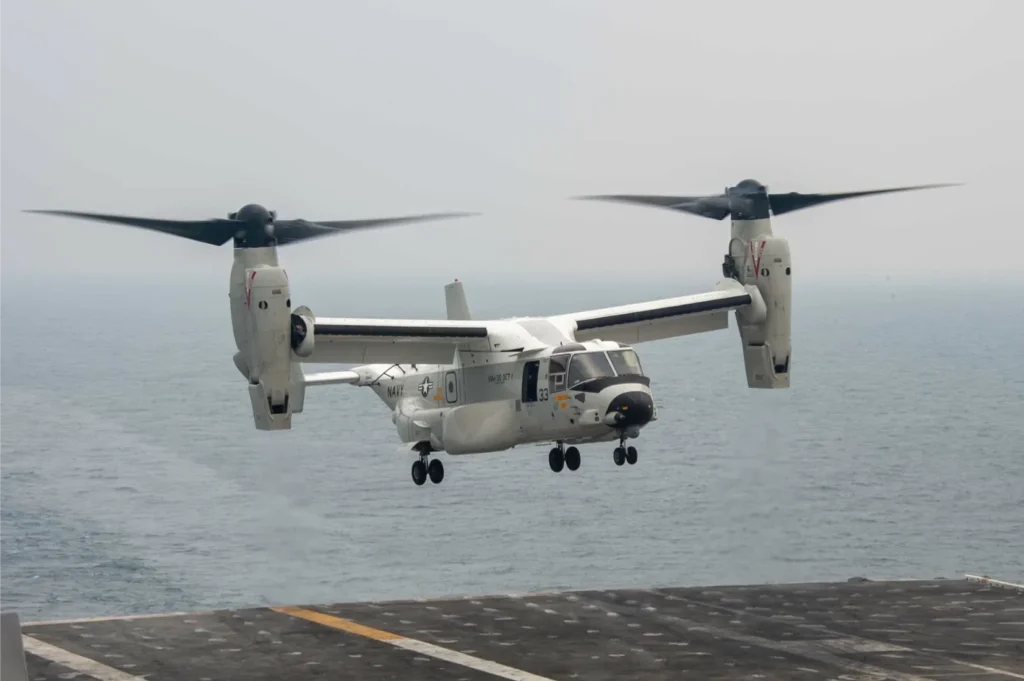
Despite its rocky start, the Bell Boeing V-22 Osprey has become a trusted tool in real-world scenarios. Its unique capabilities mean it often performs missions that no other aircraft can, proving that sometimes, bold innovation really does pay off.
The Bell Boeing V-22 Osprey has carved out a legacy unlike any other military aircraft. What started as an ambitious, and controversial, project in the 1980s has now evolved into a proven platform that has reshaped how the U.S. military thinks about vertical lift, rapid deployment, and expeditionary warfare.
With more than 400 Ospreys delivered across the Marine Corps, Air Force, and Navy, the aircraft has become central to joint operations worldwide. It’s not just a novelty anymore, it’s a workhorse.
Whether inserting Marines into hostile territory, delivering F-35 engines to aircraft carriers, or flying special ops missions in denied environments, the Osprey has shown it can do the job, and then some.
As for what’s next?
The Osprey’s design has inspired an entire new generation of tiltrotor concepts. Bell is now working on the V-280 Valor, a next-gen tiltrotor being considered for the Army’s Future Long-Range Assault Aircraft (FLRAA) program. The Valor builds on lessons learned from the Osprey but aims to be faster, lighter, and more affordable.
In terms of the V-22 Osprey replacement, there’s no immediate plan to retire the aircraft anytime soon. Instead, the Pentagon is investing in upgrades: better defensive systems, digital cockpit improvements, avionics modernization, and even more efficient V-22 Osprey engines. With these enhancements, the Osprey is expected to remain in service well into the 2040s.
And it’s not just the U.S. military. Japan became the first international customer to operate the Osprey, with more interest reportedly coming from allies who see the value in combining helicopter-like landing flexibility with turboprop speed.
Despite early stumbles, the Osprey has proven that tiltrotor flight is more than just a concept—it’s a capability worth refining and investing in. Its legacy isn’t just about what it’s done, but about what it made possible: a whole new category of aircraft.
For now, and for the foreseeable future, the V-22 Osprey helicopter remains unmatched in its role, flying boldly where others can’t—and setting the stage for what vertical flight will look like tomorrow.