Follow Us:
Follow Us:


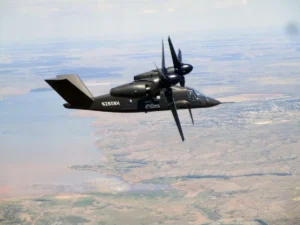
Defense Feeds – US Air Force launches YFQ-42A, marking a major milestone in advancing unmanned fighter technology with the first flight of the Collaborative Combat Aircraft (CCA) drone on August 27, 2025.
This uncrewed fighter prototype, developed by General Atomics, is designed to operate alongside fifth-generation manned jets like the F-22 Raptor and F-35 Lightning II, significantly enhancing strike capabilities and operational flexibility.
The flight represents a remarkable achievement, coming less than two years after the program’s inception and just sixteen months after the contract award.
Originating from General Atomics’ Gambit family, the YFQ-42A drone builds upon the XQ-67A Off-Board Sensing Station design.
Key structural modifications focused on speed and agility include an extended fuselage, slender wings, a dorsal engine intake, V-tail configuration, plus an internal weapons bay capable of housing two AIM-120 AMRAAM missiles.
This design is a balanced blend of affordability, radar stealth, and fighter-like maneuverability. Classified as a pre-production prototype, the designation YFQ-42A stands for Prototype (Y), Fighter (F), Uncrewed (Q), design number 42, Series A.
The autonomy software foundations come from the MQ-20 Avenger drone, providing a tested base for semi-autonomous operations.
The YFQ-42A’s initial flight contributes valuable data on airworthiness, system integration, and autonomous behavior, key parameters for future deployment.
General Atomics’ extensive industrial capacity with its 5-million-square-foot Poway, California plant producing over 100 UAVs a year and more than 1,200 UAVs delivered historically signals readiness to meet the Air Force’s ambitious plan to procure over 1,000 CCAs.
Each unit is anticipated to cost between $25 million to $30 million, making these platforms less risky for high-threat environments compared to expensive manned fighters.
The first flight came in the context of a competitive development program that also involves Anduril’s YFQ-44A, the other prototype under Increment 1.
The Air Force picked General Atomics and Anduril from five original bidders in April 2024, with final prototype assemblies completed by late 2024.
Both designs have now moved into the flight testing and evaluation phases at Edwards Air Force Base, coupled with operational trials at Nellis Air Force Base.
The YFQ-44A, based on Blue Force Technologies’ Fury platform, contrasts with the YFQ-42A by featuring trapezoidal wings, a chin-mounted intake, cruciform tail, and external weapon mounts.
Powered by a Williams FJ44-4M turbofan, it offers near-supersonic speeds and high agility with up to 9 g forces. The Air Force plans a fiscal year 2026 production decision, aiming to reach initial operational capability by 2030 for one or both designs.
These unmanned fighters will not only supplement stealth aircraft like F-35s by carrying extra weapons externally but also extend mission range and firepower.
This is critical because stealth jets face internal weapons carriage limitations, restricting payloads during long-range and complex missions.
The CCA program forms a vital part of the Next Generation Air Dominance (NGAD) Family of Systems, which envisions a networked mixture of legacy fighters, CCAs, and future platforms.
It builds on previous efforts such as the XQ-58A Valkyrie and the DARPA-funded Off-Board Sensing Station projects, designed to push autonomous flight technologies into operational environments.
Moving beyond early air-to-air combat missions, the Air Force plans to evolve CCAs into multi-mission assets handling electronic warfare, precision strike, reconnaissance, and even logistics.
This flexibility is enabled by modular open architectures that allow quick upgrades with new mission software and hardware.
Internationally, numerous nations including Australia, China, Japan, India, Türkiye, and the UK pursue similar uncrewed combat aviation programs, reflecting a wider global arms development trend incorporating drones paired with manned platforms.
General Atomics itself plans to modify the YFQ-42A for European defense customers via its German subsidiary, indicating broader market ambitions.
Looking ahead, the next phase, Increment 2, is expected to focus on cheaper, simpler drone designs starting in fiscal year 2026.
Wargaming exercises suggest that massing larger numbers of less complex drones might provide superior force multiplication, especially in Indo-Pacific theater scenarios marked by contested airspace and dispersed basing.
Legislative oversight continues to shape funding and technical requirements, emphasizing propulsion systems and open architectures to future-proof this emerging combat aircraft class.
In summary, the YFQ-42A’s inaugural flight marks a pivotal step in embracing unmanned fighter drones as key components of US air combat strategy.
By integrating CCAs with premier manned jets, the Air Force aims to multiply combat reach, enhance survivability, and adapt swiftly to evolving threats, crafting a more potent and cost-effective air warfare force for the decades ahead.