Follow Us:
Follow Us:


Defense Feeds – Russia Deploys ‘Multik’ Shield in a new step to enhance its electronic warfare (EW) defenses, unveiling an advanced system designed to protect helicopters and ground vehicles from Ukraine’s increasingly lethal first-person view (FPV) drone assaults.
Developed by the Gradient Research Institute, the Multik system marks Moscow’s latest countermeasure to Kyiv’s expanding drone warfare tactics across the battlefield.
According to information cited by Defense Express, the Russian Multik Shield system can detect and jam signal links that control FPV drones and disrupt their live video transmissions.
Operating between 700 MHz and 6,000 MHz, the EW suite provides an effective detection range of about 1,000 meters and can jam drones within roughly 500 meters.
Weighing under 9.5 kilograms and powered by onboard systems, the Russia Deploys Multik Shield system offers full 360-degree coverage with three jamming channels, making it suitable for both helicopters and ground platforms.
Russian defense sources claim its compact design allows flexible integration for escort missions and close-range counter-drone operations.
Ukraine’s frontline forces have increasingly relied on FPV drones to strike Russian rotary-wing aircraft, tanks, and armored vehicles.
These drones, often modified for kamikaze missions, can zero in on vulnerable targets with precision and are difficult to intercept using conventional air defense systems.
The introduction of Multik follows a noticeable rise in Russian helicopter losses attributed to low-cost FPV drones operated by experienced Ukrainian crews.
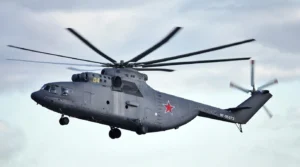
By developing a portable EW system capable of localized protection, Russia aims to shield its Ka-52 and Mi-8 helicopters, which frequently operate at low altitude over contested zones.
Sources close to the Russian defense sector indicate that early field trials showed promise, especially against swarm-like formations of drones launched simultaneously from multiple directions.
The country’s armed forces plan to expand Multik deployment not only across aviation units but also within infantry formations exposed to kamikaze drone threats.

Multik is part of a broader Russian counter-drone modernization effort that has accelerated throughout 2024 and 2025.
Existing systems like the 1L269 Krasukha-2 and Krasukha-4 continue to act as heavy-duty jamming platforms, protecting strategic assets by neutralizing enemy radar and communications.
These large mobile stations are commonly stationed near command centers and logistics hubs, where they disrupt Ukrainian reconnaissance and guidance systems.
On the tactical level, Russia also employs Repellent-1 and Silok-01 for medium-range detection and jamming of drone control networks.
In parallel, smaller Volnorez and Rubezh systems have been issued to front-line units, offering localized coverage for vehicles and fortifications. Each of these solutions contributes to a layered counter-UAV shield stretching from divisional command posts down to individual platoons.
By integrating Multik into helicopter operations, Russia is extending this multi-tier defense vertically, ensuring that both ground and air formations operate under a shared EW protection umbrella.
Moscow’s Ministry of Defence has also updated its official counter-UAV doctrine, mandating that every battalion and platoon carry at least one electronic warfare capability. This directive reflects a growing awareness of how FPV drones have transformed battlefield dynamics, forcing both sides to adapt tactics rapidly.
The doctrine further emphasizes fast operator training, the deployment of modular jamming units, and the synchronization of EW systems with armored, artillery, and aviation units. Analysts note that Russia’s push toward universal EW adoption suggests a long-term strategy to offset Ukraine’s innovation in drone warfare—a domain where Kyiv currently holds tactical superiority through agility and commercial adaptation.
As the conflict continues to evolve, the deployment of systems like Multik underscores how modern warfare increasingly hinges on electromagnetic dominance. The effectiveness of these solutions will likely shape future engagements where drones, sensors, and countermeasures battle for control of the electronic spectrum.