Follow Us:

Follow Us:


Defense Feeds – The Next-Gen APKWS II Guided Weapons are at the center of a pivotal $1.743 billion contract signed by the U.S. Department of Defense with BAE Systems, setting the stage for the delivery of up to 55,000 advanced guided rockets to the Army, Navy, and allied forces.
This major investment in Next-Gen APKWS II Guided Weapons underscores a significant expansion of America’s precision-guided munitions capability and promises a robust defense posture well into the future.
On August 28, 2025, BAE Systems, based in Hudson, New Hampshire, won the contract to produce APKWS II rockets for Full-Rate Production Lots 13 through 17, with deliveries planned until December 2031.
Unlike previous contracts, this long-term procurement guarantees a steady supply for key military branches, supporting ongoing Army and Navy missions plus approved Foreign Military Sales.
The APKWS II stands out as one of the most reliable weapons for precision strikes, bridging the gap between unguided rockets and expensive missile systems.
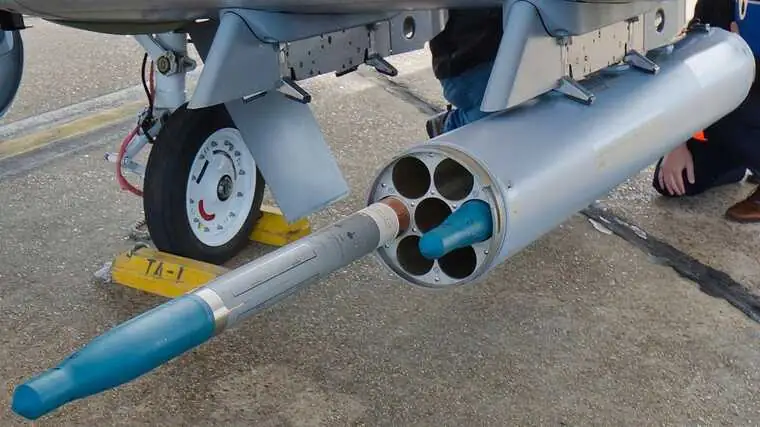
At its heart, the APKWS II upgrades the long-serving 2.75-inch Hydra 70 rocket by integrating a WGU-59/B guidance section.
This transformation turns a traditional rocket into a semi-active laser-guided projectile, capable of hitting targets within a one-meter radius.
The system allows warfighters to precisely engage soft vehicles, light armor, fortified structures, and even hostile drones while minimizing collateral damage.
Costing about $35,000 per unit, it delivers accurate firepower far cheaper than larger missiles like the Hellfire or Javelin.
For the U.S. Army, APKWS II fulfills a critical tactical need. It’s cleared for AH-64 Apache, AH-6 Little Bird, and A-10 Thunderbolt II platforms, letting aircraft carry more precision munitions without losing payload flexibility.
This enables prolonged operations during close air support and counter-insurgency, especially against emerging threats like low-cost drones.
The Navy and Marine Corps also rely heavily on the APKWS II for versatile maritime missions. The APKWS II rocket is utilized by aircraft such as MH-60 Seahawk, AH-1Z Viper, and AV-8B Harrier II.
Navy units employ these guided rockets to target fast-moving boat swarms, mobile missile launchers, and coastal defense systems in crowded littoral zones where accuracy and limiting collateral damage are essential.
The Navy is now assessing the system’s utility in shipborne anti-drone operations—an area of growing importance amidst rising unmanned threats.
APKWS II’s reach extends well beyond American shores. Nations such as Australia, the UAE, Lebanon, Jordan, and Iraq have added APKWS II to their arsenals, thanks to the Foreign Military Sales program.
As more joint operations rely on cost-effective guided munitions, APKWS II has become a key element of coalition interoperability, fostering stronger defense ties and unified battlefield tactics.
The Department of Defense has designated APKWS II as its primary guided 2.75-inch rocket program through this recent contract.
It comes at a time when global conflicts in places like Ukraine and the Middle East demonstrate how low-cost drones are reshaping combat.
APKWS II offers a way to counter these threats without draining expensive missile inventories, balancing affordability, versatility, and rapid deployment.
For BAE Systems, locking in this multi-year award marks a strategic win in the global defense sector, ensuring industrial momentum and innovation for years ahead.
For the U.S. military, it means no gap in precision rocket availability, whether in full-scale conflicts or targeted anti-insurgency actions.
Upcoming developments, such as integrating dual-mode seekers with infrared tracking, promise to expand APKWS II’s tactical utility, making it even more adaptable for future battlefield needs.
This $1.743 billion expansion is much more than routine procurement. It signals a shift in how the Pentagon views modern warfare, prioritizing scalable and flexible precision strike options that meet evolving threats without overstretching budgets.
As America invests in proven solutions like APKWS II, both U.S. and allied forces will benefit from reliable, accurate, and affordable firepower across domains, shaping the future of global security for the next decade.