Follow Us:
Follow Us:

Defense Feeds – New OA-1K Skyraider II is pushing the limits of innovation as the United States Air Force’s latest light attack and reconnaissance platform.
Currently undergoing a rigorous round of developmental trials at Eglin Air Force Base, the new OA-1K Skyraider II is designed specifically for Air Force Special Operations Command (AFSOC) to enhance the capabilities of special ops forces operating in resource-limited and harsh environments.
Developed in partnership with defense manufacturer L3Harris, the new OA-1K Skyraider II combines affordability, adaptability, and cutting-edge technology.
Built on the reliable AT-802 airframe—previously proven in civilian operations—this military-configured aircraft is outfitted with advanced sensors, weapons systems, and secure communications.
The 96th Test Wing, working with US Special Operations Command, is leading a comprehensive evaluation of the OA-1K Skyraider II, focusing on airworthiness, mission reliability, and operational effectiveness in remote or rugged locations

What truly sets the Skyraider II apart is its robust, no-nonsense design philosophy. Its tailwheel landing gear—a feature rarely seen in modern military aircraft—hearkens back to a bygone era.
This unique characteristic has prompted pilots and ground crews alike to revisit their training. The Air Force even arranged for specialized preparation using the civilian AT-802, as tailwheel aircraft require different skills, especially for safe takeoff and landing.
This retro-inspired feature isn’t about nostalgia, though; it’s about ensuring the aircraft can land on rough, unprepared strips, far from the comforts and support found at major air bases.
Maj. Stephen Wakefield of the 96th Test Wing explained that the transition to this new configuration meant addressing regulatory requirements and securing the right operational backing.
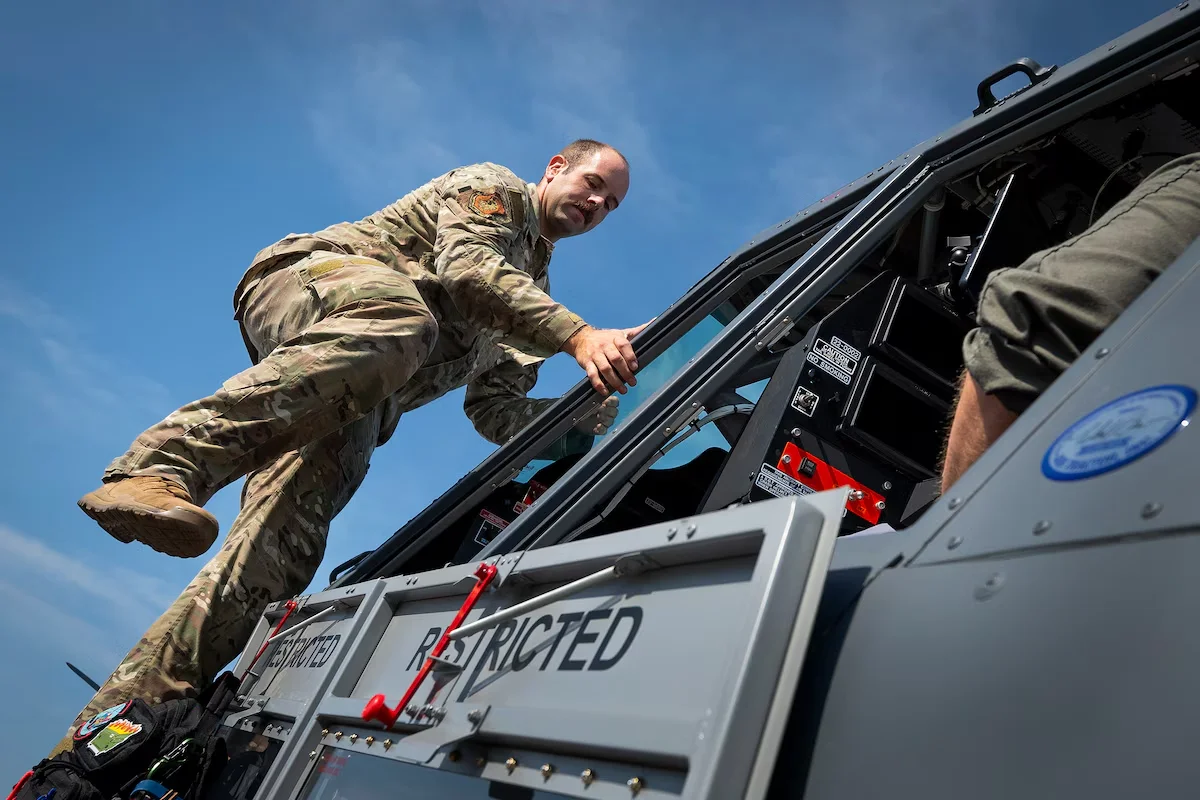
“There was quite a bit that went into this, from making sure we were compliant on the regulatory side, to ensuring we had the proper operations support for the Skyraider II,” he noted.
Test pilot Maj. Jacob Marsh, reflecting on his experience transitioning from flying un-augmented UH-1N helicopters to handling the OA-1K, likened the skill and coordination required for the Skyraider II to that of operating rotary-wing aircraft.
This comparison is especially relevant at lower speeds, where managing the aircraft’s handling characteristics becomes the most demanding—and, as Marsh puts it, rewarding part of the job.
So far, the Skyraider II has undergone detailed evaluations—ranging from how easy and safe it is for aircrews to operate, to how well it manages rough, unimproved landings.
The next phase of its testing will push the envelope further, with live-fire exercises and advanced sensor evaluations scheduled to determine its effectiveness on real-world missions.
The main mission for the OA-1K Skyraider II is simple but vital: support special operations forces in places where other aircraft just can’t go.
Its range of up to 1,500 miles at 8,000 feet and a top speed of 245 miles per hour at 10,000 feet, as touted by L3Harris, mean it can cover vast stretches and stick around above trouble spots much longer than high-end jets.
These capabilities let the Skyraider II perform close air support, precise strike missions, and armed intelligence, surveillance, and reconnaissance (ISR) where it’s needed most.
Thanks to its durability and minimal infrastructure requirements, the OA-1K can take on roles typically left to more expensive, harder-to-maintain planes.
This includes overwatch, identifying moving targets, and even executing rapid-response strikes on high-priority threats.
All of this can be done from remote dirt runways or basic field setups, which is exactly the kind of flexibility AFSOC needs when operating in challenging environments.
Despite its impressive adaptability, the Skyraider II isn’t intended to replace frontline fighters or specialized ISR aircraft.
Rather, its strength lies in its capacity to fill operational gaps—giving field commanders a practical, nimble tool capable of supporting a wide range of missions with relatively low maintenance and logistical headaches.
The arrival of the OA-1K Skyraider II highlights the Air Force’s commitment to innovative solutions tailored for modern warfare’s unpredictable challenges.
As testing continues, this rugged aircraft could become a staple for US special operations—empowering American forces in some of the world’s toughest battlefields with a reliable, cost-effective edge