Follow Us:
Follow Us:


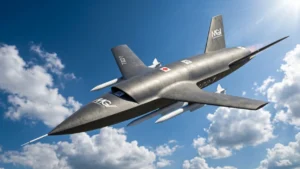
Defense Feeds, London – MGI Engineering unveils T022 Vortex autonomous combat aircraft, introducing a new unmanned platform designed to support the United Kingdom’s vision for next-generation air combat under the Stormfighter concept.
The aircraft reflects growing interest in integrating autonomous systems with crewed fighters to expand operational flexibility, improve mission effectiveness and reduce risks in contested airspace.
The unveiling comes as air forces around the world accelerate the development of collaborative combat aircraft capable of operating alongside manned platforms during increasingly complex military operations.

The announcement that MGI Engineering unveils T022 Vortex autonomous combat aircraft highlights the company’s role in advancing future combat aviation technologies. The Vortex has been developed as an autonomous aircraft capable of supporting a range of missions while operating in coordination with crewed combat aircraft through networked command-and-control systems.
Rather than functioning as a standalone replacement for traditional fighters, the aircraft is intended to complement existing air assets by performing missions that may involve elevated operational risk or require persistent presence over contested areas.
The concept aligns with the growing international emphasis on crewed-uncrewed teaming, in which autonomous aircraft operate alongside pilots to extend sensor coverage, increase survivability and provide additional mission capacity.
Its modular design also creates opportunities to adapt payloads for different operational requirements, including intelligence gathering, electronic warfare, reconnaissance and other mission profiles as future capabilities mature.

The development of collaborative combat aircraft has become a central element of modernization programs across several advanced air forces. Rather than relying solely on increasingly expensive crewed fighters, militaries are exploring autonomous platforms that can work together with pilots while expanding the number of assets available during operations.
Autonomous aircraft can support missions by carrying additional sensors, extending communications networks or operating in environments where commanders prefer to limit the exposure of crewed aircraft. As artificial intelligence, secure data links and autonomous flight technologies continue to mature, these systems are expected to assume a greater share of operational responsibilities.
The T022 Vortex reflects this broader trend by demonstrating how autonomous platforms may become integrated into future combat aviation ecosystems rather than operating independently.
The T022 Vortex is also consistent with the United Kingdom’s broader efforts to develop advanced combat aviation capabilities through initiatives that emphasize digital integration, rapid technology development and collaboration between industry partners. Programs such as Stormfighter seek to accelerate innovation by bringing together emerging technologies that can be incorporated into future operational concepts.
Developing autonomous aircraft alongside crewed platforms allows the defense industry to explore new approaches to mission planning, force protection and distributed air operations. As these concepts mature, collaborative combat aircraft could become an important force multiplier by expanding the reach and effectiveness of existing fighter fleets without proportionally increasing personnel requirements.
The announcement that MGI Engineering unveils T022 Vortex autonomous combat aircraft illustrates how autonomous systems are becoming an increasingly important element of future air power. Air forces are investing in technologies that combine artificial intelligence, secure networking and advanced sensors to improve operational flexibility while supporting more distributed and resilient force structures.
For the United Kingdom, projects such as the T022 Vortex contribute to a wider strategy of maintaining technological competitiveness in military aviation while encouraging innovation within the domestic aerospace sector. Successful development of collaborative combat aircraft could also strengthen opportunities for future industrial partnerships and export programs.
The fact that MGI Engineering unveils T022 Vortex autonomous combat aircraft demonstrates the continued evolution of crewed-uncrewed teaming from an experimental concept toward an operational capability.
As future air combat places greater emphasis on networking, autonomy and multi-domain integration, collaborative aircraft like the T022 Vortex are expected to play an increasingly significant role in next-generation military aviation.