Follow Us:
Follow Us:

Defense Feeds – Germany Unveils CA-1 Europa UCAV as its next-generation autonomous unmanned combat aerial vehicle, aiming to deliver scalable AI-driven airpower to Europe.
The drone was officially introduced by defense technology firm Helsing on September 25 at Grob Aircraft’s facility in Tussenhausen, Bavaria.
The launch highlights Europe’s growing efforts to develop affordable, high-performance combat drones capable of working alongside manned fighter aircraft.
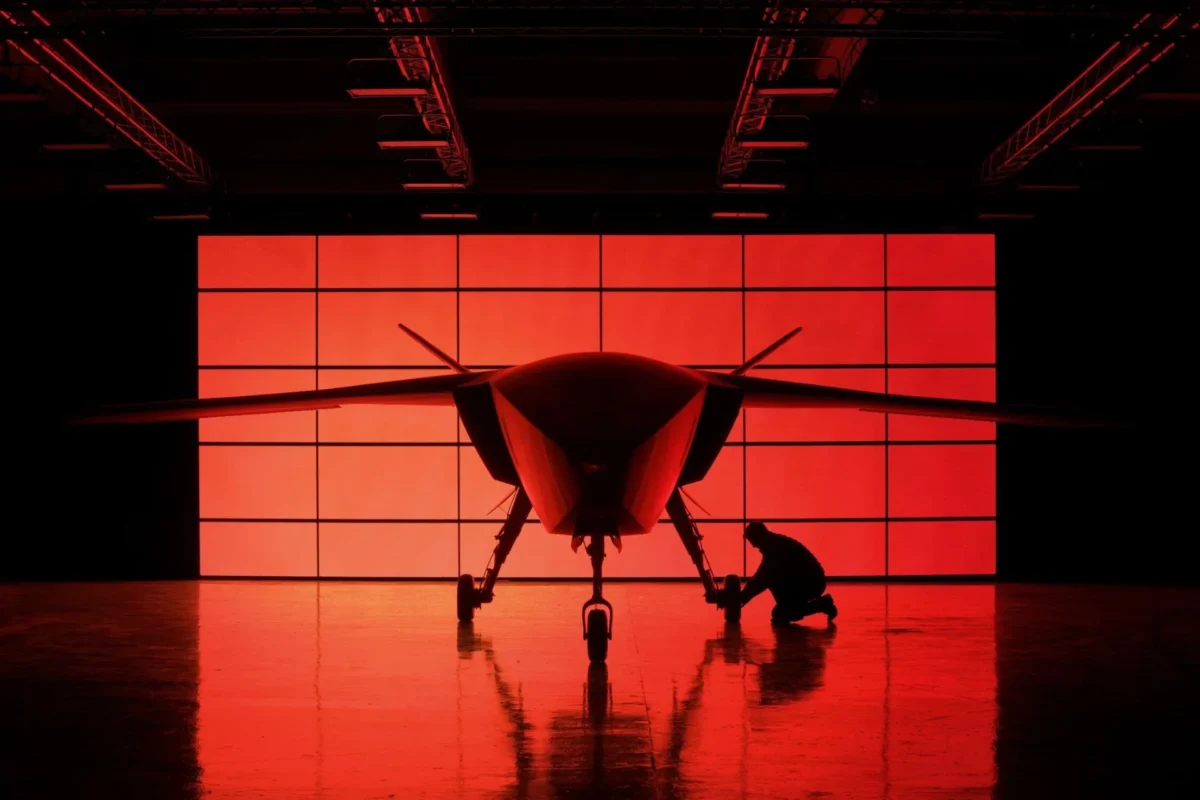
The CA-1 Europa weighs between three to five tons and is designed as a high-subsonic UCAV optimized for multi-role combat operations.
Unlike larger, expensive fighter jets, Europa is being developed to provide “intelligent mass” a scalable fleet component that can operate in high-threat environments or backfill traditional aircraft with autonomous strike, reconnaissance, or electronic warfare missions.
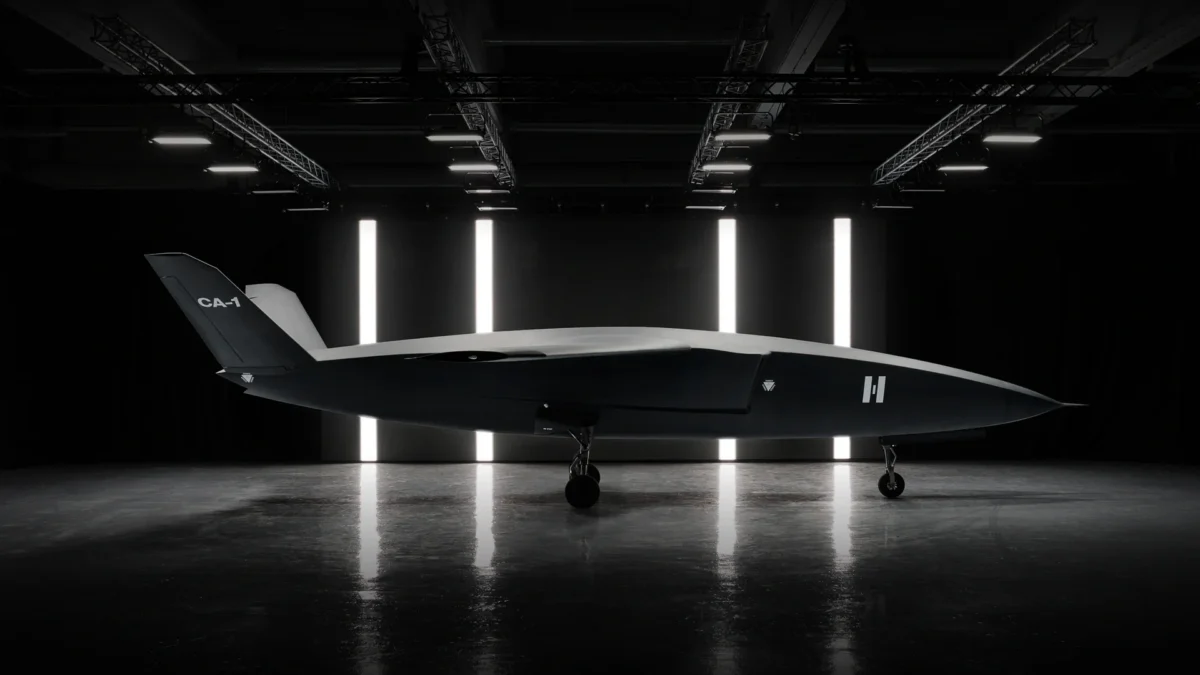
Measuring 11 meters in length with a 10-meter wingspan and a maximum takeoff weight of around four tons, the Europa incorporates stealth-inspired features such as cranked-kite wings, canted tails, and side-mounted air inlets.
A single turbofan engine drives the design, which enables reduced complexity while carrying a wide range of payloads within its internal bay.
This configuration allows the UCAV to avoid detection while carrying precision-strike munitions, compact air-to-air missiles, or specialized reconnaissance systems.
The design philosophy is clear: Europe requires affordable, attritable drones that can be built in numbers, operated from dispersed or improvised bases, and quickly adapted to shifting missions.
Helsing projects a first test flight by 2027 with an operational configuration ready within four years, aligning with global defense trends such as the U.S. Air Force’s Collaborative Combat Aircraft (CCA) program.
At the heart of Europa is a suite of AI-enabled autonomy systems, built around Helsing’s Centaur and Symphony software platforms.
Centaur is a reinforcement learning-based air combat agent tested earlier this year in beyond-visual-range (BVR) scenarios using a Saab Gripen E fighter.
This system enables the UCAV to learn and adapt in simulated combat environments, making it capable of independent decision-making in air-to-air or strike missions.
Symphony, meanwhile, acts as a mission orchestration platform that enables distributed command and control.
It allows Europa to work alone, as a wingman to crewed fighters, or as part of a larger drone swarm.
By combining real-time intelligence fusion, secure data links, and adaptive electronic warfare modules, Symphony allows European forces to coordinate multiple assets against advanced threats.
Helsing has also integrated Cirra, a digital electronic warfare suite capable of disrupting integrated air defense systems (IADS).
The system employs modular payloads such as jammers, decoys, and secure communications packages, offering operational flexibility for missions ranging from electronic attack to suppression of enemy air defenses (SEAD).
This modularity ensures that Europa can be rapidly upgraded with new sensors, weapons, or countermeasures as threat environments evolve.
The CA-1 Europa enters development at a time when European defense planners increasingly emphasize dispersal, survivability, and affordable combat mass.
The ongoing war in Ukraine has accelerated the need for aircraft that can operate from austere bases, survive advanced air-defense networks, and deliver precision fires at reduced cost compared to traditional fighters like the Eurofighter Typhoon or Dassault Rafale.
Operational concepts suggest Europa could be employed for deep strike missions into contested airspace. By penetrating defenses to stimulate enemy radar emissions, it can provide targeting data while heavier aircraft maintain standoff distance.
Alternatively, fleets of Europa drones could be deployed in saturation attacks or electronic warfare support roles, shaping the battlespace for manned fighters.
Helsing has positioned the program as a sovereign European solution, ensuring that both software and hardware supply chains are sourced from within Europe.
This strategy is in part a response to concerns over dependency on U.S. or non-European defense suppliers.
With hundreds of millions of euros anticipated in development investment, Helsing is in discussions with European partners to expand the industrial base for series production.
Details on certified weapon systems remain limited, though officials suggest the cost per unit will be “a fraction” of modern fighters, potentially enabling European air forces to deploy dozens or even hundreds of UCAVs rather than a handful of jets.